.jpeg)

Pro Gear Advisers
•866-498-7882
Fall Tone Feast at Guitar Center’s Pedal Station
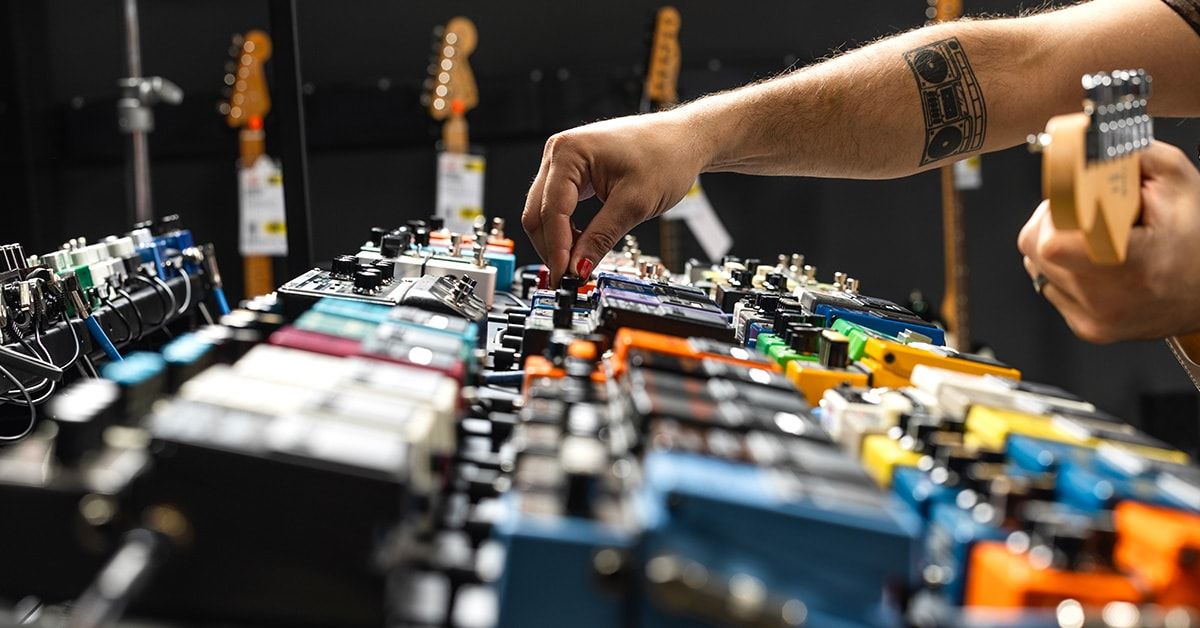

This article is the second in a series about chasing sound at a Guitar Center Pedal Station. Hopefully, you’ve already had a chance to sit at one of our integrated pedalboards to spin through a bunch of pedals and discover just the ones your rig (and music) is longing to welcome.
The first article was about my quest for a new chorus pedal that delivered the retro textures I used in my ’80s new wave bands. It also contained some tips on maximizing your Pedal Station experience. I’ll save you from a summary—because unlike your favorite streaming service, there’s no “Skip Recap” button—but if you want to review the introductory content (and find out which pedal I picked), check out my first tonal trip at a Guitar Center Pedal Station.
What's on the Menu This Month?
I’m sitting at the Pedal Station seeking a reverb pedal. This sonic pursuit is actually a gig-dependent choice, because—full disclosure—I’m not a massive fan of reverb. It’s just my opinion, of course, but I find lots of guitarists dissipate their tone in not very compelling or vibey ways by slathering on ambient goo. I’m far more attracted to the impact of dry, upfront and assertively blunt sounds.
And, yes, I know I’m in the minority on this subject.
All of that said, I currently need a reverb pedal for a couple of gigs, so the atmospheric/cosmic joke is on me. I play drums in a San Francisco Bay Area surf band (Surf Monster), and if I want to compose style-appropriate original songs for it, I’m going to have to make friends with guitar reverb. Likewise, I’ve stepped into an ambient-guitar position for singer-songwriter Eva Jay Fortune, and I can’t do the job if my tones are as dry as Chile’s Atacama Desert.
Happily, the Pedal Station at Guitar Center San Mateo—as with the chorus pedal auditions in my previous article—makes for straightforward A-B testing of reverb boxes. I don’t have to connect and disconnect and reconnect patch cables or set up a pedal chain. With just two caveats—more on this later—the Pedal Station has it all sorted for me.
Quick Chart of Reverb Pedal Basics
The menu at the time of my visit included five reverb pedals. Here’s a quick look at what they offer.
|
Pedal |
Controls |
Reverb Types |
Price* |
|
Effect Level, Tone, Time, Selector |
8 |
$153.99 |
|
|
Reverb, Selector |
3 |
$137.90 |
|
|
FX Level, Tone, Time, Mode, Selector |
11 |
$176 |
|
|
Mix, Decay, Tone, Selector |
3 |
$79.99 |
|
|
Decay, Tone, Mix, Selector |
3 |
$99.99 |
Pricing as of October 2025*
Pedal Station Pursuit
How does someone who is not obsessed with reverb pick a reverb pedal? Well, I like to think after decades of owning multiple recording studios and doing hundreds of sessions, I can identify a decent sound. (Hahaha—defensive much, Mike?) But quite frankly, this venture wasn’t about going for an excellent reverb tone. Instead, I wanted a pedal that worked best for the uses at hand, rather than one that sounded fabulous but wasn’t exactly right for the job.
I’ll explain …
Goal number one: This pedal is mostly for live performance, so it has to work for how I play on stage. Real-world ramifications: While I believe most audiences can recognize crap sound, I’d wager they are far less adept at pinpointing subtle variations of timbral quality—especially in a crowded music club or local bar.
In this case, if a reverb is perhaps a little grainier than I’d like, but the pedal has the feature set I’ll need for ambient guitar and surf melody composition, I’d give the grain a pass in deference to the application. In other words, a more “pure sounding” reverb pedal that doesn’t have the features I need won’t make the cut, even if it exhibits greater sonic quality.
Which brings us to the scores of beloved and annoying musical buddies I’m sure we all have. You know—the ones who love saying things such as, “Have you lost it? Always go for top quality—the absolute best sound possible.”
Well, let’s consider my initial observation. I’m betting the audience won’t know if I “cheat” them out of 7.8 percent of potential sound quality, but I’m certain I’ll be frustrated if I can’t deliver the aural soundscapes I’m expected to produce. The resulting discomfort could hamper the quality of my performance—a situation the crowd and the band leader will notice.
With that in mind, I sat down to my Pedal Station tone feast …
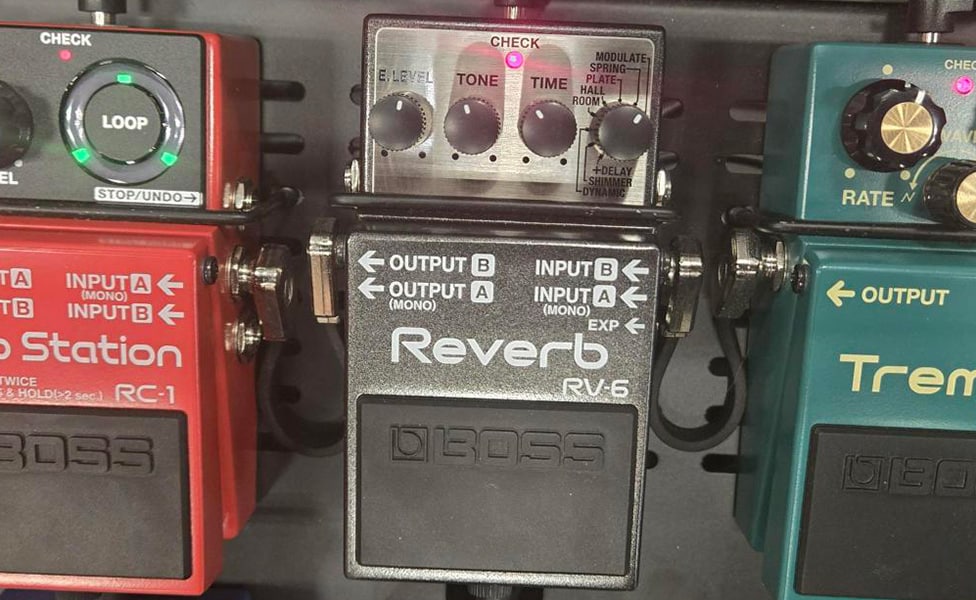
BOSS RV-6
What I Dug:
- Eight reverb types
- Tough, yet easily replaceable if tragedy descends
- Mono or stereo output
Didn’t Make Me Smile:
- Small control knobs a tad close together for stubby fingers
Shop Now: BOSS RV-6 Reverb Pedal
The BOSS RV-6 offers a good selection of reverb types—perfect for my dual-purpose plan of using it to write in the studio and bring it onstage. I went right to the Spring setting, and while it doesn’t have quite the twang and boing of a vintage reverb tank, the sound is articulate and bright—groovy enough to get me in the mood to compose surf tunes. The Room reverb has the snark and bite of a tiled bathroom or cement stairway, so I felt that tone would also work for channeling Dick Dale and The Ventures.
On the ambient guitar side of things, the RV-6 includes three spooky and vibey washes—Dynamic, Modulate and Shimmer—that are super fun for crafting different types of blossoming soundscapes.
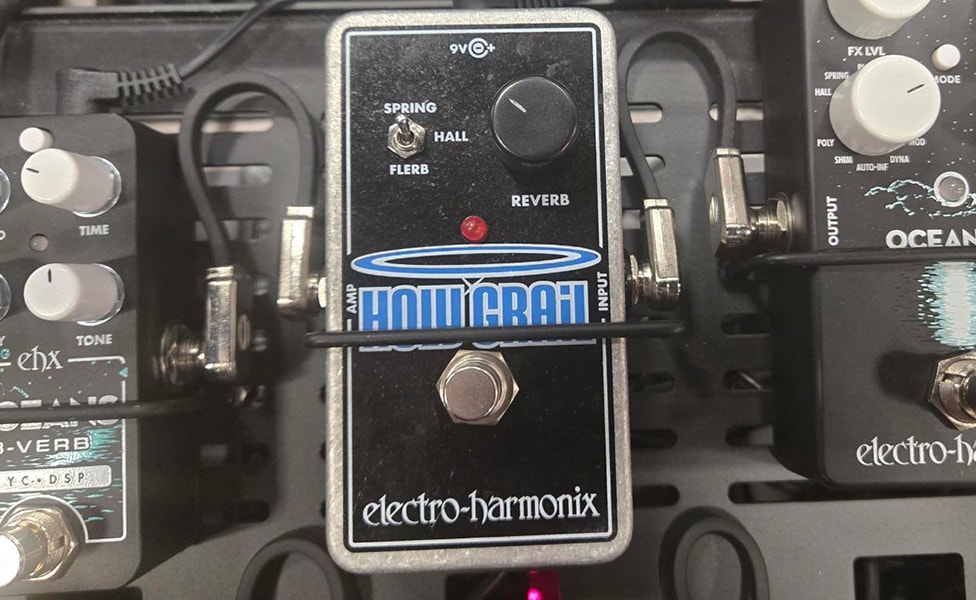
Electro-Harmonix Holy Grail
What I Dug:
- Three-mode selector switch and one big ol’ knob
- Pedalboard-friendly dimensions
Didn’t Make Me Smile:
- Limited reverb types
- No tone control
Shop Now: Electro-Harmonix Holy Grail Reverb Pedal
The Electro-Harmonix Holy Grail is a super simple pedal with three sounds—two of which could meet my needs. The Spring setting is vibey, tight and bright with a nice, surf-approved drip. I played around with some melodic ideas, and I liked how the Holy Grail’s spring reverb adds torrential waves without blurring the attack of single-note lines. The Hall setting can definitely rock ambient washes. It has a pleasantly warm initial sound that cascades into a ping-ponging, hard-edge-like atmosphere—kind of like a warehouse storage space. There’s too much of a flanging swirl for me on the Flerb reverb, so I likely wouldn’t use it for eerie soundscapes. But what’s not to like about an uncomplicated pedal that will make things easy on stage?
Electro-Harmonix Oceans 11
What I Dug:
- 11 onboard reverb types
- Emulates “kicked” reverb tank on Spring setting
- Infinite reverb mode for ambient awesomeness
Didn’t Make Me Smile:
- Hidden parameters require remembering what they are
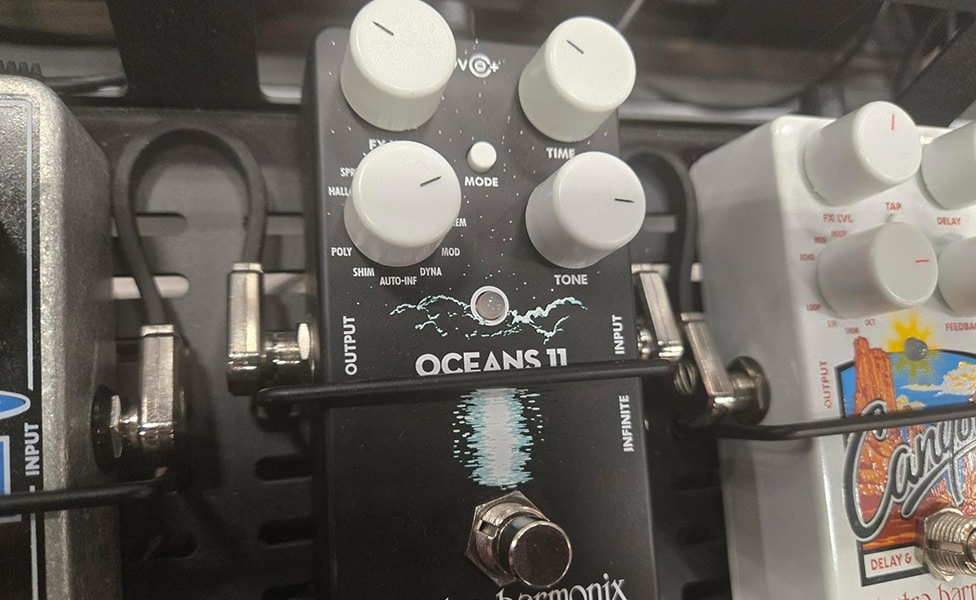
Shop Now: Electro-Harmonix Oceans 11 Reverb Pedal
The Electro-Harmonix Oceans 11 delivers the most reverb options of the pedal quintet—some of which aren’t my taste, but a fair amount are pretty awesome. The Spring setting produces one of the best pedal simulations of a vintage reverb tank I’ve heard. It possesses all of the attitude, twang, grit, sproing, shimmer and drip inherent in famous surf-guitar performances of the past. I could get lost for hours writing melodies on this setting.
There are also a lot of potential ambient options, although some are a tad too “trippy” for me, as I prefer washes without added effects. My favorites are Hall, Plate and Auto-Infinite reverbs—they’re lush and moody, yet bright enough to cut through a dense music mix. Being a ’60s aficionado, the Reverse reverb makes me swoon—to the point of overusing it to near death. The infinite sustain feature of the Oceans 11 also lets me craft luscious drones and add more ethereal lines and washes after them.
GAMMA Cumulus
What I Dug:
- Three-mode selector switch and big control knobs
- Emulates “kicked” reverb tank on Spring setting when you slap guitar strings
- Ambient washes available on Plate setting
Didn’t Make Me Smile:
- Limited reverb types
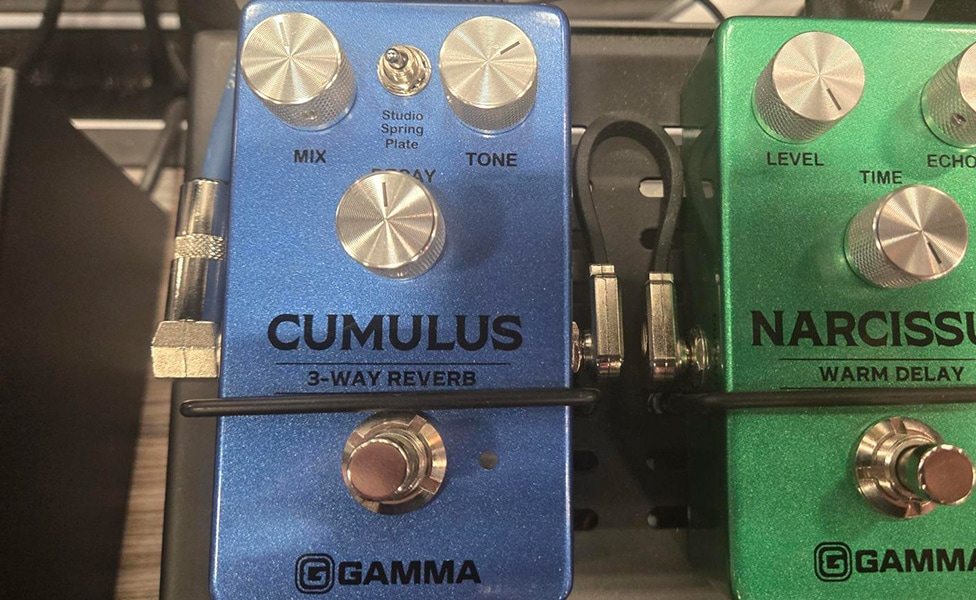
Shop Now: GAMMA Cumulus 3-Way Reverb Pedal
Even while working at Guitar Player, where I had access to upscale gear, I was always the emperor of inexpensive instruments, so the value and quality of the GAMMA Cumulus is attractive from the get-go. The pedal’s three reverb types isn’t a limitation if the trio has everything you need, but I only got really excited about the Plate setting. It serves up charming swells and expansive sound waves, and I love the option of going full ghostly spirit by cranking the Mix knob to full wet (no dry signal). The Spring reverb, however, is too polite for the style of instrumental music Surf Monster plays. It’s an agreeable sound to be sure, and it definitely works splendidly behind rock chords and riffs, but its lack of twang makes it a tough go for inspiring surf melodies. Studio mode sounds pretty much like a room reverb—and bravo to GAMMA for coming up with a title other than the ubiquitous “Room”—but I didn’t find it sharp or moody enough for my surf and ambient applications.
Walrus Audio Fundamental Reverb
What I Dug
- Fader-type sliders for parameter control
Didn’t Make Me Smile
- Limited reverb types
- Power input at side, rather than top
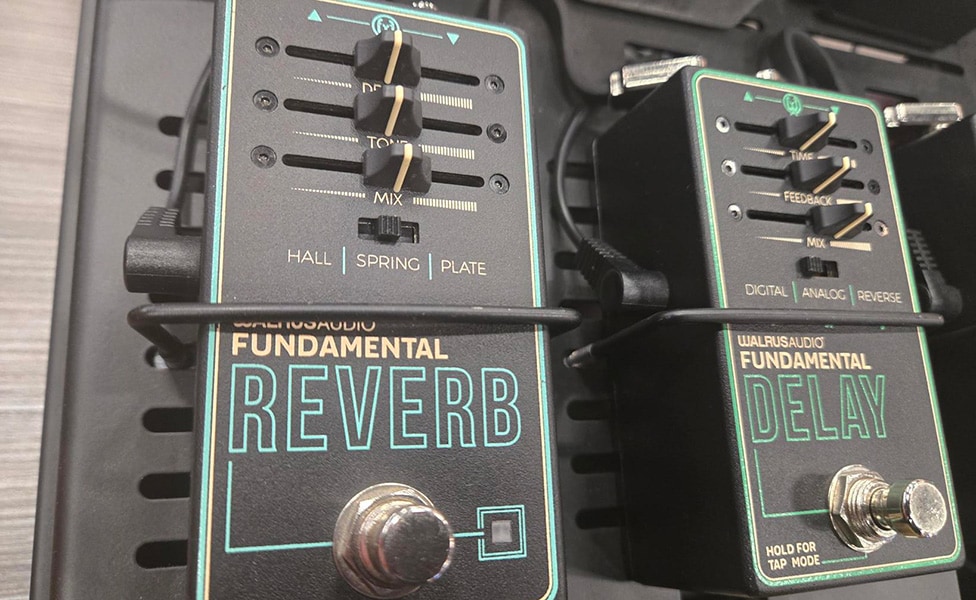
Shop Now: Walrus Audio Fundamental Reverb Pedal
The Walrus Audio Fundamental Reverb—like all of the pedals in the company’s Fundamental series—is designed for easy and uncomplicated effects generation. In other words, it’s a beginner-oriented pedal that can also delight working professionals who just want a good sound fast. That’s me. I’m too clumsy and impatient to negotiate tricky parameter changes while on stage. I loved the slider controls for that very reason. While I found all three reverbs (Hall, Spring, Plate) to be lovely—albeit a little bit on the bright side—I didn’t get enthused enough with any of them for my surf-ambient musical missions.
However, I should mention that in doing my initial research for this article, I found the Walrus Audio Fundamental Ambient pedal. It wouldn’t have helped me with my surf needs, but the Ambient’s Deep, Lush and Haze settings sound ideal for cinematic guitar gymnastics. Why didn’t I look for one, you might ask? Well, these articles are about the advantages of sound surfing with Guitar Center Pedal Stations, so I didn’t venture off trail.
Table Talk
I totally adore the Pedal Station concept—that’s why I’m doing this series. However, based on this trip, I have two tips for optimizing your stint at the Pedal Station.
First, while it is obviously impossible to have every available pedal tabled at all times—that would require an expansive bench running down Interstate 5 from the San Francisco Bay Area to Los Angeles and likely beyond—I’d have loved the chance to audition the Walrus Audio Ambient pedal. Happily, if you want to try a pedal not currently sitting at the table, just ask a store associate to grab it for you.
The other consideration is that I typically play through a VOX AC15 (or AC30 for festival-type gigs), and for something as ambient and textural as a reverb pedal, I wanted to hear the options through a tube amp. Guitar Center San Mateo has four Line 6 Catalyst CX60 combos wired into its Pedal Station. They are excellent digital amps with a slew of sounds and effects, but I opted to bring over a Fender ’68 Custom Deluxe Reverb, as my ears are more attuned to tubular timbres. Likewise, if you’re not digging the amp setup at the Pedal Station, ask an associate to help you find one that’s more to your liking.
Reverb-O-Rama
All five of the reverb pedals installed on the Guitar Center San Mateo Pedal Station are marvelous, and if I didn’t have two specific needs in mind, I’d be happy to install them on one of my pedalboards. But as I was having “surf-ambient-surf-ambient” spinning constantly across my neural net, I picked the Electro-Harmonix Oceans 11.
The Spring reverb is monumentally fantastic. You can even get the classic surf “kick the reverb tank” kerrang by stepping on the footswitch twice. In addition, I can choose whether to let the reverbs fade organically or stop on a dime when I switch to bypass, and a Secondary Knob Mode unleashes added parameter controls. In short, the Oceans 11 has a ton of “there there” for reverb lovers—even if you never access some of the 11 options for reasons of personal taste and musical application. I’ve already written one bad surf song with my Oceans 11, and I’m looking forward to getting on stage soon to craft cinematic swells of undulating ambience.
Written By: Michael Molenda
Michael Molenda is a content strategist, editor and writer for Guitar Center, where he has worked since 2022. He is the longest-serving Editor in Chief of Guitar Player (1997-2018), and former Editorial Director of Bass Player, EQ, Keyboard, Electronic Musician, Gig and Modern Drummer. A guitarist, drummer, bassist and producer, Mike co-owned three pro recording studios in San Francisco, and performs with Surf Monster and The Trouble With Monkeys.
Be the first to know about exclusive offers, tips and more.

866-498-7882 English
877-687-5402 Español