.jpeg)

Pro Gear Advisers
•866-498-7882
A Tonal Trip at My Local Guitar Center Pedal Station
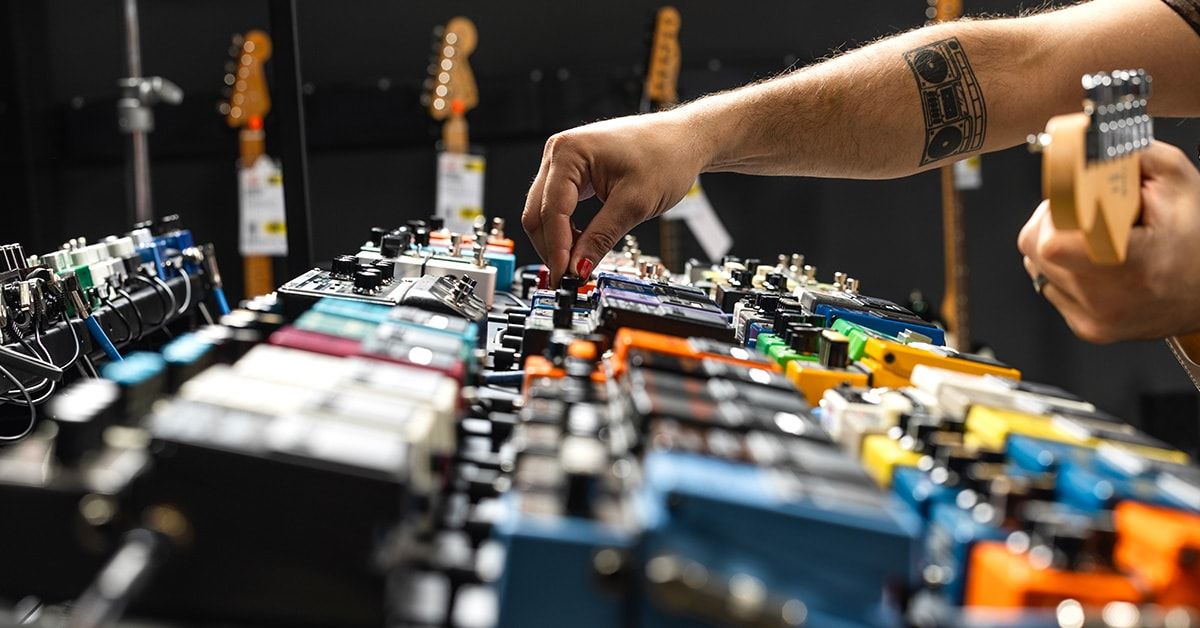
Pedal shoppers are seldom treated to a concierge experience. Usually, it’s more like a trip to a sketchy smorgasbord restaurant. (I still have nightmares from my parent’s obsession with Perry Boys’ Smorgy outings when I was a youngster.) You shuffle over to the store’s pedal selection, find something interesting and ask if it’s possible for you to try it out. If it’s a display model, you’re probably in luck. If it’s a brand-new pedal in its box, your chances may diminish somewhat.
Then, you seek out the right guitar and amp to begin a productive audition, pick a (hopefully) quiet-ish spot in the store and start putting the pedal through its paces. Oh, wait. Did you remember to ask the sales associate for two guitar cables?
Depending on your level of music-shop paranoia, you either dig what you hear and buy it, or do the walk of shame to the counter, say, “No thanks,” and slink away like you did nothing except waste the store’s time.
However, Guitar Center recently made stompbox shopping way easier and way more fun. We now invite pedal seekers to a first-class sonic repast by installing wired-up and ready-to-go pedal stations in all of our locations.
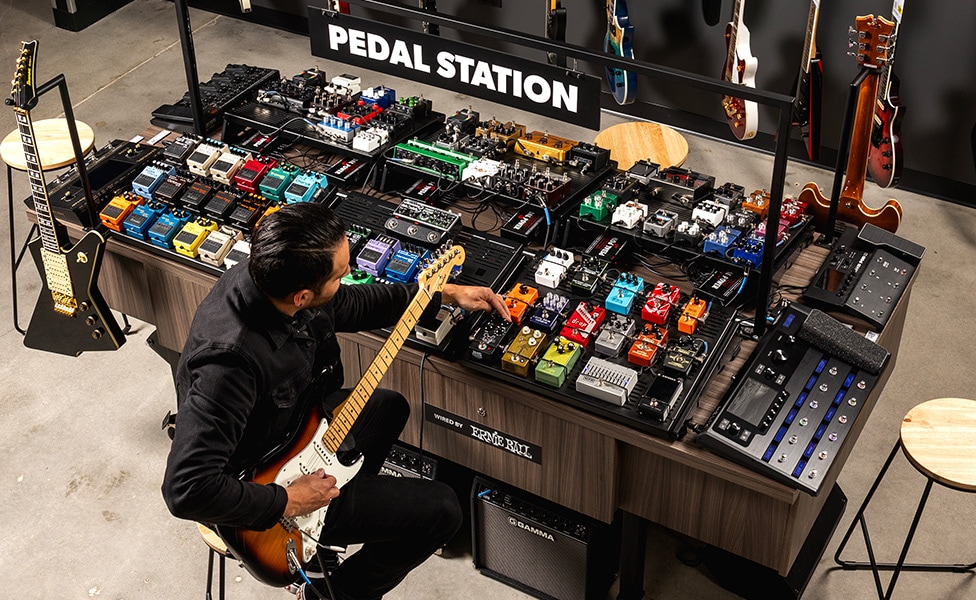
Pictured: Guitar Center Pedal Station
What Are Guitar Center Pedal Stations?
Well, it’s pretty self-explanatory—although the stations are much more than dining room furniture with stompboxes as the buffets. These are serious sonic workstations, professionally wired up with Ernie Ball cables, powered by Voodoo Lab, neatly secured by ties and arranged so that everything is right within reach. Guitar? Check. Amp? Yes. Pedals? Of course.
The pedals change up regularly, so surprises are always afoot. (Pro tip: Visit your local Guitar Center frequently to ensure you aren’t missing out on anything cool.) You can sit down and devour everything on offer, or pick your way through a planned quest to find the perfect something.
That’s what I did …
Join Me at the Station
I was seeking a sound from my past. My first pedal after the punk era—where all I ever used was a ProCo RAT—was a BOSS CE-2 Chorus. At the time, the new wave scene was expanding—and I revered Andy Summers—so it was time to get modulated. But I haven’t included a chorus effect in my pedalboard rig since around 1987, and sonic nostalgia was swirling around my head. The pedal station at Guitar Center San Mateo beckoned to check out some options.
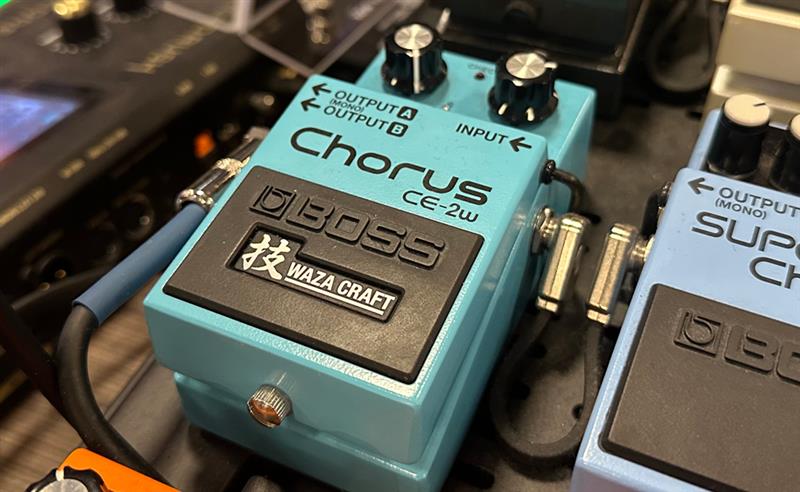
Shop Now: BOSS Waza Craft CE-2W Chorus Effects Pedal
The menu on the day I arrived included a (familiar) BOSS Chorus CE-2W (Waza Craft), GAMMA Eros Clean Chorus, MXR M234 Analog Chorus and Walrus Audio Fundamental Chorus. A Gibson Les Paul was hanging on a nearby guitar stand, and a Line 6 Catalyst combo amp was plugged in and ready to go. Not surprisingly, the Catalyst was set to a brutally saturated tone—that woke me right up—so I turned the voicing dial to Clean, and turned off all of the onboard effects. I decided to start with the BOSS CE-2W for a personal historical context. Of course, Waza Craft didn’t exist back in the ’80s, so I stuck with Standard mode to recreate the sound of the original CE-2.
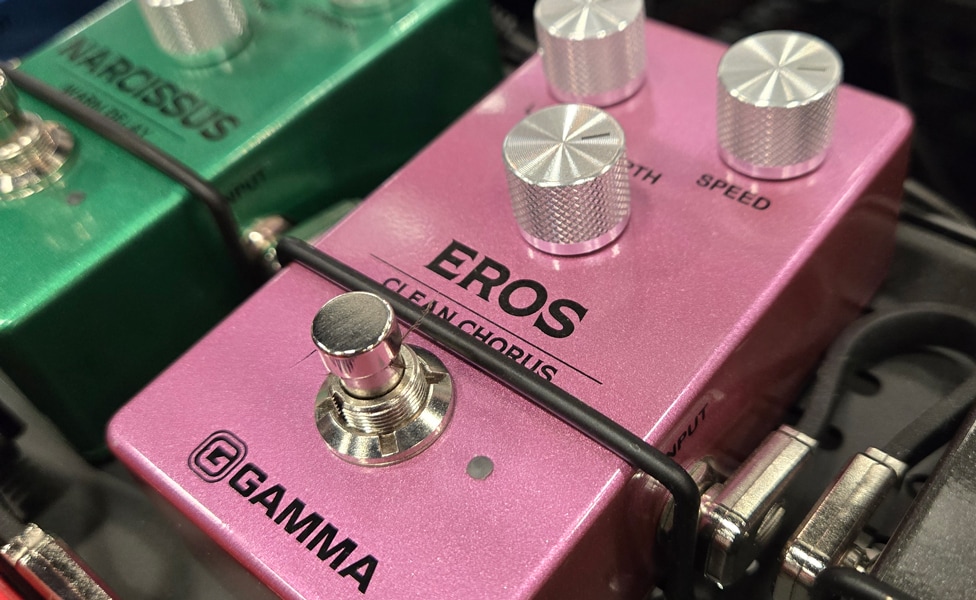
Shop Now: GAMMA Eros Chorus Effects Pedal
After establishing my primary BOSS chorus sound, the pedal station made it so easy to switch between the CE-2W and the GAMMA Eros, MXR Analog Chorus and Walrus Audio Fundamental Chorus. Recently, I had been performing a cover of Crowded House’s “Don’t Dream It’s Over” with singer-songwriter Eva Jay Fortune (without chorus), so I set all four pedals to roughly the same shimmer I had studied from the original track. Then, I played the song’s intro section while clicking each chorus pedal on and off to get a feeling for the various tone personalities. The pedal station made this operation quick and seamless, and I had no huff negotiating footswitches with my hand rather than my Vans.
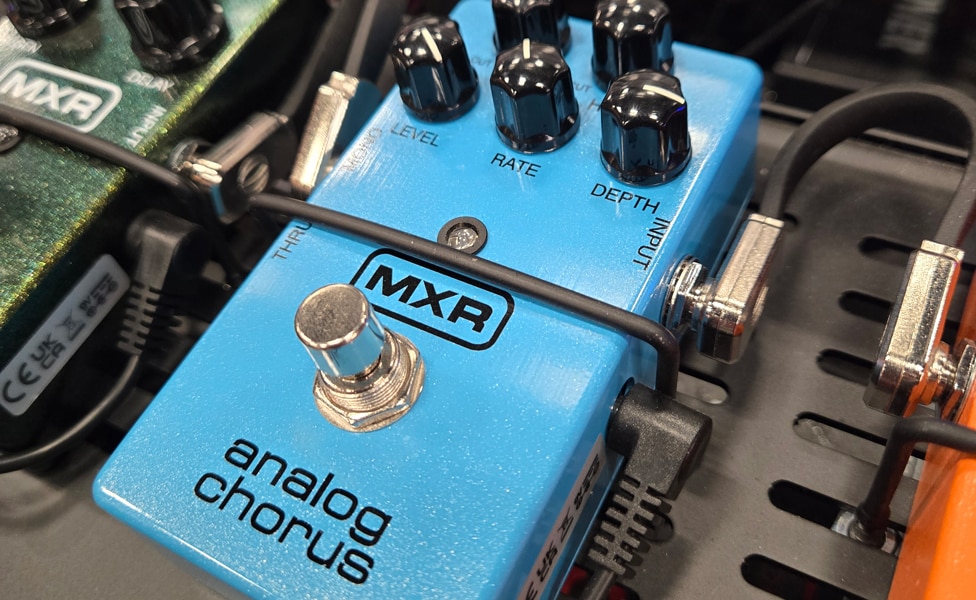
Shop Now: MXR M234 Analog Chorus Effects Pedal
As a commercial recording studio owner and producer for many years, I’m accustomed to making rapid sonic assessments, but I feel that anyone—from beginner to working professional—will be able to evaluate distortions, overdrives, delays, reverbs or any other effect type meticulously and methodically while sitting at a Guitar Center pedal station. But you don’t have to sit down with a specific goal in mind—you can simply experience the joy of tone in all those multi-colored boxes.
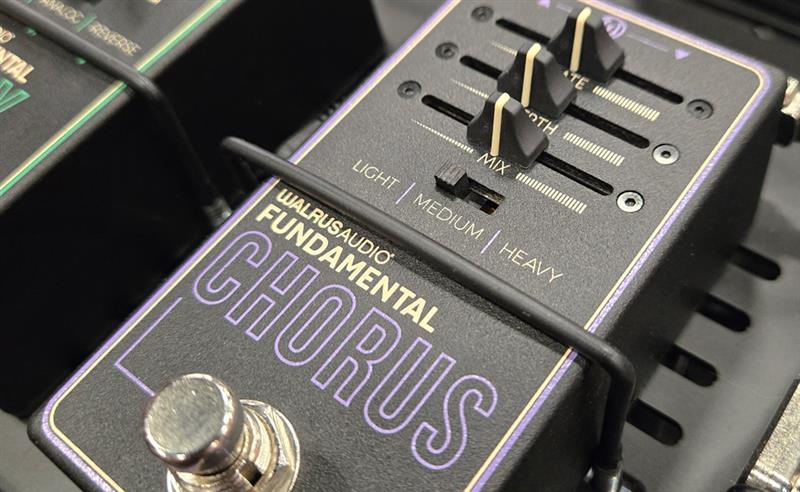
Shop Now: Walrus Audio Fundamental Series Chorus Effects Pedal
Quick Chart of Chorus Pedal Basics
Please keep in mind the following tone notes are my subjective perceptions of what I heard sitting at Guitar Center San Mateo’s pedal station. While obviously not auditioned in an isolated home studio, I feel the pedal station tests are perfect for illuminating much of what I’d hear during a live performance or rehearsal.
|
Pedal |
Controls |
Tonal Character |
Price* |
|
Rate, Depth, Voicing |
Chewy, lush shimmer |
$241.99 |
|
|
Level, Depth, Speed |
Clear and coherent sparkle |
$89.99 |
|
|
Rate, Level, Depth, Lo-cut, Hi-cut |
Articulate, bell-like chime |
$129.99 |
|
|
Rate, Depth, Mix, Mode |
Well-defined glimmer |
$99.99 |
Pricing as of August 2025*
How to Optimize Your Pedal Station Tests
Professional recording studios often practice the concept—and courtesy—of “zeroing the board.” This means an engineer restores every knob and fader on the mixing console and outboard processors (physical or virtual) back to their original positions. In essence, each new client gets a clean slate from which to start their own session, including a tidy studio space with all mics, cables, stands, instruments and so on returned to their storage areas.
However, be aware the pedal station at your local Guitar Center may not be zeroed out for you. The amps might be parked on settings from previous users, and certain pedals could be left active with parameter knobs akimbo. In a DEFCON 3 scenario, you may want to scan if any essential cables have been disconnected by a rowdy or clueless player.
For convenience, guitars are positioned at each station, but if you want to test pedals with something different—perhaps your favorite semi-hollow, hollowbody or other model—just go grab it and plug it into the signal chain using the cable from the present guitar.
Switching out the provided amps at the pedal station might be a bit more difficult, but it’s understandable if you need a specific amp to make a final decision as to whether a pedal is “the one” for your rig. My recommendation is to start off using the supplied amp for auditioning the basic sounds of the pedals—your “Do I dig this or not?” stage. When you’ve narrowed your search down to the most likely possibilities, seek out a Guitar Center associate to help you place the amp of your choice into the pedal station's signal chain.
I should also state the obvious: Please be courteous to other customers—and the Guitar Center staff—by testing pedals at a reasonable volume. Cranking the amp to gig volume won’t unveil any significant attributes of a pedal you won’t be able to hear at more sensible levels. Don’t be that person looking to emulate a guitar store scene from Wayne’s World.
And The Winner Is ...
So, which chorus did I feel was best? I have an affinity for the sumptuous, sonically verdant chorus effect of the ’80s, and I thought the BOSS CE-2W captured that tone accurately. But while that beautiful box is marvelous and reliable, my limited use-case—a dash of chorus on just a few selected songs during a set—doesn’t justify its boutique-level price. I settled on the MXR M234 Analog Chorus for its lavish yet focused shimmer and helpful tone-shaping controls.
I hope this missive was helpful, as I plan to regularly report on the latest and greatest stompboxes showcased on Guitar Center pedal stations. Let’s keep each other up to date on some conventional, surprising and truly wacky pedals to inspire our creative expeditions.
Written By: Michael Molenda
Michael Molenda is a content strategist, editor and writer for Guitar Center, where he has worked since 2022. He is the longest-serving Editor in Chief of Guitar Player (1997-2018), and former Editorial Director of Bass Player, EQ, Keyboard, Electronic Musician, Gig and Modern Drummer. A guitarist, drummer, bassist and producer, Mike co-owned three pro recording studios in San Francisco, and performs with Surf Monster and The Trouble With Monkeys.
Be the first to know about exclusive offers, tips and more.

866-498-7882 English
877-687-5402 Español