.jpeg)

Pro Gear Advisers
•866-498-7882
Inside the Rare Fender Low Power Tweed Twin
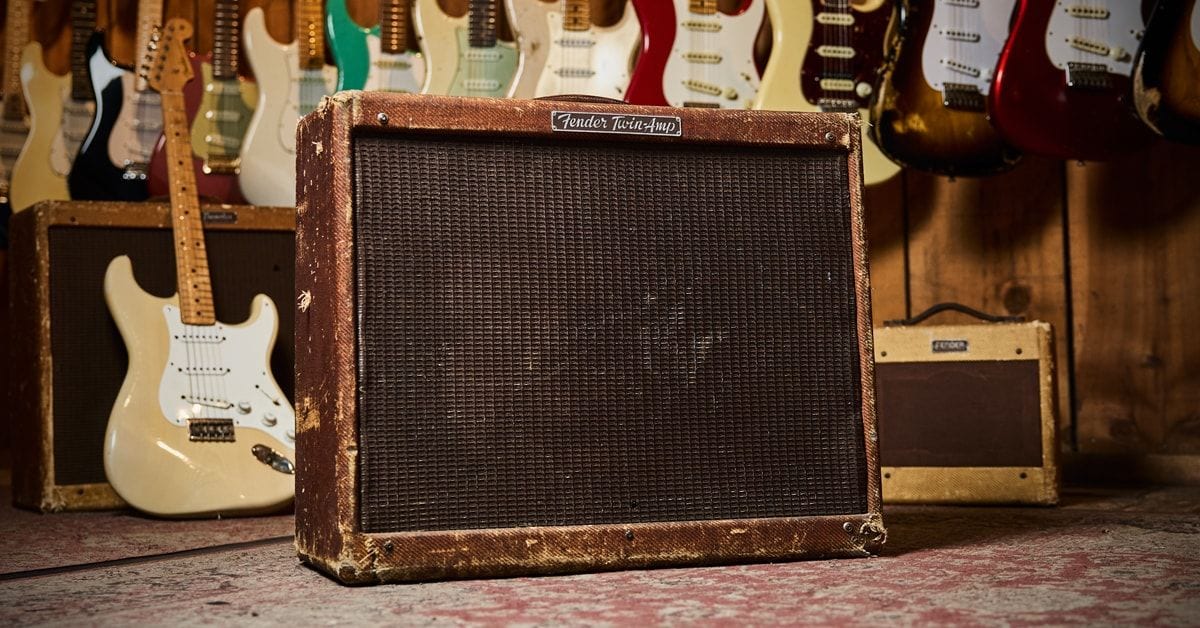

In the long and storied history of the Fender Twin, there’s a version that almost slipped through the cracks. It never got a formal schematic. It didn’t last a full production year. And it arrived during a moment of fast-moving evolution at Fender, when circuits and cabinets were changing faster than the catalogs could keep up.
That amp is the early 1955 “Low Power” Twin, built during the narrow window between the wide-panel 5D8 and the higher-powered 5E8. Known by its tube chart as the 5D8-A, this transitional model is one of the most elusive Twins Fender ever made. And it just might be the most interesting.
We recently acquired a beautiful example of this amplifier for the Guitar Center Vintage Collection, and in this article, we’re going to explore why this short-lived Twin is such a rare bird. We’ll look at what sets it apart from both its predecessor and its successors. Most excitingly, we’ll get hands-on time with the amp itself to hear how it plays, feels and reacts, because sometimes, the best way to understand a piece of gear is to plug in and let it speak for itself. Spoiler alert: It’s pretty awesome—tight and punchy, with just enough growl, but let’s save the details for later.
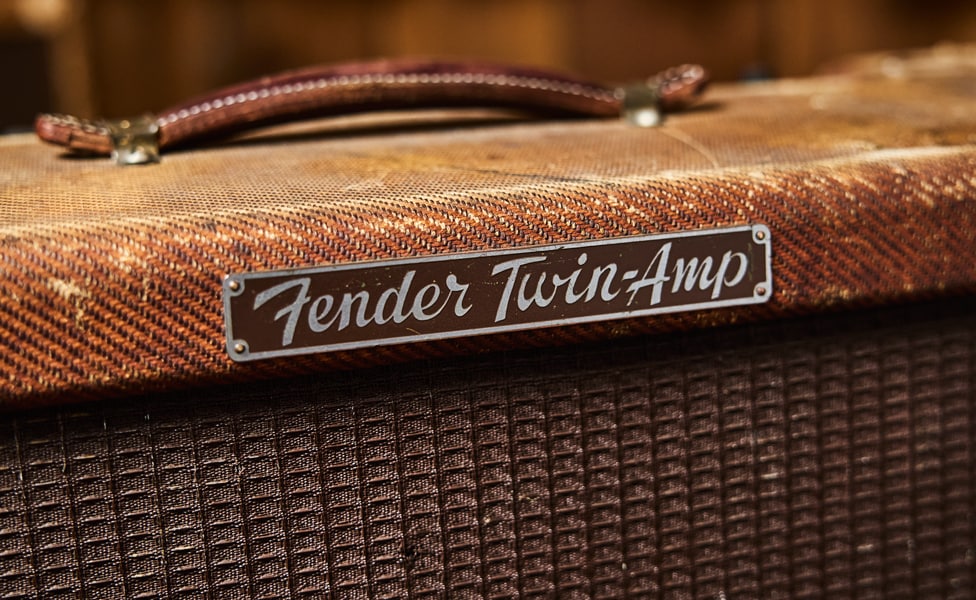
Pictured: Fender 1955 Low Power Tweed Twin Branding
Table of Contents
Why Is This Amp Different?
There are several factors that set this amp apart and mark it as a unique piece of gear history. While this isn't going to be a deep dive into the technical aspects of the amp, I do need to touch on a couple of basic concepts along the way.
Rectification
The rectifier is the part of the power supply circuit that converts the AC current from the amp's power transformer into the DC current that the amp's tubes need to operate. Tube rectifiers (like the 5Y3, 5U4 or GZ34) don't deliver instantaneous, perfectly stable current. When the amp is pushed hard—like during big chords or loud solos—the demand on the power supply increases. A tube rectifier can't keep up with that demand instantly, causing a temporary drop in voltage known as "sag."
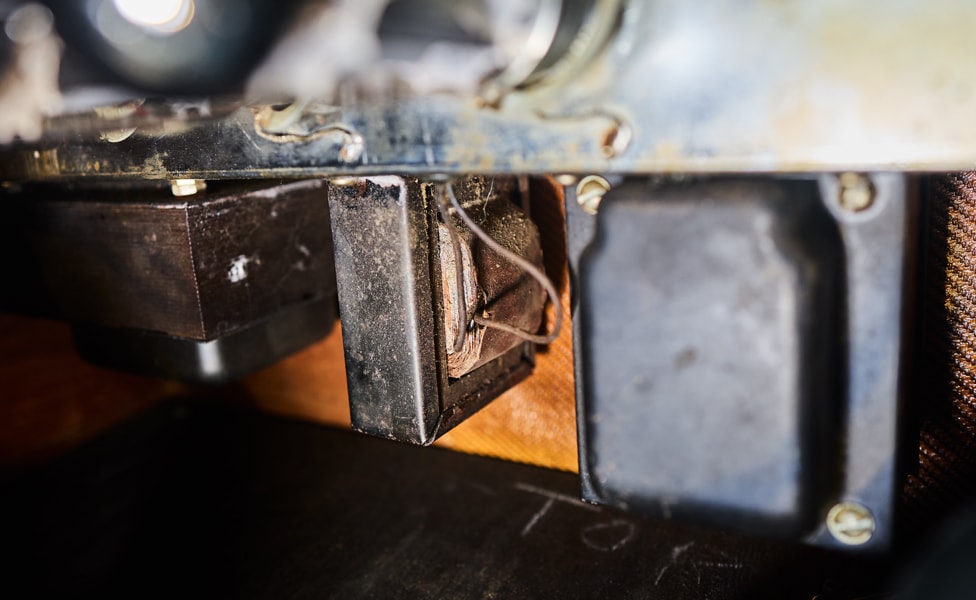
Pictured: Fender 1955 Low Power Tweed Twin Power Transformer
"Hmmmm, sounds like a bug to me," you might be thinking, but it's most definitely a feature. Sag softens the attack of notes, compresses transients and adds a subtle, musical bloom to your playing. The feel becomes more dynamic, elastic and expressive—especially when you're playing with touch-sensitive dynamics or edge-of-breakup tones. These are the exact characteristics that make Fender's tweed circuits (as well as many other amps of the 1950s) so beloved by so many players.
By contrast, the later move to solid-state rectifiers delivered stiffer, more immediate current with less sag. While that’s better for tight bass and high headroom, it lacks the forgiving, spongey feel that many players associate with vintage amps. Sag, in short, is part of what gives older amps their musicality.
This part of the circuit is the biggest change from the 5D8 to this amp's 5D8-A design. While the earliest Twins had a single 5U4G rectifier (the 5C8 circuit) for a substantially spongier feel, and the 5D8 used a pair of 5Y3G rectifiers for increased headroom, the pair of 5U4G rectifiers in the 5D8-A circuit substantially increased the amount of available current under load. In part, this is where I do a little detective work and make a couple of assumptions about this undocumented circuit. The increased current capacity of a pair of 5U4s would have substantially increased the stiffness of the power supply, decreased sag and allowed for higher plate voltages to the power tubes. While the 5D8 circuit would have allowed for a B+ voltage of between 360–380 volts, the 5D8-A circuit would have allowed raising the B+ voltage to somewhere around 400V, creating greater headroom and approximately 3–5 watts of additional power, so somewhere between 28 and 30W from an amp putatively rated at 25W. A brief conversation with amp designer (and old friend) Bruce Egnater seems to confirm this assumption.
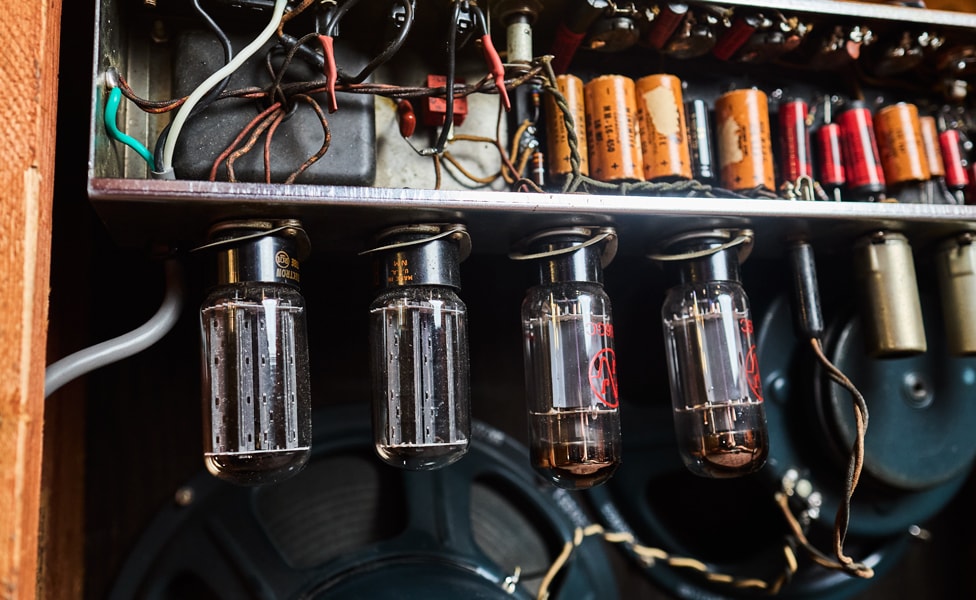
Pictured: Fender 1955 Low Power Tweed Twin Power Tubes
Cathode-bias vs. Fixed-bias Circuits
Biasing is how a tube amp sets the operating point—or "idle"—for its power tubes. The two most common methods are cathode bias and fixed bias, and each one has a noticeable effect on how the amp feels and sounds.
In a cathode-biased amp, the tubes self-regulate their idle via a resistor on the cathode, making the system somewhat self-correcting and more forgiving. This method creates earlier breakup, a bit of compression and a softer, more responsive playing feel. It’s part of what gives many vintage Fender Tweed-style amps their signature bloom and sag.
Fixed bias, by contrast, uses a separate negative voltage source to set the tube bias. It’s more efficient and allows for more power and headroom. The result is tighter bass, cleaner transients and a punchier, more immediate feel—great for high-volume clarity or pedal platforms. Cathode-biased amps, by contrast, are far less efficient, and getting more than 30W out of a cathode-biased push/pull amp (as with the VOX AC30, probably the best-known cathode-biased amp around) starts to put severe stress on the tubes and reduces their lifespan substantially.
Cathode-biased push-pull amps are often described as “Class A,” but most actually operate in Class AB, only with a longer duty cycle (about 70–75%) than normal Class AB's 50%. True Class A operation—where each tube conducts for the entire waveform—is rare in anything but single-ended designs. Still, cathode bias retains a lot of that smooth, touch-sensitive character players associate with Class A tone.
The 5D8-A, with its higher clean headroom and resistance to early breakup is one of the first steps along the way to Fender switching from cathode bias to direct bias, as would happen later that decade.
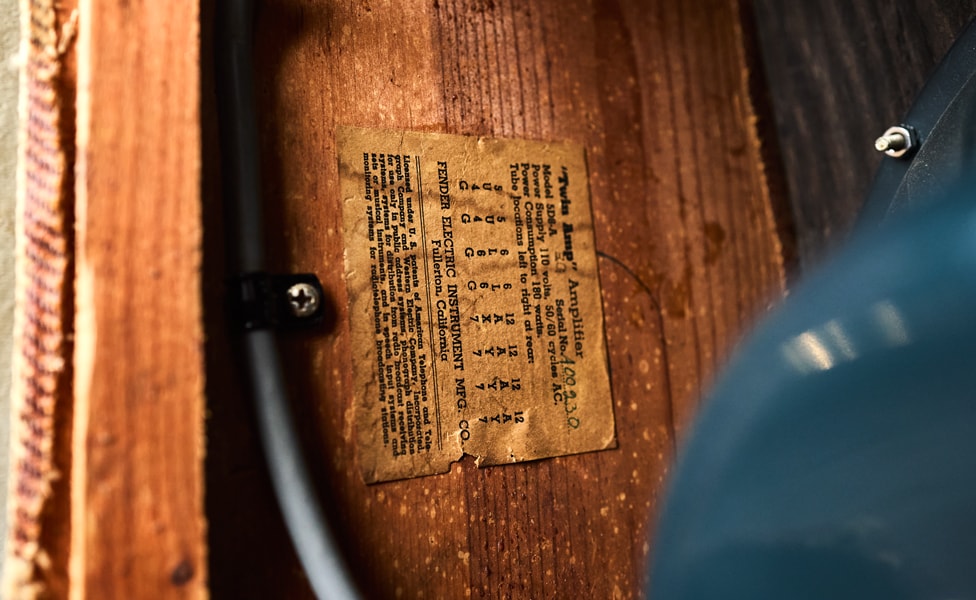
Pictured: Fender 1955 Low Power Tweed Twin Tube Chart
Cathode-follower Tone Stack
In many Fender Tweed amps, including the 5D8, 5E8 and 5F8-A Twins, the tone controls are driven by a cathode follower stage—a tube circuit that doesn’t amplify voltage, but instead buffers the signal with low-output impedance before it hits the EQ section. This setup was standard in Tweed amps that included full tone stacks.
Why does that matter? Because traditional passive tone stacks (like Fender’s Treble/Bass/Presence or Treble/Mid/Bass) inherently load down the signal—they eat gain. A cathode follower prevents this by acting like a shock absorber: It preserves dynamic content and allows the tone controls to operate more smoothly and musically.
Compared to later Black Panel circuits (which typically feed the tone stack directly from the plate of a 12AX7 gain stage), cathode follower tone stacks feel more interactive, with a rounder, more harmonically rich response—especially in the mids. They’re slightly less mid-scooped and more dynamically expressive.
This design contributes heavily to the immediate, touch-sensitive feel of Tweed amps. It’s one of the secret ingredients that gives those circuits their unmistakable voice, especially when played on the edge of breakup.
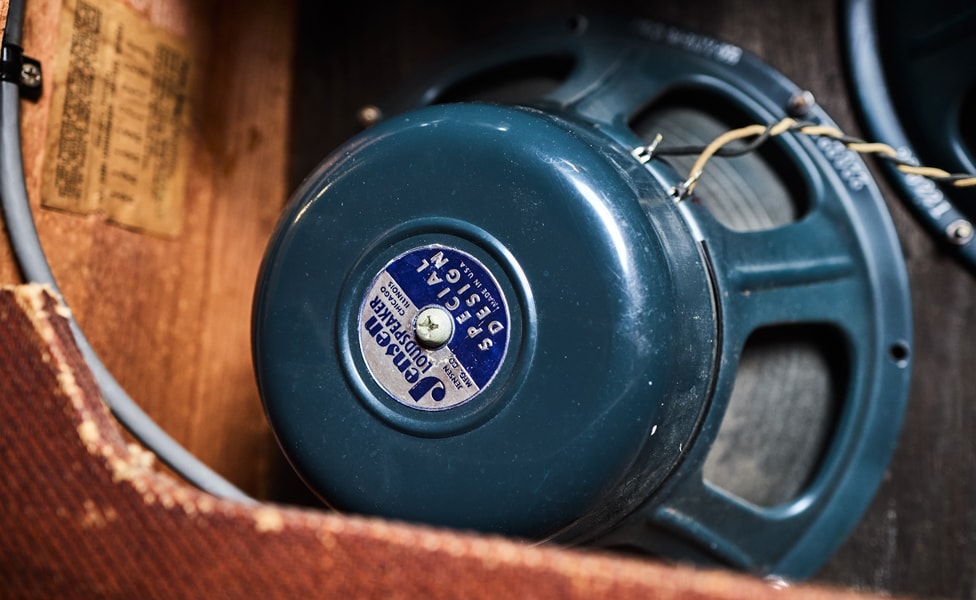
Pictured: Fender 1955 Low Power Tweed Twin Jensen Speaker
Hands-on With a 1955 Fender "Low Power" Twin
So, with all that being said, what's this particular version of the 5D8-A Tweed Twin like? One of the advantages of this job is that we occasionally get to sit down with some incredibly rare pieces of gear and get a feel for them. So, I made the trek to Guitar Center Hollywood's famed Vintage Room to get a little playing time in on this rare beast as well as a chance to take a closer look at the interior of the amp.
First impression on firing up the amp is that it has possibly the lowest noise floor of any Tweed amp I've ever played. We're talking dead quiet until you start to play. And this is despite the fact that most of the capacitors in the circuit (the component most likely to need replacement in amps of this age) were still the original Mallory caps. Not having another Tweed Twin of similar vintage to compare with directly, I had to rely on memory, but this particular amp was noticeably a bit stiffer and cleaner than other Tweed circuits I've played in the past. Despite this, it still had that quality of having a musical conversation with the amp in its response to playing dynamics with the volume controls set to the edge of breakup (which, by the way, is plenty loud enough that I broke out the earplugs) you expect from a cathode-biased Tweed circuit. The sag, though still there, was somewhat less pronounced, enabling a little more subtle bloom in the notes, while still offering up the natural compression players love about these amps.
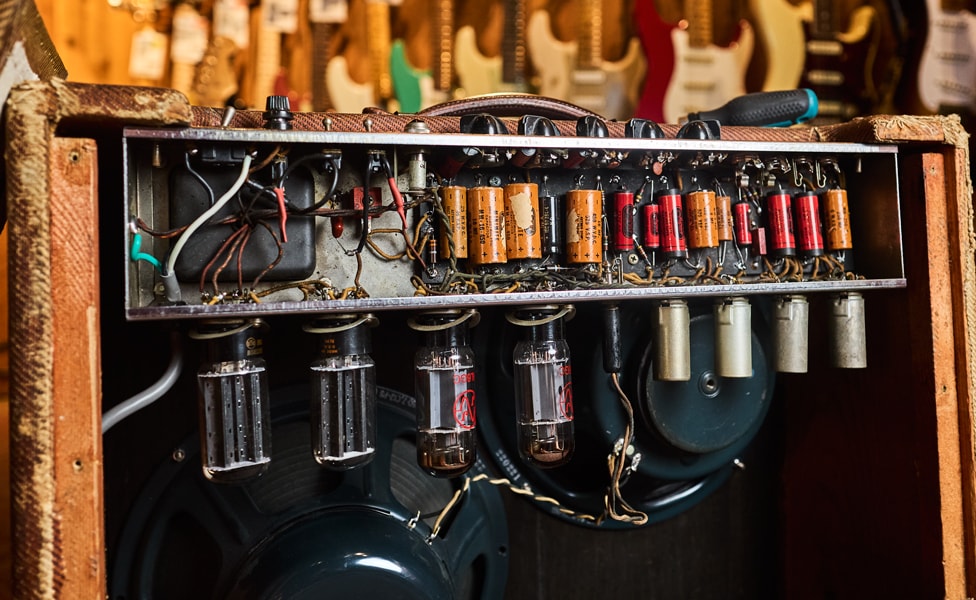
Pictured: Fender 1955 Low Power Tweed Twin Chassis with Back Panel Removed
On taking off the back panel, here are a few notes:
- As mentioned above, the amp retains a remarkable number of original Mallory capacitors, both coupling and bypass. Visually, these components appear well-preserved, with only one of the 16μF/450V filter caps showing signs of replacement.
- Jupiter Condenser caps have been installed in select locations—likely part of a targeted, sympathetic restoration. These modern replacements are period-appropriate in tone and construction.
- The filter section shows only minimal intrusion into originality, which is exceptional for a 70-year-old amp.
- The amp's astonishingly low noise floor suggests excellent grounding, clean solder work and possibly favorable transformer tolerances.
- The tube chart is stamped “EC,” dating this unit to March 1955. This fits neatly into the known production window between the wide-panel 5D8 and the fixed-bias 5E8.
- The tube chart also bears serial number A00230, placing it early in the 5D8-A production run and aligning with other early 1955 Twins.
- Aside from the grounded 3-prong power cord (a sensible safety upgrade), the amp appears to retain all of its original cloth-insulated wiring. The wiring harness is not only intact but also exhibits excellent layout and craftwork, with clean solder joints and careful routing.
- At least one of the speakers appears to be a replacement Jensen P12Q blue-label ceramic magnet model. The other speaker appears to be original, with a Jensen date code showing a mid-May 1955 production date. Despite the one substitution, speaker wiring and baffle integrity appear undisturbed.
While the 5D8-A is already rare, its preservation state pushes it into near-museum quality, despite some obvious wear of the lacquered tweed covering. This unit provides not only a sonic snapshot of Fender's transition period but also a reference point for how well these circuits can age when cared for properly.
Conclusions and Surmises
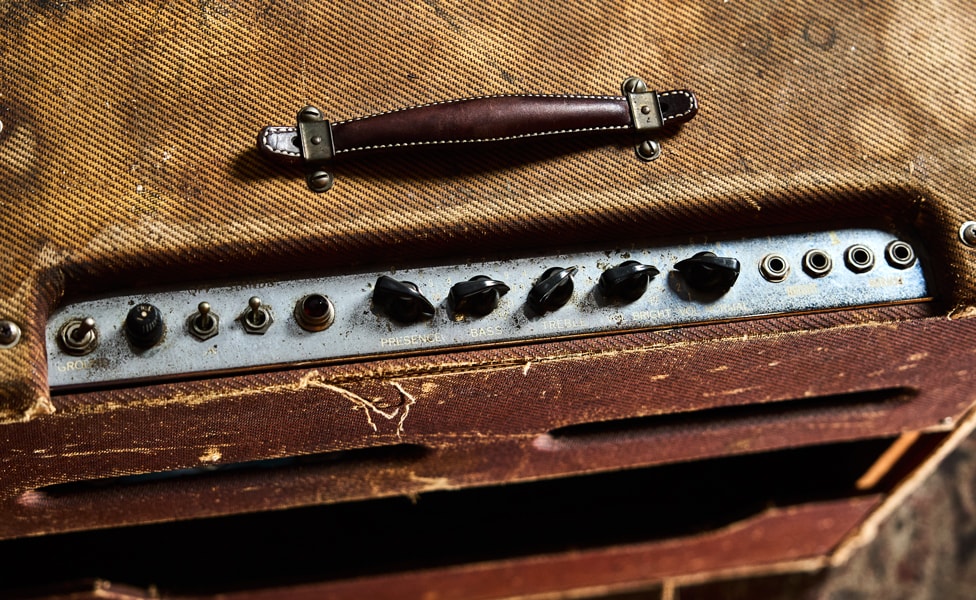
Pictured: Fender 1955 Low Power Tweed Twin Control Panel
So why was the 5D8 such a short-lived circuit? While we may never really know, given its lack of official documentation, we can make some educated guesses.
During this period, Fender was doing a lot of experimenting and routinely making changes based on player feedback and input. The 5D8-A may have been used because it fit in existing chassis that had been designed for the wide-panel 5D8 circuit, with the 5E8 circuit already in the wings waiting for the old chassis to run out (which would not be an uncommon move for the ever-thrifty Leo Fender). Player feedback may have been that the small power increase of the circuit wasn't yet enough clean headroom for their taste (remember that most of Fender's customer base in Southern California comprised Western swing and country players, not rock and rollers). This problem would have been partially fixed with the 40W 5E8 circuit and fully dealt with by the addition of the 80W 5F8 circuit in 1958.
On a certain level, this rare and elusive model may remain both a mystery and a footnote in the history of Fender's evolution as an amplifier manufacturer. The one thing I can say for certain is this example has everything a player might want both tonally and historically in the vaunted history of this particular version of a "grail" amplifier.
Written By: George Van Wagner
George Van Wagner is a writer and editor for Guitar Center, where he has worked since 2007. A multi-instrumentalist, freelance recording engineer, arranger, composer, writer and all-around tech geek, he has over 30 years of experience in the musical instrument industry at companies like Midiman/M-Audio and Line 6, doing everything from customer service and writing user manuals to working in product development. He is currently gigging around Los Angeles with Gruppo Subconscious and Bobby “Hurricane” Spencer.
Recently Added to Gear Tips
Be the first to know about exclusive offers, tips and more.

866-498-7882 English
877-687-5402 Español