.jpeg)

Pro Gear Advisers
•866-498-7882
Spotlight on the QSC CB10 Battery-Powered Portable Loudspeaker
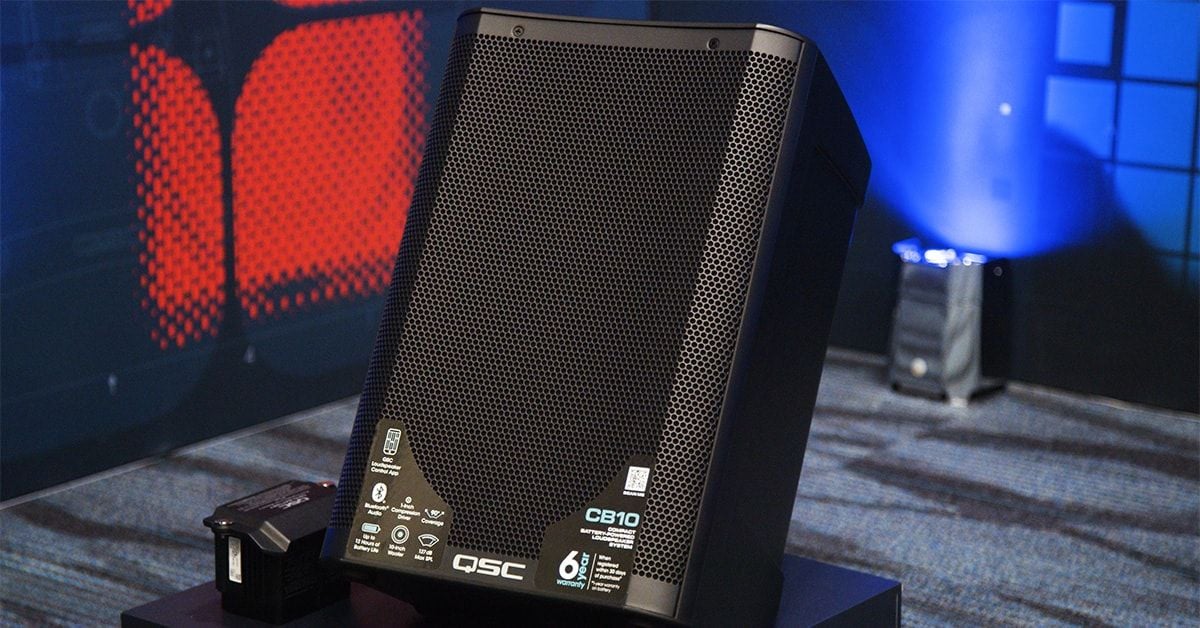
In our article “5 Top Music Gear Trends for 2026,” another emerging development we forecast was the continuing evolution of even more powerful and portable PA solutions for self-sufficient musicians on the go.
Apparently, the only foresight we needed was attending NAMM 2026 and visiting the QSC booth, where they exhibited the new CB10—the company’s first battery-powered loudspeaker.
The QSC CB10 checks a whole lot of boxes for serious artists who need much of the clarity, full-range frequency spectrum, wide sonic dispersion, room-filling power, and mixing and EQ options of a professionally installed sound system in a single portable enclosure.
Singer-songwriters, DJs, multimedia musicians, loop-based artists, acoustic duos, environmental-audio producers and other creators can use a CB10 to fill most small to moderately large spaces—even the great outdoors—with sound that astounds, rather than pummeling an audience’s ears with too bright, too loud (or not loud enough) or muddy sonic quality. And no tech crew is needed—any somewhat audio-savvy musician can comfortably transport, set up and mix excellent sound with the CB10.
“The CB10 is always grab and go,” QSC Senior Product Manager Chris Brouelette told Guitar Center Senior Manager of New Product Marketing Dustin Hackworth at NAMM. “There are no displays or menus to get lost in. You can look at the controls on the back and intuitively get up and running. However, if you put the CB10 into custom app mode, there’s more under the hood because you unlock more features—such as EQ, reverb, delay and so on—via an Apple and Android app.”
Who Is QSC?
Before we get into specs and applications, you may wonder why QSC might be a good audio partner for your music performances—especially given the amount of portable, battery-powered speakers seeking your attention. QSC was founded in 1968 by Patrick Quilter and brothers Barry and John Andrews, in a garage in Costa Mesa, California. (You may recognize the “Quilter” name, as Patrick’s current company is Quilter Labs, which makes guitar and bass amps.) QSC’s commitment to innovation, practicality and quality made it a renowned and well-reviewed pro sound manufacturer.
I had a good amount of experience with QSC products when I was editor-in-chief at Electronic Musician magazine—working side by side with Mix and Pro Sound News—and every QSC speaker we evaluated exhibited superior audio quality and was built tough enough to shake off abuse from the rigors of the road. This is the definition of a trusted audio brand.

Shop Now: QSC CB10 Portable 10" Battery-Powered Loudspeaker
Why Choose a CB10?
It’s no secret streaming audio revenue is not going to keep musicians in vintage Marvel comics or boutique popcorn. So, getting out there and playing shows to replace trifling music sales with performance fees and merchandise sales can be critical. There’s also the business necessity of managing time, expenses and profits. It’s not for everyone to drag a five-person band into an SUV, drive across a state or two to play a series of $100 shows, stay in cheap hotels, eat at fast food joints and have enough cash at the end to hand everyone a few dollars.
But the expense/benefit equation veers significantly in your favor if you (and perhaps one collaborator) can travel in a car and play almost anywhere—adding busking for tips to a business plan of performing your songs in small venues, coffee shops, restaurants, street fairs, farmer’s markets, breweries, wineries, house concerts and wherever a portable PA speaker can broadcast your music to a crowd. Being a self-sustaining traveling troubadour could be the gig economy hack of the moment.
But you still need marvelous sound to truly engage a crowd—as well as the capacity to get the ear-catching nuances of your music to an outdoor or indoor audience. You need a QSC CB10.

Pictured: QSC CB10 Rear Control Panel and I/Os
Power. The CB10 delivers 440 watts of Class-D amplification, reaching a 127dB peak sound pressure level. That should ensure your acoustic guitar and wispy vocals can be heard clearly at an outdoor flea market—even amongst people haggling over prices—as well as guarantee the low-end grooves of your DJ set will move bodies in a small club.
No Plug Necessary. You can plug in the CB10 via its universal AC power supply, but for some gigs—even indoor performances—it can be hard to find a conveniently placed wall socket or a power strip that can reach your staging area. Happily, the CB10 is a “no plug/no problem” sound system, because its rechargeable battery can keep the party going for up to 12 hours. Keep in mind “battery powered” doesn’t exclusively mean you have the freedom to perform outdoors. I’ve played indoor band gigs and solo multimedia shows (improvising ambient guitar textures to video art) where the power was far away from the location the client wanted the music set up. (Sometimes, architecture and/or interior design trump performer necessities.) A battery-powered speaker saved the show every time—but just barely. (More on this below.)
Two-Way Design. The CB10 is an active two-way system with a built-in crossover managing a 10" woofer and 1" high-frequency compression driver. Add the CB10’s wide signal dispersion and the aforementioned 440 watts of power, and your performance should fill the space at hand. That wasn’t the case when I had to borrow a powered speaker at nearly the last minute to save my multimedia performance at a tech party in Atherton, California. I learned immediately that all powered speakers are [a] not created equal and [b] not always pro quality. I was set up in a huge, glass-enclosed swimming pool oasis where the available power was devoured by an HD video projector and two lighting rigs—hence, the panic for the battery-powered speaker. Unfortunately, the speaker’s wattage, sonic coverage and frequency spectrum was more semi-pro than pro, and my music was met with annoyed looks and exclamations of “I can’t hear you,” instead of the hoped-for contentment and polite applause.
Sound Quality. The CB10 is a live-performance speaker, not a studio monitor, so it’s kind of mind blowing that it projects a very “studio monitor” vibe. Every sound blasting out of this box is balanced, refined and smooth. This polished sonic posture obviously bodes well for music reproduction in general, but it also alleviates ear fatigue for performers and the audience. This is actually an important element of show craft, as anyone who has been barraged by brittle mids and crispy highs during a concert can attest. The 10" driver isn’t going to punch out subwoofer-style lows for DJs desiring to rock the house, but the taut bass content is surprisingly deep and warm.
Bluetooth 5.1. Bluetooth connectivity means you can stream audio for backing tracks and program material such as break music, use the QSC Loudspeaker Control mobile app (iOS and Android) for controlling the CB10 remotely and access deeper features (EQ, effects, additional presets, etc.), and pair two CB10s together without cables using the True Wireless Stereo feature.
Onboard Mixer. The 3-channel mixer on the CB10 back panel is basic and streamlined, which makes for a quick setup and easy operation. You get two XLR and 1/4" combo jacks and one 3.5 mm TRS stereo input with a dedicated gain knob for each channel. For my multimedia performances, that’s the perfect number of inputs for a guitar pedalboard, vocal mic and prerecorded tracks from a laptop. If I needed more inputs for a small band, I could simply route the outputs of an unpowered mixer to channels A and B.
There are no physical EQ knobs or a graphic equalizer provided on the back panel, but you do get a preset knob on each of the first two mic/line channels that lets you tailor the speaker voicing for a balanced frequency range, or optimized for dance, vocals, speech, speech with ducking (automatically reduces the level of the other two channels when talking is detected) or acoustic guitar. But thanks to Bluetooth, you don’t have to touch the back of the CB10 to refine its sound. Setting the preset knob on Custom (app) activates remote control via the QSC Loudspeaker Control mobile app (iOS and Android). You can also dial in reverb, select additional voicing presets and more.
Room Placement. The CB10 can be mounted on a stand, positioned straight up on the floor or a table or tilted back 30 degrees. The cabinet isn’t designed to lay horizontally at a performer’s feet as a floor monitor, but you could rest the CB10 on a guitar case (or other hardshell container) if you want it angled toward your face for stage monitoring applications. The vertical tilt-back feature could also work if you need an extra monitor in a pinch.
The Lugging It Factor. While it’s seldom an exercise of joy to drag speakers from the trunks or back seats of cars and carry them to performance spaces—especially if you’re unable to park right near the venue, or discover that lots of stairs are between you and the stage—the CB10 makes the activity somewhat less trying as it’s compact, weighs just 27 lb. and the top-mounted carry handle is large and easy to grasp.
More Goodies. A jack on the CB10’s back panel lets you use an optional footswitch (sold separately) to mute channels or effects, or activate the channel boost. The enclosure is not waterproof, but if you find yourself performing outdoors in the rain, the optional CB10 nylon cover (sold separately) can protect the speaker during your set. (Note: It’s not designed as a permanent outdoor cover.) The ability to dial in 200 ms of room delay is something I would never use, but the feature points to QSC’s commitment to professional sound reinforcement—even in a battery-powered speaker. For example, if you were setting up a larger PA system—such as front and rear speakers for a wedding or conference in a large room—you could dial in the amount of delay imposed on the CB10’s output to ensure everyone in the venue hears consistent, echo-free sound.

Shop Now: QSC CB10 Battery-Powered Loudspeaker on Pole Mount
Get Out There and Play
QSC is known for not always being the first to market with an emerging technology or feature set. They tend to study products first, and if something has legs, dig in and devise a more “QSC approach” to the category. In this case, many battery-powered speaker systems were released before the CB10, but as Brouelette stated at NAMM, being late to the battery party was not a major concern.
“People come to us with product ideas all the time,” he said. “We heard that a QSC battery-powered speaker was something people wanted, but there was also an expectation of performance that was higher than some other options out there in the market. So, we knew we needed to do something special—to try to shake up the category and create a real PA speaker that happens to also run on batteries.”
Written By: Michael Molenda
Michael Molenda is a content strategist, editor and writer for Guitar Center, where he has worked since 2022. He is the longest-serving Editor in Chief of Guitar Player (1997-2018), and former Editorial Director of Bass Player, EQ, Keyboard, Electronic Musician, Gig and Modern Drummer. A guitarist, drummer, bassist and producer, Mike co-owned three pro recording studios in San Francisco, and performs with Surf Monster and The Trouble With Monkeys.
Be the first to know about exclusive offers, tips and more.

866-498-7882 English
877-687-5402 Español