.jpeg)

Pro Gear Advisers
•866-498-7882
What’s on My Wish List? | Max's Top 5 Music Gear Picks for 2025

Have you ever “liked” a piece of gear online at Guitar Center? (Netizens have colloquially referred to similar actions as “smashing the like button” and have turned “heart” into a verb.) If so, then you’re acquainted with the wish list feature in your account. It’s a handy way of collating the stuff we’ll buy tomorrow, fantasizing about gear that’s further off and compiling a dossier on our equipment-related proclivities.
In this article, I’ll share some of the gear I’ve recently added to mine. This modest assortment includes guitar and bass amps, effects pedals and studio monitors, all intended to flesh out my collection, spark some creativity and bring even more fun to my (mis)adventures in music.
With any luck, it might inspire you to start checking things off your own wish list, too.

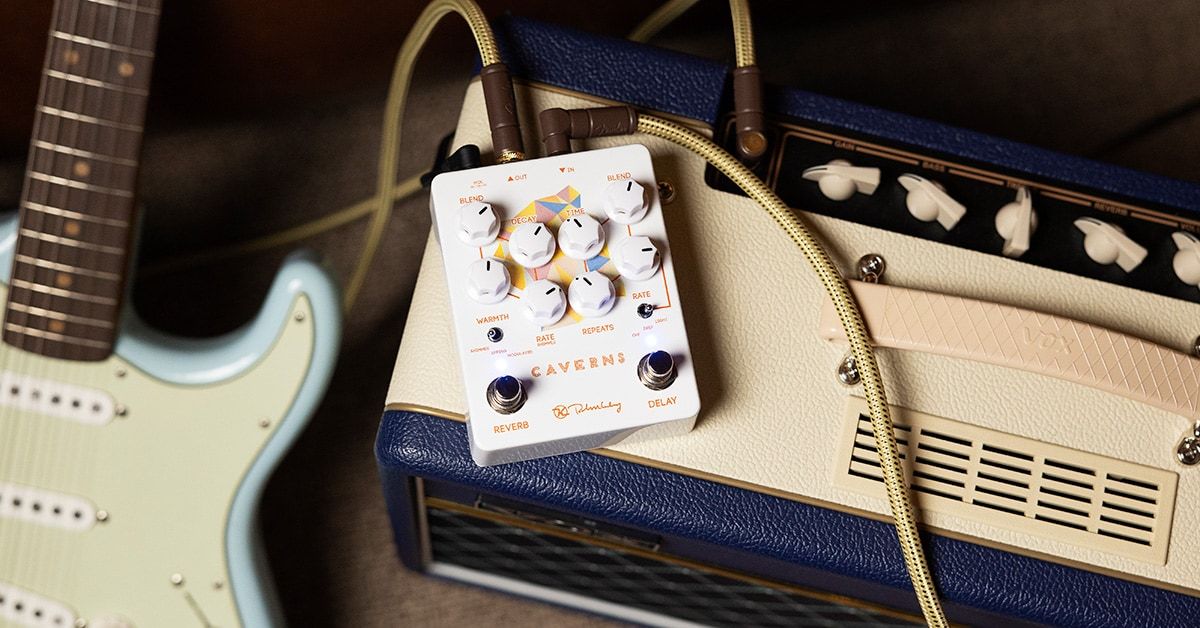
Pictured: VOX AC10 in Blue/Cream with Keeley Caverns V2 Delay/Reverb Pedal
Table of Contents
What Informs the Gear I Buy: A Bit About Me
For as long as I can remember, music has been the focal point of my life. I wanted to play guitar after hearing KISS’ “Detroit Rock City” at an early age, and almost 30 years later, I’m still wrestling with the instrument.
As a player and a fan, I’ve always had a thing for metal and progressive music, but my interests have typically been pretty broad. I’d played both guitar and bass in a bunch of bands in my teens and early 20s, and for the first time in ages, the group I joined alongside my best friends in high school recently decided to reunite for old time’s sake.
About 10 years ago, I took a trip down the path of music production, where I completed some formal education before interning, assisting and eventually engineering for the Brewery Recording Studio. I met the team shortly after their expansion from Brooklyn, New York, to Los Angeles, where I was able to help them relocate their shared studio space in Burbank to a private location downtown, building a brand-new recording facility in the process.

Pictured: Max McAllister at The Brewery Recording Studio in Los Angeles
That DIY endeavor was an incredibly valuable experience, and I spent the subsequent five or so years enjoying the fruits of our collective labor, recording and mixing hip-hop, pop and R&B records for a variety of artists in the house we built. I also ran a lot of sessions for close clients in my previous home studio.
Now, I’m mostly out of the formal studio workspace, and my current home setup doubles as an office and triples as a gaming station, so I’ve opted for coziness and practicality over pure music production capabilities. As someone who owns a bit of outboard gear, a rackmount interface, a couple pairs of monitors, several microphones, and a handful of guitars and amps, I’m big on downsizing and streamlining at this point, believe it or not.
I’ve taken (most of) the absorption panels down in favor of wall decor. I’ve broken all the rules of speaker placement. I’m less a stickler about acoustics and far more interested in how I can maintain a comfy, multifunctional space with just enough studio gear at hand for whenever inspiration strikes or an old client calls.
When it comes to guitar, I’m also a more casual player these days, but I’ve never stopped collecting. In this phase of my guitar-playing journey, I find myself becoming a strange brew of the many influences I’ve had over the years and the new ones continuing to emerge.

Pictured: Max McAllister gigging in 2013
From the raw, unfiltered edge of The Sex Pistols, the Misfits and underground extreme metal acts to the frenetic eclecticism of The Mars Volta; from the polished, prog rock brilliance of Porcupine Tree to the beautiful, brutal duality of progressive metal pioneers Opeth; and from the psychedelic, heavy metal-infused musings of alt-rock gods Soundgarden to the anthemic Britpop megahits of Oasis, I’ve never been more inclined to try out the many instruments, amps and effects I’ve yet to experience. Even if it’s just for fun.
Long story long, I’m a gear nerd. I’ll probably never stop collecting, but it’s okay to be mindful about my choices—for that, my Guitar Center wish list keeps me honest.
My Top 5 Music Gear Picks
VOX AC10 Tube Combo in Limited-Edition Blue/Cream
Why I Want It: It’s a ubiquitous old-school amp that wasn’t on my radar until I tempered my obsession with high-gain metal histrionics in favor of a somewhat more chilled-out, alt-rock vibe.
Things I’ve Considered:
- I’m here for that Top Boost tone, so I don’t need the Normal input other AC models offer
- It’s the most streamlined amp I’ve probably ever considered (love that)
- 10 watts are still more than enough for apartment playing, but it’s manageable

Shop Now: VOX AC10 Limited-Edition 10W Combo Amp in Blue/Cream
I’ve never owned a VOX AC combo. I’ve tried many flavors of high gain from ENGL, Laney, Blackstar, PRS, Victory and MESA/Boogie, and have routinely called upon my Fractal Audio Axe-FX for a little bit of everything, tone-wise.
But I feel like I’ve missed a rite of passage when it comes to exploring historically significant amps, and as a 30-something whose music taste and tone preferences have “slowed down” considerably in recent years, the VOX AC10’s classic character meets me precisely where I’m at today.
The amp’s small, so I’ve already got a corner picked out for it in my home studio/office, and I won’t have to hide my Friedman JJ Jr./Orange 1x12 cabinet away in storage—there’s room enough for both. I could even see it being a great “couch” amp for the living room.
I’ll likely run some gain pedals in front of the VOX (don’t get me wrong, I still love belligerent distortion, and I’ve really been digging my recently acquired EHX Op-Amp Big Muff fuzz). For the most part, though, I just want to fill the VOX AC10-sized hole in my collection and enjoy the biting rock ’n’ roll tones that’ve made these amps legendary for decades.
Check out our small amp buying guide for more suggestions like this.
EarthQuaker Devices Dirt Transmitter Rancho de la Luna Fuzz Pedal
Why I Want It: I’m a simple person—I like fuzz, and I like cool pedal art. This has both.
Things I’ve Considered:
- Bias control offers an impressive range of fuzz tones, from voltage-starved sputter to thick, wooly saturation
- Commemorates 30 years of Dave Catching’s famous Rancho de la Luna recording studio in Joshua Tree, California
- I can’t stress enough how much I love Mike Egan’s calavera artwork for this pedal

Shop Now: EarthQuaker Devices Dirt Transmitter Rancho de la Luna Fuzz Pedal
For a long time, my tonal north star was Opeth’s Ghost Reveries—in my humble opinion, that album is an Alan Parsons-level masterclass in mixing dense prog metal for clarity and cohesion. The rhythm guitars throughout are punishing and punchy, and somehow impossibly polished and articulate.
Kudos to legendary hard rock/metal producer Jens Bogren for his part in conjuring up that sound. To my chagrin—as a developing guitarist and someone who hadn’t yet gotten into recording at the time I discovered the album—it’s not a tone easily achieved.
All of this is to say fuzz always seemed a little out of control to me—it didn’t offer the right texture or definition for the particular brand of high gain I strived for back then. But, as I alluded to earlier, my taste is always evolving. I somewhat impulsively picked up my first fuzz pedal only a few months ago, and now it’s one of the most inspiring sounds I can pull from my rig—the riffs practically play themselves. Naturally, I’m inclined to further pursue this muse.
The limited-edition Dirt Transmitter fuzz by EarthQuaker Devices breathes new life into an old EQD circuit by celebrating a legendary studio in the middle of the Southern California desert—Rancho de la Luna.
Countless rock ’n’ roll icons have called it home over the course of more than three decades. If it channels even a fraction of owner/engineer/multi-instrumentalist Dave Catching’s sonic swagger, I’ll be a happy player.
Still searching for your favorite flavor of fuzz? We’ve compiled a list of the top options to help.
Keeley Caverns V2 Reverb/Delay Pedal
Why I Want It: Time-based effects are my absolute favorite—I love dialing in a spacey, ambient tone and meditating on atmospheric soundscapes.
Things I’ve Considered:
- Three reverb types and analog tape-style delay (the latter is based on Keeley’s Magnetic Echo circuit)
- Relatively compact for a two-in-one effects pedal
- I appreciate the symmetrical, intuitive control layout

Shop Now: Keeley Caverns V2 Delay/Reverb Pedal
For me, reverb and delay go hand in hand, so I rarely use one without the other. My go-to time-based effects pedal has been an EarthQuaker Devices Dispatch Master, which I originally purchased largely based on its convenient combination of reverb and delay. The Keeley Caverns V2 is a similar concept, but would put more sonic possibilities at my disposal.
Straight away, I’m one of those people who’ll look at a pedal, and if it strikes me as needlessly complex, I’m moving on. I don’t get that from Caverns—in fact, it’s quite easy to read.
The controls are thoughtfully arranged with reverb on one side and delay on the other. Each effect has its own on/off footswitch and wet/dry Blend knob, which is fantastic. Plus, on the reverb side, it offers the tonal flexibility of traditional spring sounds, in addition to lush modulated and experimental octave-up settings.
The way I see things, after I buy the VOX AC10, I’ll have to build a whole new pedalboard around it, starting with the EQD Dirt Transmitter fuzz and this Keeley Caverns reverb/delay. I mean, what other option is there?
If you’re also looking to add a little dimension to your sound, take a peek at “The Best Reverb Pedals of 2025” and “The Best Delay Pedals of 2025.”
ADAM Audio D3V Studio Monitors
Why I Want Them: These are at the peak of practicality when it comes to studio monitoring and would favorably help me scale back my rig—or even become part of a mobile music production workstation.
Things I’ve Considered:
- Room compensation switches optimize response for various placements and untreated spaces
- Speaker pair shares a single power supply, freeing up an extra outlet
- Detachable monitor lifts and threaded speaker stands are convenient inclusions

Shop Now: ADAM Audio D3V Desktop Studio Monitors
The influx of prosumer studio monitors these past few years has been interesting to watch. They bridge the gap between run-of-the-mill computer speakers and professional monitors, attracting gamers, content creators and casual listeners who want to level up their audio, while retaining much of the accuracy and fidelity music producers come to expect. Neat.
I have a pair of Yamaha HS8s and Kali Audio LP-6s. Both are amazing, and I’ve done a lot of solid work on them, but I just don’t need all that sonic might right now. To that end, ADAM Audio D3V studio monitors are impressively compact and deceptively powerful—even their bass extension (down to 45Hz) is insane for the size.
I mentioned downsizing earlier, and these fit my agenda. One day, I’ll have a bigger home studio space where I can set up all my gear. Until then, I can save some desktop real estate with ADAM Audio D3V speakers.
Explore a deeper dive on this subject in “The Best Studio Monitors of 2025.”
Blackstar Unity 250 Bass Amp
Why I Want It: I’ve always been impressed by Blackstar’s performance and value, and now that I’m back to jamming bass in a three-piece band with my buds, I could use a new amp to get my tone right.
Things I’ve Considered:
- Substantial tone-tweaking options, including three distinct voices, three styles of saturation, a one-knob compressor, and chorus and sub-octave effects
- 250 watts through a 15" speaker are plenty for practicing in the garage and playing a handful of small gigs
- While I may use plug-ins for my recorded tone, having a USB output for direct recording could be handy in the studio

Shop Now: Blackstar Unity 250 1x15 Combo Bass Amp
I hadn’t played bass in years, but I’ve picked it up again to make music with friends. I’m in a position right now where I want to punch up my tone without investing a ton of money. The Blackstar Unity 250 bass amp seems to be exactly what I need.
First off, I love the fact this is a portable combo. In a previous life, I gigged with an Ampeg 4x10 cabinet and rackmount SVT head, and while the tone was outrageously good, it was a pain to lug around. (Once or twice, I even borrowed an 8x10 refrigerator to use on stage—needless to say, those days are behind me.)
Second, I can explore a huge variety of sounds with this thing and almost never have to run a pedal; although, it does have an effects loop, just in case.
It’s got its own OD, distortion, fuzz, compression, chorus and octave, as well as Classic, Modern and Flat voicings. That’s all pretty rad, in my opinion, and having a self-contained bass rig is ideal for my current situation.
The Blackstar Unity 250 is high on my wish list, but I also plan to do my homework and consult “How to Choose the Best Bass Amp” for good measure.
What's on Your Wish List?

Pictured: VOX AC10 in Blue/Cream with Keeley Caverns V2 Delay/Reverb Pedal
Thanks for coming along as I’ve waxed poetic about some of the gear I hope to bring to my collection soon. One of the many perks of writing for Guitar Center is being exposed to a lot of the crazy-cool pieces out there, whether they’re brand-new releases or longtime player favorites that’ve passed me by. Frankly, Guitar Center’s massive assortment is too much to keep up with, but my wish list helps me prioritize the standouts.
Finally, the most important question of all: What’s on your wish list? Now’s a perfect time to revisit your “favorited” selections, drop by your local store for a hands-on experience or connect with a Gear Adviser about anything you’ve wished for.
Written By: Max McAllister
Max McAllister is an audio engineer, guitarist and writer. At the Brewery Recording Studio, he earned engineering credits on Kid Cudi’s Man on the Moon III, Duckwrth’s SuperGood and the LeBron James Space Jam compilation, among others. Max previously wrote for Produce Like A Pro, where he authored over 600 articles, and has also contributed to Adorama’s 42West. He’s proudly served Guitar Center as a senior writer since 2023.
Recently Added to Buying Guides
Be the first to know about exclusive offers, tips and more.

866-498-7882 English
877-687-5402 Español