
.jpeg)

Pro Gear Advisers
•866-498-7882
NAMM 2026: These New Acoustic and Electric Guitars Stole the Show

January means more than just the start of a new year. In the music world, it means the NAMM show—and the annual deluge of new gear as the industry turns its attention to the Anaheim Convention Center in California. Despite being a veteran of more than 30 years of NAMM shows, I tell myself every January I won’t be surprised by what I see—and every year, I’m wrong.
As an “industry insider” (whatever that means in an era of influencers and year-round product launches), my Guitar Center colleagues and I get some advance notice and sneak previews of what’s coming. In this piece, I want to share some of that with you. But rather than offering a dry recitation of specs and features, I’d like to add a bit of perspective—what’s new in acoustic and electric guitars this year, and how this gear might actually fit into your musical world.
Table of Contents
New in Acoustic and Electric Guitars at NAMM 2026
Córdoba
Córdoba has been quietly breaking new ground by putting hybrid acoustic-electric nylon-string guitars into the hands of players who don’t necessarily come from a traditional classical guitar background—most notably with their Stage Artist series. These guitars move away from conventional nylon-string construction, aiming instead at players who want that characteristic warmth and roundness, but with a neck that feels familiar to anyone used to steel-string acoustics or even electric guitars.
The 2026 Stage Artist additions feel like a refinement of that idea. Updates focus on coaxing more acoustic volume and a fuller unplugged tone while maintaining the feedback resistance and slimmer profile that make these guitars so stage-friendly in the first place. If you’re after a softer, warmer voice—or exploring styles like manouche (gypsy jazz)—these are well worth a look. Córdoba is also expanding beyond traditional cedar tops (still available) with spruce top versions finished in some nicely understated colors, including a particularly handsome Agave burst.

Shop Now: Cordoba Stage Artist Nylon-String Acoustic-Electric in Agave Burst
Leave it to the ferociously talented guitarist and electric guitar designer Tosin Abasi to bestow nylon-string instruments with the expansive range of a multi-scale, fanned fret neck. The Cordoba Abasi Stage 7 nylon-string acoustic-electric features a chambered mahogany body, solid spruce top with acacia veneer, flat C compound-radius mahogany neck, Fishman Stage preamp system and more. Segovia would probably be horrified, but today’s classical and nylon-string players who used to gaze longingly at advances in electric-guitar design now have their day.

Shop Now: Cordoba Abasi Stage 7 Multi-Scale Nylon-String Acoustic-Electric Guitar in Acacia
A couple of friends of mine run a monthly ukulele night at a small local venue, and it’s an absolute hoot. As more than a few people have pointed out, it’s almost impossible to play a ukulele without smiling—making it possibly the most mood-enhancing instrument ever invented. Córdoba’s 15C concert-size ukes, which we’ll have in a couple of exclusive colors—Sangria and Sea Sky—are an easy way to get in on that fun. All-mahogany construction gives them a warm, friendly sound, and if you’ve never played ukulele before, consider this your prescription for not taking yourself quite so seriously.

Shop Now: Cordoba 15C Concert Ukulele in Catalonia Green
For guitarists, the transition is especially painless. Think of it as the top four strings of your guitar—yes, the fourth string is tuned an octave up, making it physically the lowest string but the highest in pitch, but you adapt quickly—and suddenly a whole lifetime of chord shapes just works. This one’s firmly on my personal list of instruments that should always be within arm’s reach around the house.
Epiphone
Epiphone has been on a steady, deliberate roll over the past few years, and their 2026 NAMM presence feels less like a reset than a confident continuation. The focus here isn’t reinvention—it’s refinement, expansion and, in a few key cases, making very clear statements about who Epiphone is building guitars for right now.
At the heart of the lineup are new additions to Epiphone’s ever-popular Les Paul Standard platform, including limited-edition and guitar center-exclusive ’50s P-90 and ’60s Figured models. These guitars don’t try to rewrite the Les Paul story—they simply make it more accessible and more visually compelling. Figured maple tops and familiar neck profiles do exactly what they’re supposed to do: deliver the look, feel and tonal expectations players associate with a classic Les Paul, without drifting into boutique pricing or unnecessary complication. For players stepping up from a first electric—or adding a dependable second guitar—this is very much the sweet spot.

Shop Now: Epiphone Les Paul Standard '60s Figured in Lemon Burst
Epiphone’s broader Inspired by Gibson lineup continues to do exactly what it was designed to do: put historically correct silhouettes, proportions and tones into the hands of players who want the feel of classic Gibson designs without the associated price tag or preciousness. Rather than chasing novelty, these models focus on getting the fundamentals right—neck shapes that feel familiar, pickups voiced to match the character of the originals and construction choices that honor the intent of the vintage instruments. For many players, this series has quietly become the most practical entry point into traditional Gibson territory, especially for working musicians who want instruments that sound right, play comfortably and don’t feel like they need to live in a case between gigs.
Epiphone is also continuing to lean into artist collaborations that feel genuinely intentional rather than purely cosmetic. The Fatoumata Diawara Signature SG is a standout example—not just because of who it honors, but because of how thoughtfully it’s executed. Based on the Muse SG platform, it blends traditional SG construction with modern, flexible electronics, including coil-splitting and phase options, wrapped in a visually striking design that reflects Diawara’s artistic identity. It’s a guitar that clearly prioritizes versatility and expression, and it carries real cultural weight as the first Epiphone signature model built for and honoring a woman of color.

Shop Now: Epiphone Fatoumata Diawara Signature SG
On the opposite end of the stylistic spectrum, Epiphone is also doubling down on unapologetic hard rock and metal with the Explorer 80s EMG. This one wears its influences proudly: active EMG pickups, a fast neck profile and the unmistakable Explorer silhouette point directly at high-gain tones and players raised on ’80s metal and modern heavy genres. It’s less about subtlety and more about delivering exactly what that audience expects—power, speed and authority—without the cost barrier of a U.S.-made counterpart.

Shop Now: Epiphone Explorer 80s EMG in Classic White
Taken together, Epiphone’s NAMM 2026 showing reinforces a familiar but increasingly well-executed strategy: classic shapes, modern usability and artist partnerships that feel meaningful rather than ornamental. Whether you’re chasing vintage-flavored Les Paul tones, modern SG versatility or full-throttle metal aggression, Epiphone continues to make a strong case for itself as a brand that understands both its heritage and its audience.
ESP
ESP has quietly rolled out one of its most ambitious lineups yet for 2026, adding new signature models, expanded USA Series options and broadened the LTD range with instruments that span from affordable workhorses to high-end player guitars. On the signature front, the long-awaited Joe Duplantier JD-1 joins the lineup as a single-humbucker offset guitar built to the Gojira frontman’s specifications, marking a notable milestone for metal and heavy music fans.

Shop Now: ESP LTD JD-1 Joe Duplantier Signature
Among the many new and updated instruments, a few standouts across different tiers help illustrate the variety on offer:
- ESP LTD Phoenix-200DX – A player-friendly guitar in the LTD 400 Range with flowing curves and solid performance at an accessible price point.
- ESP LTD EC-400 – Classic single-cutaway shape brought into the 400 Range with pro-tier build quality and versatile playability.
- ESP LTD Jack Simmons JS-7 Baritone – Signature baritone from Slaughter to Prevail’s Jack Simmons, giving extended range and modern heavy tones.
- ESP LTD RS-1000 – Random Star-shaped professional guitar offering smooth playability and versatile voice for modern rock players.
- ESP LTD TH-1000– Familiar shape with hardtail reliability and expressive performance thanks to Seymour Duncan Mortal Coil 3-voice active humbuckers.
At the more accessible end, models like the ESP LTD MH-200 provide solid performance at lower price points, rounding out a lineup that really does have something for players at nearly every stage.

Shop Now: ESP LTD Jack Simmons JS-7 Baritone
Gibson
Gibson’s presence in this year’s roundup comes via a single, highly focused release: the Gibson Custom Keith Richards 1960 ES-355 Collector’s Edition. This is an exacting recreation of the black ES-355 made famous by Keith Richards, created using 3D scans of the original instrument to capture everything from the neck profile to the wear patterns.
Limited to a run of only 150 guitars, the project goes well beyond cosmetic accuracy. Gibson Custom developed bespoke pickups for the model and engineered a chambered center block to reduce weight while preserving the tonal character of the original instrument. The attention to detail extends to the presentation as well, with period-correct case candy—including a replica of Richards’ strap—and a chainsaw-style Protector case rounding out the package.
This is unapologetically a collector-grade instrument, aimed at Gibson Custom devotees and Rolling Stones superfans rather than everyday working players. But it also serves as a clear reminder of what Gibson Custom does best when it commits fully to a singular historical vision: translating a specific moment in rock history into a meticulously realized instrument, with little interest in compromise or mass appeal.
Guild
If you’re up for a huge (very friendly) bear hug of jangle and chime, the Guild F-412 Standard 12-string Jumbo acoustic guitar can produce enough of a massively nurturing tone to calm an arena full of puppies. I’ve always loved jumbo acoustics—even though they can be sometimes challenging to record and like to call attention to themselves if you’re trying to craft a broad landscape of acoustic textures with different guitars. But the glories of resonant lows and complex midrange timbres are a benevolent force all their own, so why would you even try to suppress the majesty of a 12-string jumbo’s tone? The Guild F-412 features a solid sitka spruce top, African mahogany back and sides, C-shaped mahogany neck, rosewood fingerboard, 20 frets and a bone nut and saddle. Let this tonal behemoth speak!

Shop Now: Guild F-412E Standard 12-String Jumbo Acoustic-Electric in Pacific Sunset Burst
For those who always want more—yeah, guitarists are like that—there’s an acoustic-electric version available with the Guild F-412E Standard. Armed with a LR Baggs Element VTC pickup system, the F-412E can plug into an acoustic amp or P.A. system and strike fear into the souls of any electric guitarists sharing the stage with you. But it’s not just about power. Amplifying this beauty ensures that most dynamic and subtle aspects of your picking technique will be shared with everyone in the venue, from a small coffee house to a theater.
Notes from the Floor:
"I stopped by the Guild booth for a chat with Rick Gagliano and got a chance to play the USA-made F-412. Right away, it had that huge Guild voice—big and loud, with enough 12-string jangle for a whole jug band. Also, it was really easy to play, even if finger-picking a 12-string was a fumbling trip down memory lane. This is one that’s well worth a look if you’re considering a 12-string." - George Van Wanger (Sr. Creative Writer)
Ibanez
Ibanez once again seems determined to set a new Guinness World Record for the most new and updated guitar models introduced at a single NAMM show—not that we’re complaining. As usual, the company’s acoustic and electric releases cover the entire musical map, from folk strummers to prog-metal shredders.
Ibanez Acoustics
Ibanez’s acoustic lineup for 2026 is less about a single flagship model and more about scale, accessibility and deliberate cross-pollination with the company’s electric guitar DNA. This is a wide-ranging refresh—nearly 30 new or updated models—that makes one thing very clear: Ibanez continues to approach acoustics the same way it approaches electrics, by lowering barriers to entry and emphasizing playability first.

Shop Now: Ibanez ALT50FA Dreadnought in Violet Sunburst
What stands out across the range is how intentionally these guitars are designed for players who don’t necessarily identify as “acoustic players.” Compact body sizes, slimmer neck profiles, tighter string spacing on certain models and thoughtful cutaway designs all point toward electric guitarists looking for an acoustic that feels immediately familiar. Models like the ALT50FA and AEWC16QA lean heavily into that idea, pairing acoustic bodies with electric-style ergonomics, non-traditional headstock designs and visual cues that feel more contemporary than an homage to the past.

Shop Now: Ibanez AEWC16QA Auditorium Acoustic-Electric
Ibanez is also continuing to experiment with features aimed at improving the unplugged playing experience without overcomplicating things. Their A.I.R.port system, Advanced Access cutaways and updated bracing designs are all practical attempts to increase projection, comfort and upper-fret usability—areas where entry-level acoustics often fall short. The growing number of Blackout finishes and Art Grain tops, models like the AEG621, further reinforce that Ibanez isn’t chasing vintage nostalgia here; these guitars are meant to look current, not inherited.

Shop Now: Ibanez AEG621 Auditorium Acoustic-Electric in Blackout
Taken as a whole, this acoustic lineup feels less like a collection of individual statements and more like a modular ecosystem. Whether you’re a beginner upgrading from a starter pack, an electric player adding an acoustic to the mix or someone who simply wants a comfortable, modern-feeling instrument without boutique pricing, Ibanez is casting an extremely wide net—and doing so with a level of consistency that’s hard to ignore.
Ibanez Artcore
If you’re looking for a well-built, affordable semi-hollow or hollowbody electric, Ibanez’s Artcore line remains one of the safest—and smartest—places to land. These guitars have never been about chasing vintage fetishism or boutique scarcity. Instead, Artcore has long focused on delivering playable, reliable hollow and semi-hollow instruments that feel immediately usable, whether you’re playing jazz, blues, roots rock or anything adjacent.
What makes Artcore particularly successful is its consistency. Neck profiles are comfortable without being generic, bodies are well balanced and the overall feel tends to inspire confidence rather than caution. They’re guitars you can take to a rehearsal or a gig without worrying about babying them, which is something not every hollowbody can claim. For players who want the air and warmth of a hollow instrument without the fragility—or the price tag—Artcore hits a practical sweet spot.

Shop Now: Ibanez Artcore AM73G Semi-Hollow Electric in Black
Ibanez has also been smart about offering Artcore models across a range of formats, from compact semi-hollows like like the AM73G to full hollowbody designs, like the AC95MG, allowing players to choose how much “acoustic” they want in their electric sound. Whether you’re chasing clean articulation, warm comping tones or just a little bit of controlled bloom under gain, these guitars tend to deliver without fuss. They may not be aspirational objects in the vintage sense, but they are deeply functional instruments—and that’s exactly why so many players end up keeping them.
In short, Artcore has become one of those rare lines that’s easy to recommend with a straight face. If you want an affordable hollow or semi-hollow electric that plays well, sounds right and doesn’t require a leap of faith, you could do far worse.

Shop Now: Ibanez Artcore Expressionist AG95MG Hollowbody in Dark Amber
Ibanez Artstar
Where Artcore is about accessibility and practicality, Ibanez’s Artstar line feels like a deliberate step up in refinement—still recognizably Ibanez but with a stronger nod toward traditional archtop values. These are guitars that slow the conversation down a bit, inviting you to notice the details rather than just the price tag.
Models like the ASH300 and AF115 strike a particularly nice balance between restraint and sophistication. The tailpieces alone say a lot: elegant, understated designs that feel purposeful rather than decorative, adding visual weight without tipping into flash. It’s the kind of hardware choice that signals confidence—nothing here is trying to steal focus from the instrument as a whole.
Shop Now: Ibanez Artstar ASH300 Semi-Hollow in Tobacco Brown
More broadly, Artstar guitars feel designed for players who already know why they want a hollow or semi-hollowbody. Neck shapes, body proportions and acoustic response are all tuned toward comfort and musicality, not spectacle. These instruments tend to reward a lighter touch, with a sense of air and articulation that makes them well suited for jazz, blues and more nuanced styles—but they’re far from one dimensional.
What’s especially compelling about the Artstar line is how it manages to feel “grown up” without becoming precious. These aren’t museum pieces or vintage stand-ins; they’re modern guitars that respect tradition without being trapped by it. For players who want a hollowbody that looks right, feels right and doesn’t shout about either, Artstar quietly makes a very strong case for itself.

Shop Now: Ibanez Artstar AF115 Hollowbody in Aged Whiskey Burst
Ibanez Iron Label
The Ibanez Iron Label series has never been subtle, but the Xiphos takes that philosophy and sharpens it to a point. This is a guitar that makes several declarations at once—and none of them are accidental.
First, it reinforces what Iron Label has always stood for: modern metal instruments built without nostalgia in mind. Fast necks, aggressive body shapes and hardware choices that prioritize stability and precision are table stakes here. These guitars are designed to operate comfortably under high gain and extended techniques, where clarity and control matter more than tradition.
Second, the finish itself is a statement. A Rose Gold Chameleon treatment on a razor-edged body shape deliberately disrupts the usual visual language of metal guitars. It’s confrontational in a way that feels self-aware—simultaneously flashy and defiant, refusing to default to the expected blacks, greys and military tones. Love it or hate it, it signals confidence and a willingness to poke at genre orthodoxy rather than simply reinforce it.

Shop Now: Ibanez Iron Label Xiphos in Rose Gold Chameleon
Finally, it underscores Ibanez’s comfort with segmentation. The Iron Label line isn’t trying to convert everyone. It’s aimed squarely at players who already know what they want and don’t feel the need to justify it. In that sense, the Rose Gold Chameleon Xiphos isn’t just an extreme aesthetic choice—it’s a filtering mechanism. It finds its audience quickly and lets everyone else move along.
Whether it ends up being a cult favorite or simply a memorable outlier, it does exactly what a guitar like this should do: It commits fully to its identity. And in a crowded modern metal landscape, that kind of commitment still counts for something. Just be careful—you could put an eye out with that thing.
Ibanez Iceman
The Ibanez Iceman remains one of the most instantly recognizable shapes in the company’s long history, even without an artist’s name attached to it anymore. Its appeal has never really depended on branding anyway. The Iceman occupies that rare space where a guitar’s silhouette alone carries decades of cultural weight, and Ibanez has been smart enough to leave that DNA intact.

Shop Now: Ibanez Iceman IC420MFM in Caramel Burst
As a design, the Iceman walks a careful line between aggression and elegance. It’s angular, yes, but also surprisingly balanced—less extreme than it looks at first glance. That combination has always made it appealing to players who want something visually bold without venturing fully into pointy-metal territory. Plugged in, it delivers exactly what you expect from a guitar with this pedigree: solid sustain, authoritative midrange and a feel that encourages big, declarative playing.
What’s notable about Ibanez’s continued commitment to the Iceman is that it isn’t treated as a nostalgia piece or a novelty throwback. It’s presented as a living part of the lineup, updated enough to feel current while remaining unmistakably itself. That restraint matters. Change the Iceman too much, and it stops being an Iceman; change it too little, and it risks becoming a costume. Ibanez has largely avoided both traps.

Shop Now: Ibanez Iceman IC420FM in Transparent Blue Gradation
For players drawn to guitars that carry a strong visual identity—and who understand the history baked into that shape—the Iceman still feels like a deliberate choice rather than a retro indulgence. Some designs never really leave the conversation. They just wait patiently to be picked up again to rock all night.
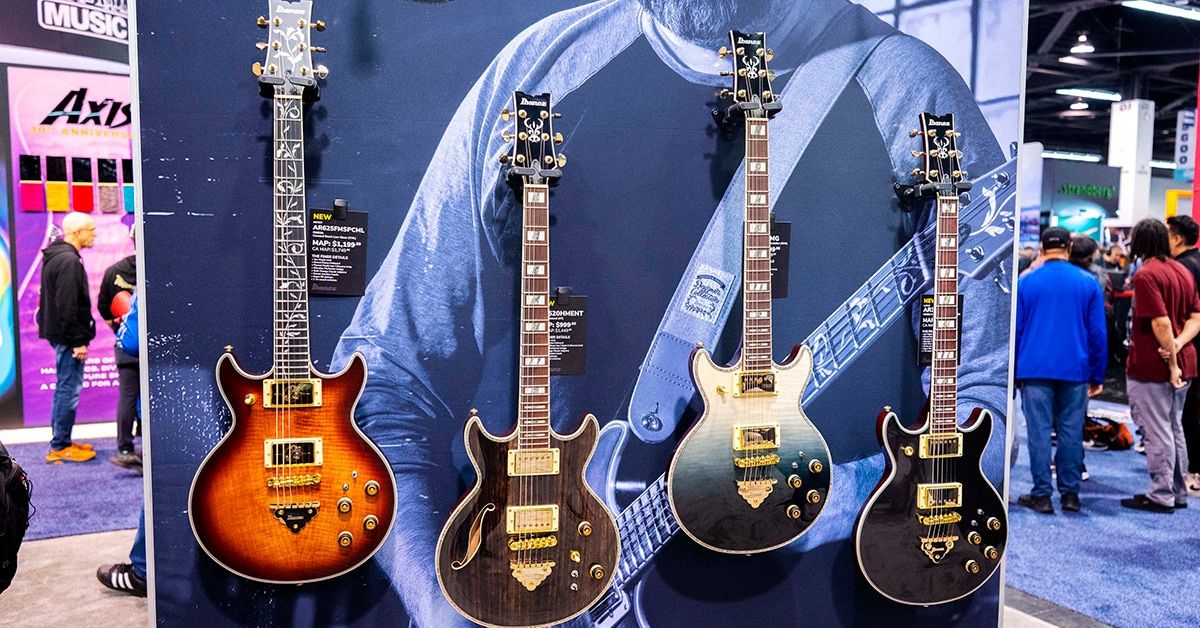
Ibanez AR
The Ibanez Artist series has always been Ibanez at its most unapologetically expressive. Where other parts of the lineup prioritize utility or genre specificity, Artist guitars lean into identity—bold shapes, substantial feel and finishes meant to be noticed rather than explained.
That sensibility comes through clearly in models like the AR420, where the gradient finish does a lot of heavy lifting. It’s dramatic without being gaudy, modern without feeling detached from the series’ ’70s roots. Even the iconic string anchor tailpiece strikes that same balance—distinctive and just flashy enough to feel special, without tipping into excess. The effect feels intentional rather than decorative, reinforcing the guitar’s inherently solid, confident personality instead of trying to distract from it.

Shop Now: Ibanez Artist AR420 in Black Mirage Gradation
Artist guitars have never been about chasing minimalism. They’re built for players who like a bit of weight in the hands, a sense of authority in the tone and an instrument that feels finished rather than stripped down. The designs tend to reward commitment: dig in, and they respond with sustain and presence; back off, and they still retain character. That balance is part of why the Artist line has endured, even as tastes and trends have shifted around it.
In the broader Ibanez ecosystem, Artist occupies an important middle ground. It bridges vintage influence and modern execution without leaning too hard in either direction. And when the visuals are this dialed in, that bridge doesn’t just function—it makes a statement.
Notes from the Floor:
"When I was looking over the Ibanez announcements before going to the show, I mentioned to a friend that I really wished Ibanez would bring back the Artist "Tree of Life" guitar from the late mid–late ’70s. Aside from the fact that it was one of my first gear lust instruments, it's a great reminder that before all the cool shred machines, Ibanez had a significant presence in the jazz fusion and straight-ahead jazz world, and the original Artist series was a big part of that. It was a joyful thing to stop by the Ibanez booth and see that it's back and (checking wallet) within reach. Now I just need approval from the comptroller." - George Van Wagner
Ibanez RG
The Ibanez RG series remains the structural backbone of Ibanez’s electric lineup, and for good reason. Few guitar families have been as consistently refined around the needs of high-performance players. Thin, fast necks, flat fingerboards, stable hardware and clear articulation under gain are assumed here—not marketed—because that’s the baseline expectation for an RG.
Within that framework, Ibanez continues to evolve the line in ways that address very real playing realities, not just stylistic trends. A key example is the RGD branch of the family—embodied by the new RGD621AH—which extends the traditional RG concept by increasing scale length. That extra length isn’t about novelty—it’s about physics. Longer scale lengths improve string tension and definition when tuning down, keeping low notes tight, intelligible and harmonically stable rather than floppy or indistinct. For players working in lower registers, the RGD models are purpose-built tools, not variations for variation’s sake.

Shop Now: Ibanez RGD621AH in Midnight Shade Flat
Across the broader RG range, Ibanez continues to offer an unusually wide spectrum of options, from straightforward six-strings to seven- and eight-string models, traditional fixed bridges and locking tremolos, and both Standard and Prestige tiers. What ties them together isn’t any single feature, but a shared design philosophy: remove friction between the player and the instrument. RGs are meant to disappear under the hands, leaving technique, articulation and intent fully exposed.
Shop Now: Ibanez RG Prestige RG653DX in Transparent Deep Blue Flat
That’s why the RG line has endured as more than just a “shred” category. While speed and precision are part of the DNA, the real achievement is how adaptable these guitars have become—capable of handling everything from technical metal to more nuanced, dynamic playing, provided clarity and control are the priority. In that sense, RG isn’t chasing extremes so much as quietly defining what modern electric performance feels like.
Ibanez S
The Ibanez S Prestige models distill the S series (per their website) concept down to its essentials: extreme comfort, elegant minimalism and precision craftsmanship. This year’s offerings keep things refreshingly focused, with two closely related variants—the S6621AH hardtail, and the S6670SK, equipped with a Lo-Pro Edge tremolo—allowing players to choose their preferred feel without changing the core instrument.

Shop Now: Ibanez S Prestige S6621AH in Transparent Gray Burst
What immediately separates these guitars visually is the finish. Subtle but distinctive, it complements the S series’ famously slim, sculpted body rather than competing with it. On a design this pared back, finish choices matter more than usual—they’re part of the personality, not decoration layered on afterward.
Where the S Prestige line really earns its reputation, though, is in the build. Crafted in Japan, these guitars reflect the kind of consistency and attention to detail that has made Ibanez’s Japanese production such a quiet benchmark for decades. Neck shaping, fretwork, balance and setup all feel deliberate and refined, reinforcing the idea that the Prestige badge isn’t about flash—it’s about trust.

Shop Now: Ibanez S Prestige S6670SK in Dark Ultramarine Blue
The result is a guitar that feels almost weightless under the hands but never insubstantial. Whether you favor the immediacy and tuning stability of a hardtail or the expressive range of a Floyd Rose, the S Prestige models prioritize responsiveness and comfort above all else. They’re instruments designed to get out of the way, leaving nothing between the player and the music.
Ibanez Alpha
With the Alpha series, Ibanez makes no attempt to soften the message. These guitars are purpose-built for extended-range players who want modern ergonomics, precise low-end control and designs that embrace contemporary technique rather than borrowing credibility from the past.
The new Alpha models—the A527 and A528—lean heavily into multi-scale construction, offered in both seven- and eight-string formats. Here, the fanned-fret approach isn’t a stylistic flourish—it’s the foundation. By optimizing scale length across the strings, Alpha guitars maintain clarity and tension in lower tunings while keeping the higher strings comfortable and responsive. The result is an instrument that feels engineered around modern playing realities, not adapted to them after the fact.
Shop Now: Ibanez Alpha A527 Multi-Scale 7-String in Nebula Shift
Visually, Alpha guitars are unapologetically forward-looking. Compact body shapes and streamlined hardware all reinforce the idea that efficiency and balance matter more than tradition. These are guitars designed to sit naturally against the body, reduce fatigue and remain stable under aggressive playing styles—practical concerns that become increasingly important as string counts and tuning complexity increase.
What’s notable is how confidently Ibanez positions Alpha alongside more established lines like RG and S, rather than treating it as an experiment or niche offshoot. This signals long-term commitment. Alpha isn’t a concept series—it’s Ibanez acknowledging that for a growing segment of players, multiscale—whether headless or not—extended-range guitars aren’t the future anymore. They’re simply the right tools for the job.
Ibanez AZ
The Ibanez AZ series covers an unusually wide stretch of ground, running from accessible, upper-entry-level instruments in the $500–$600, like the AZ22S2, ranging all the way up to roughly $2,000 for the AZ2402 Prestige model. On paper, that’s a big jump. In practice, it reflects how carefully Ibanez has defined the AZ platform itself.

Shop Now: Ibanez AZ Standard AZ22S2 in Black
At its core, AZ is Ibanez’s answer to the “do-everything” electric guitar—familiar enough to feel immediately playable but refined enough to reward deeper exploration. These guitars lean away from extreme profiles and radical aesthetics, favoring comfortable neck shapes, balanced body contours and versatile electronics that make sense across genres. It’s a line designed to feel neutral in the best possible way, adaptable rather than prescriptive.
What changes as you move up the range isn’t the concept, but the execution. The jump to AZ Prestige isn’t about reinventing the guitar—it’s about refinement. Crafted in Japan, the Prestige model brings noticeably tighter tolerances, more nuanced fretwork and a level of consistency that appeals to players who already know exactly what they want their instrument to do. The feel under the hands becomes more precise, more predictable and more responsive, especially for players with a well-developed touch.

Shop Now: Ibanez AZ Prestige AZ2402 in Roadster Orange Metallic
That wide pricing span makes the AZ series something of a gateway. Players can enter the line at a relatively modest cost, get comfortable with the design philosophy and—if it clicks—move upward without having to relearn the instrument. It’s a long-view approach that mirrors how many musicians actually grow, rather than how guitars are often marketed.
In that sense, AZ isn’t about a single model or tier. It’s about continuity—one design language expressed at different levels of finish and detail, depending on where a player is on their journey.
PRS
PRS has dropped a wave of new models for NAMM, with most of the activity landing in the SE lineup. Highlights include a very trippy Ed Sheeran Signature piezo-equipped hollowbody baritone in a Cosmic Splash finish, along with a distinctive Herman Li Chleo Signature model,that leans into high-energy, modern rock styling.

Shop Now: PRS Ed Sheeran SE Hollowbody I Piezo Baritone in Cosmic Splash
On the other end of the price spectrum, there’s a new Mark Holcomb Signature model at the high-end PRS level, featuring his signature Seymour Duncan pickups and a striking mango wood top—because when are PRS instruments ever not visually dialed in? We haven’t had hands-on time with these guitars yet, but PRS instruments tend to arrive eminently playable and thoughtfully designed, whether you’re looking at an SE workhorse or an upper-end signature model.

Shop Now: PRS SE Chleo Herman Li Signature in Orchid Dusk
Sterling by Ernie Ball Music Man
Ernie Ball Music Man has added a number of new models to their Sterling line that, as with all the Sterling guitars deliver serious value.
First, in the Cutlass line, there's the Cutlass Plus, which upgrades the pickups in the HSS models and adds a push/push mid boost feature. We have an exclusive Seafoam Green edition of this model. Plus, there's a Jason Richardson Signature Cutlass in both 6- and 7-string versions with a mossy Kokiri Green finish.

Shop Now: Sterling by Music Man Cutlass Plus HSS in Cashmere
If you love the sound of down-tuned instruments, there's a baritone version of the iconic StingRay model. And, if you've always wanted to have a baritone, this is definitely a great entry point.

Shop Now: Sterling by Music Man StingRay Baritone in Toluca Lake Blue
Aside from the Jason Richardson, there are several other new signature Sterling models coming. First the JP60, Sterling's version of John Petrucci's JP6 signature, featuring Petrucci's preferred DiMarzio LiquiFire and Crunch Lab pickups. Next is a version of Steve Lukather's signature Luke HSS model with the 12dB mid-boost for cutting through any mix. And lastly, the Tosin Abasi-designed Kaizen with high output ceramic humbuckers for some serious crunch.

Shop Now: Sterling by Music Man JP60 John Petrucci Signature in Mystic Dream
Takamine
Takamine is also introducing a pair of Taka-mini acoustic-electric guitars that bring a fresh voice and texture to both recording and live performance. The compact-bodied Taka-mini GX31CE and GP3HSE are built with ease of play and stage readiness in mind, but what sets them apart is that they come set up for Nashville tuning right out of the box—a configuration that replaces the lower four strings with higher-octave counterparts to create a chiming, harp-like quality.

Shop Now: Takamine TakaMini GP3HSE Acoustic-Electric Guitar
Paired with the smaller body size, this tuning gives the TakaMini models a distinctive sonic footprint that can cut through a mix without overpowering it, making them useful as complementary rhythm instruments, atmospheric layers in studio work, or as a lively solo voice. For players curious about something that lives between a full dreadnought and a travel guitar but still has its own personality, these Taka-mini guitars are worth a look.
Taylor
Taylor has opened 2026 with one of its most substantial acoustic updates in years, rolling out what the company terms its Next Generation series alongside an expanded Gold Label lineup—a move that feels intentional rather than incremental.
At the heart of this evolution is the Next Generation Grand Auditorium family, where Taylor’s already influential V-Class bracing has been revised with a next-gen scalloped pattern that increases top movement for greater warmth and responsiveness without losing the clarity and sustain players expect. A new Action Control Neck system—adjustable from the soundhole—lets players fine-tune action without a truss rod wrench, and the updated Claria pickup/preamp system mounts discreetly inside the soundhole for more natural amplified acoustic tone with intuitive control. These features appear across a wide range of models, beginning with guitars like the 314ce and scaling up to premium Builder’s Edition instruments.
Shop Now: Taylor Next Generation 814ce Grand Auditorium
The lineup spans several familiar body shapes and series, from entry-level Grand Auditorium-style instruments with enhanced electronics and updated bracing to high-end Builder’s Editions—including offerings like the 814ce with premium tonewoods and more sophisticated voicing. The overall sense is of a platform that retains Taylor’s signature balance and playability while pushing the acoustic envelope in a way that matters musically, not just cosmetically.

Shop Now: Taylor Next Generation 814ce Builder's Edition Acoustic-Electric
Alongside this Next Generation family, Taylor has also expanded its Gold Label Collection—the line that reimagines classic, square-shouldered dreadnought styles through Taylor’s contemporary design lens—with the introduction of the 510e, 710e and 810e models. These square-shouldered acoustics bring a more traditional dreadnought voice into the Gold Label world while complementing the brand’s broader acoustic offerings.
Shop Now: Taylor Gold Label 710e Acoustic-Electric
Taken together, the Next Generation and Gold Label Collection expansions give players more distinct choices: Next Generation models push forward beneath the company’s most refined innovations in bracing, neck adjustability and amplification, while Gold Label dreadnoughts offer a grounded yet modern take on a timeless body style. Both approaches feel like meaningful additions rather than catalog padding—an evolution for a brand comfortable with its strengths and still interested in meaningful refinement.
Martin
For 2026, Martin has put its focus squarely on the Road Series, delivering a full-line refresh that significantly expands the scope and ambition of one of the brand’s most important working-player platforms. The updated Road Series now spans more than 30 models, including Retro, Retro Plus, Modern and left-handed options, with an emphasis on advanced construction and materials, built-in electronics and prices that bridge the gap between entry-level instruments and Martin’s higher-end, U.S.-made offerings.
At the core of the update is a clear upgrade path for players moving into solid-wood acoustics. Models across the Road Series feature scalloped X-bracing, fast fingerboards and onboard electronics—either Martin’s E1 system or LR Baggs Element pickups—making them gig-ready without pushing prices into boutique territory. The Retro and Retro Plus models, in particular, draw inspiration from classic Martin designs like the D-28 and 000-28, pairing thermally aged, torrefied spruce tops with granadillo back and sides for a more traditional tonal profile within a modern, accessible package.
Shop Now: Martin DE Retro Plus Road Series Granadillo Acoustic-Electric
The Modern branch of the Road Series leans in a different direction, emphasizing playability and ergonomic design. Cutaway models, such as the DC and GPC Series, expand upper-fret access, while the SC Series introduces Martin’s patented Sure Align neck system and offset body shape, offering full fretboard reach and a playing feel that will be immediately familiar to electric players transitioning to acoustic. These guitars underscore Martin’s ongoing effort to balance heritage with contemporary performance needs, particularly for players who spend time both on stage and in the studio.
Shop Now: Martin DC-10E Modern Road Series Dreadnought Acoustic-Electric
Taken as a whole, the 2026 Road Series refresh reinforces Martin’s commitment to serving hobbyists, aspiring performers and long-time Martin enthusiasts alike—players who want the feel and tone of a traditional Martin, but with modern conveniences and a more approachable entry point. It’s less about reinventing the brand than about making its core values available to a wider range of musicians.
Two other notable additions are the Super D-18 and Super HD-28. What's "Super" about them? For starters, it's a 20% increase in internal air volume, in concert with "Golden Era" scalloped X-bracing, which combine to offer a substantial boost in volume projection and an increased low-end response. To use the vernacular, they're "cannons" both in the studio and onstage. With alter-egos that look like a traditional D-18 or D-28, they're your new superheroes.
Shop Now: Martin Super HD-28 Dreadnought
There are also a pair of Molly Tuttle signature models inspired by the bluegrass superstar’s 1943 D-18. The first is the D-X2E Molly Tuttle Signature, which pairs a solid spruce top with HPL back and sides, along with Martin’s E1 electronics package for an accessible, stage-ready take on a wartime Martin. Further up the scale is the D-18 Molly Tuttle Signature, which uses rear-shifted scalloped X-bracing to emphasize the lively response of the solid spruce top, with resonance reinforced by solid mahogany back and sides. Both signature models feature the fast, comfortable 1940s neck profile that has been one of the keys to Tuttle’s speed and accuracy—well, that and plenty of practice.

Shop Now: Martin D-18 Molly Tuttle Signature Dreadnought in Vintage Sunburst
No Martin NAMM showing would be complete without something a little extra special. This year, that honor goes to the limited-edition O‘ahu K-42 “Hibiscus” guitar, which flashes back to Martin’s historic 1916 Kealakai body. Originally designed for Major Kealakai of the Royal Hawaiian Band, it’s something of a proto-dreadnought, built for projection and volume in the days before amplification. The hibiscus inlay is, as you’d expect from Martin’s craftspeople, intricate and precise, and the move from the original 12-fret neck to a 14-fret design strikes a thoughtful balance between historical reference and modern playability.

Shop Now: Martin O'ahu K-42 Hibiscus Limited-Edition
Yamaha
For NAMM 2026, Yamaha arrives with two releases that highlight very different sides of the brand’s personality—one focused on technology as a creative catalyst, the other doubling down on a guitar platform that’s already earned real traction with players.
The newest TransAcoustic TAS3 C models introduce a fresh concert cutaway body design, pairing a solid Sitka spruce A.R.E. top with solid mahogany back and sides. The core idea remains Yamaha’s signature trick: immersive onboard effects—reverb, chorus and delay—that resonate through the guitar itself, without the need for amps or pedals. For 2026, Yamaha expands that concept further with a built-in looper controlled via a tap sensor, Bluetooth audio connectivity and compatibility with Yamaha’s TAG Remote app. Power comes from a rechargeable lithium-ion battery with a proprietary magnetic charging system, reinforcing the sense that this is meant to be a self-contained creative instrument rather than an acoustic with add-ons bolted on.

Shop Now: Yamaha TAS3 C TransAcoustic in Natural
The appeal here is less about convenience and more about inspiration. TransAcoustic guitars are clearly aimed at singer-songwriters and creative players who want to explore ambience, layering and texture anywhere they happen to be—without building a signal chain or unpacking a pedalboard. It’s a premium hybrid approach that feels very Yamaha: technologically confident, neatly integrated and focused on expanding what an acoustic guitar can do rather than imitating tradition.
Notes from the Floor:
"I found these extremely comfortable to play—they're all-solid wood, and they would be nice acoustics without all the TransAcoustic bells and whistles. With them, however, they're serious creative tools. I also learned that Yamaha puts their wood through a minimum three-year drying process, so you're getting materials that have had time to properly settle before becoming an instrument." - George Van Wagner
Yamaha is also celebrating its history in acoustic guitar with a striking 60th Anniversary Edition of its flagship dreadnought. The 60th anniversary FG9 pairs an Adirondack spruce top with premium Guatemalan rosewood back and sides and commemorative appointments, honoring six decades of the legendary FG series while pushing the model into truly premium territory. Yamaha’s FG9 platform is handcrafted in Japan and has long been praised for its combination of strong projection, clear articulation and traditional dreadnought responsiveness, making it a compelling option for singer-songwriters and seasoned players alike. Limited to just a small number of units worldwide, this edition underscores that Yamaha can absolutely compete with upper-end acoustics on both craftsmanship and tonal presence.

Shop Now: Yamaha FG9 60th Anniversary Edition Dreadnought in Natural
On the electric side, Yamaha continues to build momentum behind the Revstar platform with the Chris Buck Signature Revstar, based on the RSS02T—currently Guitar Center’s best-selling Revstar model. Buck’s version keeps the core feel intact while adding player-specific refinements, including custom-voiced VP5 P-90 pickups, a TonePros AVT2 wraparound bridge and a goldtop finish with custom inlays that mirror his own instrument.
For players already drawn to the Revstar’s retro-futuristic design and muscular, no-nonsense tone, the Buck signature feels less like a radical departure and more like a focused variation—one shaped by a player known for expressive touch and dynamic phrasing rather than sheer volume or speed. It’s a reminder that while Yamaha guitars are often praised for their build quality and consistency, the Revstar line continues to carve out a stronger sense of identity with each iteration.
Shop Now: Yamaha Chris Buck Signature Revstar RS02CB in Honey Gold
Finally, Yamaha is adding a couple of new refinements to the Pacifica line. I've been a fan of Pacificas since I got my Pacifica 311MS (the Taiwan-built version of the 1611MS Mike Stern Signature guitar) some years ago. The new models—the SC Standard Plus and the SC Professional—are a similar single-cutaway design, but with a few interesting refinements like chambered alder bodies and Neve co-designed Reflectone pickups.

Shop Now: Yamaha Pacifica SC Standard Plus PACS+11S in Desert Burst
Both models come with maple or rosewood fingerboards, depending on finish, and the Japan-built Professional version features a 9–12" compound-radius fingerboard and premium hardware. The Professional model also has Yamaha's Initial Response Acceleration (I.R.A.) treatment, which is similar to torrefication, for the resonance that usually comes from vintage/aged wood. I know that Pacificas are sometimes overlooked, but my experience has always been that they are well-worth checking out if you're looking for a refined instrument that gives exceptional value.

Shop Now: Yamaha Pacifica Professional PACP11SM in Black Metallic
Taken together, these releases underline Yamaha’s broader strategy. Whether it’s pushing acoustic guitars into new creative territory with TransAcoustic technology or refining electric platforms that have steadily earned player loyalty, Yamaha isn’t chasing trends so much as quietly expanding its own design vocabulary. It’s an approach that rewards time spent with the instruments—and one that should make for interesting follow-up conversations once the show floor settles in.
Wrapping It Up
This is just a quick overview of some of the interesting things I encountered in this year’s NAMM debuts. If you’ve ever been to NAMM, you know just how much there is to cover. We’ll be adding to the coverage over the next couple of weeks, and as new information comes in, so check back often, and see what’s new in the world of what’s new.
Want the latest on NAMM 2026 releases? Don't miss out on the rest of our coverage:
Written By: George Van Wagner
George Van Wagner is a writer and editor for Guitar Center, where he has worked since 2007. A multi-instrumentalist, freelance recording engineer, arranger, composer, writer and all-around tech geek, he has over 30 years of experience in the musical instrument industry at companies like Midiman/M-Audio and Line 6, doing everything from customer service and writing user manuals to working in product development. He is currently gigging around Los Angeles with Gruppo Subconscious and Bobby “Hurricane” Spencer.


Be the first to know about exclusive offers, tips and more.

866-498-7882 English
877-687-5402 Español