

Pro Gear Advisers
•866-498-7882
5 Reasons to Use Gator GTSA Cases When Traveling
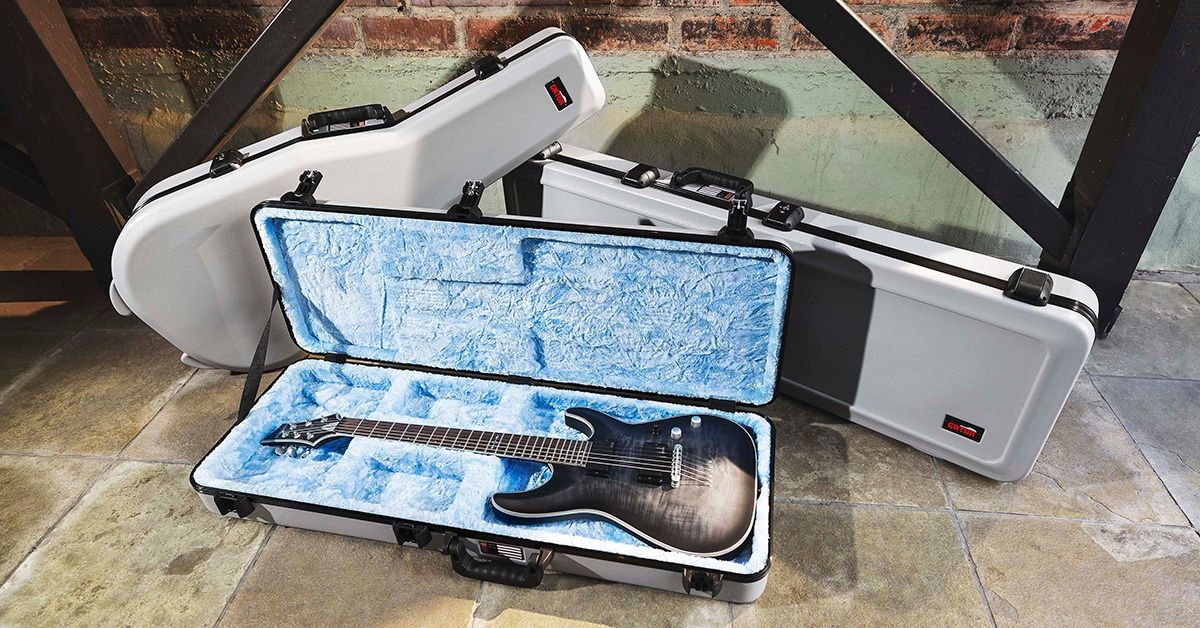

Gator GTSA Series molded hardshell cases are vigilant “bodyguards” when taking a guitar or bass outside of the relative safety of your home. After all, we’ve learned from just about every buddy movie ever made, from The Shawshank Redemption to Girls Trip, that it’s prudent to have a trusted companion watching your back.
The Gator GTSA TSA ATA Series does just that by protecting your instrument with a military-grade, polyethylene shell, reinforced latches (including a TSA-accepted center lock), EPS foam and plush fabric interior, and an extended neck cradle.
Although a well-dressed bodyguard is probably no more or less effective than one wearing a track suit, the sleek Gator GTSA Series hardshell cases do look pretty sweet. The outer shell rocks a mid-century modern-approved silver gray, and the plush interior is dressed up in an electric blue. An injection-molded handle is a very nice touch. It’s comfortable in your hands, and throughout testing, it never gave me “carrying fatigue.”
For a thorough review of why GTSA cases are smart choices for travel, my local Guitar Center loaned me three models—for acoustic guitar, electric guitar and bass—so I could do real-world, hands-on “torture tests” at home and during gig treks with my bands Surf Monster, The Trouble With Monkeys, Cher Alike and Douglas Von Irvin’s Carnival. So, here we go …
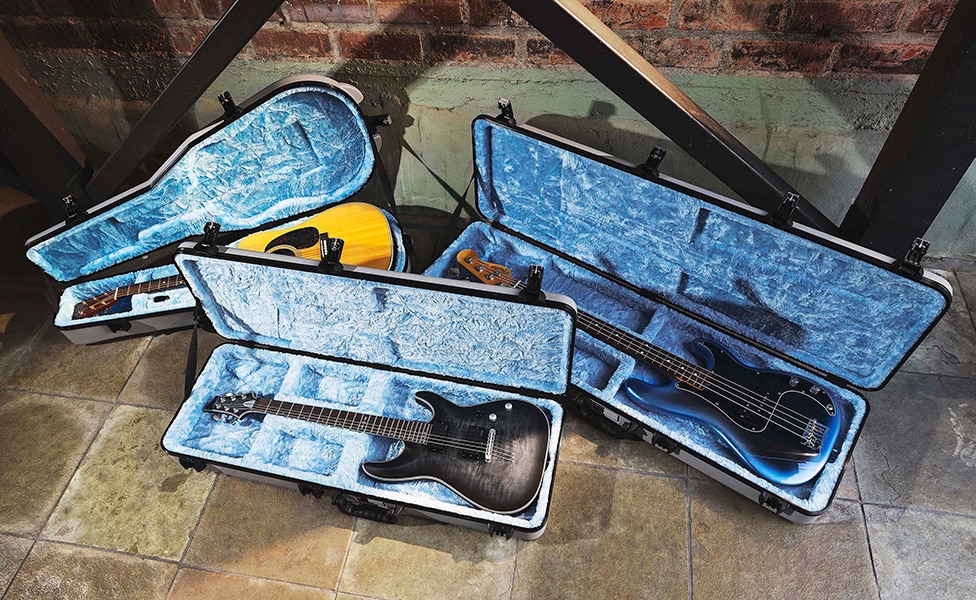
Pictured: Gator GTSA Acoustic, Bass and Electric Guitar Cases
Finding the Right Fit
Before we dive into the “Five Reasons to Use Gator GTSA Cases When Traveling,” there’s a “bodyguard audition/interview” you should do before selecting your hardshell case. Gator helpfully states caveats, such as “Designed to fit many electric guitars,” “Designed to fit most standard dreadnought acoustics” and “Designed to fit most standard electric bass guitars.” It’s helpful to take this wording into account.
For example, the Gator GTSA Electric Guitar case did not accommodate my Epiphone Les Paul Custom Widow or 1973 Gibson Les Paul Heritage, Musicvox Space Cadet 12-string or Reverend Reeves Gabrels Signature Dirtbike. Okay, the Musicvox was a weird choice, but it almost fit, so it wasn’t that strange.
Happily, Gator does offer a dedicated GTSA Les Paul case, as well as a model for semi-hollowbody guitars. (These cases were not part of this hands-on test.)
The Reverend Dirtbike could have made the scene, but the fit was very tight, so I chickened out. I doubt any damage would have occurred, but I was concerned about stress on the neck caused by the headstock being tightly embraced by the topmost foam. In addition, I would have needed to remove the Wilkinson tremolo—an adjustment many hardshell cases require—so, as I had a show to get to, I opted to use my gig bag.
From my own collection—as well as borrowing flat-tops from friends—I couldn’t find a dreadnought acoustic that wouldn’t fit in the GTSA Acoustic Guitar case.
Of course, none of this has any bearing on the protective advantages of these Gator cases. You just need to take a tiny extra step—such as taking measurements or talking to one of our Guitar Center Gear Advisers—to ensure your favorite guitar or bass can fit. You can see the interior dimensions for the Gator GTSA cases in the chart below.
Gator GTSA Quick Spec Chart
|
Case |
Outer Material |
Inner Material |
Neck Support |
TSA Lock |
Inner Dimensions |
|
Military-grade polyethylene |
EPS foam, plush fabric |
Yes |
Yes |
Overall length: 41.5"; Body length: 21.75"; Body height: 21.75"; Bouts: upper 12.75", middle 12.5", lower 16" |
|
|
Military-grade polyethylene |
EPS foam, plush fabric |
Yes |
Yes |
Overall length: 39.5"; Body length: 18.5"; Body height: 2.8"; Bouts: upper, middle, lower 12.8" |
|
|
Military-grade polyethylene |
EPS foam, plush fabric |
Yes |
Yes |
Overall length: 47.5"; Body length: 21.1"; Body height: 2.6"; Bouts: upper, middle, lower 13.5" |
|
|
Military-grade polyethylene |
EPS foam, plush fabric |
Yes |
Yes |
Overall length: 41.5"; Body length: 18.5"; Body height: 3.5"; Bouts: upper 9.4", middle 7.5", lower 13.2" |
|
|
Military-grade polyethylene |
EPS foam, plush fabric |
Yes |
Yes |
Overall length: 44.1"; Body length: 22.4"; Body height: 4.7"; Bouts: upper 12.8", middle 10.8", lower 15.9" |
A Gig Bag Is Great But It Can’t Fly Like Supergirl
It’s one of the most fearsome horror shows for a traveling guitarist or bassist boarding a flight with a gig bag. The air crew denies allowing your guitar or bass to be stowed as carry-on luggage and compels you to gate check your instrument—meaning it gets tossed into the same terrifying baggage system as the other suitcases and is just as vulnerable to damage. When that happens, you’re going to wish you could pull a Criss Angel and magically transform your soft gig bag into a tough Gator GTSA hardshell case.
I think guitarists frequently opt to try their luck on flights—and, happily, lots of us do succeed in carrying on our guitars and basses—due to a possible misunderstanding of the FAA Modernization and Reform Act. Since the law passed in 2015, some players think all airlines must let them take their instruments on board.
But that’s not what the Reform Act says.
The ruling states airlines must accommodate your guitar or bass on board only if it can be stowed safely and space is available in the overhead bins or suit closet. In other words, airlines are not obligated by law to reserve space for your instrument, and they can legally require you to gate check it if storage space does not exist when you board the aircraft.
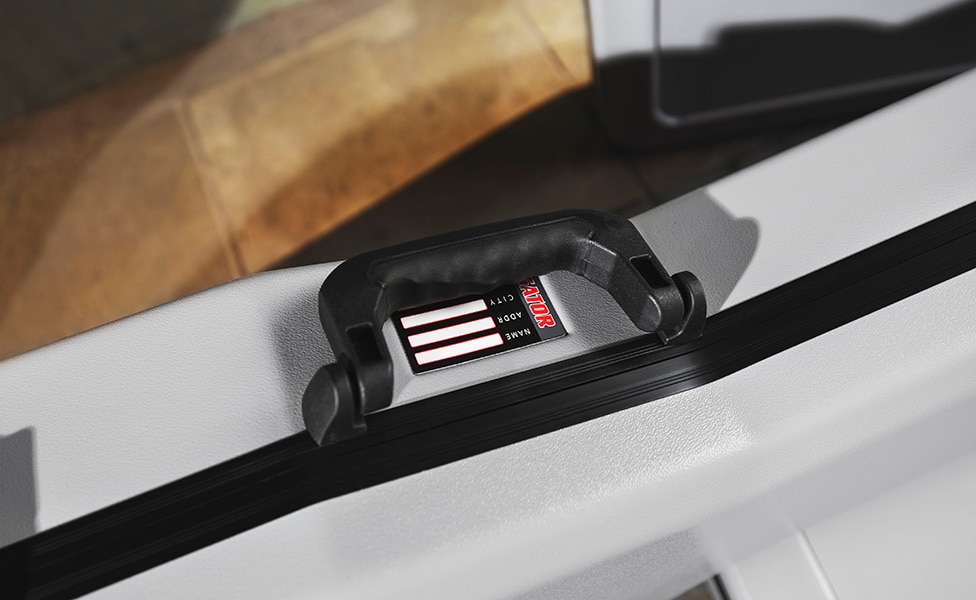
Pictured: Gator GTSA Acoustic Case Carrying Handle
What’s against you. Enforcement of the Reform Act is inconsistent. Gate agents and flight crews may not be familiar with the law’s details and automatically gate check your instrument. Access is open to interpretation. On journeys with connecting flights, one crew could allow a guitar on board and another crew may not. Storage bins are not always uniform from aircraft to aircraft, and one plane may have suitable storage available, while another may only have enough room to store backpacks. Finally, as a United States ruling, the law only applies to U.S. air carriers, so get your negotiation chops in top shape if you’re flying Lufthansa, Air France or any other foreign airline.
What’s on your side. Because the FAA Modernization and Reform Act of 2012 only protects you if space exists when you are ready to board the aircraft, make sure you can board early. This may require purchasing early, primary or elite boarding status with your airline. Touring professionals sometimes carry a copy of the United States Department of Transportation rule that outlines the Reform Act to show air crews, hopefully avoiding judgement calls that condemn their guitars to hanging out with the other baggage. For complete security, you could also purchase an extra seat for your guitar. I mean, it works brilliantly if you happen to have the available cash of a Sir Paul McCartney, Jimmy Page or Eric Clapton—or if the promoter of your tour added the additional guitar ticket to the travel budget.
What always works 100% of the time. Put your guitar or bass into a Gator GTSA molded hardshell case. The suit closet in a decent-sized plane should be able to accommodate the case, even if the overhead bins can’t, and your guitar is still protected if it gets bumped to the underbelly of the aircraft.
Gator Test: Case Catastrophes. As I was borrowing these three cases from my local Guitar Center, it was requested I not try to destroy them. (There went the “tossing the case off my roof onto a concrete driveway” test.) But, inspired by my friend Jude Gold and his often-hilarious videos of baggage handlers mistreating his guitar road cases when touring with Jefferson Starship, I had a few less-lethal tricks up my sleeve.
I placed a “parts” T-style guitar in the electric guitar case, an Epiphone dreadnought in the acoustic guitar case and a Squier Classic Vibe ’60s Precision Bass in the electric bass case. The first test was leaning the cases against my VOX AC30 road case and knocking each one over onto the concrete floor of my garage. Second test was tipping each case off my landing to tumble ten stairs down to the garage floor. Test number three was smashing my amp’s road case against the latches of each case as they laid flat on the sidewalk to see if any of them opened upon impact. Then, I dropped each case right on its latches from a standing position to determine if that jolt compromised the locks.
In every instance, there was no injury noted on any of the instruments—even the somewhat fragile Epiphone acoustic. In fact, no jostling of the instruments at all was observed. They all sat serenely in the plush inner casing as if they were never bounced about. None of the latches opened during the two latch-smack tests, either.
Band Vans Can Be Torture Chambers
I call it “playing Tetris with gear,” because there is only so much space in the Surf Monster van, and it needs to accommodate a full drum set, one or two guitar amps, a bass rig, two guitars and two basses, merchandise, simple lighting, stage clothes, suitcases for multi-night gigs and whatever else we decide to carry. In many situations, cases are crammed against cases and other items to maximize the space that always seems a bit too dense for the amount of gear being packed.
Gig bags are ready-made to be slid between tight spots, but that “cram advantage” is only possible because the totes are usually soft and pliable—which is great for gear Tetris, but not super awesome for protecting your instrument from contents banging about during a long journey across a variety of roads. I recommend leaving the extra coolers of root beer (or equivalent space takers) behind, so you have enough room to put your guitars and basses into hardshell cases.
Now, we’re talking about overcrowded gear vans here, but jam-packed vehicles are more the norm than the exception in my touring experience. If your bandmates are minimalist space savers, then you could probably wrap your guitar in beach towels while it rests somewhat safely in a roomy van or SUV. But if there are a lot of items that could snap off your headstock or neck if they fall atop your guitar or bass, go with a Gator hardshell case.
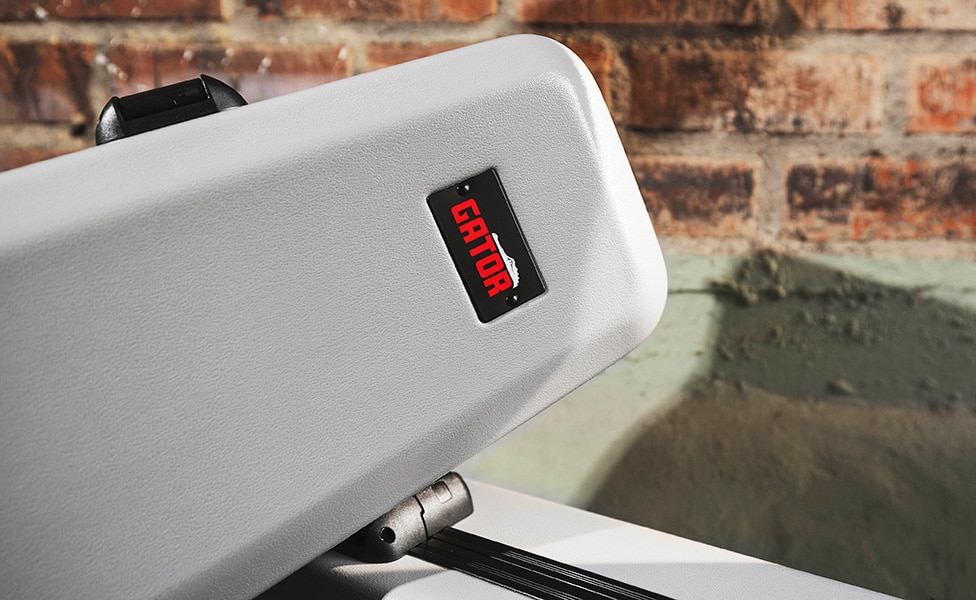
Pictured: Gator GTSA Acoustic Case Logo
Gator Test: Band Van Pile-Up. It really fries my pancakes when I open the back of a jam-packed SUV, and the gear immediately tumbles to the street. This happens more often than I’d like to admit. So, for the band van test, I positioned each Gator case right against the hatchback door so they slid to the ground upon opening it. Then, I thought, “What if we were almost unloaded at a venue, and someone left their hardshell case on the floor of the van—but wait, some floor monitors were still precariously stacked against the van wall and one of them fell onto the guitar case?” Could happen. How could I resist dropping a monitor onto the top of each Gator case from a height of about four feet? (Yes. I did that.) Randomly, I also got the notion to jump up and down on the top of each case while wearing my Doc Martens. Why not? (I weigh 150 lb.)
I’m only about six tests in and I’m already sounding like a broken record. None of the instruments were damaged. Even the cases themselves were no worse for the pounding—which is good, as I don’t want my local Guitar Center store manager coming after me for ruining inventory.
Leaving an Unprotected Guitar Onstage Is Pure Folly
In every soundcheck I’ve every done, some guitarist (not me and hopefully not you) leaves their guitar laying atop a gig bag for quick access or propped up in a guitar stand—or even set against an amp, stage monitor or amplifier flight case. If this scenario describes your modus operandi, you are risking hellfire.
Stage crews are typically very professional, but they also tend to be ruled by schedules, so they may not be leisurely strolling around, taking note of where the band has left things in their way. So, let’s talk about accidents. I’ve witnessed mic cables take out guitar stands along with the guitars as the cables are being run to and from stage snakes, road cases rolling over gig bags, guitars kicked off of monitors, gig bags being pushed from drum risers and other calamities.
However, if you leave your instrument in a Gator hardshell case whenever you’re not soundchecking or actually performing, you can forget about typical gig disasters. It also helps to avoid haphazardly leaving your gear littered across the stage. You’ll definitely make friends with the sound crew, who won’t have to step around your stuff during setup. (Why some bands feel the stage is no different than their little kids’ room where they once left toys and clothes piled in every inch of floor space is beyond me.)
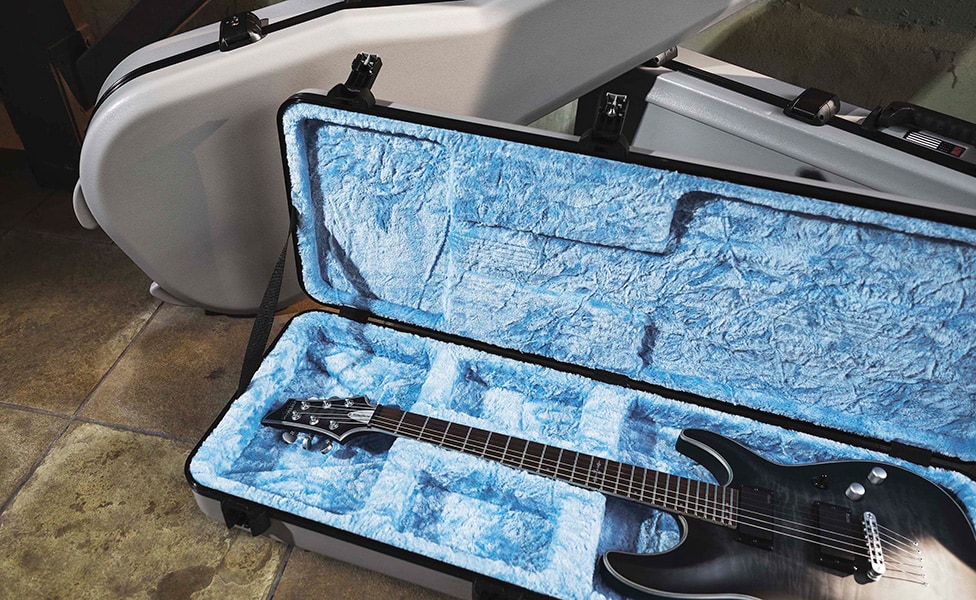
Pictured: Gator GTSA Electric Guitar Case Liner
Gator Test: Stage Crash. Most of the tests I did during the flight-check torment are applicable to potential stage mishaps. But I did add a stage-drop test for this section. I’ve certainly seen cases inadvertently kicked off the edge of stages by distracted band members or sound crews. The average stage height in the joints I play is around two feet, so I set up a 26"-high TV table in my backyard, placed each Gator case on top and pushed it off onto a brick surface. Again, it was as if the electric guitar, acoustic guitar and electric bass were taking naps through the jolts. No damage.
The Road Can Accelerate Wear and Tear
Every piece of gear you bring on tour is going to be subjected to significant stress—from your instrument cables to your amp and pedals. Moving things in and out of vans, rolling stuff into venues, carting gear on and off stages, carrying rigs into the safety of your hotel room (rather than tempting fate by leaving them in the van) and back to your transport, and even the vibrations inflicted on everything from miles and miles of driving from city to city—it all takes a toll.
In my experience with gig bags, zippers can fail, straps can break and fabrics can be assaulted by water, beer, mud and various band van foodstuffs, such as milkshakes, smoothies, burritos and more. This does not in any way mean quality gig bags aren’t robust and resilient. They most certainly are. But given the other defensive advantages of a Gator GTSA case, I’d rather not even worry about road wear and tear causing a gig bag zipper to break. There’s not much joy in having to gaffer’s tape a gig bag shut en route to the next gig or music shop.
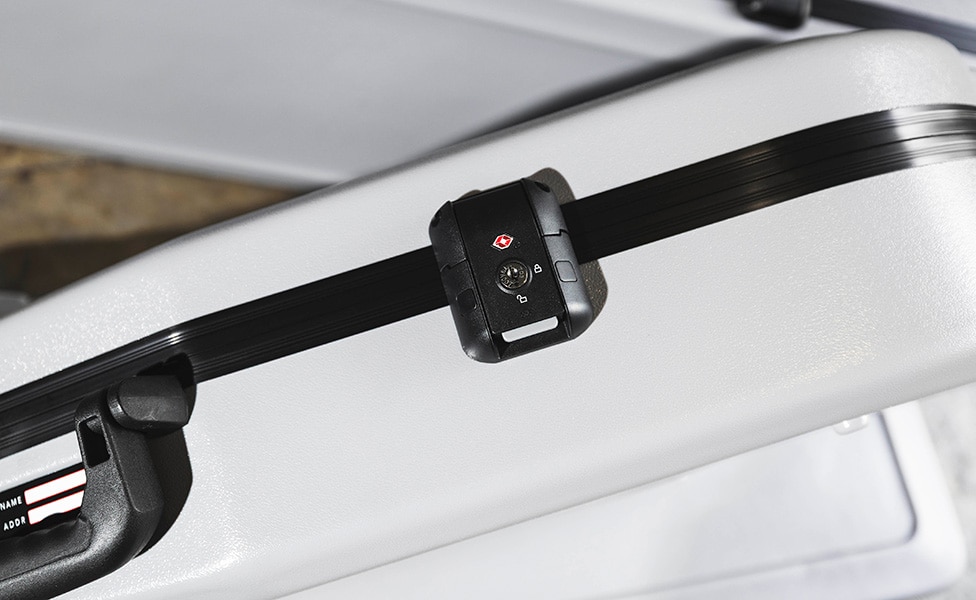
Pictured: Gator GTSA Acoustic Case TSA-Approved Locking Latch
Gator Test: Latch and Handle Endurance. Gear “erosion” takes a while—typically, a long while—so I can’t guarantee a Gator GTSA case could emerge unscathed following years of use, or even after one brutal tour schedule. But I did push back the tops of the Gator cases aggressively to test the hinges, brutishly snap open the latches as if I was too much in a rush to get onstage to be gentle, and wobble the carrying handles up and down and back and forth to check the durability of their assembly. Nothing broke while I was trying to make like the gorilla in that famous 1971 TV commercial for American Tourister luggage (if you don’t know it, Google it as it was a fun and effective ad). I feel confident the Gator cases would be just as sturdy on the road.
A Hardshell Case Is a Secret Sentinel
I usually trust motels, hotels and short-term home rentals, but I’ve also stayed in some extremely sketchy joints in my time on the road, so I’ve retained a few quirks from the past—especially if I’m given a room on the bottom floor. One of those eccentricities is security, and a hardshell case offers a reasonable guarantee of worry-free sleep when deployed as a “guard.”
Like most gigging guitarists, I bring two guitars to every show—one is a spare to avoid the hassle of changing a broken string in front of an audience—so I generally have two hardshell cases with me. The first case is wedged against the front door of the room, so even if someone manages to defeat the outside lock and security latch, they probably won’t avoid having the case fall to the floor as they open the door. Hopefully, the noise will compel the potential intruder to move on.
The other case is placed in front of the blackout curtains behind the oh-so-not-very-secure sliding glass door, directly in the path of a prowler attempting to squeeze through the small opening he or she likely made to minimize noise by not opening the door very wide. A surprised, tripped-up (and possibly swearing) housebreaker is quite the warning—as is a now awake musician calling 911.
Happily, I’ve never had an incident with motel break-ins, but I do sleep better knowing I have those hardshell cases on the job. My case sentries may seem a bit silly and possibly over cautious, but road warriors will know the feeling. There’s too much history of bands losing gear due to van and trailer burglaries, thefts from stages and green rooms and, yes, savvy crooks casing musicians staying in local motels. Prepare for the worst and stay safe.
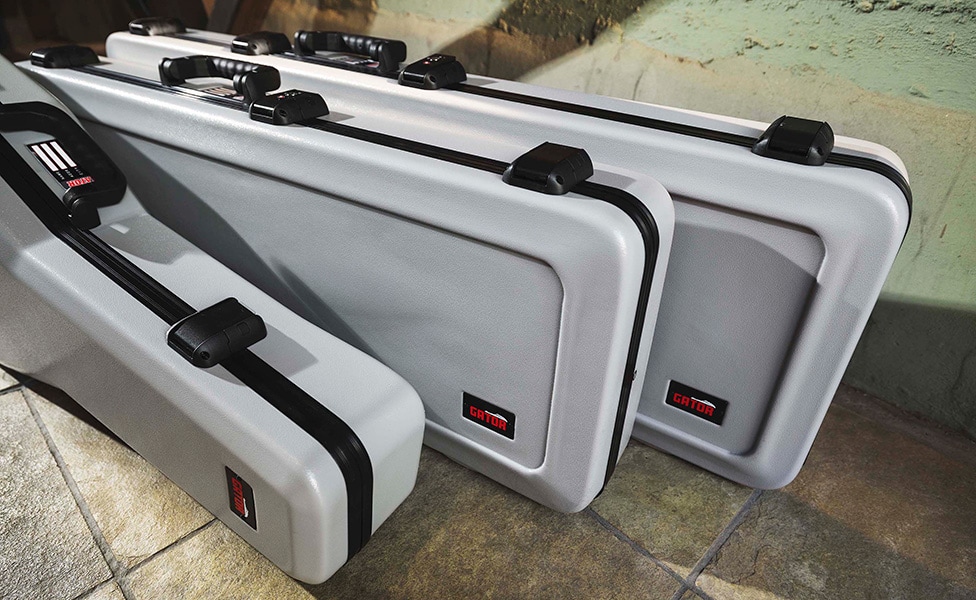
Pictured: Gator GTSA Acoustic, Bass and Electric Guitar Cases
Gator Test: Clatter Alarm. I’ve done these security tactics with other hardshell cases (including past Gator models), so I know they work, but I retested the methods in my house. I placed each of the Gator GTSA cases against a bedroom door with the instruments inside, and, yes, there was quite the racket when the opening door tipped the case to the floor. In every scenario, the acoustic guitar, electric guitar and electric bass were unharmed. Then, I tried the sliding door tactic at a neighbor’s house, and once the case was hidden behind the curtain, there was no way my neighbor could squeeze the sliding door through without knocking over the case.
Where Gig Bags Shine
While not providing ultimate protection from the ravages of the road, reinforced gig bags are pretty tough customers that offer some convenient features hard cases typically do not. For one thing, they are soft and pliable, so they can be scrunched into spaces that would be impossible to fit hardcases. In a jam-packed vehicle, gig bags are amazing at scrunching between wheel wells, rooftops, seats and other gear.
In addition, gig bags are basically luggage for guitars and basses, so much like a Samsonite carry-on or a traveler’s backpack, they tend to provide additional storage pockets. The only extra room you’ll find in the typical hardshell case is a small compartment for a few picks and nicknacks.
Storage space is the main reason I choose a gig bag when I’m traveling relatively safely to local gigs, recording studios and rehearsal spaces—and I’m certain there’s no chance of Godzilla going on a rampage to destroy the city and my guitar along with it. The extra pockets in my gig bag let me tote instrument cables, a pedal or two, a microphone, extra strings and picks, my iPad (for note taking at sessions and teleprompter-style chord charts for rehearsals), a few snacks and even a collapsible stand for the iPad.
If I took the hardshell case, I’d need an additional bag for the extra kit. While carrying a guitar case and a gear duffel isn’t the end of the world, the “one and done” scenario is most attractive as it presents less stuff to keep an eye on and less things to dig into to find what you need.
If you’d like to explore more, check out what Gator has to offer in the gig bag space.
Pack It Up and Take It
Paraphrasing The Fabulous Thunderbirds 1986 hit, it’s time to “pack it up and take it.” Whether it’s carting your favorite acoustic guitar on a family vacation by car, band vanning with an electric bass on a three-week tour or doing a series of fly gigs with an electric guitar, Gator GTSA cases are virtually ironclad contracts against calamity.
Of course, as we mentioned earlier in this article, you should confirm your instrument fits securely in the case you choose. If you want help with that, let our Gear Advisers do the work for you, and ensure the Gator GTSA series hardshell case is just right. You can also drop by your local Guitar Center, have an associate show you the Gator case you’re considering (check the website to see if they are in stock first) and then place in your instrument to see if it fits.
Written By: Michael Molenda
Michael Molenda is a content strategist, editor and writer for Guitar Center, where he has worked since 2022. He is the longest-serving Editor in Chief of Guitar Player (1997-2018), and former Editorial Director of Bass Player, EQ, Keyboard, Electronic Musician, Gig and Modern Drummer. A guitarist, drummer, bassist and producer, Mike co-owned three pro recording studios in San Francisco, and performs with Surf Monster and The Trouble With Monkeys.
Recently Added to Gear Tips
Be the first to know about exclusive offers, tips and more.

866-498-7882 English
877-687-5402 Español