

Pro Gear Advisers
•866-498-7882
Warm Audio's Jr Series Microphones | Hands-On Review

There is nothing like having a well-stocked mic locker. But, for most of us, owning classic mics such as vintage Neumanns can be a bit of a stretch. So, what's an ambitious but resource-constrained home studio owner to do? There are options, including the ones from Warm Audio we cover in this review, that can get you close to those iconic microphone sounds without making too big a dent in your wallet.
In this article, I'm taking a look at some of the most affordable vintage-voiced mics from Warm Audio. Specifically, I'm looking at Warm's Jr Series transformerless mics, which includes the WA-47jr in SE (Studio Essentials) and FET versions, and the WA-87jr, also in SE and FET versions. I'll put them through their paces on a variety of sources to see how they stack up, and if they deserve a spot in your personal mic collection.
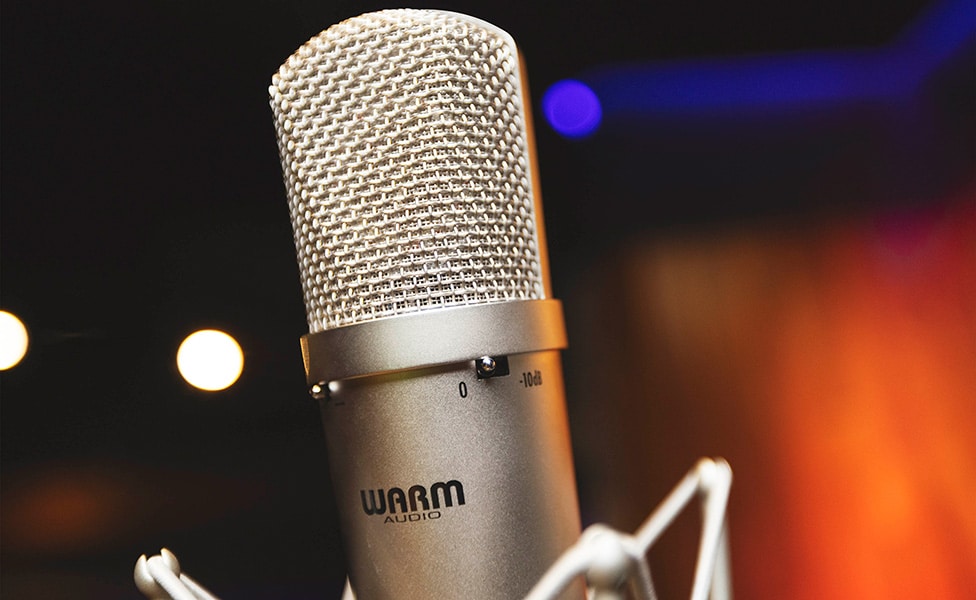
Pictured: Warm Audio WA-87jr FET K47-style Dual Large-Diaphragm Capsule
Table of Contents
What Is Warm Audio's Jr Series?
Warm Audio has built a reputation for making high-quality, affordable studio gear inspired by and based on some of the most sought-after vintage gear. Their WA-47 tube condenser and WA-87 FET condenser mics have been lauded by the audio community for how closely they capture the sound and response of the classic Neumann mics that inspired them. With the Jr Series, Warm opens up a whole new entry point into the world of vintage-inspired audio gear.
What is it that sets the Jr Series apart from their "senior" versions? For starters, these are transformerless versions of the traditionally transformer-coupled WA-47 and WA-87. While removing the transformer-coupled output stage generally results in a cleaner and more neutral presentation, many engineers perceive transformer-coupled designs as having additional weight and harmonic character. The Jr Series leans toward the cleaner side of that spectrum while retaining much of the underlying capsule character of the larger models.
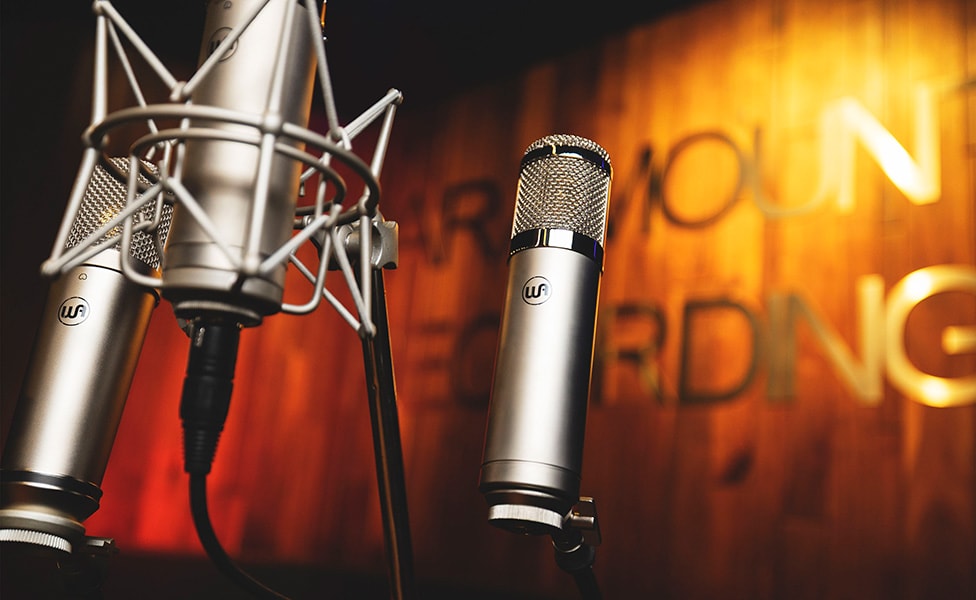
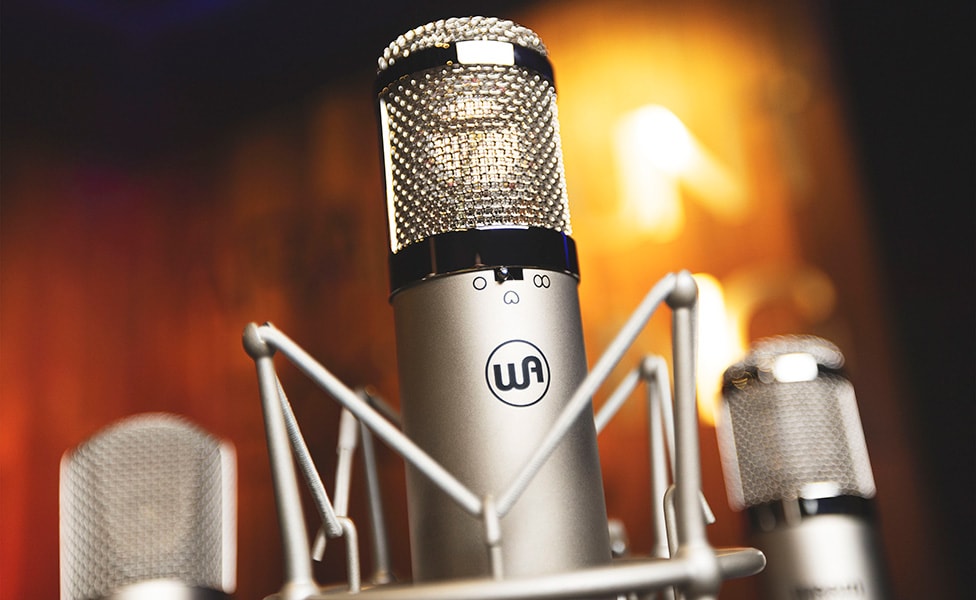
Pictured: Warm Audio WA-47jr SE Condenser Microphone
Whether in the SE or FET versions, the Jr Series microphones hit the mic preamp with greater transient precision and an overall somewhat more neutral quality than their transformer-balanced siblings. It’s not that they lose the core personality of their higher-priced counterparts so much as present it in a slightly more open and less overtly colored way.
|
Model |
Type |
Capsule |
Max SPL |
Sensitivity |
Features |
Price |
|
Transformerless large-diaphragm condenser |
K47-style capsule |
147 dB |
14 mV/Pa (-37 dBV) |
Fixed cardioid design; no pad; no HPF |
$199.00 |
|
|
Transformerless FET condenser |
K47-style dual large-diaphragm capsule |
147 dB (157 dB with pad) |
10 mV/Pa (-40 dBV) |
-10 dB pad; 70 Hz high-pass filter; multi-pattern (Cardioid, Omni, Figure-8) |
$299.00 |
|
|
Transformerless large-diaphragm condenser |
K87-style capsule |
125 dB |
14 mV/Pa (-37 dBV) |
Fixed cardioid design; no pad; no HPF |
$199.00 |
|
|
Transformerless FET condenser |
K87-style dual large-diaphragm capsule |
125 dB (135 dB with pad) |
10 mV/Pa (-40 dBV) |
-10 dB pad; 80 Hz high-pass filter; multi-pattern (Cardioid, Omni, Figure-8) |
$299.00 |
Price as of July 2026*
How I Tested the Warm Audio Jr Series Mics
Since I don't have a full-fledged testing lab, you're not going to be seeing response curves, distortion measurements or anything like that. What I did here was create a series of tracks for electric guitar (clean rhythm and overdriven lead), acoustic guitar (strummed and single-note), percussion and vocals. Since the SE versions don't have a pad, high-pass filter or switchable polar pattern, I did all these tests with the FET versions set to cardioid with neither the pad nor the high-pass filter engaged, though I did test both of those features individually, and they work exactly as advertised.
I recorded the tracks with each mic in turn, taking care to ensure that the mic placement was as close to identical for each track. I then normalized them all to -6dBFS so there would be a minimal amount of "louder is better" bias for any track. Finally, I did some extensive A/B listening, both with the tracks soloed and in the context of a mix.
All tracks were recorded with Logic Pro 12 running on an M2 Max Mac Studio with a PreSonus Quantum audio interface using the standard XMAX mic preamps. No signal processing or EQ was applied to any of these tracks. My monitoring was done switching between my Slate VSX system, Harbinger VARI SM-508s and my venerable Alesis M1 Actives that are officially vintage studio gear at this point. Samples from these tracks are available for you to listen to below.
Now that we know where we're coming from, let's take a closer look at the Jr Series.
Pictured: Warm Audio WA-47jr FET Microphone Capsule
Warm Audio WA-47jr
First up is the WA-47jr. This is, for me, an interesting comparison, since I've been using the WA-47F (FET version) of Warm's transformer-coupled, more vintage-sounding 47-style mic for well over a year, so I had a thorough and recent experience with the baseline for these mics. Since they all use the same basic mic capsule, the differences will live in the output circuitry.
What I'm hearing here seems to point out apparent differences between the FET and the discrete transistor output stage on the two mics. On the clean and overdriven electric guitar tracks, the JFET version has a bit more "bite" doing a great job of capturing the transients of the pick attack, where the SE is a little smoother and a bit more rounded—call it a bit more "polite," but not in a bad way.
Electric Guitar Comparisons
WA-47jr Clean Electric Guitar
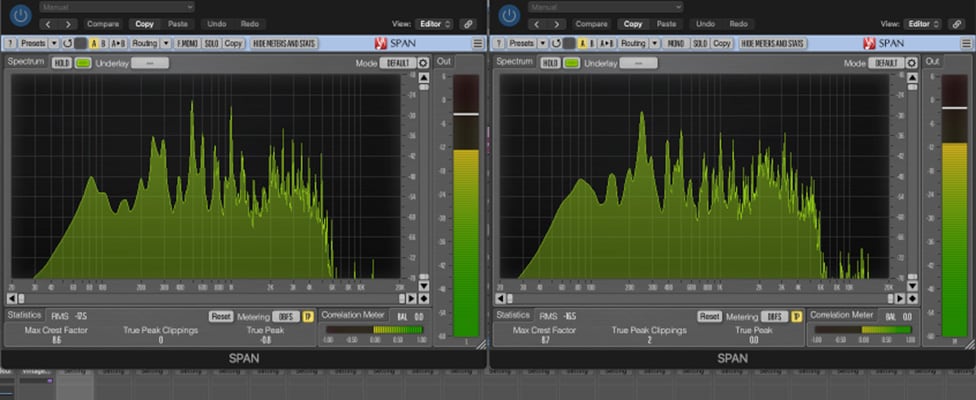
Pictured: Warm Audio WA-47jr SE and FET Clean Electric Guitar Spectrum Analysis Comparison
WA-47jr Overdriven Electric Guitar
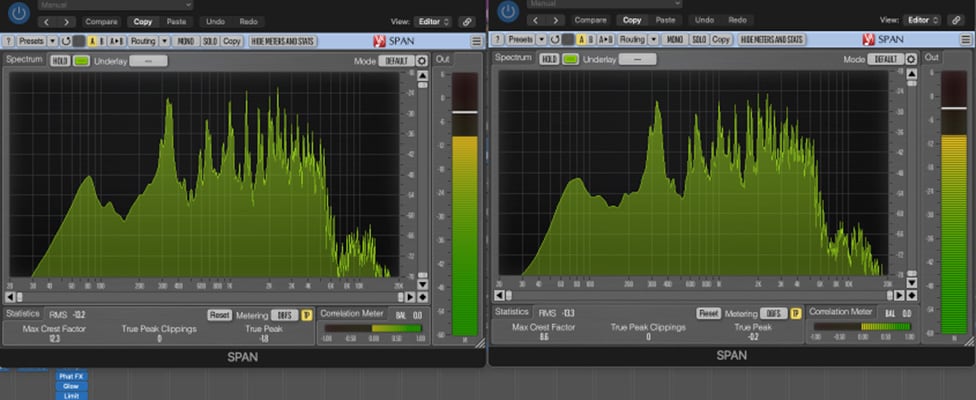
Since it's generally best to capture the sound you want with as little extra processing as possible, I would look at a scenario of tracking the clean rhythm tracks with the WA-47jr SE for smoothness and use the extra attack and bite that the FET version delivers for the lead tracks.
On the acoustic guitar tracks, results were similar, with the FET version having faster transients and a bit more "bite," where the SE rounded the edges, as well as de-emphasized the pick "click" a bit, which made the SE version better for the type of hard-strummed acoustic guitar tracks I was doing here.
Acoustic Guitar Comparisons
WA-47jr Acoustic Guitar Strumming
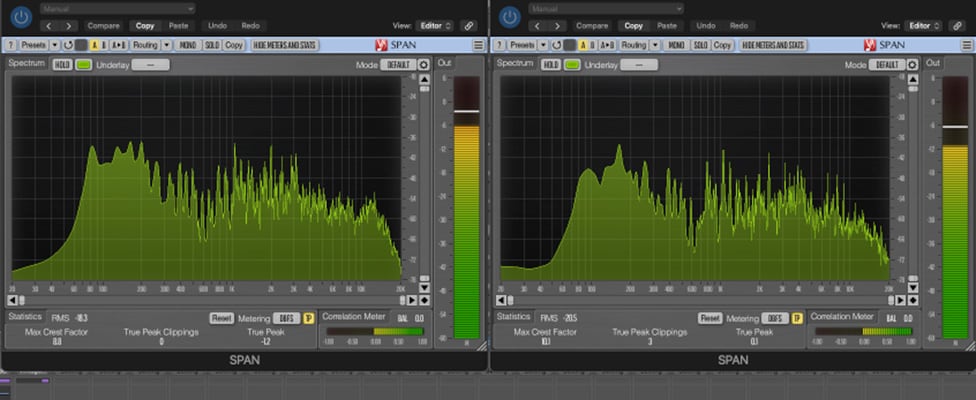
Pictured: Warm Audio WA-47jr SE and FET Strummed Acoustic Guitar Spectrum Analysis Comparison
WA-47jr Acoustic Guitar Single Note
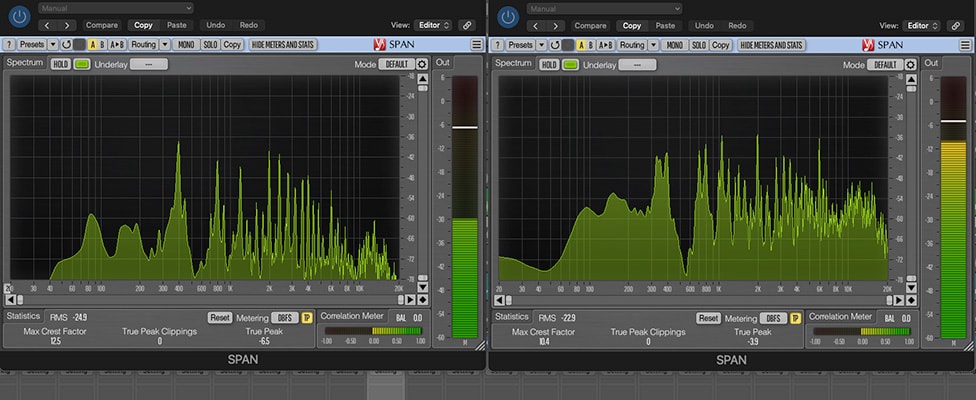
For fingerstyle acoustic, the FET version would be a better choice. On the other hand, the FET version's more aggressive transient response made it a better choice for capturing the single-note acoustic lines, helping the dulcet tones of my ’64 Guild D-50 pop out a bit more without any added EQ or other processing.
Out of curiosity, I also cut an acoustic rhythm track with my transformer-coupled WA-47F to compare the more vintage-voiced mic to the Jr Series WA-47s. The slightly accentuated low-mid and mid frequencies of the transformer-coupled mic gave it a bit more punch, but it was at the expense of some of the immediacy of the more modern-sounding Jr Series. The transformer-coupled mic was also a little less sensitive (but not by much) than the SE and FET Jr Series mics. But the family resemblance was definitely there, and all three mics, sharing a common capsule, live in the same sonic space.
The djembe tracks—a drum that usually gets a pair of mics, one at the base of the drum and the other at the head—were a little more interesting. I had miked the djembe about 8" away and slightly below the level of the head when I was holding the djembe tilted between my knees.
The WA-47jr SE showed a bit more warmth in the low frequencies, doing a little better job of capturing the deep bass tones of a center strike, while the FET version had a bit more attack on the high-pitched edge slaps. In a traditional djembe miking scenario, where one mic would be placed to capture the low tones and the other to capture the high tones, the low-frequency job would be slightly better off with the SE and the direct-head mic position would fall to the FET version.
Djembe Comparison
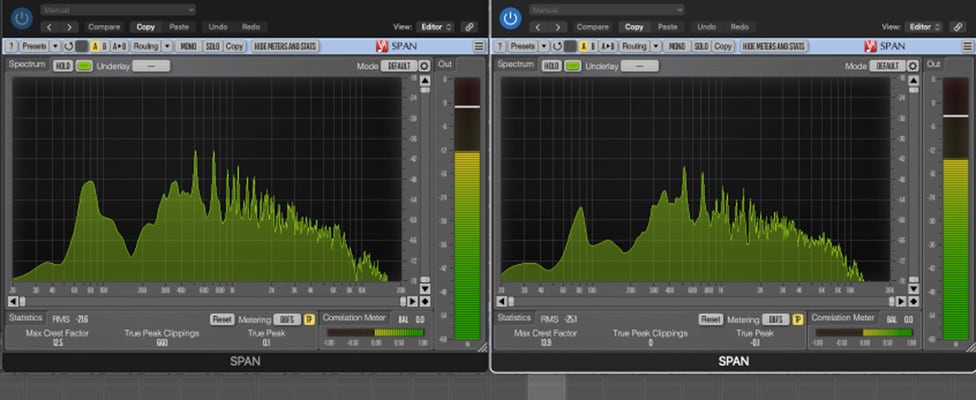
Pictured: Warm Audio WA-47jr SE and FET Djembe Spectrum Analysis Comparison
For vocals, I retracked a song of mine, "Is That Alright?" with both WA-47jr mics. Both sounded great with my tenor voice, and it was honestly hard to pick a favorite here. Both sat in the mix equally well. The FET version may have had a bit of a slight edge in terms of capturing the transients, but not enough to rate one over the other. Vocals, of course, are tricky to evaluate if the mic technique of the singer isn't identical between takes.
Vocal Comparison
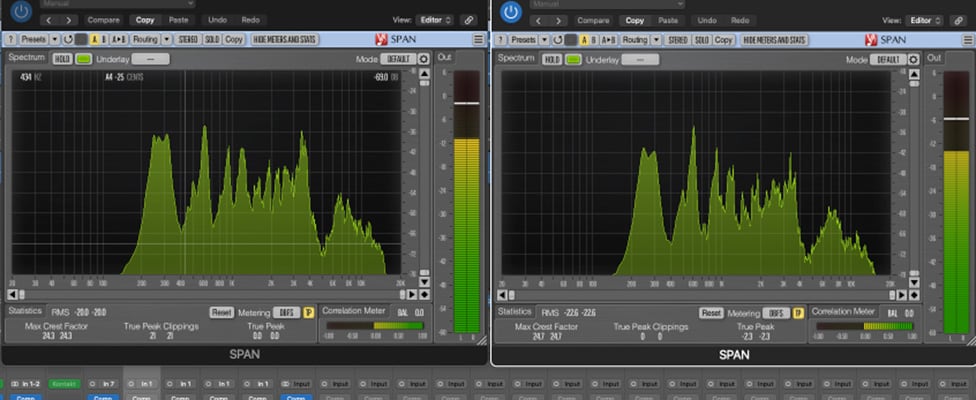
Pictured: Warm Audio WA-47jr SE and FET Vocal Spectrum Analysis Comparison
Warm Audio WA-87jr
On the WA-87jr side, the differences between the SE and FET versions map pretty closely to what I heard with the WA-47jr mics. Overall, the SE version is a little smoother and more neutral, while the FET version has that fast transient response and a touch of high-mid presence that gives it the "bite" the SE doesn't. It's been years since I've used a Neumann U87, so I won't be doing a direct comparison here, as I did with the WA-47F in the previous section.
The K87 capsule Warm Audio uses across the entire WA-87 lineup is a little brighter and, especially in the transformerless SE and FET WA-87jr mics, a little more "hi-fi" to my ears than the K47 capsule in WA-47 mics. Looking at the frequency analysis in the free Voxengo SPAN plug-in (and if you don't have this one, it can be a valuable addition to your DAW), the display tracks to what I'm hearing.
On the electric guitar tracks, I'm hearing (and seeing) a bit more content above 6kHz with the WA-87 than I did with the WA-47jr mics. Directly comparing the WA-87jr SE and FET versions, I'm definitely noticing the faster transient response on the FET version, and a little extra midrange punch. The characterization of smoother vs. punchier as I moved from SE to FET versions holds true here, so the application notes are similar.
Electric Guitar Comparison
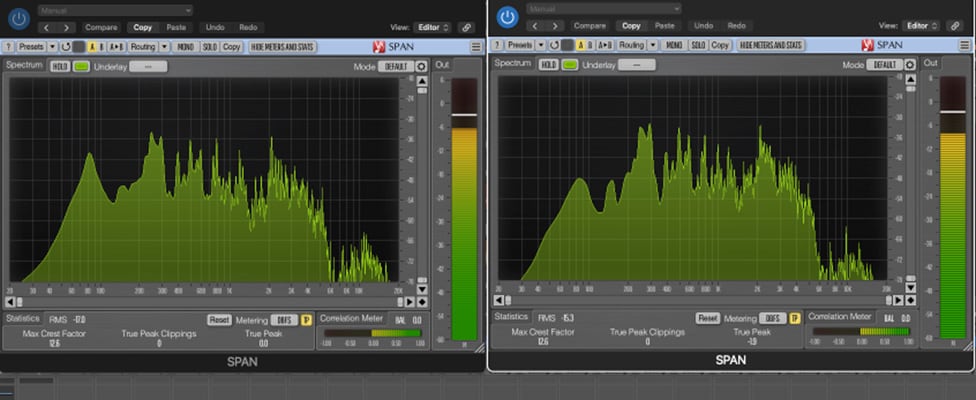
Pictured: Warm Audio WA-87jr Clean Electric Guitar Spectrum Analysis Comparison
WA-87jr Clean Electric Guitar
WA-87Jr Overdriven Electric Guitar
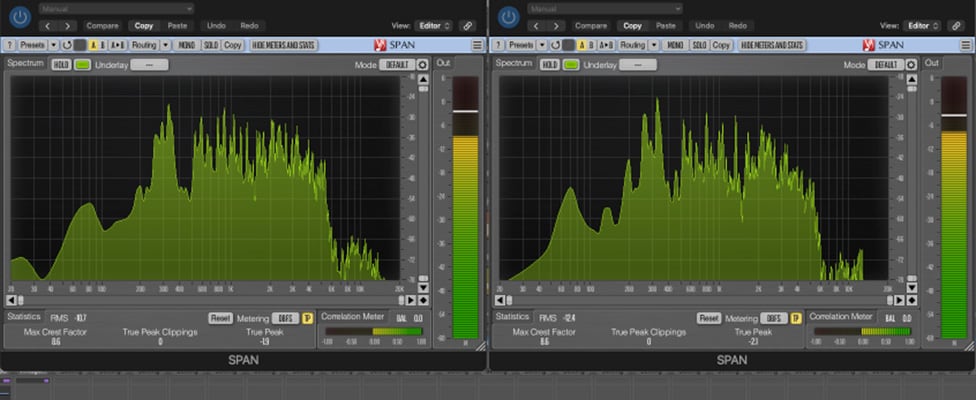
Pictured: Warm Audio WA-87jr SE and FET Overdrive Electric Guitar Spectrum Analysis Comparison
Acoustic guitar tracks recorded with my Guild D-50 (a 1964 Hoboken factory build) point out one significant difference between the SE and FET versions.
FETs are known for fast transient response, but whether due to the circuit implementation or voicing choices, the FET version presented less low-end content than the SE model. This was obvious when comparing the two, both audibly and in the spectrum analysis.
The Guild has a lot of low end, and it was more apparent with the SE version, which felt a little more natural when isolated. Granted, in a mix with other instruments, you might end up rolling off some of that beefy low end, so you don't muddy up something else, but for a solo guitar track, that wider bandwidth might come in handy.
The FET version with the added bite and slight midrange presence increase was great for the acoustic single-note track, popping it out over the rhythm nicely without being too harsh.
Acoustic Guitar Comparison
WA-87jr Acoustic Guitar Strumming
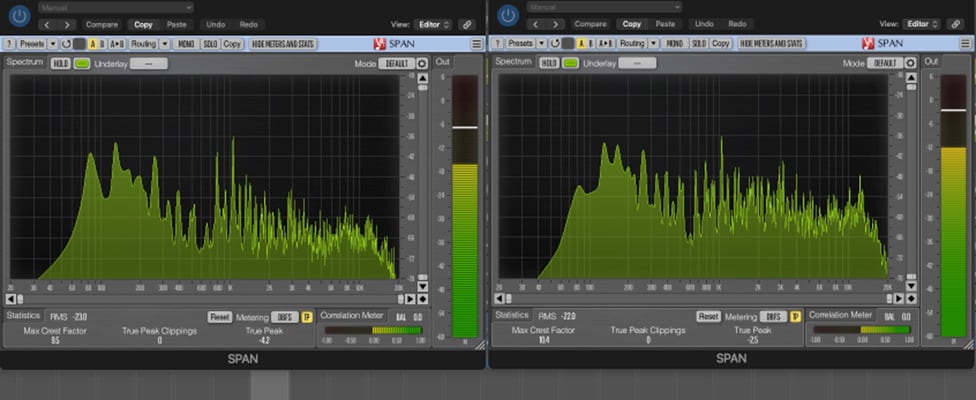
Pictured: Warm Audio WA-87jr SE and FET Strummed Acoustic Guitar Spectrum Analysis Comparison
WA-87jr Acoustic Guitar Single Note
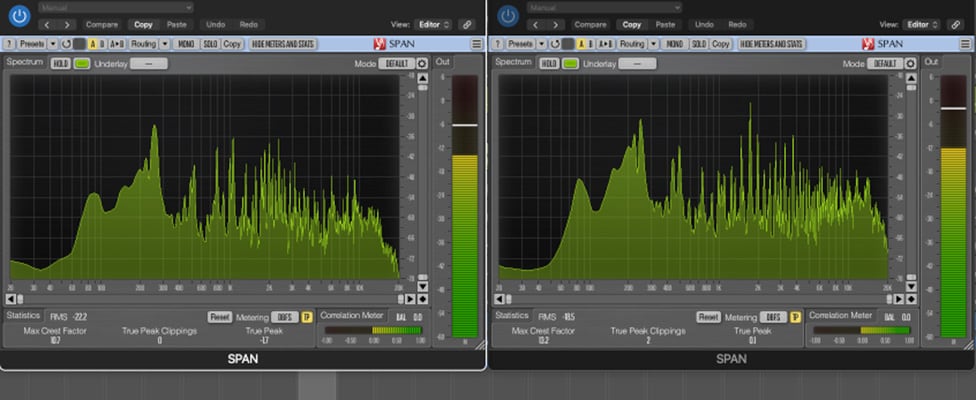
Pictured: Warm Audio WA-87jr SE and FET Strummed Acoustic Guitar Spectrum Analysis Comparison
With the djembe, that change in low-end response between the SE and FET versions was even more apparent, with the SE having substantially more content below 40Hz when the djembe was struck in the center of the head. The edge slaps had more impact with the FET version.
Djembe Comparison
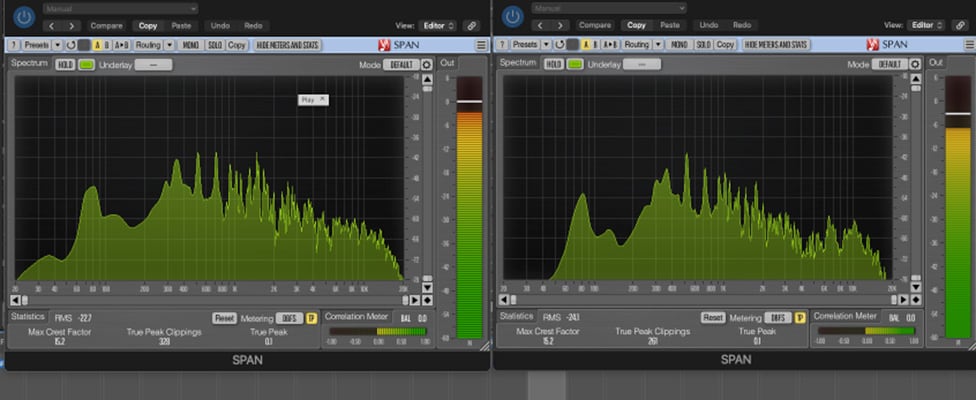
Pictured: Warm Audio WA-87jr SE and FET Djembe Spectrum Analysis Comparison
As far as the vocal tracks go, the faster transient response made the WA-87jr FET seem a little crisper than the SE, but the SE's smoother response worked better for my voice—though for a vocalist who is a baritone or bass, the FET version might be a better choice.
As always with vocals, it's a matter of taste and of matching the mic to the voice. And, I'll add that for vocals, the less processing you have to do to get the sound you want, the easier it will be in the long run to get the mix you need.
Vocal Comparison
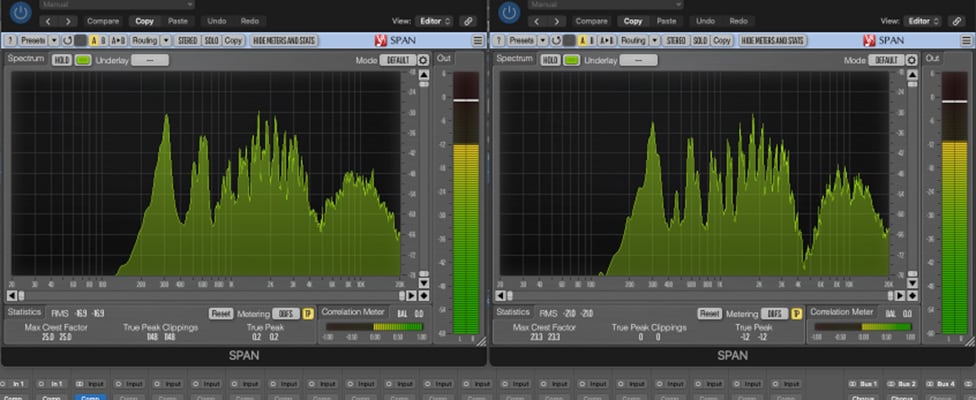
Pictured: Warm Audio WA-87jr SE and FET Vocal Spectrum Analysis Comparison
Conclusions
So, where do we end up with these mics? Do they deserve a place in your mic locker? They raise some interesting questions and possibilities.
As someone who has been both fortunate enough to have worked in studios with world-class mic collections but never had the resources to own the classics, I've spent most of my home studio time with a handful of mics that are a quirky mix of types and manufacturers—including some oddball vintage dynamics and a plethora of affordable compromises.
I've worked with real vintage-tube U 47s, including in a studio where one of the interns dropped the U 47 and put it back in the mic safe—without telling anyone. The story became legend. I've also tracked with mics held together with gaffer's tape and zip ties. I would have loved to have had these Warm Audio mics available at the time.
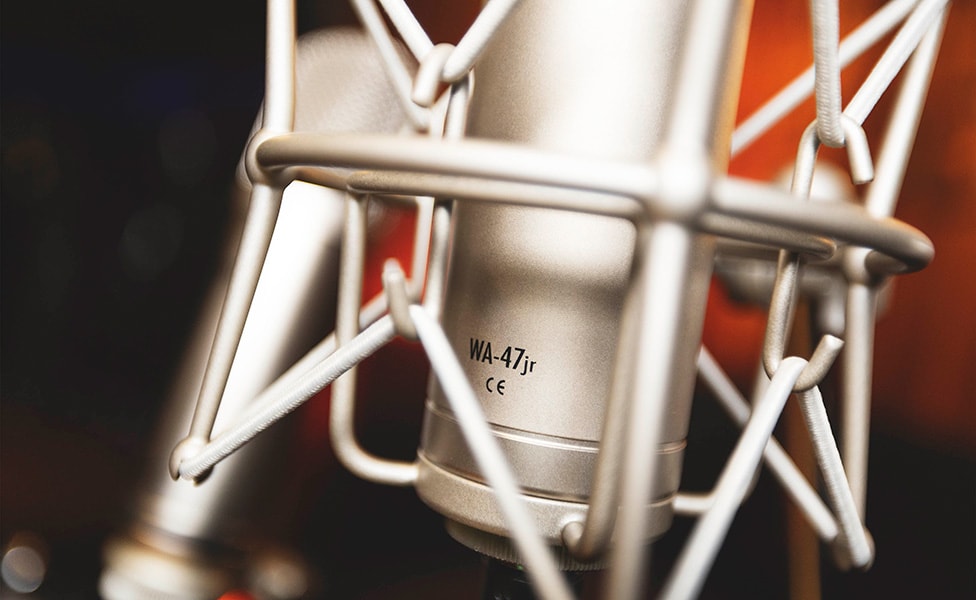
Pictured: Warm Audio WA-47jr FET Shockmount
Are they the real deal? It depends on what you mean by "real deal." They're not what most people characterize as "vintage warmth," but they're not intended to be.
They're built around a capsule that can do that—and a capsule is, many engineers claim, probably 70% or more of a mic's sound—but with an internal preamp that is more suited to a wider range of modern recording needs. But that basic sonic footprint—the big deep sound of the K47 capsule and the wide-open sound of the K87 capsule—is still there. If you were using these alongside a vintage U 47 or U 87, they'd be recognizable as being members of the same family.
In fact, if you stayed entirely within the Warm Audio world and used the WA-47F, the WA-47jr FET and the WA-47jr SE on the same session, you'd have a set of mics that would be the equivalent of "double first cousins," where each cousin shares the same four grandparents. The differences between them are complementary, not competitive.
This last point leads me to a recommendation, and not just because we want to sell you these mics, but because it's a useful way to think about recording and audio engineering in general: Buy 'em all. Or rather, figure out which capsule type appeals to you the most, and then buy both the SE and FET versions of that mic.
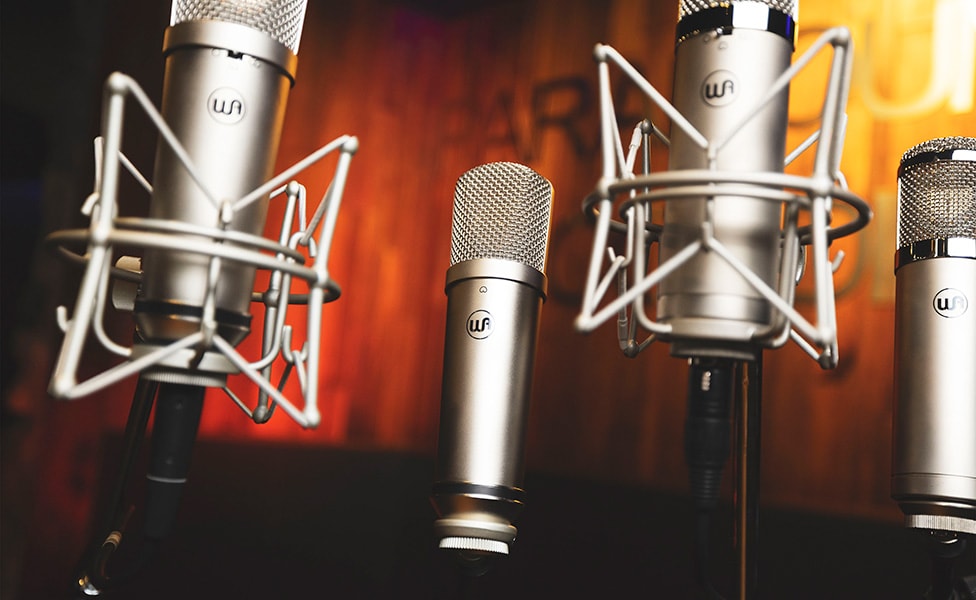
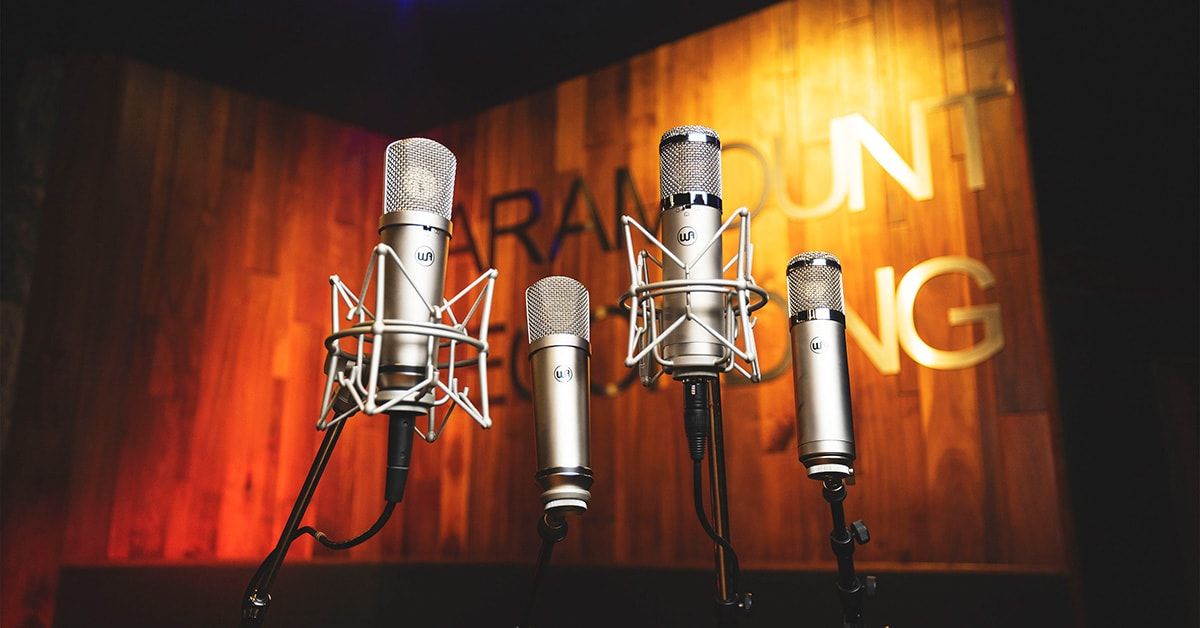
Pictured: Warm Audio Jr Series Microphones
And here's the reasoning behind that: As I've stated above, if you can capture a source in such a way that it needs as little post-processing as possible, your recordings will sound better. They will be more cohesive, more natural and sound more like a single, seamless performance. By using mics with the same capsule type, but slightly different performance characteristics, you can get the immediacy of an old-school, "put up a pair of mics to capture the room and let the musicians do their thing" approach, but with the level of control that modern recording offers.
Not to mention that, at current pricing, a combination of the SE and FET versions is right around $500; that's an order of magnitude (or more) cheaper than the cost of a single vintage classic.
Written By: George Van Wagner
George Van Wagner is a writer and editor for Guitar Center, where he has worked since 2007. A multi-instrumentalist, freelance recording engineer, arranger, composer, writer and all-around tech geek, he has over 30 years of experience in the musical instrument industry at companies like Midiman/M-Audio and Line 6, doing everything from customer service and writing user manuals to working in product development. He is currently gigging around Los Angeles with Gruppo Subconscious and Bobby “Hurricane” Spencer.
Recently Added to Gear Tips
Be the first to know about exclusive offers, tips and more.

866-498-7882 English
877-687-5402 Español