.jpeg)

Pro Gear Advisers
•866-498-7882
Top 5 Delay Pedals

Slash’s tension-building opening lines in “Welcome to the Jungle.” The Edge’s percussive, cascading riff in “Where the Streets Have No Name.” Jonny Greenwood’s choppy, stuttering bursts of ambience in “Airbag.” Each of these famous cuts relies on delay to paint the sonic picture, and there are thousands more applications of the effect throughout the history of recorded music—on guitar as well as every other instrument.
For many players, delay is an essential effect. You can build rhythmic, pulsating riffs with it, give solos dimension and depth, create dreamy soundscapes and so much more. So, if you’re still looking for the right stompbox for your board, we’ve gathered five of the most popular delay pedals here at Guitar Center.
How We Picked These Delay Pedals
These delays are five of our best-sellers at Guitar Center. So really, the guitar-playing community has chosen them based on a variety of factors, including overall sound quality, flexibility, ease of use and affordability. There’s also a great mix of time-tested pedals—such as the BOSS DD-8, which originally launched as the DD-2 in 1983—to more recent releases that have already made a splash (the Walrus Audio Fundamental Series Delay debuted in 2023).

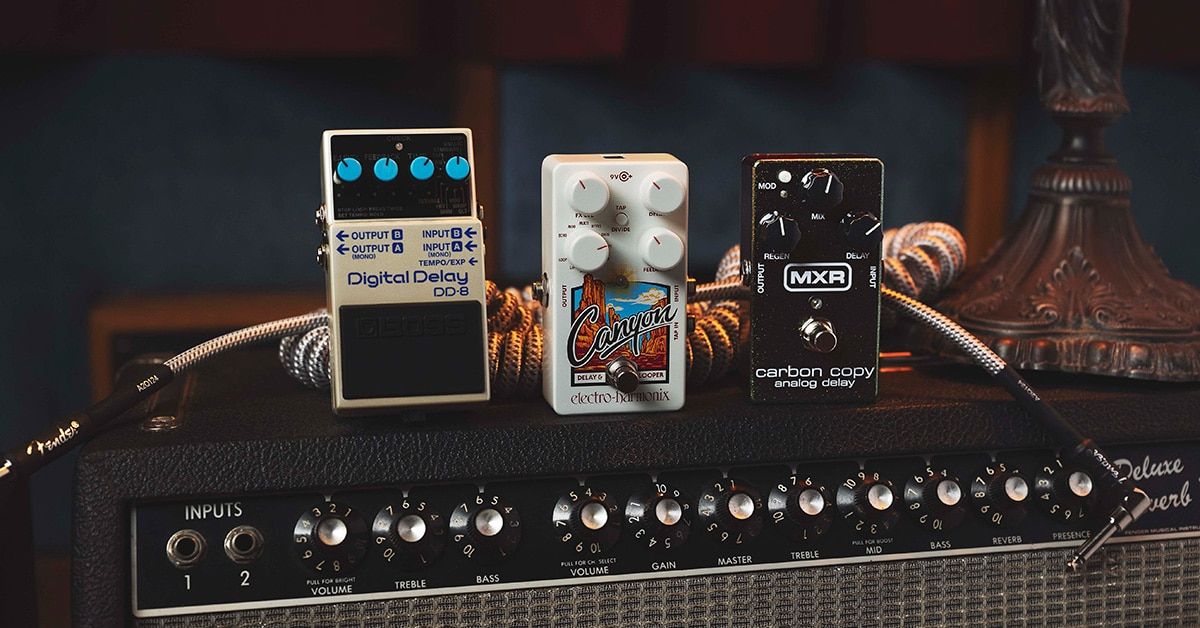
Pictured: MXR M169 Carbon Copy Analog Delay Effects Pedal
Most Popular Delay Pedals
BOSS DD-8 Digital Delay
Why We Picked It: The DD-8 contains 11 delay modes (including a looper) for sounds ranging from mild to wild.
Key Features:
-
Streamlined control layout (Effect Level, Feedback, Time, mode select)
-
Up to 10 seconds of delay time
-
Stereo I/O

Shop Now: BOSS DD-8 Digital Delay Effects Pedal
BOSS stompboxes are ultraintuitive, sound fantastic, are built like tanks and tend to get the job done with zero friction. The DD-8 Digital Delay lives up to this reputation. It’s very easy to dial in a wide variety of delay styles, including everything from analog BBD (bucket-brigade delay), clean digital and vintage-style tape echoes to experimental reverse and shimmer delays. There’s also a +RV mode which combines reverb and delay, as well as a GLT setting that creates glitchy patterns for unique, percussive riffs.
Electro-Harmonix Canyon Delay & Looper
Why We Picked It: EHX prides the Canyon on being a compact pedal with a vast array of cavernous delay.
Key Features:
-
10 delay types and a built-in looper
-
Up to 3 seconds of delay time
-
Power supply included

Shop Now: Electro-Harmonix Canyon Delay and Looper Effects Pedal
Echo … echo … echo. You hear that? That’s the Electro-Harmonix Canyon enveloping your sound in deep, rich delay. Among the available modes are ECHO (digital delay), MOD (modulated delay), REVRS, TAPE, DMM (Deluxe Memory Man) and OCT (octave delay), plus a dedicated looper.
Canyon also has a nifty “hidden” feature where the Delay and Feedback knobs work as secondary controls based on whichever mode you’re in. You can engage secondary knob mode by pressing and holding the Tap/Divide switch until the LED blinks. If you have MOD selected, for example, secondary knob mode allows Delay to control modulation rate and Feedback to control depth.
MXR M169 Carbon Copy
Why We Picked It: Carbon Copy is a classic bucket-brigade delay offering everything from crisp slapback to lush, soaring repeats.
Key Features:
-
Regen, Mix and Delay controls with a Mod button
-
Up to 600 ms of delay time
-
Internal trim pots adjust modulation width and rate

Shop Now: MXR M169 Carbon Copy Analog Delay Effects Pedal
The MXR M169 Carbon Copy channels the vibe of those earliest stomps from the ’70s. The sound is rich and warm. It’s not as unpredictable as tape and not as pristine as digital circuits—it has its own character that’s been a player and audio engineer favorite for decades. What’s more, the Mod button is a nice touch when you want to inject some movement into your echoes and potentially save some pedalboard real estate.
Line 6 DL4 MkII
Why We Picked It: The DL4 became a classic as one of the first digital delay modelers in 1999, and the MkII continues its legacy with even more onboard sounds.
Key Features:
-
30 total delays (14 OG DL4 algorithms, 15 algos pulled from the HX family and Echo Platter)
-
XLR input for vocal or acoustic instrument processing
-
Built-in looper with up to 240 seconds of recording time

Shop Now: Line 6 DL4 MkII Delay Effects Pedal
The Line 6 DL4 MkII looks intimidating if you’re used to standard-sized stompboxes, but it’s actually easy to get to know. In addition to the rotary delay selector—which includes an ALT button engaging Legacy mode to access the 14 old-school DL4 sounds—there are Time/Subdiv, Repeats, Tweak, Tweez and Mix dials. Tweak and Tweez being the outliers, these function as mode-specific parameter controls. You also have A, B and C footswitches to select presets, in addition to a tap tempo switch. When you’re using the looper, the first three footswitches operate recording and playback.
Walrus Audio Fundamental Series Delay
Why We Picked It: Walrus Audio’s Fundamental Series was established to bring affordable, intuitive and excellent-sounding pedals to players of all stripes.
Key Features:
-
Three delay types
-
Unique slider controls
-
Tap Mode

Shop Now: Walrus Audio Fundamental Series Delay Effects Pedal
The Walrus Audio Fundamental Series Delay offers Digital, Analog and Reverse algorithms operated by a trio of sliders: Time, Feedback and Mix. Digital mode will give you clean, transparent repeats, while the Analog setting slightly filters and saturates the signal BBD style. From there, you can tap into psychedelic textures by flicking the switch over to Reverse.
This delay pedal’s “secret” function is Tap Mode, entered by holding the footswitch down. Manually set the tempo by tapping the switch, then choose your subdivision from quarter, dotted eighth or eighth notes using the delay algo switch.
Don’t Delay …
… get a pedal today. Corny tagline aside, one of the best ways to audition the featured stompboxes and others is to visit the Pedal Station at your local Guitar Center. All you have to do is grab your favorite guitar off the wall, plug in and demo anything included on the prewired pedalboard. Alternatively, you can always call or virtually chat with one of our expert Gear Advisers—they’re there to answer your questions and offer personalized recommendations based on your taste and preferences.

Pictured: BOSS DD-8 Digital Delay Effects Pedal
In the meantime, be sure to also check out our guide to “The Best Delay Pedals of 2026” for a broader selection.
Written By: Max McAllister
Max McAllister is an audio engineer, guitarist and writer. At the Brewery Recording Studio, he earned engineering credits on Kid Cudi’s Man on the Moon III, Duckwrth’s SuperGood and the LeBron James Space Jam compilation, among others. Max previously wrote for Produce Like A Pro, where he authored over 600 articles, and has also contributed to Adorama’s 42West. He’s proudly served Guitar Center as a senior writer since 2023.
Recently Added to Buying Guides

Be the first to know about exclusive offers, tips and more.

866-498-7882 English
877-687-5402 Español