.jpeg)

Pro Gear Advisers
•866-498-7882
How to Choose the Best Electric Guitar
As a beginner, one of the first steps on your musical adventure is finding the best electric guitar for your needs. It’s a thrilling ride when you’re hyped to start playing, but that initial rush can wear off pretty quickly when you’re suddenly inundated with dozens of options and dizzying spec sheets. How do you dwindle it down?
In this electric guitar buying guide, we’ll cover everything you need to know about choosing your first instrument, starting with basic guitar anatomy: body styles, tonewoods, neck shapes, pickups and hardware.
We’ll tie all of that into common applications, so you can begin to let your music taste and desired playing style narrow your choices. We’ll even discuss how to get the best deal for your personal budget and where to go when you’re ready to take your chops to the next level.
Be sure to also check out our beginner electric guitar collection to find a perfect entry-level electric for yourself or the beginner player in your life, and consult “Top 5 Most Popular Electric Guitars” for some inspiration.
Table of Contents
- How to Choose the Best Electric Guitar: Quick Tips
- Electric Guitar Body Styles: Solidbody vs. Semi-hollowbody vs. Hollowbody
- Electric Guitar Tonewoods: How Body, Neck & Fingerboard Woods Affect Tone
- Electric Guitar Neck Types: Neck Construction, Scale Length & Neck Shapes
- Guitar Pickups Explained: Single-Coil vs. Humbucker vs. P90
- Electric Guitar Bridges: Fixed vs. Tremolo (Vibrato) Systems
- How to Try Out an Electric Guitar: What to Test Before You Buy
- Electric Guitar Buying Tips: Questions to Ask Before Buying
- How to Get the Best Deal on an Electric Guitar: Sales, Price Match & Trade-Ins
- Guitar Lessons for Beginners: Next Steps After Buying Your Electric
- People Also Ask ...
How to Choose the Best Electric Guitar: Quick Tips
- Choose a body style that meets your comfort
- Decide between single-coil, humbucker or P90 pickups
- Consider scale length and neck profile
- Match the guitar to your preferred genre (e.g., a Superstrat for metal/shred or a hollowbody for jazz)
- Set a realistic budget
- Whenever possible, play before you buy
Electric Guitar Body Styles: Solidbody vs. Semi-hollowbody vs. Hollowbody
The three main electric guitar body styles are solidbody, semi-hollowbody and hollowbody. Electric guitars first appeared in the 1930s, when demand for an amplifiable guitar began to rise from big band players who found themselves unable to compete with the volume of the rest of the band.
During the 1930s, brands like Gibson, Rickenbacker and Epiphone began producing archtop hollowbody acoustics with built-in electromagnetic pickups. In 1950, Fender introduced the first commercial solidbody electric guitar with the Esquire (later renamed the Telecaster), which had a “slab” (noncontoured) body.
In 1958, Gibson introduced the ES-335, the first semi-hollow electric, which combined a solid block of maple surrounded by the hollow wings of an archtop-body guitar.
For a closer look at the development of timeless electric guitars, check out “The History of the Fender Telecaster,” “The History of the Fender Stratocaster” and “The History and Evolution of the Gibson Les Paul.”
|
Body Type |
Tonal Profile |
Best For … |
Typical Weight |
|
Tight, focused, punchy |
Rock, metal, punk, pop, funk, blues, country |
7–10 lb. |
|
|
Warm, resonant, woody |
Blues, jazz, indie, rock, soul, rockabilly |
6–8 lb. |
|
|
Open, airy, mellow |
Jazz, rockabilly, swing, roots, country, folk |
5–7 lb. |
Solidbody
Solidbody electrics provide more sustain and are less susceptible to feedback. Solidbody electrics are staples in most popular music styles, including rock, country and blues.
Popular models: Check out Fender Telecaster and Stratocaster models or the affordable Squier Tele and Strat alternatives. Plus, explore legendary Gibson Les Paul and SG models and the budget-friendly Epiphone versions of the Les Paul and SG.

Shop Now: Gibson Les Paul Standard '60s Electric Guitar
Semi-Hollowbody
Semi-hollowbody electrics combine the style and resonant, warm sound of a hollowbody with the feedback-fighting benefits and longer sustain of a solidbody. Their distinctive tones are popular among rock, blues and rockabilly players.
Popular models: Check out Gibson ES-335 semi-hollow electrics or the more accessible Epiphone semi-hollow models.
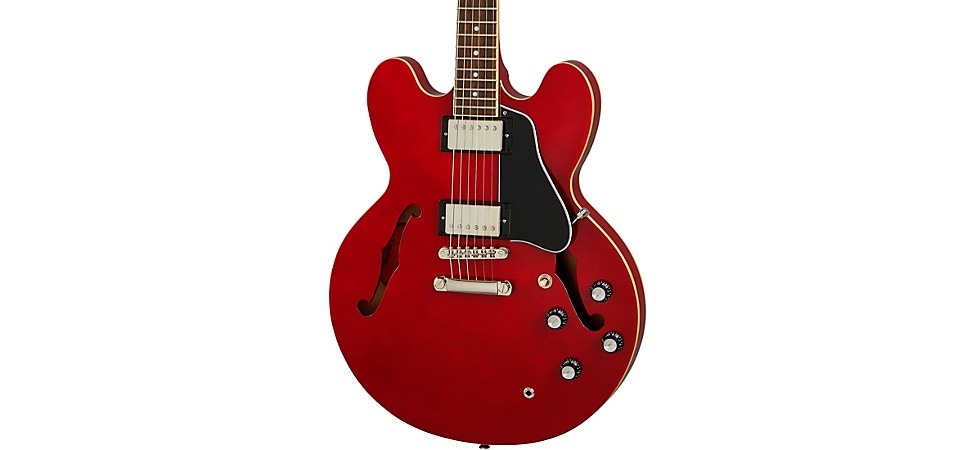
Shop Now: Epiphone ES-335 Semi-Hollow Electric Guitar
Hollowbody
Hollowbody guitars retain the natural, airy and woody sound of an acoustic guitar, but are prone to feedback when amplified at high volume levels. Hollowbody guitars are popular among jazz, country and folk players.
Popular models: Check out our collection of hollowbody electrics from Gretsch, D’Angelico, Ibanez and other top brands.
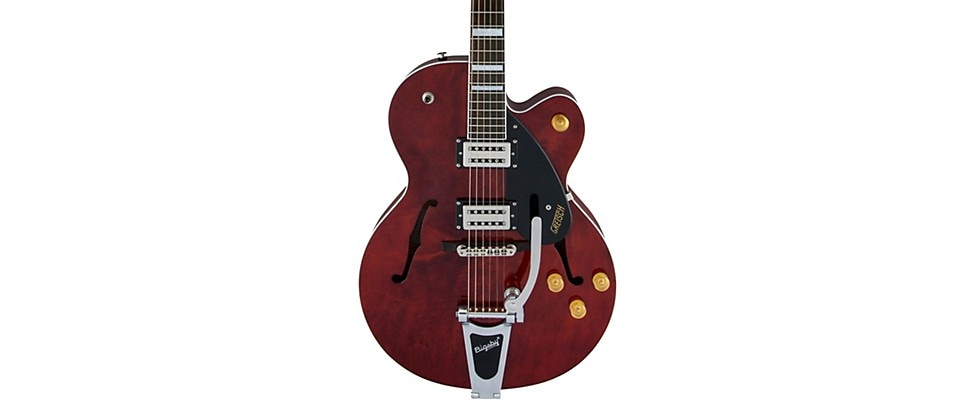
Shop Now: Gretsch G2420T Streamliner Electric Guitar
Electric Guitar Tonewoods: How Body, Neck & Fingerboard Wood Affect Tone
Tonewoods are varieties of wood with tonal properties—their fundamental sound—that make them good choices for use in instruments. The firmness, weight and density of each species of wood help shape its tone. Every piece of wood within a species will also have unique variations in grain and color, which contribute to the unique look and feel of an electric. Below are some common tonewoods used for the bodies, necks and fingerboards of electric guitars.
Popular Body Woods
Alder
Alder is a medium-weight wood with a strong, clear, full-bodied sound.
Swamp Ash
Swamp ash is light and resonant, offering pleasant highs, firm lows and a slightly scooped midrange.
Northern Ash
Northern ash is slightly denser and heavier with a more cutting sound and is most commonly paired with a carved maple top.
Mahogany
Mahogany is a fairly dense wood that offers natural compression (leveling of dynamics) with strong mids and an overall warmer, more woody tonal range.
Maple
Maple is a dense hardwood generally partnered with a second, lighter wood. An all-maple body produces a bright, focused tone with a fast note decay that cuts through a mix.
Korina
Korina is a fairly light hardwood that yields great clarity, warmth and definition with strong resonance and sustain.
Basswood
Basswood is a very light and fairly soft wood with a well-balanced tonality and a muscular midrange.
Poplar
Poplar is a relatively soft hardwood that is well-balanced sonically, but isn’t particularly resonant or sustaining.
Popular Neck Woods
Maple
Maple necks can impart a lively and bright tone that can help add clarity to the top end of a large-bodied guitar.
Mahogany
Mahogany necks can help add warmth and fatness to the overall tonal range of a guitar.
Carbon Fiber-Reinforced Necks
Carbon fiber rods have little to no effect on tone. Rather, they’re used to add rigidity and stability to necks, helping protect thinner, faster-playing profiles against breakage and excessive bending.
Popular Fingerboard Woods
Ebony
Ebony is a very hard, smooth wood. As a fingerboard, it is fast playing and is very bright sounding with long sustain.
Pau Ferro
Pau ferro is a very hard wood with tighter grain than rosewood, making it smooth and easy to play. Tonally, pau ferro has a slightly snappier tone than rosewood and a warmer tone than ebony.
Maple
Maple fingerboards and one-piece maple necks are fast playing and bright sounding with great sustain.
Rosewood
Historically, rosewood was one of the most commonly used woods for fretboards. However, due to environmental concerns, many manufacturers are transitioning to rosewood alternatives, including ebony and pau ferro. Where rosewood is still in use, it’s a soft, porous wood with a warm, smooth sonic profile.
Electric Guitar Neck Types: Neck Contstruction, Scale Length & Neck Shapes
There are three general types of neck construction. Bolt-on necks are, as the name implies, bolted onto the body of the guitar. This allows for easier repair or replacement but offers less overall sustain and resonance. Set necks are glued into the body, which creates a more stable neck joint and gives better sustain and resonance to the guitar. The neck of a “neck-through” guitar extends through the entire length of the body, which is even more stable and offers even greater sustain and resonance.
Scale length is an important measurement taken from the guitar’s nut to its bridge, telling us how much string length will be vibrating when we play. Longer scale lengths increase tension on the strings, while shorter ones decrease it. Sometimes you’ll hear scale length referred to by the brand it’s most commonly associated with: “Fender” scale is 25.5", and “Gibson” scale is 24.75". Extended-range guitars typically offer even longer scale lengths (26"–27") to ensure the lowest string is tight and articulate.
Neck shapes, or “profiles,” don’t heavily affect the sound of the guitar but have a great effect on the guitar’s overall feel. C-, D-, U- and V-shaped necks are popular neck profiles. The letters refer to the basic shape of the back of the guitar neck.
C-shaped necks are the most common, offering a comfortable oval profile that works well for most players. D-shaped necks are flatter in the center than a C-shaped profile and have more aggressive shoulders. U-shaped, or “baseball bat,” necks are chunky and rounded, which makes them more comfortable for large-handed players or those who prefer to play with their thumb on the back or side of the neck. V-shaped necks have a sharper profile preferred by players more comfortable with their thumb hanging over the fretboard.
Note: Sometimes, neck profiles are categorized by decade rather than, or in addition to, their shape. The definition of these terms varies slightly by brand but, in general, ’50s necks tend to be rounder, and ’60s necks are usually slimmer. “Modern” necks typically have a flatter profile that lend themselves to faster playing.
Guitar Pickups Explained: Single-Coil vs. Humbucker vs. P90
Electric guitars rely on a pickup or multiple pickups mounted on the body to generate a sound that can be amplified by a guitar amp and speakers. Pickups function as a magnetic field, and the vibration created from strumming or plucking the metal strings generates a current. This current is transmitted through the guitar’s preamp circuit, and by using a guitar cable to connect the guitar to an amp, creates an amplifiable signal.
Most electric guitars have a pickup close to the neck and one close to the bridge. The neck pickup produces a thicker, more rounded sound, while the bridge pickup has a clearer, more cutting sound. A three-way pickup switch allows you to choose between these pickups or blend them.
If a guitar has a third or middle pickup—most often used blended with either the bridge or neck pickup—it will likely have a five-way pickup selector, which blends the pickups and changes their phase relationship. How you blend these pickups, the circuitry of the guitar’s tone controls, the type of strings you use and your playing techniques will all influence the sound that is sent to the amplifier.
Let’s take a look at the three most common pickup types.
Single-Coil Pickups
Single-coil pickups are composed of a magnet, or magnets, with one coil of fine wire wrapped around the pickup to create a magnetic field that captures the strings’ vibrations and converts them into an electronic signal.
Single-coil pickups typically have a crisp, cutting sound. This bright tone cuts well through dense bands, but single-coils are also susceptible to hum generated by noise radiation from fluorescent lighting, computer monitors and building wiring.

Pictured: 1959 Fender Stratocaster Pickups
Humbuckers
Humbucking pickups consist of two out-of-phase coils wired together in series, with the polarity of the magnets arranged opposite each other, which cancels, or “bucks,” the hum produced by single-coils.
Humbuckers tend to have a warmer, smoother tone than single-coil pickups and lend themselves to thicker rock sounds. Many guitars feature both single-coils and humbuckers, and some guitars feature a coil-tap switch that turns off one of the coils in the humbucker to offer the player a choice between single-coil and humbucker sounds.

Pictured: Gibson Custom Custombucker Humbucker Pickup Set
P90 Pickups
P90 pickups are another type of single-coil, though their voice is quite different from what people often consider the “Strat-style” single-coil sound. P90s sound thicker and fuller, with a ton of midrange snarl, a nice high-end bite and dynamic responsiveness that makes them feel interactive. They’re articulate and raw, which makes them awesome for irreverent punk and rock sounds, but they work great for warm, smoky blues and jazz tones, too.
Lots of players swear by P90 pickups, though they do tend to be overshadowed by Fender-style single-coils and humbuckers. For a deeper dive into everything pickups, check out “Comparing Guitar Pickups: Humbucker vs. Single-Coil vs. P90.”

Pictured: Vintage Gibson 1959 Les Paul Junior P90 Pickup
Electric Guitar Bridges: Fixed vs. Tremolo (Vibrato) Systems
The bridge of an electric guitar anchors the ball ends of the guitar strings. The bridge is also where adjustments to the action (the distance between the strings and the frets) and intonation (the pitch accuracy along the fretboard) can be made.
The two main types of electric guitar bridges are fixed (a.k.a. stoptail or hardtail) bridges and tremolo (or vibrato) bridges. Fixed bridges offer more stable tuning and tend to provide more sustain. Tremolo bridges feature a vibrato arm (or whammy bar) that allows players to create vibrato effects by rocking the bridge back and forth to bend the pitch of the strings. Locking tremolo systems, like a Floyd Rose bridge, lock the strings in place at the nut and bridge of the guitar, which allows players to heavily use the vibrato arm.
How to Try Out an Electric Guitar: What to Test Before You Buy
If you need a pick, strap, tuner, slide, capo or a guitar amp to properly compare electric guitar models, ask one of our helpful store Associates, and they’ll be happy to provide those for you to demo.
Don’t feel like you have to put on a demonstration of your talents to get a feel for the guitar. If all you know is a few chords, strum those chords. Hear how those chords sound and how it feels to change between chords up and down the neck. If you haven’t learned to play anything yet, you can pay more attention to the ergonomics of the instrument. See if the body is comfortable to hold and see if the width of the neck is comfy when gripping it.
Electric Guitar Buying Tips: Questions to Ask Before Buying
Don’t be afraid to ask questions. Even if you’ve done hours of research on electric guitar forums, you’re not going to become an electric guitar expert overnight. If a guitar you’re looking at has a material or special feature you’re unfamiliar with, one of our Associates can explain or quickly find you information on the benefit of that feature.
The price tags on each guitar in the store also have bullets that call out key features. These can include the different tonewoods, neck shapes, pickups and switching.
If you’re unfamiliar with what’s in the store or just need help to find electrics in your price range, you can also ask an Associate to show you options for the best electric guitar under $500, the best electric guitar under $200 or whatever your budget may be.
How to Get the Best Deal on an Electric Guitar: Sales, Price Match & Trade-Ins
It never hurts to ask if there are any promotions or sales currently running, but our 45-day price-match guarantee takes the guesswork and haggling out of getting the best deal on electric guitars. At the time of purchase or any time within 45 days of your purchase, if you find the identical guitar advertised by any authorized dealer—including Guitar Center—at a lower price than what you paid, just show us the ad and your original receipt, and we’ll refund you 100% of the difference.
Another way to save money on your new electric is by selling us old musical gear you have to trade up to a new electric. So, if you have a qualifying item you’d like to trade in, you can get 10% off your new electric, in addition to your trade credit.
Guitar Lessons for Beginners: Next Steps After Buying Your Electric
Did you know that Guitar Center offers one-on-one guitar lessons for all skill levels? Our expert guitar instructors will work closely with you to tailor your lessons to your musical tastes and goals. Whether you’re a beginner using tablature to learn your first riffs or a more experienced player looking to grow, we’re here to help.
People Also Ask …
What is the best electric guitar for beginners?
There are so many choices, but the best ones usually balance affordability, playability and sonic versatility. A beginner should really be able to squeeze every ounce of inspiration and tone out of their guitar for months or years as they progress with their playing. Here are a few popular models:
For more, we’ve written a detailed guide on “The Best Electric Guitars for Beginners.”
Should I get a Strat or Les Paul?
Yes. Jokes aside, both are perennial icons, and you can’t really go wrong with either. Ultimately, it’s going to depend on the sound you’re looking for. Strats tend to sound bright, chimey and articulate, while Les Pauls are thick, smooth and powerful. A lot of this difference comes down to pickups (single-coils vs. humbuckers), as well as body wood and shape. Stratocasters often have sleekly carved alder bodies, whereas Les Pauls feature a chunky, heavy slab of mahogany with a maple cap.
If you’re curious, we can walk you through “How to Buy the Best Stratocaster” and “How to Choose the Best Gibson Les Paul.”
How much should I spend on my first electric guitar?
The sweet spot for many entry-level instruments is in the $300–$500 range. There, you can start to break away from the really inexpensive stuff with poor factory setups, bad fretwork or other quality control issues. You can always shop used, too, and score a deal on a mid-level axe.
Are expensive electric guitars worth it?
High-end guitars are expensive because they’re built with better craftsmanship and greater attention to detail. They’ll have nicer pickups, top-notch electronics and hardware, and sometimes exotic woods or finishes. How much all that’s worth to you is the question. If you don’t vibe with an instrument, for whatever reason, then it’s not worth it—but if you love how an “expensive” guitar sounds and feels, you might want to spring for it.
Worth being aware of, sometimes players report diminishing returns when they get into the really high-end stuff. That is, the tangible differences between a $2,000 guitar and a $4,000 one may not justify the substantial markup. Ultimately, though, that’s for you and your taste to decide.
What pickups are best for rock?
Throughout history, rock players have relied on sizzling single-coils, high-output humbuckers and pummeling P90s to supply crunchy distorted tones. Jimi Hendrix, Ritchie Blackmore and Uli Jon Roth have delivered scorching solos with single-coils. Mick Ronson and Slash have turned heads with humbuckers. Neil Young, Pete Townshend, Tony Iommi and Billie Joe Armstrong have pulled rowdy riffs out of P90s. And countless many more guitar legends have used any tools at their disposal to perform rock music. The point is, you should feel free to explore a variety of pickups to find a sound that rocks for you.
Recently Added to Buying Guides
Be the first to know about exclusive offers, tips and more.

866-498-7882 English
877-687-5402 Español