

.jpeg)

Pro Gear Advisers
•866-498-7882
DR Dragon Skin+ Electric and Acoustic Guitar Strings | Hands-on Review
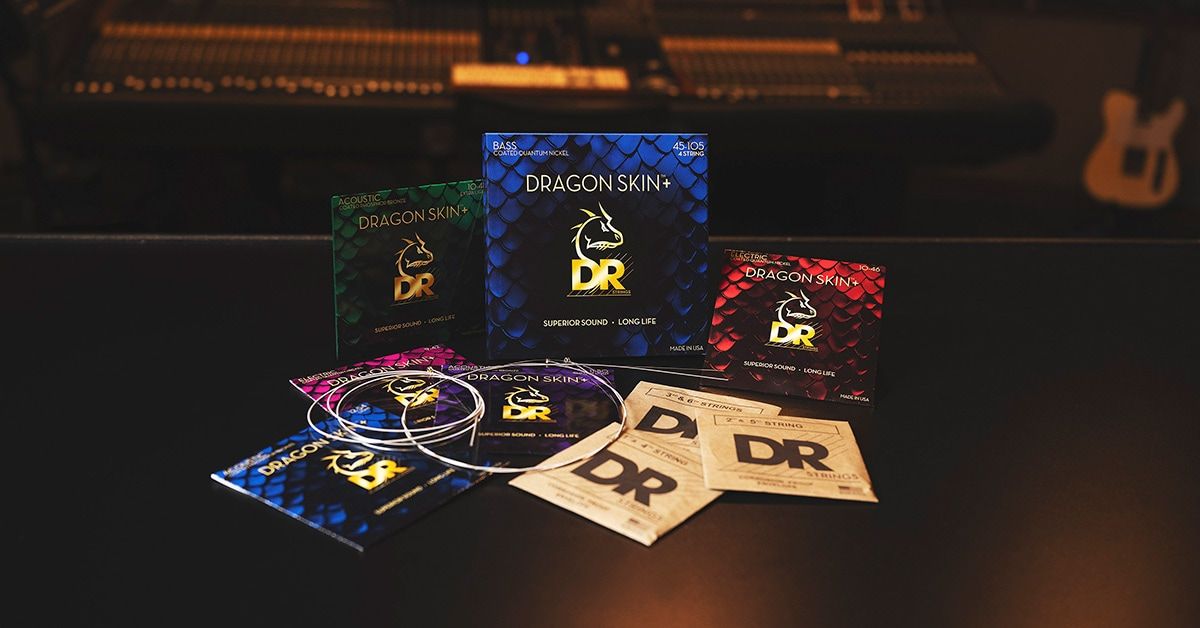

My first experience with DR coated strings was the day I was nearly blinded by them.
Around 2010, while editor of Guitar Player, I was hanging out at a Bass Player Live event—which was basically a mini NAMM show for bassists—at S.I.R. Studios Hollywood. The near-windowless rehearsal and rental facility was reasonably lit, but the illumination didn’t tame the sensory overload when I turned a corner and came upon an entire booth of DR’s new coated and brightly colored Hi-Def NEON guitar and bass strings. I saw flashes of bright green, pink, yellow and orange lines whenever I closed my eyes for the entire day.
The Hi-Def NEON strings were not just designed to shock, amaze and delight when wielded onstage. DR’s patented K3 coating—which made the first-ever day-glow strings possible—offered increased durability and longevity with tones comparable to uncoated strings. The company also offered the less-ostentatious Black Beauties coated string variety in basic black, as well as Red Devils for those looking for a pop of color who aren’t into day-glow.
In 2011, DR Dragon Skin strings appeared. This formulation also incorporated the K3 coating, but without the neon, noir and crimson hues for players more comfortable with traditional-looking strings.
However, even with four popular coated string options available to electric and acoustic players, DR wasn’t done tinkering with the assortment. A significant upgrade made the scene in 2024 with the Dragon Skin+, which sought to terminate any remaining objections to the feel and tone a player might have regarding coated strings.
Let’s dig in, put a set of Dragon Skin+ strings on an electric and acoustic guitar, do some real-world tests and see if DR achieved that goal.

Pictured: DR Dragon Skin+ Coated Strings
Table of Contents
What’s the Difference Between DR Dragon Skin and Dragon Skin+ Strings?
But first, how are Dragon Skin+ strings a more evolved version of the original Dragon Skins? Longer string life is always a goal of coated strings, and the initial Dragon Skins nailed that objective. However, Dragon Skin+ strings up the ante by also offering more output, improved tuning stability, a more natural feel, and a livelier tone with enhanced resonance and sustain.
Here are the major factors of the upgrade:
- Micro-thin Coating. By minimizing the coating, Dragon Skin+ strings retain the benefits of protection and longevity, but deliver a finger-to-string feel that’s very close to that of uncoated strings. Essentially, you can say goodbye to the slip-and-slide, plastic-like sensation that typified coated strings for some players. In addition, the K3 coating is applied to the outer wrap wire before it is wound around the string, allowing it to vibrate naturally.
- Accurate Core Technology. DR’s patented microscopic locking grooves on the core wire grab the wrap wire like a python, resulting in better intonation and tuning stability, richer harmonic content, reduced string breakage and even a few tonal benefits.
- Tone Profile. DR tackled the perception that coated strings lack sparkle, can sound dry and compressed, and diminish high-frequency overtones. The new formulation appears designed to offer increased volume, more richness and “ring,” longer decay times and enhanced articulation.
|
Feature |
Original Dragon Skin |
Dragon Skin+ |
|
Coating |
K3 |
Micro-thin K3 |
|
Core |
Conventional round |
Accurate Core Technology (cradles the first wrap wire) |
|
Feel |
Smooth and slightly slick |
More like uncoated strings |
How I Tested the DR Dragon Skin+ Electric and Acoustic Strings
I wanted to subject the Dragon Skin+ strings to real-world situations that have bedeviled my choice of strings since I first started learning songs by listening to 45 RPM singles. (Yeah. It has been a while.) Your experiences and needs may be different, but I hope these tests will offer some helpful insights.

Pictured: DR Dragon Skin+ Coated Quantum Nickel Electric Guitar Strings (10-46)
The Strings. I reviewed a DR Dragon Skin+ Acoustic Coated Phosphor Bronze Medium set (.013-.056) and a DR Dragon Skin+ Electric Coated Quantum Nickel set (.011-.050).
The Guitars. The acoustic set was applied to my Gretsch G5022CE Rancher Jumbo cutaway. It’s not an expensive instrument, but it sounds great in the studio for solo acoustic figures and layered overdubs. (My fave textural technique is two parts tracked for the left channel and two parts tracked for the right, panned in hard stereo.) I played the Rancher around the house, and then miked it in my studio with an AKG C414 XLS positioned off-axis to the soundhole at a distance of about one foot and an AKG C151 pointed at the 12th fret from approximately two feet away. The electric set was put on my beautiful Collings 290 armed with two Lollar P-90 Soapbar pickups and a Bigsby. I played the Collings acoustically and I also plugged it into my classic red-colored VOX AC15C1.
The Studio Session Quick String Change. You’re in the middle of an hourly session at a pro studio. The producer says your guitar sounds dull and asks you to change all of the strings immediately. (Yes—this really happens.) The clock is ticking, so you know you have to get those strings replaced fast. Plus, the entire band is looking at you like you’re some kind of rank amateur who is single-handedly tanking the recording budget. Speed is of the essence. So, in this case, I simply put the strings on and started tuning them right up. I did not take the time to stretch them out at various moments during the tuning process—which is the recommended practice. Did the Dragon Skin+ strings tune up and hold their pitch during such a rapid deployment?
The “Oops, I Left My Guitar in the Sun” Tuning Integrity Test. We all know the weather loves to mess with tuning. However, coated strings are supposed to resist temperature and humidity changes better than uncoated strings. I once made the mistake of leaving my Les Paul—strung with conventional strings—onstage while performing at a Gilroy Garlic Festival where the temperature hit 106 degrees. By show time, that Les Paul was parked in the key of Z minor—totally unplayable. It wasn’t that hot when I tested the Dragon Skin+ strings at home, but I left the Rancher and the Collings in my backyard basking in direct sunlight to see how the heat affected tuning. Then, to be even more evil, I tossed both guitars on the couch in an air-conditioned room. Could the Dragon Skin+ strings stay in tune?
Subjecting Strings to Furious Pick Attacks and Careening Dynamics. I came up during the first era of ’70s punk rock, so I can pummel guitar strings like The Hulk. This is not typically a good thing. I broke so many strings when I was a younger, more buckaroo-style guitarist. But I still have my moments, so after tuning the acoustic and electric Dragon Skin+ strings to pitch, I wailed on them mercilessly to see if I could snap the high strings and/or knock them out of tune.
Tremolo Terror. Bigsbys aren’t the best tremolos for aggressive warbles and extreme dive bombs, but they can still wreak havoc on tuning if your strings aren’t up to the abuse. I tussled with the Bigsby tremolo on my Collings 290 to see if the electric Dragons winced.
Did the DR Dragon Skin+ Electric and Acoustic Strings Survive the Torture Tests?
They did. These coated strings are as tough as Navy Seals.
However, toughness isn’t necessarily the main attribute you want from a set of strings. You certainly want the intonation and tuning integrity to be impeccable, but the strings also need to feel welcoming under your fingers and produce pleasing tone.
Time to rate the Dragon Skin+ strings from 1 (epic fail) to 10 (awesomeness).

Pictured: DR Dragon Skin+ Coated Phosphor Bronze Acoustic Guitar Strings (11-50)
Initial Stringing: 8/10
It’s a very small thing, but I wasn’t a huge fan of the combo packaging, where strings 1 and 4, 2 and 5, and 3 and 6 are nestled together in the same corrosion-proof envelope. It’s pretty obvious which is which, but my brain still wanted each string to be in its own pack. I’m a neatnik, so it bothered me to have the 4th string hanging out as I dealt with the first, second and third strings and so on.
As I brought each string up to pitch—without stretching them as noted earlier in this article—they would typically slip once, but then maintained tension until the string was perfectly in tune. Both the electric and acoustic Dragon Skin+ strings settled in quite nicely. A few strums, bends and riffs caused the tuning to wander just a tad initially, but a quick retune usually solved the problem and I could have recorded a track right away with no fear of the pitch going sour. As a result, the cranky producer “studio session quick change” test did not humble these coated strings. They were good to go.
Tuning Integrity: 9/10
After the “studio session quick change” evaluation, I set the Rancher acoustic against the fireplace and put the Collings into its case and stored it in the garage. I didn’t touch either guitar until after lunch the next day, so they were neglected for approximately 18 hours. When I grabbed each guitar to start playing, they were both remarkably still in tune. I double checked the tuning using a headstock tuner, but I didn’t need to. I could have done a gig or a recording session immediately.
The previously mentioned tuning torture tests were hardly torment to each string set. The acoustic and electric Dragon Skin+ strings were, for the most part, not bothered at all by my fiendish ordeals. Not surprisingly, the “left out in the sun” test affected the Rancher and acoustic Dragons a bit more than the Collings and electric strings, but the tuning wasn’t terrible—just a bit “off”—and neither variety required a surgical tuneup. I did a quick freshen up and I was back in tune and ready to rock. Similarly, both string sets didn’t seem to mind intense bashing about. I thrashed the strings for about the length of two songs each, and I did need to attend to a flat G string on the Collings and slightly hurtin’ low-E and A strings on the Rancher, but they tuned right up without further incident. The Bigsby wrangling had just a bit more success in messing with the tuning of the Collings, but it was no different than what I experience during gigs with uncoated strings. I tuned back up. No big deal.
Feel: 10/10
To me, Dragon Skin+ strings feel almost exactly like uncoated strings. I felt no difference at all when going between the Collings, the Rancher and all of my other guitars that are strung with uncoated strings. Absolutely seamless. Thanks to DR, I was even able to freak out a fellow guitarist who is vehemently anti-coated strings. He figured I would never befoul my Collings 290 with coated strings, so he started playing around with the Dragon-Skinned Collings as I showed him my new ProCo RAT2 distortion pedal. After about 15 or 20 minutes, I told him he had been playing coated DR Dragon Skin+ strings and I wish I could have grabbed my cell phone fast enough to document his shocked and confused expression. That moment is lost to history, but at his request, I gave him my spare set of Dragon Skin+ coated quantum nickel strings. He may now be a convert.
Tone: 8/10
I must admit, strings have usually sat somewhat low on the tonal signal chain for me. If I like the feel and they don’t break, I’m in. There are so many other elements that add to an electric and acoustic guitar sound—from amps, pedals, signal processors, tone woods, microphones and more—that I unfairly dismissed the role of the string.
But while not expecting much, I was impressed with the big, sparkling and dimensional sound of the DR Dragon Skin+ Acoustic Coated Phosphor Bronze Medium string set. I had strung up the Rancher first, and I was really caught by surprise. Such a huge, rollicking sound. Single-note lines were robust and articulate, and strummed rhythm parts possessed shimmering overtones.
I rushed to string up the Collings, and the DR Dragon Skin+ Electric Coated Quantum Nickel set delivered comparable sonic giddiness. Clean tones glistened with vibe, translating finger and hand dynamics with precision. Sustain was somewhat muted compared to the uncoated strings on my other guitars, but I doubt an audience member would go, “Hey, I noticed a millisecond less decay on that strum. What’s up?” Of course, sustain wasn’t a problem for crunch and saturated sounds, and the electric Dragons leapt out of dense rhythmic mixes with ferocious clarity.
Even allowing for the fact the Dragon Skin+ sets were new strings compared to the more worn-in sets on my other guitars, I dug the broad, three-dimensional frequency range they produced. It was even cooler realizing that, because these are coated strings, that initial impression of fabulous tone will likely showcase itself for weeks to come.
Pictured: DR Dragon Skin+ Coated Quantum Nickel Bass Guitar Strings (45-105)
Dragon Strings Are Not to Be Feared
Advances in coated and uncoated string technology have been rather stunning the past few years. So much so, that I run into lots of players on gigs and sessions who just can’t stop themselves from jabbering about their latest and greatest string find. Whatever brand you swear by, improvements in string formulations are good for all of us.
Like mythical dragons—at least until the advent of the cuddly How to Train Your Dragon flicks—coated strings were once feared, misunderstood, dismissed and vilified. Today, coated strings may represent nearly a third of string sales in a $1.4 billion market, according to DATAINTELO.
Obviously, more and more electric and acoustic guitarists are trying, embracing and using coated strings. If you plan to take the plunge yourself, DR Dragon Skin+ strings are a wonderful place to start. These wires are fierce—in a good way.
Written By: Michael Molenda
Michael Molenda is a content strategist, editor and writer for Guitar Center, where he has worked since 2022. He is the longest-serving Editor in Chief of Guitar Player (1997-2018), and former Editorial Director of Bass Player, EQ, Keyboard, Electronic Musician, Gig and Modern Drummer. A guitarist, drummer, bassist and producer, Mike co-owned three pro recording studios in San Francisco, and performs with Surf Monster and The Trouble With Monkeys.
Recently Added to Gear Tips


Be the first to know about exclusive offers, tips and more.

866-498-7882 English
877-687-5402 Español