.jpeg)

Pro Gear Advisers
•866-498-7882
An Evening With TOKiMONSTA and the AlphaTheta CDJ-3000X at Guitar Center Hollywood
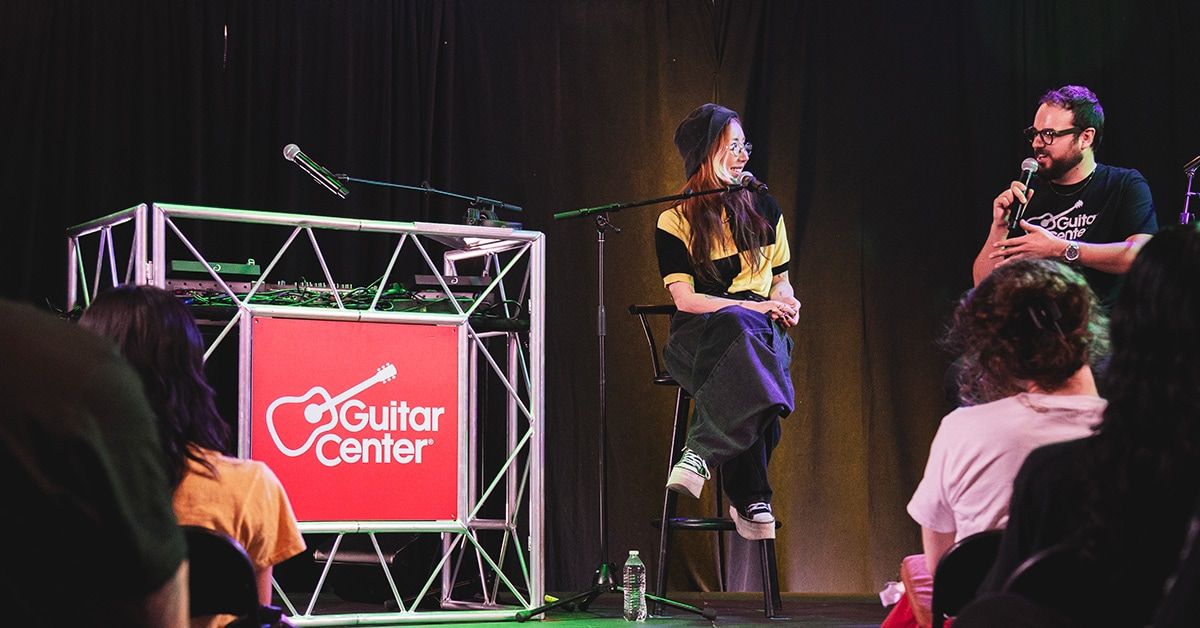
L.A. native electronic artist TOKiMONSTA descended upon the flagship Guitar Center store on Sunset Boulevard Thursday night, October 2, to a particularly packed house of enthusiastic fans and fellow producers and DJs. The event consisted of a livestreamed Q&A session, accompanied by demonstrations of her workflow on AlphaTheta’s CDJ-3000X.
The producer/DJ detailed her journey as an artist, explaining how she landed on using Pioneer DJ—now AlphaTheta—CDJs for her live sets after a period of using a MIDI controller/laptop rig. Championing her “Music is for everyone” approach, she touched on her various influences, her blending of styles and how the CDJ-3000X’s feature set helps her focus on what matters most: the music.
As a special bonus, fans were treated to new music in addition to some classics from her discography and live DJ repertoire.
After the livestreamed portion of the event, she generously took the time to answer audience questions, and held a meet and greet where she signed memorabilia and chatted with fans one on one.
TOKiMONSTA's Approach to Music and DJing
TOKiMONSTA’s trajectory as an artist naturally includes the story of her transition to using CDJs. “Unlike a lot of my peers, I did not start off DJing. I started off making beats, mostly in the realm of weird hip-hop beats. And I think as a producer, the most sensible way to perform is to DJ your music—or find (another) way to perform your music live.
“So, I definitely have different versions of what it means to perform. Some of it is like more ‘concert live,’ and then there’s DJ sets, which are a little more dancy.
“I used to make a lot of lo-fi beats, and the one thing that’s important in that world is swing and movement. Obviously, a lot of music is very quantized and very 4/4—but I love when there are ways to DJ and make music that still has a lot of movement even though it’s at a set BPM.
“Sometimes you gotta push people to the point of slight discomfort or surprise people. Sometimes a whole DJ set is like one long song … if you do it right. [Laughs]”
TOKiMONSTA on Using Technology to Create
“We are always at the mercy of the tools that we have, and a lot of beautiful things can come from that, right? Even if you only have a drum machine and guitar, you can make some really cool music with that—better music than if you had a bazillion instruments.
“I’m not a band, so there’s not a lot of other ways to play your music other than DJing it in some form. Initially, the way I performed my music was through loops and these very performative tools through my computer. And now that CDJs have evolved, you have these two worlds merging. I can do something that feels very live, personal and fluid with CDJs that I couldn’t do years ago.
“And when you have something as simple as CDJs, it’s not hard to DJ. Everyone can learn technically how to DJ. It’s everything outside the technical skills that make you a really good DJ.
“Through using these CDJs, it’s shaped a lot of how some of my current music has been moving. I love this different part of my brain I get to use when I’m DJing versus when I’m producing music.”
And speaking generally on the use of technology, like Splice loops or AI, TOKi lays out her philosophy: “These tools are available for us to use and not to abuse, for us to take these tools to still be original and not derivative. So, depending on how you’re using things like AI and sample packs, are you still making art while you’re using it? Are you using those tools to copy someone else, to take art away from someone else? If you’re using any tool to really create something original that allows you to speak for yourself as a musician, then I’m all about it.”
The Influence of CDJs on Modern DJ Culture
The gold standard of media players, the CDJ is ubiquitous, which TOKi called out when discussing its effect on the direction of music. “It’s the main tool that we all use. Since we all have the same tools, what is going to set you apart? Everyone is performing on this wonderful machine, and it gives you all the things for you to be an individual.”
She also spoke to its continual improvement over the years. “You have this feedback culture where, as a DJ or performer, we can voice our concerns, and then we see these changes happen through every iteration of the CDJ. I’m someone who hopped in using the CDJ-2000NXS. And just to see the jump has been amazing. All the new features being added in today allow you to do so many cool things. It’s pretty sick.
“It's also a very sturdy piece of hardware. As a person who used to go around with my laptop and my MIDI controller—they’re very flimsy. So, it’s nice to not have to lug all my stuff on my back. I still have this wonderfully thought-out performance set, but in a format that travels easier and that can withstand a lot.”
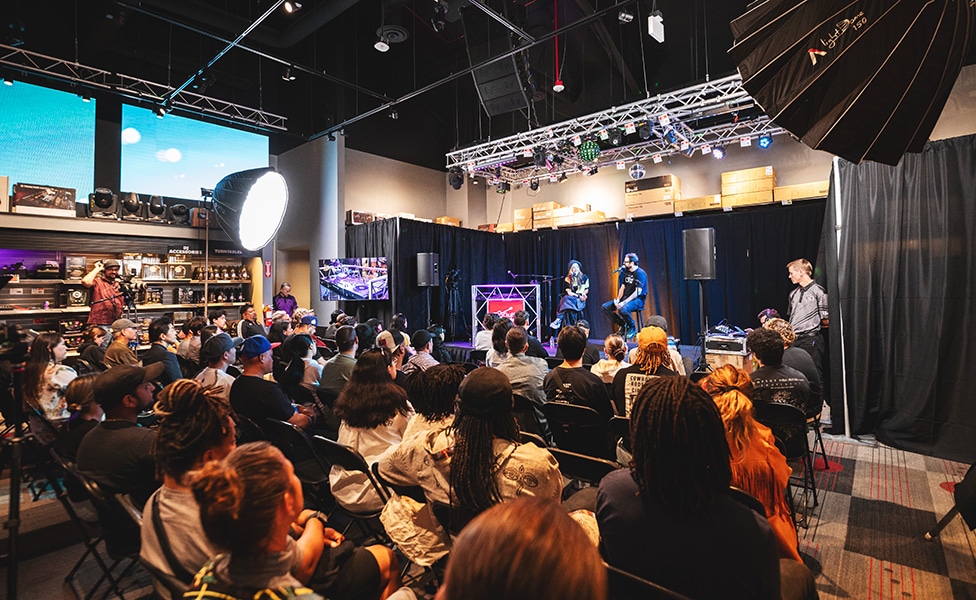
Pictured: Audience at Guitar Center Hollywood for TOKiMONSTA CDJ-3000X Livestream Workshop
TOKiMONSTA Demonstrating the CDJ-3000X
As she stepped up to the CDJ-3000X decks, she announced the first major upgrade, “What I really like about the new CDJs is that you can use USB-C—it’s happened!”
And while she played her first track, a new one titled “It Feels,” she gave audience members insight to her some of her go-to features. “One of the things is: I actually use the old-school tracker on the grid on top—I don’t use the waveforms—to me, it makes the most sense. This feature was on the earliest CDJs, and I still like it.
“A feature that’s highly underutilized is Beat Jump. But if you do use it, it’s pretty sick. You can move back eight bars—also 16, 32 or 64, but the default is four bars. Depending on what your needs are, you can just skip that build and get straight to the good stuff.
“I have a short attention span, and sometimes I’m not paying attention to every single thing I’m doing. So, active memory loops are really important for me. Even if I’m setting up something on another CDJ, I always have a drum loop set up on a lot of my tracks, so that it’s looping constantly.”
Later on, while playing “Switch It,” she demonstrated how she drops Hot Cues into the waveform itself, saving time and introducing an element of spontaneity based on crowd reaction. “That’s the feature I love the most, because sometimes you don’t have enough time to put Hot Cues in. You can perform the song, play it out and add your Hot Cues as you need.”
Next was a track called “Reverie in Rouge.” Taking some inspiration from Daft Punk’s iconic Alive live album, she noted, “I’ll preface this track before I play it. It’s two songs mashed together—my song ‘Reverie,’ which just came out this past year, and ‘Rouge’ off my album Lune Rouge. With this tour, I did a lot of mashups of my own songs—reconfigured so that it will move a crowd.
“My music obviously sounds very different. But if you’ve ever worked with sample libraries or loops, a lot of it is just: ‘What key is the track in? Will it make sense together?’ It’s like this new picture is created with the songs, but from the same palette.
“With the new CDJs—and this is something that I really like—you can edit your playlists now. You can see that on the top of the playlist, I just press Edit, and now I reorder the songs just like that. This has been a real game changer for me, personally … It helps to have a bigger screen, too. I think it used to fit like eight rows of text. It fits 12 now. With that space, you can actually make the text larger and still have eight tracks showing—it’s great.”
And that ease of use frees up the ability to focus on other things. “The more fluid it is to use CDJs, the more that you can do. These are small things that allow me to be a better DJ. Every iteration of the CDJ is getting more and more intuitive.”
Sometimes, it really is the little things. “Another feature I really like—and this is not because I’m a hater, but some people don’t know boundaries—you can hide your tracks now. [Laughs]”
TOKiMONSTA’s Approach to Production vs. DJing
TOKi let the audience in on some of the finer details of her production and DJing workflows, and how they differ from—as well as inform—each other. “It’s interesting, ’cause there are a lot of special effects that we use as producers. A good example is high-pass and low-pass filtering. That’s something I’ve always implemented into all my beats, but where did that come from? DJ culture. There are subtle things you want to mimic from the club, but you also want the club to mimic the thing you hear in the studio.
“You’re like, ‘I want to cut off this effect and have this long decay.’ Why? Probably because it’s something I also do when I DJ. So, they overlap a lot.”
On prepping for a recording session in the studio versus a live one, she explains, “The objectives are very different. When I’m making music, a lot of the music I make is not explicitly dance music, you know? I think music making is more of a ‘selfish’ process. I’m not thinking about other people; I’m thinking about what I want to make. And when I’m DJing, I’m like, ‘How can we all have this shared experience together through the music I’m about to play right now?’ And that’s really important for me.”
When asked about her approach to live DJing, she emphasized progression and buildup throughout the set. “I’m someone who really believes in DJ sets that evolve over time. I’m not about two hours of 150 BPM—that’s not my thing. I like starting typically on the lower range, somewhere around 115, and I will build it up all the way and show the audience—you know, subtly—that all music is related. Maybe I’m playing something more soulful on one end; maybe I’m making something that makes you want to shake your butt more on the other end.
“And the way you bridge those gaps and make it seamless—that’s the artistry.”
On to her signature sound, she divulged a couple secret ingredients to her production style. “Going back to what I said earlier about swing and movement—the more you DJ, the more you do kind of need things to be on a grid—but not everything has to be completely quantized. So, if I’m making music in the 125 range, there’s not that much room for swing. But, if I have my kick and snare on, there’s all that beautiful space in between those to create more motion. There’s still room to add something that feels natural into your music.
“On top of that, warm sounds are really important. I love using crusty samples. Or creating my own—just have a field recording and find ways to integrate real life into your music. Electronic music by default can be very cold, so what can we do to keep it warm? And a lot of that is sonics, melodies, harmonies and chords that you choose. And a lot of it is the movement that is carried within the song.”
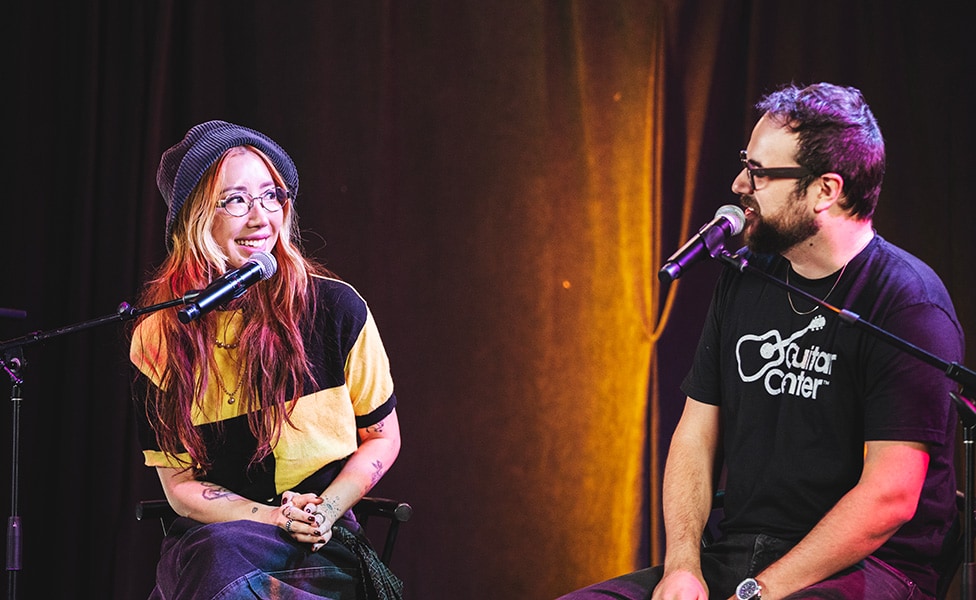
Pictured: TOKiMONSTA On-Stage at Guitar Center Hollywood with Guitar Center's Dustin Hackworth
TOKiMONSTA on Playing to Big and Small Crowds
Asked if she had a crowd size preference, she professed her love for both: “When you’re DJing for a very, very large crowd, it’s like the whole audience is one organism. You’re seeing everyone influence each other, and the crowd also influencing you. When you’re in that sweaty warehouse rave, you’re amongst everyone, so you’re not just controlling or influencing an organism—you are a part of it. You’re just having this really raw and real experience.
“They’re both so amazing, and they have a huge impact on me and what I do as a musician, but you can’t pick one.”
TOKiMONSTA’s Tips for New DJs
Always keen to pass the torch to up-and-coming artists—as she’s done with her record label—she had some wise advice for attendees looking to start their DJing foray. “I think if you’re learning how to DJ for the very first time—specifically on CDJs—have Beat Sync on. That’s where everything is gridded with each other. The songs are just automatically locked in. A lot of DJs really frown upon it, but when you’re learning how to DJ, it’s a really helpful tool. And then eventually, once you figure it out, you can turn it off.
“I don’t use it myself, but when I first started DJing, it was really helpful for me to have because I could just focus on getting the songs to work together and not having to align them and so on.”
She also recommended to not sweat slipups and other performance-related hiccups. “There’s something very human about making mistakes. I have been in front of thousands and thousands of people and made huge mistakes. It’s just really how you carry yourself forward. We love a disaster because it bonds us, and sometimes when those things happen, I’m just like, ‘Hey guys, just so you know, this is real.’ Just bang out another track. So, it hurts when you mess up, but when you come back, it’s just that much more heroic.”
TOKiMONSTA on Creative Inspiration
When asked about her favorite albums of all time, she responded, “36 Chambers – Wu Tang Clan—that’s up there. I really like Smashing Pumpkins. That was like one of my favorite bands growing up. Mellon Collie and the Infinite Sadness is a really good album. My friend Flying Lotus has an album I thought was really iconic called Los Angeles. I’m a fan of a lot of my friends—Anderson .Paak has an album called Venice.”
Following up on what music she’s been inspired by lately, TOKi brought up some classics. “A lot of what I’ve been listening to lately is older music, so I’ve been going back listening to old Portishead, Massive Attack—things that take me back to a different era. It’s been really exciting to go back into the wealth of music that already exists.
“Living in L.A., you’re always in a car. So, it’s a really wonderful time to listen to music. You’re favoriting a song like, ‘I wanna DJ it out later.’”
Drawing upon her heritage and other various inspirations, she mentioned, “I use a lot of Korean percussion in my music. The ability to implement some of my cultural roots in my music has always been important. I’m a product of all my influences. So, I’m really grateful for all the amazing artists that came before me that made the music that inspired me.”
Written By: Drew Beaupré
Drew Beaupré is a multi-instrumentalist, audio engineer and writer. With a bachelor’s in psychology from Purdue and background as a gigging guitarist and drummer, he began his audio career at the world-famous Westlake Recording Studios, before venturing into live sound engineering for clients such as KCRW, Santa Monica College, CSULA and Nyjah Huston—eventually becoming studio manager at Guordan Banks’ Bank On It Studios in downtown L.A. He also has worked extensively with the industrial band Ministry, as an engineer at Al Jourgensen’s studio, as well as domestic and international touring stage tech for DJ Swamp and Joey Jordison. Prior to writing with Guitar Center, Drew has written for Fender and various music blogs.

Be the first to know about exclusive offers, tips and more.

866-498-7882 English
877-687-5402 Español