
.jpeg)

Pro Gear Advisers
•866-498-7882
Schecter Guitar Research | Behind the Build
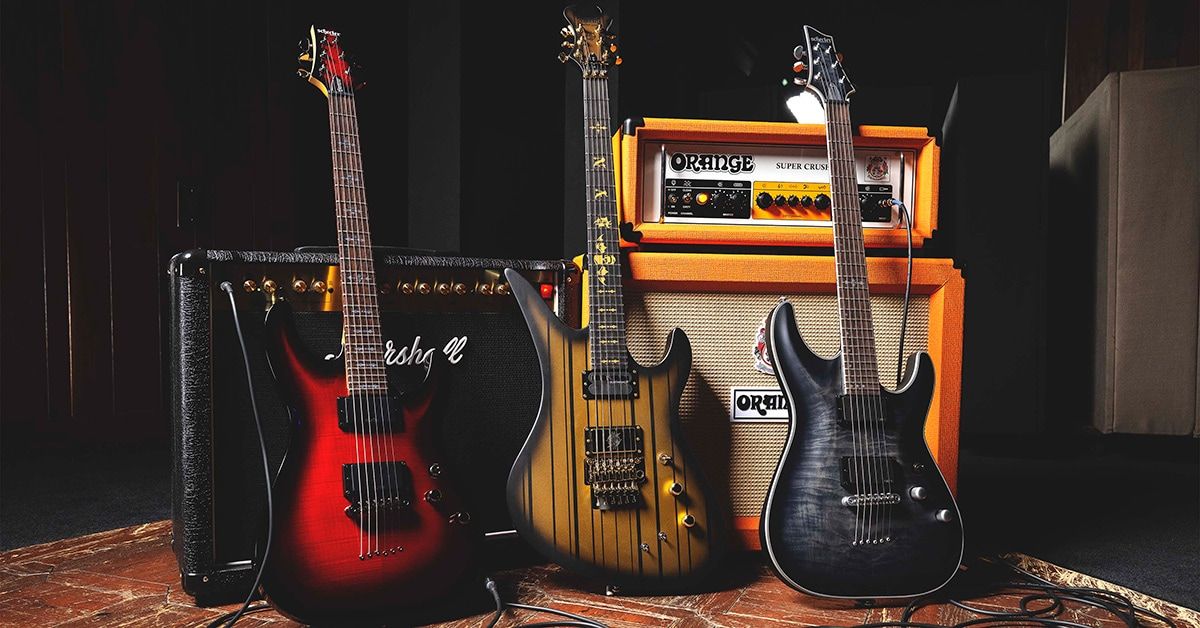

Although Schecter Guitar Research is now one of the biggest “little” guitar manufacturers in the United States, when the company was founded in 1976 by David Schecter, it didn’t make anything except parts. Eight years passed before Schecter started producing complete guitars in 1984, and that was only after the company namesake had sold the business to a group of Texas investors the previous year.
The Schecter we know today started percolating when Japanese entrepreneur Shibuya Hisatake (1937–2024) bought the company in 1987, and discovered Michael Ciravolo, who eventually rose to his current position as CEO and president. Ciravolo moved Schecter away from making guitars based on existing models to focusing on original designs, and his leadership and passion for music helped the company build a formidable artist roster of influential players, including Jerry Horton (Papa Roach), Synyster Gates (Avenged Sevenfold) and Robert Smith (The Cure). In addition to its own designs, Schecter also manufactures Black Label Society and former Ozzy Osbourne guitarist Zakk Wylde’s Wylde Audio guitars.
We decided to examine how Schecter conceptualizes, designs and produces its popular guitar lines, so we sought out Schecter Chief Operating Officer Marc LaCorte, who joined the company in 1998. LaCorte brings us “behind the build” to reveal how the Schecter team serves its customers, approaches innovation and has few hesitations for making something cool that might appeal to a small but enthusiastic audience.

Pictured: Schecter Guitar Research Demon-6, C-1 Platinum and Synyster Gates Custom-S Headstocks
When the Schecter brain trust gets together to design a new model, what kinds of things are they thinking about?
Marc LaCorte: What I always put forward—and I’m not going to lie; it’s a little dig—is that everybody at Schecter has played in a band and is a musician. Some have been very successful making records and doing tours, and some are just rocking out at clubs over the weekend. So, it’s advantageous to us that we understand the needs of semi-professional and professional players. We’ve also seen how expensive guitars have gotten—whether it’s a U.S. custom shop model or an import—and how that impacts players on a daily basis. We take that under consideration as we're building something, as well as looking at the competition, market trends and our own artist roster. Sometimes, we’ll take a model that’s doing really well—such as the C-1—and say, “Well, we don’t offer it with these features at this price point.” Then, we will kind of mold something together to address that combination.
How much does the look of a guitar factor into a player’s desire to buy?
It’s significant. Guitars are all really relative—we have to admit they're all the same components no matter what the brand—so it often comes down to cosmetics and what somebody likes. I always equate it to buying a car. They all drive and stop and do the things they need to do, but someone looks at a particular model and says, “That’s the one I want.” To me, guitars are similar, in that they all play, but a player has to connect with a guitar emotionally first. We all shop like that no matter what, but I think musicians even more so. The good thing is we have a lot of data, so we know what Schecter has historically sold over a 30-plus-year period—orange guitars versus yellow guitars and so on. Interestingly, the plain stuff—such as black colors—always sells more. Now, the data is not always 100% right, but it can lead us in a direction where we can take an educated guess if we’re going to sell 100, 600 or 1,000 of a certain model. Of course, we also talk to our artists and weekend warriors for input. There’s so much we can do nowadays with cosmetics to speak to an individual’s aesthetics.

Pictured: Schecter Guitar Research C-1 Platinum EMG Humbucker and Controls
With more and more people buying guitars online, does it change how you design and market Schecter guitars? For example, as someone may not actually play a guitar in a store before they buy it, and the seduction factor is solely an image and some text on an online product page, are looks initially more important to that buyer than other factors?
As we just discussed, looks are important. Absolutely. But for online buyers, there are other things guitar companies should consider. I think you have one shot to secure your brand's future with that potential buyer, and it’s all about them opening the box and having the guitar play well. Yes, you can make or break a potential customer with how well your guitar plays. This is why Schecter probably has more people in quality assurance than any other department we have. Quality control is one of the most important facets of what we do, and we put the same care into a $300 guitar as we do for a $2,000 guitar. Both guitars go through the same team.
If it’s your first guitar, we want you to love it as much as if it’s your 20th guitar with us. But especially with first-time buyers, that first guitar sets the stage. If a kid is getting into guitar, I feel like that's a huge win, because guitar is just not as massive as it once was. You know, when we were kids, being a rock star was the most important thing in the world. Everyone wanted to play guitar. Now, I have three boys and none of them want to play guitar.
So, to have someone step in and want to play guitar, and take the risk of buying one, you want to give that person something they are going to enjoy playing. Something well made that sounds really good for whatever style they are trying to play. Something diverse in tone and easy to play that doesn't hurt them. You know, the frets are nice and not jagged. These things are important for getting more people interested in playing music. And if we do it right, they may become fans of the brand and continue to support it.
What about hardware and playability?
Some of the players are definitely mentioning things such as, “Hey, this neck profile is really important to me.” Stainless steel frets are a great example of that, as well. They are a huge part of our line now—though they are not on all our guitars—and that request came from artists. Stainless steel fret became the number one thing people asked for.

Pictured: Schecter Guitar Research Demon-6 Humbucker Pickups and Bridge
What do you think prompted those requests?
Everybody has done nickel frets for so long, and you probably do get more wear than with stainless steel. At the end of the day, it wouldn't matter to me all that much, but guitarists who are playing every single night probably have a preference for the hardness of stainless steel, and I’m sure it makes a difference to them. As for the multiple requests, I think it just becomes a sort of “telephone game,” where everybody talks about playing stainless now. It usually works that way for us, because we’ll hear, “I talked to so and so, and he’s using stainless steel frets and I’d like to try that myself.”
It was much the same with the EverTune bridge. We started with them a long time ago—I think we put the bridge on one model. Then, more artists started using EverTune, and over the years, we’ve seen a lot more demand for it on Schecter guitars. When new technology emerges, Schecter tends to embrace it fairly quickly.
When you innovate, are there any “deep breath moments” where you worry if the technology might be too much too soon for guitarists to embrace as rapidly as Schecter does?
We're not a big ship, so if we see something people are asking for, and we think it’s a good idea, we’ll jump in. A perfect example is the Reaper-7—a 7-string, multi-scale electric—which is much more widely available now. But five to seven years ago, there weren't a whole lot of those on the market, and we were pretty quick to jump on it as a sort of mainstream brand. We like seeing those niche things and offering them to the masses.

Pictured: Schecter Guitar Research C-1 Platinum Body Carves
To that point, just how quickly are you able to find something cool and bring it to market?
If it’s an all-hands-on-deck situation, we could essentially get a new guitar to market in nine months—if it's based on an existing model. Say, if we wanted to add features to our C-1 shape, for example. We can get a sample knocked out in 30 to 45 days, and if it's on target and we know the colors we want, we can have production models in about six months. For a lot of the bigger manufacturers, it would probably take at least two years.
Timelines aside, there’s a bravery aspect to trusting your users and your development team to rush out a product without first launching tons of focus groups and other research. That kind of activity probably takes more than six months right there.
I think being a smaller brand puts us in the exclusive position where we can make something that’s really cool, but we know it’s probably only going to sell 200 pieces. We hope those 200 people are going to love it, and maybe they will be Schecter customers for life and try some of our other models. For some of the bigger guitar companies—yeah, I’d doubt they’d redraw designs and tool up for bringing something new to market that could only sell X number of pieces. It doesn’t mean they don’t want to, it simply doesn’t make sense for them from a financial standpoint. Schecter doesn’t have that limitation. I mean, brave and stupid is kind of the same for us. We may look brave, but we make mistakes. We’ve brought guitars to market that didn’t sell. But you can’t know that beforehand. We take the view of “maybe there’s a space for this in the market.” Sometimes we win, and sometimes we lose, but go, “Well, we did it. We took the risk and we brought something cool out.” We actually do sit down and play the guitars. We listen and we get it, and we hope other people have the opportunity to get it. We're not afraid to fail at something.

Pictured: Schecter Guitar Research C-1 Platinum Fretboard
How do you know when you’ve nailed a build?
Well, we're always going to say we think we make the best guitar for the money, considering the construction components and the setup. I think that has been very successful in our relationship with Guitar Center. The company is getting a great, branded guitar that has a vast artist audience behind it, and when it arrives, it's playable. I guess that matters to us as players. I mean, I’ve taken some stuff off the rack at music stores, and thought, “Wow, I would kill my guys if a Schecter left the shop in this condition.” I'm not saying we don't miss things or make mistakes. When you're making thousands of guitars, some things can slip by. But we take care of our customers, and if something is wrong when it leaves our hands, we make sure the gear is made right.
Are you ever tempted to revisit previous models and reengineer them?
If we make something and it's successful, we don’t try to reinvent the wheel. Our position is usually, “People like this. It's a successful guitar. We nailed it and we're not going to try to tell its fans we know better than them.” Maybe we'll experiment with new colors, but we don't change features for a public who have already embraced something that makes sense for them.

Pictured: Schecter Guitar Research Synyster Gates Custom-S Pickups and Controls
Something that has always given me pause is, I’ll mention Schecter to a player, and seven times out of ten they’ll say something like, “Oh yeah, the metal guitar company.” I’ve owned or played numerous Schecters throughout the years, from the original surf-y Banshee to the Hellcat, PT Fastback (with Bigsby), Stargazer, Ultra, semi-hollow Corsair and a lovely 2014 WWII Warbirds “Bomber Girl” given to me by Schecter CEO/President Michael Ciravolo because we’re both B-17 nerds. None of these models could even remotely be considered “metal” guitars. What gives?
It is interesting that we got pigeonholed, but I think a lot of it was that Schecter blew up around the 2000s, with Papa Roach being one of our main rocket rides, along with about 12 other bands from those metal days. But we work with so many different styles. Like The Cure has been with us for more than 20 years. We have a very diverse line. In fact, we joke Schecter is the Swiss Army knife of guitar companies, because you’d be hard pressed not to find what you want in our line. We have something for everyone, whether it’s a semi hollowbody or a retro-looking model with three mini humbuckers. But, yes, we probably get overlooked by a lot of people who recognize us as a metal guitar company. Truly, whenever we post something on social media, someone will always go, “Wow. I had no idea you made that kind of guitar.” And it has been in the line for 20 years, which is frustrating for us. How do you navigate that? But on the upside, Schecter has grown tremendously in the last five to ten years, so obviously the direction the company is going right now, and what we're offering, is resonating with people.

Pictured: Schecter Guitar Research Demon-6, C-1 Platinum and Synyster Gates Custom-S
A Selection of Schecters
Well, it’s kind of mean to get deep into the manufacturing process of Schecter Guitar Research without actually showing you some selected models. We’ve chosen eight guitars that show the company’s diverse range.
Schecter C-1 Electro Resin
Built for shredding. The Schecter C-1 Electro Resin makes a bold statement with its electro-resin burn finish over a striking flame maple top, black hardware and a pale moon ebony fingerboard.
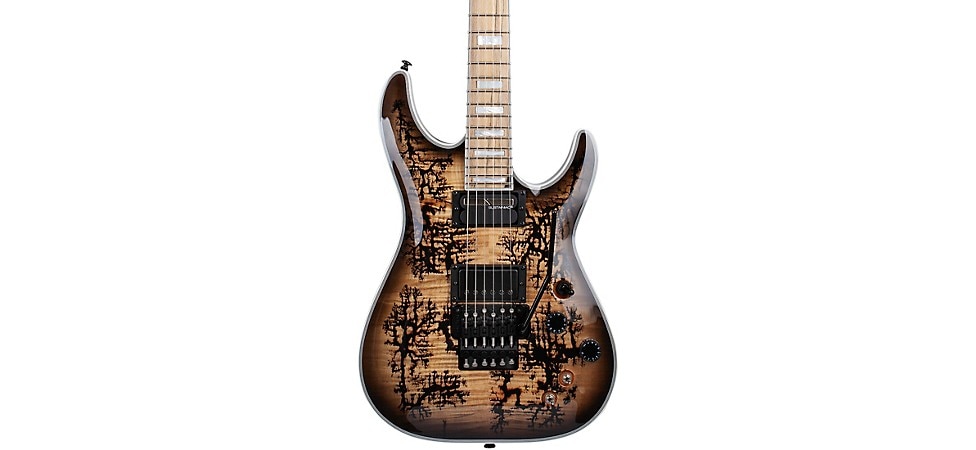
Shop Now: Schecter Guitar Research C-1 FR-S Electro-Resin
Schecter C-1 Platinum
Built for articulate punch. The Schecter C-1 Platinum struts a none-more-black silhouette and active EMG81 and EMG85 pickups for searing, high-output tone.

Shop Now: Schecter Guitar Research C-1 Platinum in Translucent Black
Schecter C-1 Platinum FR S
Built for infinite sustain. The Schecter C-1 Platinum FR S is loaded with one of my favorite pickups of all time—a Sustainiac. Paired with a Floyd Rose Special tremolo, the C-1 Platinum FR S is the perfect machine for crafting cinematic textures and astounding, off-kilter solos.

Shop Now: Schecter Guitar Research C-1 Platinum FR S in Satin Crimson Red Burst
Schecter Demon-6
Built for riffs. Armed with a basswood body, maple neck, rosewood fingerboard and Schecter Diamond Active HB-1055 humbuckers, the Schecter Demon-6 is ready for unleashing super heavy, crushing licks. Want to go even heavier? Jump to the Demon-7 7-string.

Shop Now: Schecter Guitar Research Demon-6 in Crimson Red Burst
Schecter Omen Extreme-6
Built for versatility. Who says you can’t get heavy and still explore sparkling and shimmering tones? The Schecter Omen Extreme-6 offers push-pull coil-split controls for the Schecter Diamond Plus high-output humbuckers in the neck and bridge positions.

Shop Now: Schecter Guitar Research Omen Extreme-6 in Ocean Blue Burst
Schecter Reaper-7 MS
Built for iconoclasts. The Schecter Reaper-7 MS is a 7-string multiscale electric that offers clarity and punch across the guitar’s entire range with maximum playability. If you have a musical idea—even a bizarro down-tuned one—the Reaper-7 will be ready to make it real.

Shop Now: Schecter Guitar Research Reaper-7 7-String Multi-Scale in Sky Burst
Schecter Solo-II
Built for classic rockers. The Schecter Solo-II modernizes a classic guitar shape and updates the sound—via Schecter Pasadena and Pasadena Plus humbucker—so your ’70s-inspired playing isn’t confined to dad or mom rock stylings.

Shop Now: Schecter Guitar Research Solo-II Custom in Satin Aged Black
Schecter Synyster Gates Custom S
Built for absolute rock stars. Totally magnificent. The Schecter Synyster Gates Custom S is a revelation in looks and tonal power. There’s nothing to hold you back from claiming your iconic destiny. With its mahogany body and neck, ebony fingerboard, Synyster Gates signature humbucker and Sustainiac pickups and Floyd Rose 1500 tremolo, this beast is made for mayhem, beauty and astonishing fans.

Shop Now: Schecter Guitar Research Synyster Gates Custom-S in Satin Gold Burst
You Know How They Build Them—Now Play One
If you want to explore a more comprehensive lineup of Schecter Guitar Research models, check out our Schecter collection. And while LaCorte explained Schecter offers “something for everyone,” if that something is heavy, you can just cut to the chase and read "The Best Schecter Guitars for Metal." You can also ask one of our knowledgeable Gear Advisers to help you find the best Schecter for your style, music and sonic needs, or stop by your local Guitar Center and try out some guitars in person.
Written By: Michael Molenda
Michael Molenda is a content strategist, editor and writer for Guitar Center, where he has worked since 2022. He is the longest-serving Editor in Chief of Guitar Player (1997-2018), and former Editorial Director of Bass Player, EQ, Keyboard, Electronic Musician, Gig and Modern Drummer. A guitarist, drummer, bassist and producer, Mike co-owned three pro recording studios in San Francisco, and performs with Surf Monster and The Trouble With Monkeys.
Recently Added to Interviews

Be the first to know about exclusive offers, tips and more.

866-498-7882 English
877-687-5402 Español