

Pro Gear Advisers
•866-498-7882
The History of JBL
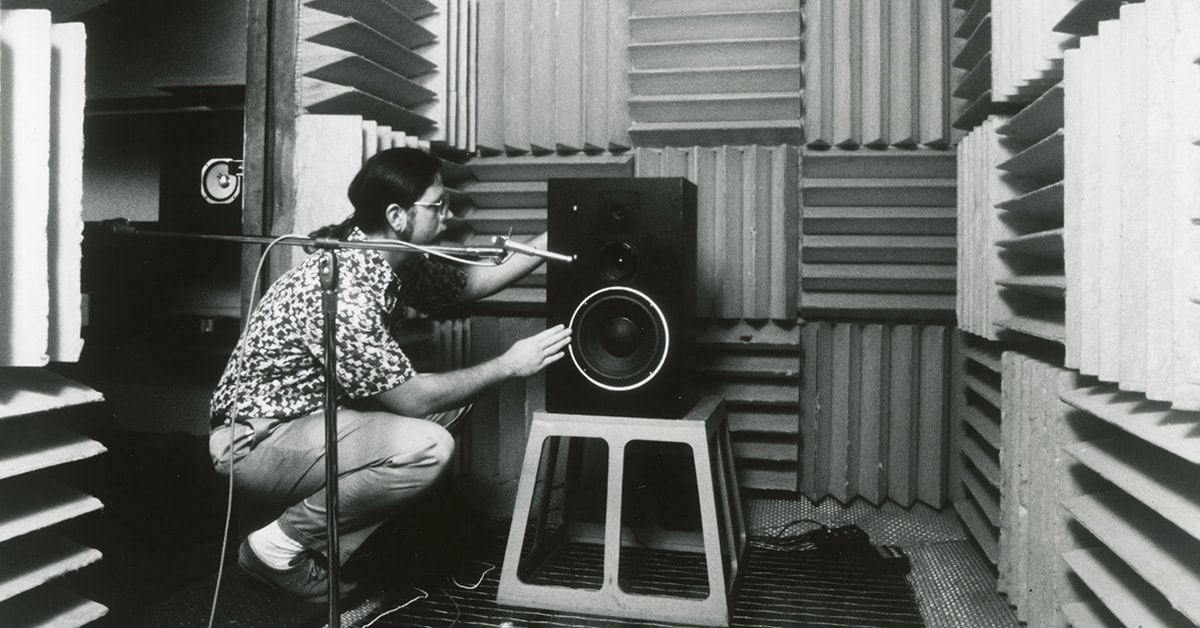

From its founder's early experiments with radio loudspeakers to the stadium-filling systems of today, JBL has been at the forefront of audio innovation since the company's founding in 1946. The case can be made—convincingly—that no single manufacturer has done more to shape the sound of modern live performance and recording studio monitoring. This is the story of how that happened, why it matters to every musician and audio professional who's ever stood in front of a speaker cabinet or sat behind a console and what JBL has to offer today that will make your musical life better.

Pictured: JBL L100 Classic Speakers
Table of Contents
The Roots of Big Sound
The story of JBL begins not in 1946, but two decades earlier, in a Salt Lake City basement. James Bullough Lansing—born James Martini in a small Illinois mining town in 1902—was already obsessed with sound. By age 10, he'd built a Leyden jar to play tricks on neighborhood kids. By 12, his homemade crystal radio was reportedly powerful enough to disrupt naval communications and attract the attention of federal authorities. They made him dismantle it. They couldn't make him stop thinking.
By 1927, Lansing and his business partner Kenneth Decker had relocated their nascent loudspeaker operation to Los Angeles, registering the Lansing Manufacturing Company as a California corporation. The timing was fortunate. Hollywood was transitioning from silent films to sound, and MGM needed speakers worthy of its ambitions—and its 2,000- to 5,000-seat Loews theater chain.
What followed was one of the pivotal moments in audio history. MGM's chief sound engineer John Hilliard, working with Lansing and a team that included engineers from RCA and Bell Labs, developed the Shearer Horn System—a two-way design that solved the echo and distortion problems plaguing existing theater systems. Lansing built the drivers, including the landmark model 284 compression driver, and the results were so significant that MGM received an Academy Award in 1936 for excellence in sound technology. The Shearer Horn work also introduced Lansing to Alnico V magnets—a material that would define JBL's driver design philosophy for decades, delivering the efficiency, power handling and dynamic authority that would become the company's signature.

Pictured: James B. Lansing, Founder of JBL
In 1941, Lansing Manufacturing was acquired by Altec Service Corporation, forming Altec Lansing Corporation. For the next five years, Lansing continued to push his engineering forward, collaborating with John Hilliard on what would become the Voice of the Theatre system—the industry standard for cinema sound through the 1940s and well beyond. He also developed the 288 compression driver and the 515 woofer, both of which would prove to have very long shadows indeed. Perhaps most significantly, Lansing was part of the team that developed the 604 Duplex—a coaxial two-way driver that went on to define studio monitoring for a generation, and influence JBL's own monitor designs years later.
When Lansing left Altec in 1946, he carried that accumulated engineering knowledge with him directly into his new venture. The D-101, his first product under the James B. Lansing Sound banner, bore clear kinship to the 515 woofer he'd just left behind. The D-175 compression driver traced its lineage openly to the 802. The D-1000 system was a refined successor to the Lansing Iconic. This wasn't imitation—it was a craftsman continuing to develop his own ideas on his own terms. JBL wasn't a fresh start. It was the next chapter of a story already two decades deep.
JBL Is Born
Lansing Sound Incorporated was registered as a California corporation on October 1, 1946. The name would soon change—at Altec's request—to James B. Lansing Sound, Incorporated, a formality that had the unintended effect of putting Lansing's full name and reputation front and center on every product he shipped.
What followed was a remarkable burst of creativity. In rapid succession, Lansing introduced the D-130—a 15" high-efficiency speaker featuring a 4" edgewound aluminum voice coil built to tolerances that were, at the time, without precedent in the industry—along with the 12" D-131, the 8" D-208 and the D-175 compression driver. The D-1000 two-way system paired the D-175 with a new multicellular horn and the D-130A in a package clearly descended from the Lansing Iconic he'd developed at Altec. His friend and marketing collaborator Norman Neeley coined the phrase "A Jim Lansing Signature Speaker" to capitalize on exactly that reputation.
The operation was small—a workspace inside the Marquardt Aviation facility in Van Nuys, three employees and Lansing himself doing whatever needed doing, including building enclosures by hand. But the products that emerged from that modest shop were anything but modest. The engineering DNA established in those first years—massive Alnico V motor structures, edgewound aluminum voice coils, aluminum foil center domes for extended high-frequency response—would define JBL's transducer philosophy for decades.
Unfortunately, Lansing would not live to see his company become one of the defining forces in both live sound reinforcement and studio reference monitoring. He passed away in September 1949, leaving behind a small but technically formidable company and a body of engineering work that pointed clearly toward the future.
That future would be built by William H. Thomas—a physicist by training, an entrepreneur by temperament and the man who had helped forge the business relationship that kept Lansing's operation alive during its earliest years. Thomas assumed operational control of JBL immediately, and with a personal capital investment of $10,000 to stabilize the company, matched by a $10,000 life insurance payment on Lansing's death—the founder's last, unintentional contribution to the enterprise he'd built—what had been a tragedy became, in retrospect, a turning point.
Bill Thomas and the Future of JBL
Bill Thomas was not an audio engineer by trade. He held a physics degree from UCLA and had built his career in acoustic engineering for the aeronautical industry—engine silencers and jet noise simulation. But he had an engineer's respect for technical excellence, a businessman's instinct for market positioning and a clarity of vision about where JBL needed to go that would prove transformative.
Thomas's strategy rested on three pillars. The first was aesthetics—the conviction that industrial design was not decoration but differentiation. He hired noted graphic and industrial designer Alvin Lustig, whose work elevated JBL's enclosures from functional objects to what collectors would later prize as artifacts of mid-century design. The second pillar was engineering excellence, which Thomas secured by bringing in Bart Locanthi—a Caltech-trained physicist who would become JBL's most important technical mind of the era, responsible for the 375 compression driver, the LE driver series and some of the most significant acoustic innovations in the company's history. The third pillar was prestige marketing, led by Ray Pepe, whose Hollywood connections put JBL systems in the homes of Frank Sinatra, Bing Crosby and Mel Tormé—and made sure everyone knew it.

Pictured: JBL Worker Building Speaker Cabinet Circa 1970
The strategy found its fullest early expression in the Hartsfield of 1954—JBL's first Project Speaker, a corner horn design using the company's finest components that Life magazine promptly declared "the ultimate dream speaker." According to Thomas's wife Margaret, the Hartsfield and the publicity it generated quite simply "made" JBL.
The Paragon of 1957 pushed the vision further still. Designed around an acoustical concept developed by engineer Richard Ranger and given its iconic form by industrial designer Arnold Wolf, the Paragon used a curved diffraction panel to create a wide, stable stereo soundfield. It was a piece of furniture, a work of art and a serious loudspeaker simultaneously—and it remained in JBL's catalog for 26 years. On the collectors' market today, it commands prices that dwarf its original selling price by an order of magnitude.
Thomas had done what he set out to do. JBL wasn't just surviving—it was defining what a high-end loudspeaker company could be.
From Movie Houses to Music Spaces
To understand what JBL meant to the working musician of the late 1960s and early 1970s, you have to understand what came before.
For most bands playing clubs, ballrooms and outdoor festivals, the PA system was an afterthought—a row of small, column-mounted speakers barely capable of lifting the lead vocal over the din of the band. These systems were designed for speech reinforcement in gymnasiums and auditoriums, not for music. They had the headroom of a polite conversation and the frequency response to match. If the kick drum and bass guitar were audible at all through the mains, that was a bonus.
Against that backdrop, the repurposed movie theatre speaker system was nothing short of a revelation. Horn-loaded, high-efficiency, capable of filling a large space with clarity and authority—these systems had been engineered to deliver dialogue and orchestral soundtracks to audiences of thousands, and that engineering translated directly into live music applications that nothing else of the era could match. The cellular horns projected where column speakers merely suggested. The high-efficiency drivers delivered clean, articulate sound at levels that didn't dissolve into mush. For the first time, a vocalist could be heard not just above the band, but as part of it.

Pictured: Vintage JBL Cabaret Series 4680A Line Array Column
This was the sonic aspiration of an entire generation of working musicians—the sound they heard at the big shows, the sound they saved up for, the sound that redefined what live performance could be. JBL, with its deep roots in exactly that cinema engineering tradition, was perfectly positioned to meet that moment. The same technology that had filled the Loews theatre chain was about to find a new home on the concert stage.
That moment arrived in the summer of 1969, on a farm in Bethel, New York. The sound system that carried the music of Woodstock to nearly half a million people was built largely around JBL components—the same high-efficiency drivers and horn-loaded enclosures that had their roots in MGM's Loews theatre chain. What had begun as cinema sound had become the sound of a generation.
From the Control Room to the Living Room
JBL's path into the recording studio began, characteristically, with someone else's mistake.
In the early 1960s, Altec Lansing—then the dominant force in studio monitoring—made the decision to replace their legendary 604 Duplex with a new version that used smaller, cheaper magnets. Rather than positioning it as a lower-cost alternative, they marketed it as a straight replacement at the same price. The studio community noticed immediately. Sales suffered, and engineers began looking for alternatives.
Capitol Records was among the first to come calling. Their chief engineer approached JBL about developing a dedicated studio monitor, and the result was the D50 series—essentially JBL's existing component kits in a purpose-built enclosure. Capitol was impressed enough to standardize on JBL systems across all their studios. Their parent company EMI followed suit worldwide. The foothold became a foundation.
By 1968, that foundation had produced the 4310—a compact three-way monitor designed to capture the sonic character of the 604 in a smaller package suitable for the new generation of independent studios and nearfield placement on console bridges. It wasn't designed to be the most accurate speaker in the room. It was designed to be the most useful—a consistent reference that engineers could trust and work with. They did, in enormous numbers. By the mid-1970s, industry surveys showed that JBL had captured a clear majority of the studio monitor market, completely displacing Altec from a position they had held for decades.

Pictured: Vintage 1970s JBL Loudspeaker Systems
That professional dominance created an opportunity that JBL's new owner, Dr. Sidney Harman, was quick to recognize. The 4310 was repackaged for the consumer market as the L100 Century—same drivers, same basic architecture, new walnut cabinet and the sculpted foam grille that would become one of the most recognizable design signatures in audio history. Marketing head Larry Phillips built the campaign around a simple, powerful idea: These are the speakers the professionals choose. In a market full of aspirational audio gear, that was an almost irresistible proposition.
The L100 became the best-selling hi-fi loudspeaker of the 1970s. Its cultural apotheosis came in a Maxell cassette advertisement—the famous "Blown Away" image of a man pinned to his chair by the force of his stereo, an L100 visible in the corner of the frame. It was the speaker as icon, and JBL had earned it.
The Speaker That Spoke Back
JBL's influence on the sound of electric guitar is a story that begins in 1963, with the introduction of the F-series—a dedicated line of ruggedized musical instrument drivers developed in response to the exploding demand of the amplified music market. The starting point was JBL's existing 12" and 15" drivers, modified with tougher suspensions, treated surrounds and slightly wider voice-coil gaps to handle the punishment that working musicians were now routinely delivering. The F designation was a nod to Fender Musical Instruments—JBL's largest customer for these drivers, and a relationship that had been quietly driving JBL's presence in guitar amplification since the late 1940s.
The D120F—the 12" member of that family—would prove to be the most consequential. Where most guitar speakers of the era compressed, softened and colored the signal, the D120F did something different. Its high-efficiency motor structure and precise voice-coil geometry delivered faster transient response, greater clean headroom, and a clarity and articulation that players hadn't heard from a guitar speaker before. Notes bloomed and decayed naturally. Pick attack was immediate and honest. The speaker didn't add character so much as reveal it—and what it revealed, players discovered, was that their guitars and amplifiers had more to say than previous speakers had allowed.

Pictured: JBL Worker Spray Painting Speaker Circa 1970
Fender recognized the opportunity and offered the D120F as a premium upgrade option for the Twin Reverb—already the benchmark clean platform for professional guitarists. The orange basket version of the D120F was manufactured specifically for Fender, while the standard grey basket version found its way into rigs across the professional music world. With JBL speakers installed, the Twin became something else entirely: a hi-fi monitoring system for the electric guitar, with headroom and frequency extension that redefined what a clean tone could be.
Perhaps no rig better illustrates the D120F's influence than that of Duane Allman. The Allman Brothers Band purchased four Marshall cabinets and sixteen JBL D120F speakers in early 1969—four speakers per cabinet, run as half-open back enclosures. That last detail matters: The semi-open back configuration let the speakers breathe, preventing the boxy low-mid buildup that sealed cabinets can produce, and giving the D120F's natural clarity and projection full room to work. The result was a tone that was simultaneously powerful and articulate—Allman's singing sustain and precise slide work carried on a foundation of JBL transparency that influenced generations of players who followed.
JBL had started by reproducing sound. With the D120F, they had begun to shape it.
Engineering That Endures
By the early 1980s, JBL had accomplished something that would have seemed improbable thirty years earlier—they had displaced Altec Lansing from the last market segment that had resisted them for decades: the cinema sound industry.
The path there ran through a 1981 demonstration at the Academy of Motion Picture Arts and Sciences Theater in Los Angeles, where JBL unveiled a prototype cinema system built around Don Keele's newly developed Bi-Radial constant-directivity horn. The existing industry standard—Altec's Voice of the Theatre—had served Hollywood well since 1945, but its limitations were well understood: uneven midrange response, restricted high-frequency extension and a dispersion pattern that narrowed badly as frequency increased. The JBL prototype addressed all of it simultaneously. The audience, which included key figures from the motion picture industry, was reportedly astonished.
That demonstration set in motion a chain of events that would permanently reshape cinema sound. Tomlinson Holman of Lucasfilm, who had heard about the presentation, approached JBL for drivers and systems to use in developing what would become the THX standard—the certification process designed to ensure consistent, high-quality playback in movie theaters worldwide. JBL's systems were the first to gain THX certification, and when theater owners rushed to upgrade in the mid-1980s, JBL was the only supplier ready to meet the demand. Altec, financially weakened and in the midst of relocating their manufacturing operations, was unable to ship product for months. They never fully recovered.
The designers behind JBL's cinema breakthrough—John Eargle, Mark Engebretson, and Don Keele—received a 2001 Academy Award for Scientific and Technical Achievement for their work. It was only the second time in Oscar history that a loudspeaker system had received that recognition. Not coincidentally, the first was the 1936 award for the Shearer Horn System, in which James B. Lansing's original company had played a central role. Sixty-five years apart, the same engineering lineage had earned Hollywood's highest technical honor twice.
But perhaps the most consequential engineering achievement of JBL's modern era had nothing to do with cinema, THX or statement loudspeakers. It was a portable PA speaker introduced in 1995 called the EON.

Pictured: JBL EON Powered PA Loudspeakers Circa 1990
Before the EON, a powered PA speaker worthy of professional use was either expensive, heavy, fragile or some combination of all three. The concept of a self-contained bi-amplified system light enough for a single person to carry, durable enough for van-tour abuse, and priced within reach of working musicians simply didn't exist at scale. What existed were heavy plywood cabinets, separate rackmount amplifiers and the considerable expertise required to make it all work together—a barrier that effectively kept professional-quality sound out of reach for smaller venues, weekend warriors and bands still playing out of the back of a van.
The EON changed that, and the engineering story behind it is characteristically JBL. Doug Button, then JBL's vice president of research and development, designed the front baffle as a single-piece aluminum casting that simultaneously served as the bass driver chassis, horn mount, structural enclosure element, amplifier mounting platform and heat sink. The cooling fins in the enclosure ports were attached to the baffle and dissipated heat convectively as air moved through the system. Everything integrated, nothing wasted—and the resulting price reflected that integration as directly as the performance did.
The EON democratized quality sound in a way that even the L100 and the studio monitor revolution hadn't. Those products had changed what professionals used and what consumers aspired to. The EON changed who could afford to sound good on a stage—and that, in its own way, was the most Lansing thing JBL had ever done.
JBL Today
In 2017, Samsung Electronics completed its acquisition of Harman International for approximately $8 billion—at the time, the largest foreign acquisition in Korean corporate history. JBL, as Harman's flagship audio brand, came along with it. It was the latest in a long line of ownership changes that had carried the company from Bill Thomas's independent operation through the Harman and Beatrice eras—and each time, the brand had emerged with its engineering identity largely intact.
The live sound story that began at Woodstock has followed an equally continuous thread. JBL first developed and sold line array systems in 1975—the same year the 4300 series monitor lineup was completing its conquest of the recording studio. The concept had actually appeared even earlier in the Cabaret series, where the 4680 portable PA system pioneered a line array configuration for working musicians that the rest of the industry would spend the next two decades catching up to.

Shop Now: JBL IRX ONE Column Line Array with Bluetooth
The modern expression of that work arrived in 2000 with the VerTec—a system that resulted from a long-range R&D program to explore the theoretical mathematical and physical concepts shaping the acoustical performance of line arrays, and which was introduced at one of the highest-profile events available: the Democratic National Convention at Staples Center in Los Angeles. VerTec was later inducted into the NAMM TECnology Hall of Fame, recognized by a panel of more than 50 audio professionals for its groundbreaking acoustic technologies and innovative rigging system. The VerTec and its successors became the standard for large-scale concert sound worldwide—the system that fills arenas and festival stages with the same clarity and dynamic authority that JBL's cinema work brought to movie theatres half a century earlier.

Shop Now: JBL BandBox Trio AI-Powered Practice Amp and Speaker
That same line array technology has now made the journey that the EON made before it—from the professional touring world down to the working musician: From the easily portable IRX One, with a 6-speaker array and 8" subwoofer in a cleverly engineered C-shape to maximize dispersion, a three input analog mixer and 1400-watt Class-D amplifier to the PRX ONE which delivers 130dB of wide, full-bandwidth coverage with consistent front-to-back throw, powered by a 12-tweeter column array featuring JBL AIM acoustic technology, a 12” woofer and a built-in 2,000-watt amplifier. It is, in its own way, the same democratization story as the EON, applied to a technology that once required a semi-truck and a crew of riggers.

Shop Now: JBL PartyBox Stage 320 Portable Party Speaker with Adaptive Light Show
Under Samsung's ownership, JBL operates as part of Harman's portfolio alongside AKG, Crown, Mark Levinson and a growing roster of other pro audio brands. JBL covers the entire range of audio products, from their consumer product line—Bluetooth speakers, headphones, soundbars and party speakers like the PartyBox, to products that break new ground for musicians, like the AI-equipped Bandbox series. This has made the name genuinely ubiquitous in a way that even the L100 era didn't achieve. JBL Professional continues to serve the markets that have always been at the heart of the company's identity: live sound, studio monitoring, with an excellent entry-level near-field monitor in the JBL 305P, installed audio and cinema.

Shop Now: JBL 305P MkII 5" Powered Studio Monitor
The range of products carrying the JBL name today would be unrecognizable to James Lansing working in his Van Nuys workshop. But the engineering principles that made the brand worth owning in the first place are still visible if you know where to look: the commitment to dynamic impact, the insistence on transducer quality and the belief that the experience of sound is worth taking seriously.
Not a bad legacy for a man who started by building a crystal radio powerful enough to annoy the United States Navy.
Written By: George Van Wagner
George Van Wagner is a writer and editor for Guitar Center, where he has worked since 2007. A multi-instrumentalist, freelance recording engineer, arranger, composer, writer and all-around tech geek, he has over 30 years of experience in the musical instrument industry at companies like Midiman/M-Audio and Line 6, doing everything from customer service and writing user manuals to working in product development. He is currently gigging around Los Angeles with Gruppo Subconscious and Bobby “Hurricane” Spencer.
Be the first to know about exclusive offers, tips and more.

866-498-7882 English
877-687-5402 Español