.jpeg)

Pro Gear Advisers
•866-498-7882
5 Ways AI Can Fire Up Your Musical Creativity


If an AI bot ever attempted to “assist” Picasso with his art while the two were hanging out at Les Deux Garçons in Aix-en-Provence, I’m thinking the grand old painter would have dragged the bot into an alleyway and kicked its butt.
Fortunately, few of us have Picasso’s storied lack of impulse control, but as AI permeates every aspect of our daily lives, it makes sense creators are apprehensive and distrustful over the software’s threat to their autonomy, uniqueness and livelihoods.
As a punk rock hippie, writer, musician and furious advocate of artists embracing their muses, you’d think I’d be raging against any interference by virtual or physical incarnations of “The Man.” But I love AI as a creative partner. It’s a roadie for your mind.
After all, AI should augment and energize your ideas. Like an awesome road crew, AI should “set up the stage” so you can deliver transcendent performances. It should never own your artistry or dictate its direction and style.
So, with you in total control of the outcome, here are five ways AI can be your best creative assistant ever.
Band and Music Marketing
I’m starting here, because promotion and marketing—gigs that fall squarely on the shoulders of independent artists these days—are often the “kiss a frog” tasks of navigating a music career. Few artists are enthusiastic about being their own public relations team, but without fan engagement initiatives, potential supporters won’t know a thing about your music unless you can Harry Potter a spell over them.
I’m baffled by artists who do not regularly launch social posts, refuse to make promo videos, slapdash together ugly show posters and album covers, foist hilariously awful band logos on the public and avoid creating a strong visual style that lifts up their brand.
Okay. I get it. Typically, musicians are not art directors. But you know who is? Your trusty AI roadie.
Get off your duff and Google “AI Image Generation” or something along those lines. I use AI to “design” band logos and social ads for gigs, provide content for promo videos and even check myself on subjects such as “Currently, what are the best ways for an independent artist to promote a music release?”
Admittedly, you may have to re-prompt the AI software a couple of times with more specific requests to get exactly what you want, but this is a task that takes just minutes from concept to result. With an AI designer, video producer and marketing consultant at hand, there’s no good reason to lame out on promoting your music when a super fast, DIY option is yours to deploy.
Songwriting Collaboration
I’m extremely cynical about AI songwriting assists. But you know what’s worse than seeking AI suggestions for chords, melody lines and arrangement ideas? Sitting with an instrument for hours with absolutely nothing appealing leaping from your brain to your hands.
Tools such as Amadeus Code can recommend chord progressions and melodies to abolish writer’s block and kick-start inspiration—much like a human collaborator would during a songwriting session.
Please note that my cynical side is only triggered if an artist lets AI write the song. Much like relying completely on synth presets, for example, you run the risk of AI “songs” resulting in conformist, cliched and bland structures that can rob you of your individual voice. Again, if I were writing with another musician, I’d be seeking the best ideas and saying things such as, “Yeah—not sure a C#m works there,” and “We need a more seductive melody to start the song.” The machine shouldn’t be released from beneficial and productive creative conflicts, either.
Assistant Mix Engineer
Perhaps foolishly, I’d like to think that after years of experience, I’m a pretty solid engineer, producer and mixer. But I’m also creatively paranoid, so a major aspect of my work is referencing mixes to current hits. Of course, this activity can still be subjective when determining if one of my rockers presents too much or too little lows, mids and highs when compared to, say, “My Only Angel” by Aerosmith and Yungblud.
However, with an AI tool such as LANDR MixChecker Ultra, I can bring an “objective” collaborator into my mix sessions. MixChecker analyzes the frequency spectrum, dynamics and stereo imaging of my mixes. It can also compare reference tracks to my mix—no more subjective A/B listening—and even provide more than 100 playback environments (various industry-standard monitor speakers, headphones, different vehicle radios and more) for ensuring my mixes will translate to other formats. I still get to choose the mix soundscape that makes me smile, but I no longer have to wallow in doubt that I may not have been hearing what I thought I was.
If you’re looking for more mixing and mastering tools, check out the iZotope Mix & Master Bundle that includes modules for AI-driven intelligent mixing, as well as vocal processing, reverb crafting, mix referencing and more.
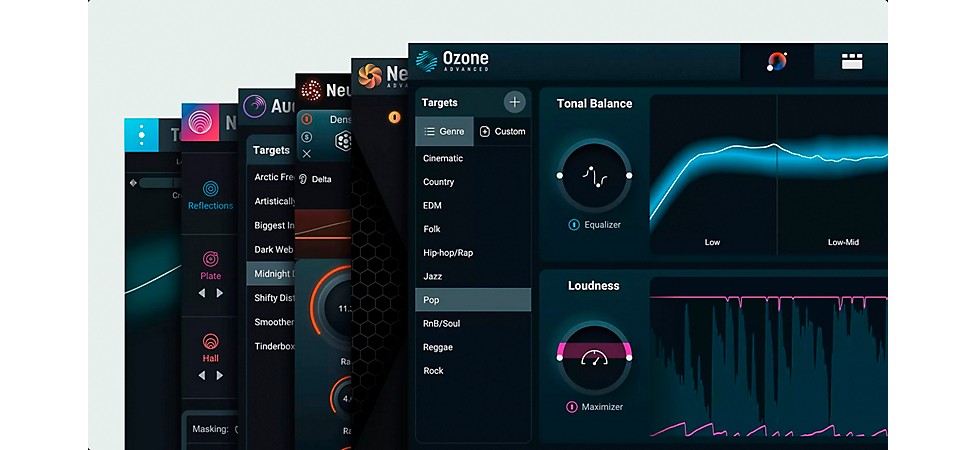
Pictured: iZotope Mix & Master Bundle Advanced
Music Production Fix-Its
Ringo Starr once said he is the “click track,” but a lot of musical styles today require drums to be locked to a rhythmic grid. While slight fluctuations in tempo that react to the emotional peaks and valleys of a song seem like a very positive thing, some of my production clients ask that I precisely lock down tempos. However, using the snap to grid feature in a DAW can produce stiff and unnatural beats, requiring me to go in and move kick and snare attacks around to dial in a bit of swing while still producing a tight rhythm track. This operation ain’t exactly my definition of fun.
Happily, DAWs such as Pro Tools and Logic offer automatic beat mapping features that can analyze a drum track and provide more natural, human-sounding options for tightening up the groove without sounding like a robot was behind the kit.
Similarly, pitch-correcting errant vocalists can be both time consuming and risky, as you want the performance to sound sweet, but not artificial. I often depend on Logic Pro’s Neural Pitch Detection to help me accomplish natural vocal tuning. It’s a workflow lifesaver—even if I may need to move individual pitches around with the Logic’s Flex Pitch feature.
Finally, deploying AI to extract stems from a stereo track is critical if one of your songs is being remixed and you no longer have access to the digital or analog multitrack version. I panicked when Ted Mason of Mi5 Recordings/Universal Music Group asked to remix one of my ’90s tracks as a new release for the label. Yes—those analog multitracks were long gone. Thanks to LALAL.AI, I was able to provide Mason selections of vocals only, instruments only and instruments minus drums from a stereo audio file. Some DAWs—such as PreSonus Studio One Pro 7 and Logic Pro—also offer stem separation features. The sonic quality can vary—there was some “ghost audio” in the separated tracks I submitted—but nothing that should trip up a good remix engineer.
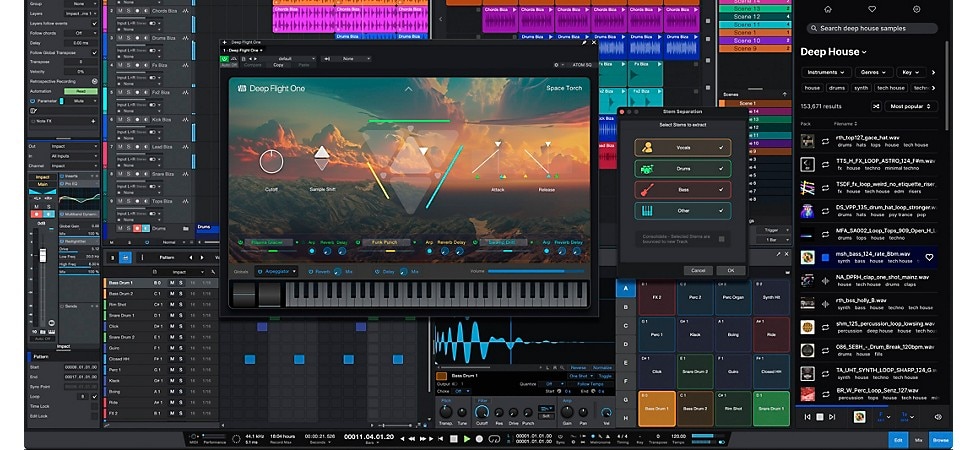
Pictured: PreSonus Studio One Pro 7
Finding Your Sound
The four previous AI helpmate suggestions are focused more on experienced and serious musicians. But how can a beginning or aspiring player use AI to help them navigate their musical journey? Well, we’ve got you. During that all-important phase when a player is seeking their personal sound, Guitar Center’s in-store mobile app, Rig Advisor, can provide options to them based on preferred musical style, performance or recording need and even the gear used by their favorite bands.
Rig Advisor can speak several languages, and the AI reacts appropriately to whichever language is used to ask questions. In addition, product recommendations are tied to the inventory of the local Guitar Center you are shopping in, so there are no “what the heck” moments where a player is excited to check out a suggested piece of gear, but it’s not available.
Other virtual assistants that can help you find the tones you’re looking for include Positive Grid Spark AI and Roland Tone Explorer.
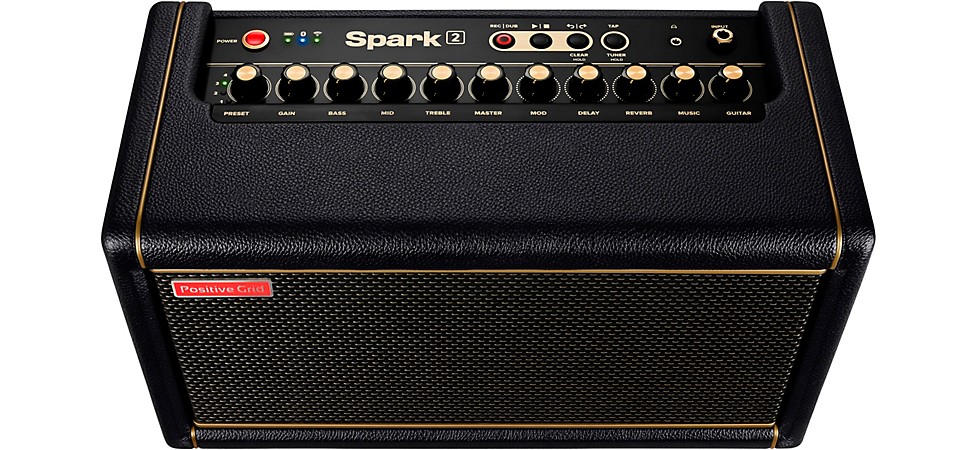
Pictured: Positive Grid Spark 2 Combo Amp
Don’t Forget to Trust Your Guts
I won’t share the bar, studio, rehearsal complex and gig debates I’ve gotten into with fellow players who believe quite intensely that AI is the Grim Reaper of humanity, as well as a scourge to creative thought. They remind me of past debacles with analog vs. digital, tube vs. solid-state amps, digital sampling, track downloading and other such perceived “threats” to music making and music makers. I can only state (calmly—because who wants to get into a bar fight these days?) that AI is here to stay, and like any endeavor, there are good points and bad about it.
Hopefully, I’ve disseminated the good bits. However, while musicians follow similar creative protocols, there are so many different and individual ways to make music that you’ll need to determine the best way for AI to work for you. (I should also mention ChatGPT can be used to help you determine precisely which AI assistants might be best for you.)
As you go through that search, I suggest you study what you are getting into. Some AI tools are free, some offer free periods with reduced features and some require pay or entering into a subscription model. I’ve also been frustrated by an AI app or two that promised a free tryout and then wouldn’t give it to me unless I provided personal data or a credit card. It’s like anything else out there on the web—buyer beware.
Another safeguard is if you use an AI tool to create music tracks that you end up keeping and distributing, be sure to review the app’s licensing terms, as there may be restrictions. Seeking an autonomous virtual lawyer to extract you from a copyright infringement case is not the best use of AI.
Written By: Michael Molenda
Michael Molenda is a content strategist, editor and writer for Guitar Center, where he has worked since 2022. He is the longest-serving Editor in Chief of Guitar Player (1997-2018), and former Editorial Director of Bass Player, EQ, Keyboard, Electronic Musician, Gig and Modern Drummer. A guitarist, drummer, bassist and producer, Mike co-owned three pro recording studios in San Francisco, and performs with Surf Monster and The Trouble With Monkeys.
Recently Added to Gear Tips
Be the first to know about exclusive offers, tips and more.

866-498-7882 English
877-687-5402 Español