

Pro Gear Advisers
•866-498-7882
Choosing a Wireless System for Guitar: Pros and Cons

Before we start, I want to come clean: I’m a fervent advocate of wireless guitar systems. For gigs when I’m the front person, having the independence to prowl all over the stage—and even pounce on the audience—is central to how I perform. When I’m banished to the background as a support player, I still love not having a cable restrict my movement, winding around my feet in tight quarters or determining where I can place my pedalboard.
Having said that, even I must confess there are valid reasons to love the cable. The following is an objective discussion of the pros and cons of wireless guitar systems, as well as when it might be the right time for you to abandon cables.
Freedom to Move
Being able to run around a stage without being restricted to the length of a cable is reportedly the number one reason why guitarists consider switching to a wireless system. It’s truly liberating when you don’t have a “long tail” shadowing you as you wander around the bandstand or rehearsal space.
Go for It
- You’re a kinetic little spark plug of a performer and every inch of the stage is your playground.
- You’re tired of a cable wrapping around your legs and feet, getting caught on your pedalboard or tripping up your bandmates if you move around too much.
- A cable ramps up the claustrophobia when you’re stuffed between a pool table and an ATM at gigs where there’s no stage and the band sets up on the floor.
Take a Beat
- You’re just fine, thank you, standing in one spot throughout an entire show.
- Your current cable setup is reliable and trustworthy, and you’re not thrilled about adding any level of complexity (potential dropouts, dealing with batteries, etc.) to your rig.
- Movement is far less of an issue than maintaining the signal integrity of a complex pedalboard, high-gain amp rig, complex stereo amplifier and effects setup, and so on.
Effect on Tone
To varying degrees, I’ve heard fears of compromised tone from every guitarist considering a wireless for themselves or from those being asked to use one by a bandleader or musical director. Most current wireless systems are not terminators of sound. In fact, players who use long cable runs or lots of pedals can improve signal clarity by going wireless to diminish high-frequency losses due to capacitance (an electrical property that filters out treble).

Shop Now: Blackstar AIRWIRE i58 Wireless Guitar System
Go for It
- The tonal difference between a high-quality wireless system and a premium cable is essentially inaudible.
- A good wireless system produces infinitesimal latency and an open, clear and uncompromised frequency spectrum.
- Some wireless systems—such as the Blackstar AirWire i-58 and BOSS WL-60 and BOSS WL-20—can simulate cable capacitance for those who really dig the sound of guitar cables.
Take a Beat
- Budget wireless systems may deliver audible latency and potential sonic compromises, such as overly compressed signals.
- If you’re used to the slightly warmer sound of cables, a wireless system may produce tones that appear too bright, too clean and too brittle for you.
- A good cable is still the lowest-risk option if dropouts are absolutely unwelcome.
Clean Stage Setups
While it hasn’t significantly trickled down to club gigs yet, the concept of a clean stage—no amps, monitor wedges, wired mics or visible cables of any kind—is becoming more and more popular with big touring acts. Obviously, a wireless guitar system would be essential in a performance landscape devoid of any objects except drums, keyboards and musicians.
Go for It
- Your act incorporates video screens and projections, and you want all the audience’s focus on the cinematic elements of the show—not on the gear.
- You’re also the main driver regarding staging and choreography, and going wireless will help you realize your vision for the band’s performances.
Take a Beat
- Your band isn’t yet at the point where a clean stage is desirable, affordable or workable (due to increased setup and soundcheck time).
- You’re happy as an outlier punk rocking a guitar cord on an otherwise cableless stage.
Cost Factor
Generally, a cable is less expensive than a guitar wireless system. Although, I’ve invested in several cables, and I bring multiple varieties to gigs, because who wants a surprise cable fail to tank a show or recording session? On the other hand, inexpensive wireless systems, such as the NUX B-1 LITE and XVive U2 can be yours for around $100 or less.

Shop Now: Xvive U2 Guitar Wireless System
Go for It
- You’re all about tone (and running unfettered around the stage), so you’ll spend whatever it takes—within reason—to get the best sounding wireless system for your needs.
Take a Beat
- Admittedly, a gig-tough guitar wireless system is probably going to cost you more than $100, so if you’d rather spend the dough on a new pedal or some other tone machine, make it so.
Is a Wireless Guitar System Right for Me?
If a guitar wireless system simply does not make sense for you, you’ll know it. Perhaps you play or record somewhat exclusively at home, and a cable is the easy choice. Maybe your style isn’t to move much on stage, and a wireless would be wasted on a stationary player. You could even be a tone fanatic who is unwilling to explore any option that could adversely affect even a microscopic level of sound quality.
But even if you’re open to going wireless, there are still some factors to consider:
- There are lots of wireless options for club musicians and weekend giggers, such as the Fender Telepath, Sennheiser XSW 2-Cl-1-A and Shure BLX14. You can even incorporate pedal-sized wireless systems into your pedalboard with the NUX B-8 Professional, Shure GLX-D16+ and XVive 5.8GHz Wireless guitar pedal. Visit your local Guitar Center or talk to one of our Gear Advisers to see which model meets your needs.
- Getting ready to go on tour or join a big worship band? You may need to consider a pro system with tweakable features and more range. Consider the Audix AP41, Sennheiser EW 500 G4 Cil and Shure GLX-D14R+.
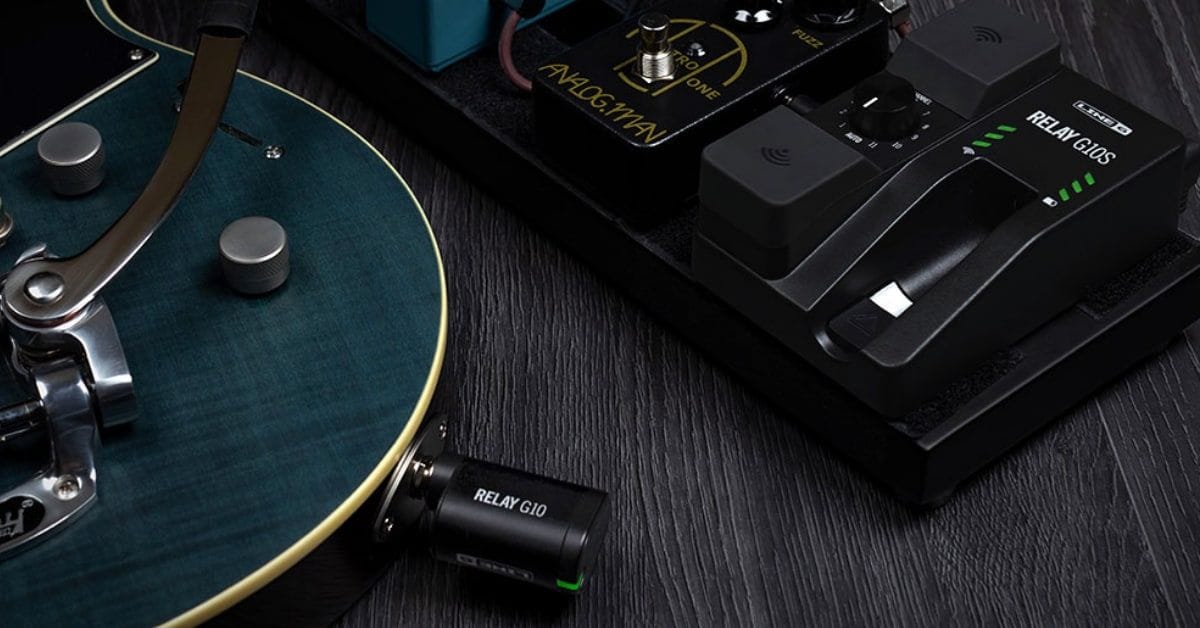
- If you’re shopping for a wireless system where the transmitter fits right into your guitar’s input jack, you should determine if the unit wobbles too much for you. Trust me, I’ve had some systems where the transmitter has swung back and forth so freely while I’m jumping around the stage that the bottom edge of my right hand was quite bruised after shows.
- Latency—the time it takes to hear a note or chord after you strike your guitar strings—is almost imperceptible in current wireless systems. However, if you sprint a football field’s length away from the stage, you may experience some disconcerting delays. These days, I doubt you’ll find a system where latency approaches 10 ms—which can affect timing—but double-check that the latency on any model you’re considering is 5 ms or less.
- I’m often invited to perform at an annual guitar festival in Wroclaw, Poland, and I’d love to go wireless—the stage is huge—but I always chicken out and bring a 25' cable. You may be braver than I am, but you should still be aware of what you’re up against when going wireless abroad. It’s not just about packing the correct adapter to power a standalone receiver (if applicable)—you need to address the country’s legal wireless audio frequencies. The safest, globally compatible frequency bands are 2.4GHz and 5.8GHz. UHF bands are restricted in some countries, so leave those wireless systems at home. I also recommend double- or triple-confirming a country’s wireless situation to avoid bringing an American unit that may not work reliably in non-USA airspaces.
To Be or Not to Be Wireless?
Like many aspects of musical expression, there’s no right or wrong to embracing wireless or staying tethered to a guitar cable. You be you. Whichever option inspires you to deliver the most mesmerizing performances possible—whether the venue is an arena or the corner of your bedroom—is the win you should be pursuing.
Written By: Michael Molenda
Michael Molenda is a content strategist, editor and writer for Guitar Center, where he has worked since 2022. He is the longest-serving Editor in Chief of Guitar Player (1997-2018), and former Editorial Director of Bass Player, EQ, Keyboard, Electronic Musician, Gig and Modern Drummer. A guitarist, drummer, bassist and producer, Mike co-owned three pro recording studios in San Francisco, and performs with Surf Monster and The Trouble With Monkeys.
Recently Added to Gear Tips
Be the first to know about exclusive offers, tips and more.

866-498-7882 English
877-687-5402 Español