.jpeg)

Pro Gear Advisers
•866-498-7882
Fender Vintera III | Vintage “Era Specific” Authenticity Without Premium Prices

Fender obviously has a celebrated history to draw from, and the company’s archives—and existing vintage instruments—enable it to construct exacting replicas of the iconic guitars, basses and amps designed by Leo Fender from the 1950s onward.
Let’s say you are yearning for a reproduction of a vintage guitar or bass from a specific year—say, a 1957 Stratocaster. You can have it. It will be fastidiously crafted to original specs and teeming with vintage Fender mojo. And it will exist in the higher-budget end of the regular Fender line (such as the American Vintage II series) or trigger premium pricing from the Fender Custom Shop.
However, for years, Fender has ingeniously managed to delight fans of its past who may not have the means to acquire big-ticket vintage reproductions. The strategy has been to release models focused on a particular decade—1950s, ’60s, ’70s—that synthesize the tone and feel of the period, while sometimes also offering a few contemporary features to enhance playability. These decade desserts can be found in the previous Vintera II line and the budget Squier Classic Vibe series.
But the new Vintera III collection now gets as close to era-correct replicas as ever before offered in more affordable Fender vintage-style lineups.
Split into early-, mid- and late-decade selections, Vintera III guitars and basses don’t simply curate the best specs from a tighter three- or four-year timespan, they also incorporate evolutions and advancements from the months surrounding it.
For example, a Vintera III Mid ’60s Telecaster could have pickups modeled after a ’64 Tele, but the neck might emulate a more easily playable ’66 model. The preceding is just to illustrate a point, as we don’t know precisely how Fender conceptualized the Vintera III Mid ’60s Telecaster.
We do know the Vintera III project prompted a significant upgrade of the processes and handcrafting utilized by Fender’s Ensenada, Mexico, factory, as well as some intensive hardware rethinks that served to create even more vintage-correct vintage replicas.
As a result, the Vintera III collection is far more than a model “refresh,” and we’re lucky to have Senior Product Development Manager of Fender Electric Guitars and Basses Patrick Harberd share the inside story about the strategies and manufacturing maneuvers that ultimately produced an elevated “vintage victory” for everyday guitar and bass players.
You've already refreshed the line with the Vintera II series, and have now seriously upgraded the vintage features with Vintera III. Does this mean Fender’s view of the skill level and vintage awareness of the typical Vintera customer has changed?
Harberd: By and large, I think the demographic is the same. We have Vintera customers who are knowledgeable, and who may already own a Fender USA vintage-replica Strat or Tele, but may be looking for something else that has that vibe at a more approachable price point. Then, there are players who aren’t quite up to snuff regarding the vintage-reissue world, or the lore of the instrument. The topic can run so deep. But the added level of detail in Vintera III models opens things up to education. We’re talking about these vintage features in a more specific way—hopefully giving players the hook to take the next step and go deeper into these instruments and their transitions over the many years of Fender's history.
I’m curious how you landed on the feature set for the Early, Mid and Late designations.
We felt it was time to really freshen the approach and really differentiate the stuff from the many years of the Classic series and the Vintera instruments we had already released. So, we had done the decade span, and we felt breaking a ten-year timeline into Early, Mid and Late would do just that, as well as allow us to get as close as possible to year-specific models.
At that point, we knew we needed to be strategic about offering a nice range of features. We didn’t want to bunch up anything, so we tried to avoid an Early ’60s model next to a Mid ’60s variation. It’s not 100% perfect, though, as we have a Late ’50s Stratocaster and an Early ’60s Strat. However, there was a pretty big difference in that short span of time where you move from a one-piece maple neck to round-laminated rosewood. You also had slab rosewood necks during that period.

Pictured: Fender Vintera III Late ’50s Telecaster and Early ’60s Stratocaster
Do you feel the average player fully understands the spec differentiations between, say, a Vintera III Late ’50s, Early ’60s and Late ’60s Stratocaster, or how some vintage-specific features might be beneficial to their playing?
Well, let’s take neck shapes, which can be all over the place—especially as vintage instruments can always present exceptions and variations. But, generally, necks from the early to mid-’50s are fairly chunky. The ’50s Strats and Teles have a soft V shape that’s pretty rounded off. It’s not a super prominent V, but it’s definitely going to be noticeable compared to necks from the ’60s models.
As you get into the ’60s, the necks are slimming down. Again, there are a few variations, but the neck is slimmer at the first fret, and some models present an aggressive taper to a thicker feel at the 12th fret. The Mid and Late ’60s models also gave us an opportunity to emphasize round-laminated neck construction. That’s a new discipline for the Ensenada factory, because, previously, everything was essentially slab construction. But getting that rounded fingerboard was part of the overall storytelling package for Vintera III.
Do all players understand the neck shapes used during certain eras of Fender history? I’m not sure, but that’s part of the educational aspect I mentioned earlier. A player can look for a neck shape that’s comfortable for them and also get insights on how, when and why that shape was developed.
You said the round-laminated rosewood fingerboard was a “new discipline” for the Ensenada factory. Could you explain how the process unfolded?
When the Ensenada factory was set up, the team wasn’t trained to focus explicitly on historical accuracy. At the time, the decision was made to keep the vintage stuff more generic. The thinking was, “Let’s not worry about that right now. We’ll leave those types of instruments to the Corona shop.” But when we started talking about the Vintera III refresh, we knew it was time to evolve the capability of Ensenada. It was time to step up—to push the factory a bit to make vintage stuff at a higher level.
Can you share how some of the models came together?
For the Vintera III Late ’60s Strat, we wanted a big headstock and no Bullet truss rod. Then, it was like, “Let’s do ‘F’ stamped machine heads instead of vintage-style tuners.” That decision kind of drove some other specification choices on the model that would have paired well with the headstock and tuning machine choices—such as the slightly larger aged white pearloid dots. All of that in turn informed our decision on the pickup recipe to make sense for the time period.
The Jazzmaster is based on a period of time where they would have been getting rid of the Fender spaghetti logo and using the transition logo, but you still get clay dot inlays on the fingerboard, capturing a rare moment in time before the transition to the larger pearloid dots.

Pictured: Fender Vintera III Late ’60s Stratocaster, Early ’60s Custom Telecaster and Early ’60s Jazz Bass
So, it seems you would concentrate on a particular period for an instrument as a foundation. For example, it appears you might have based the Late ’60s Stratocaster on a 1967 model, but then, is it fair to assume the team might have said, “Hey, we can also get some cool stuff from a 1969 Strat?”
Or maybe even from a 1968 Strat. Yes, that is fair to say. We could play a little fast and loose with the timespans. We just wanted to make sure we didn’t have any anachronisms. In other words, we didn’t want to add something that wouldn’t make sense, given the time period.
Let’s talk about some of the other elements of the Vintera III collection. The colors are super vivid and fun. How were the finishes devised?
The Late ’60s colors are some of my favorites, and it was like, “Okay, if we're going to do these, let’s get them dialed in with really accurate representations—like they would have looked when they were new at the time.” So, we had the Fender Custom Shop make us a bunch of paint swatches. I actually flew out to our paint vendor in Las Vegas with a bag full of paint chips, and about three iterations later, they had cloned the colors.
These are not off-the-shelf paints, however. We instituted a new paint technology in the Ensenada factory, creating bespoke colors with a slightly lighter polyester finish to replicate the lacquer we would normally use. The big thing was getting the pigmentation right and really have these colors pop with the vibrancy you would get with lacquer.
What is the advantage of a thinner, non-lacquer finish?
A thinner finish contributes to a lighter instrument. In addition, the thicker the top coat, the more yellowing can happen, which can dull the colors a little bit.

Pictured: Fender Vintera III Early ’70s Jazz Bass
How did you voice the pickups?
For Vintera II, we started to use fiber bobbins [the structural support for the coil wire] instead of plastic, and we were slowly pushing this stuff more and more over the years. We kind of had one leg over the vintage pickup fence, and for Vintera III we said, “Let’s just jump the whole way in.” So, now we’re using Formvar or plain enamel for the wire and either Alnico II or Alnico V magnets. Sometimes, we’ll use a different alnico because we want to get a sound like the pickups have degaussed a little bit. We were not trying to simulate how a vintage pickup would sound right off the shelf in 1963, but what it would sound like now, after decades of its magnetic field slowly dissipating. As a result, a particular pickup may not necessarily be 100% spec correct to the original from an alnico perspective. For us, it was more about the intent of the voicing.
I should also mention we’re using cloth insulated wire for connecting all the electronics, so underneath the pickguard, you’re not going to see black plastic wire like you would have in Vintera II. It’s just one step further toward being more era correct in Vintera III.
Wow. Now, that’s a deep cut, so to speak. But outside of the vintage authenticity of using cloth insulation, is there also a sonic benefit to using that instead of plastic wire?
The cloth wire covering is more about the overall vibe, and it’s more accurate to vintage lore. I assume changing the gauge of the wire would have more of an impact on the tone than how the wire is wrapped. Admittedly, using period-correct cloth insulation instead of plastic is something we may never get the extra credit for. The cloth covering is under the hood, and most players will probably never see it. But we wanted to do it as yet another step to replicating the way it would have been done. It’s another piece of that puzzle. However, perhaps 1% of the players who know, might say, “Cool. If they’re paying attention to stuff at that level, they must be concentrating on all the bigger things, too.”
You also looked at the hardware to make it appear more era correct, right?
Absolutely. There are even details on the hardware, such as “Fender” stamps on the tuning machines to emulate the single-line, vintage-style tuners of the appropriate era. We have a “Pat Pend” stamp on the Strat saddles now. The “Pat Pending” Tele bridges would be correct for the Late ’50s. Then, you get the patent number stamp into the ’60s. All of them are “of the era,” so you wouldn’t see a “Pat Pending” on the Mid ’60s Tele.
Although a lot of these hardware things could be considered by some as subtle, people who are really in the know might say, “I can’t believe they did that”—meaning not just the era-correct hardware, but also era-correct inlays and finishes. But the educational side for those who aren’t aware is, “What do they mean by ‘era correct’? What is it about the details in the finish and inlays and so on?” We’re trying to start the curiosity about vintage instruments without detailing people to death with content.

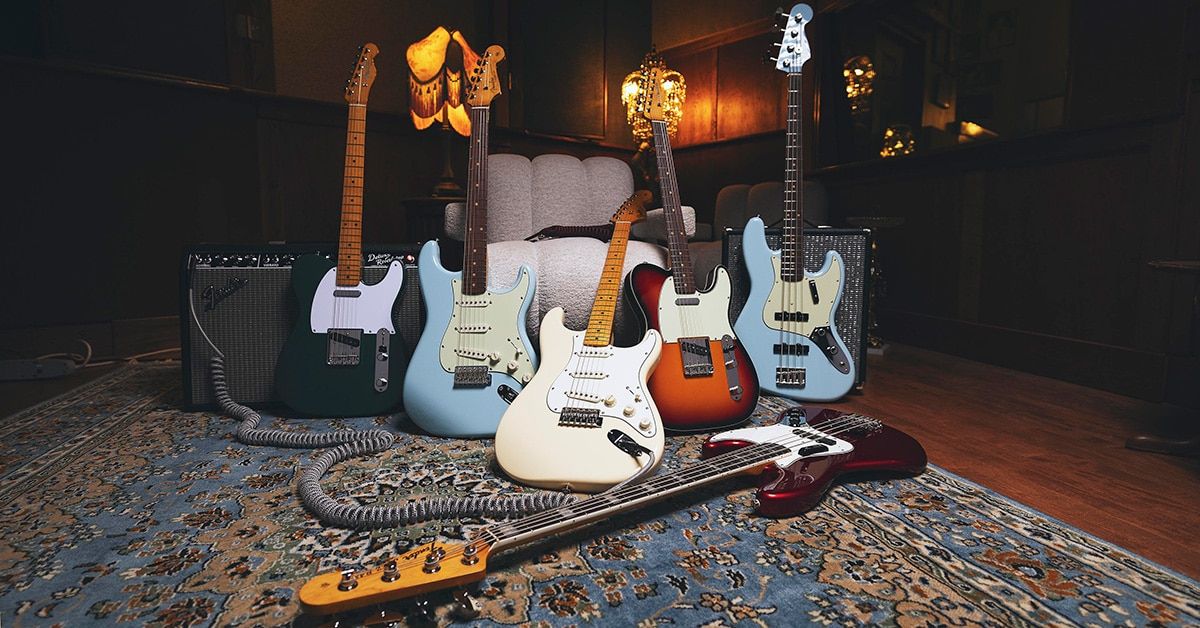
Pictured: Fender Vintera III Guitars and Basses
As you endeavored to push the boundaries on era-correct details, did you run into any challenges that surprised you?
Placing the headstock decals over the finish required some trial and error—such as figuring out which material to use. Funny enough, it ended up being the same decal material as you'd use with a lacquer guitar because they're applied the same way. You dip it, position it and very gently flatten it to get all the air out from underneath it. It can be a time-consuming process, because it's this delicate rice paper that essentially melts into the finish. But what’s different when you place a decal over the finish is you need to spend a little more time ensuring it adheres flat, because it won’t be sealed underneath the finish.
Do you have any personal favorites in the Vintera III line?
I’m partial to the Late ’60s Strat in Ocean Turquoise. It's funny. For a very long time, I just couldn’t connect with the big headstock of the CBS era. But over the two years we’ve been working on Vintera III, the mid- to late-’60s stuff has really grown on me, and the big headstock slowly filtered into my subconsciousness. Obviously, it’s synonymous with Jimi Hendrix at Woodstock, and he was pretty cool [laughs].
You accepted a pretty heavy responsibility to deliver a more vintage-correct, vintage experience with the Vintera III collection while simultaneously making the instruments more accessible. Were there any motivational, North Star discussions to keep the project on track through its development and production?
The main goal was to substantially increase the quality and value of what players get out of the Vintera series—to make these instruments look, feel and sound more like the revered instruments that put Fender on the map, while also keeping them at a more attainable price point.
Authentic Vintage Vintera
Fender constantly evolves its offerings to delight fans of the platform, re-engineer or replicate its iconic instruments and enhance playability and tone across the entire line. At times, these refreshes can seem perhaps too subtle. But as Patrick Harberd has revealed in this interview, the Vintera III collection is a massive upgrade in vintage vibe, features and tone from the already vintage-terrific Vintera II models.
If the Vintera III series is inspiring you to do some more comprehensive research about vintage Fender instruments, we have some articles to get you started: The History of the Fender Stratocaster, How to Buy a Vintage Stratocaster and How to Buy a Vintage Telecaster. Interested in perhaps making a vintage Fender your own? Take a peek at our vintage Fender guitar collection.
We’ve even got you if you’d prefer expert counsel. Simply contact one of our Gear Advisers, who will be glad to run you through the Vintera III collection or Guitar Center’s considerable stock of used and vintage Fender instruments.
People Also Ask ...
How is Fender’s vintage-reissue guitar and bass manufacturing shared between its Ensenada, Mexico and Corona, California factories?
Vintera III represents an evolution of the Fender Ensenada factory towards producing more explicit era-correct models, rather than instruments characterized by more generic features spread across an entire decade (’50s, ’60s, ’70s, etc.). Year-specific replicas will continue to be made in Corona, California—either by Fender USA or the Fender Custom Shop.
What exactly are “era-correct” Fender Vintera III vintage reissues?
The Fender Ensenada factory has elevated its manufacturing processes to zero in on specific early, mid and late ’50s,’60s and ’70s instruments for the company’s Vintera III collection. What this means for players can be broken down simply—although actual vintage guitars and basses can present some variations within the broad specifications below.
Fender in the 1950s
- One-piece maple necks
- Small headstocks
- “Spaghetti” logo (handwritten style)
- Ash bodies initially, alder later in the decade
- Thicker necks
Fender in the Early 1960s
- Slab and round-laminated rosewood fingerboards introduced
- Small headstocks
- Alder now main body wood
- Slimmer neck shapes
Fender in the Mid to Late 1960s
- Large headstock (beginning in 1965)
- “Transition” logo (slightly bolder and thicker)
- Nitrocellulose lacquer finishes replaced with polyurethane
- Neck plates sport “F” logo
Fender in the Early 1970s
- Heavier bodies
- Thick polyester finishes
Why are Fender Vintera III instruments desirable?
The Vintera III collection allows players who prize vintage-style features in their instruments to get closer to “year-specific” vintage specs than previously possible in more-attainable models produced by Fender’s Ensenada factory.
Written By: Michael Molenda
Michael Molenda is a content strategist, editor and writer for Guitar Center, where he has worked since 2022. He is the longest-serving Editor in Chief of Guitar Player (1997-2018), and former Editorial Director of Bass Player, EQ, Keyboard, Electronic Musician, Gig and Modern Drummer. A guitarist, drummer, bassist and producer, Mike co-owned three pro recording studios in San Francisco, and performs with Surf Monster and The Trouble With Monkeys.
Be the first to know about exclusive offers, tips and more.

866-498-7882 English
877-687-5402 Español