.jpeg)

Pro Gear Advisers
•866-498-7882
The History of Orange County Drum & Percussion
It was the sound of chart-topping hits across a myriad of rock and metal subgenres from the mid ’90s though the mid ’00s, and it was the interesting looks that had concertgoers and MTV viewers asking, “What are those drums?”
Vented snares. Shallow toms. Deep kick drums. Jaw-dropping finishes and fuzzy animal-print wraps. Double- and triple-ported bass drum heads with the endlessly puzzling Russian-doll logo that could’ve been an IQ test.
All of a sudden, they were everywhere.
Once the logo was deciphered, the phone at Orange Country Drum & Percussion (OCDP, for those still scratching their heads at the logo) rang off the hook with inquiries about the custom drum kits their favorite drummer played, how much it would cost and how long it would take the shop to fulfill the order.
The story of Orange County Drum & Percussion was the ultimate underdog chronicle.
Over the span of a few short years, OCDP had gained a raucous, star-studded following. 311, No Doubt, Deftones, Blink-182, Sum 41, Limp Bizkit, Staind, Lit, The Offspring, Slipknot, P.O.D., Nine Inch Nails, NOFX, New Found Glory, The Used, Story of the Year, Thrice, Taking Back Sunday, (Hed) P.E., Kottonmouth Kings, Poison the Well, Senses Fail, Angels and Airwaves, The Dirty Heads, Street Drum Corps—the list of drummers who played OCDP drums in their prime was endless.
During its zenith of influence, OCDP drums dominated the main stage at Warped Tour and Ozzfest.
Any casual observer could have assumed OCDP had a giant Walmart-sized factory pumping out massive quantities like Ludwig, Pearl, DW or TAMA. But unbeknownst to the masses, OCDP was an incredibly small company, fluctuating anywhere between 10–15 employees at any given time, functioning out of a dust-covered space akin to a storage unit and the culture of a tightly-knit gang to juxtapose their well-oiled-machine corporate competition.
All the while, their slogan “The only limitation is your imagination” rang true. OCDP spared no expense, denied no outlandish creative idea and held their craftsmanship to the highest standard whether it was destined for the Super Bowl halftime show or an anonymous customer through a dealer.
In this article, we’ll walk you through the OCDP story, from its humble beginnings, meteoric rise, trouble keeping up with unprecedented demand and Guitar Center acquisition in 2011 to a revival of the brand in 2026 guided by co-founder Daniel Jensen and longtime OCDP endorser Adrian Young.
Table of Contents
The Origins of Orange County Drum & Percussion
In the 1980s, Daniel Jensen and John Machado both worked in the repair shop at West Coast Drum Center in Santa Ana, California. They hit it off and ultimately decided to give their own venture a try, with Jensen as the main creative force and “people person,” and Machado assuming more of the accounting and administrative tasks. However, both had worked extensively with drums, and—spoiler alert—would continue to in a big way going forward.
By 1991, Orange County Drum & Percussion had been established as a drum retail, lessons and repair shop out of a three-car garage in Lake Forest, California before moving to Santa Ana. Being in the cultural hotbed that was the LA/OC music scene at the time, it fostered a community of artists and earned its place as a known hangout spot for drummers like Taylor Hawkins, who practiced in their rehearsal room for a month leading up to his audition with Alanis Morissette.
By the mid ’90s, Orange County Drum & Percussion had started making drums using Keller shells, a high-end New Hampshire-based manufacturer that had supplied other drum makers like Rogers, DW and Gretsch since the ’60s. It wasn’t long before it became clear that the demand for their new boutique endeavor was far outpacing their retail, lessons and room rental sectors, so they dropped the rest and went all in on what they did best: building custom, one-of-a-kind drums.

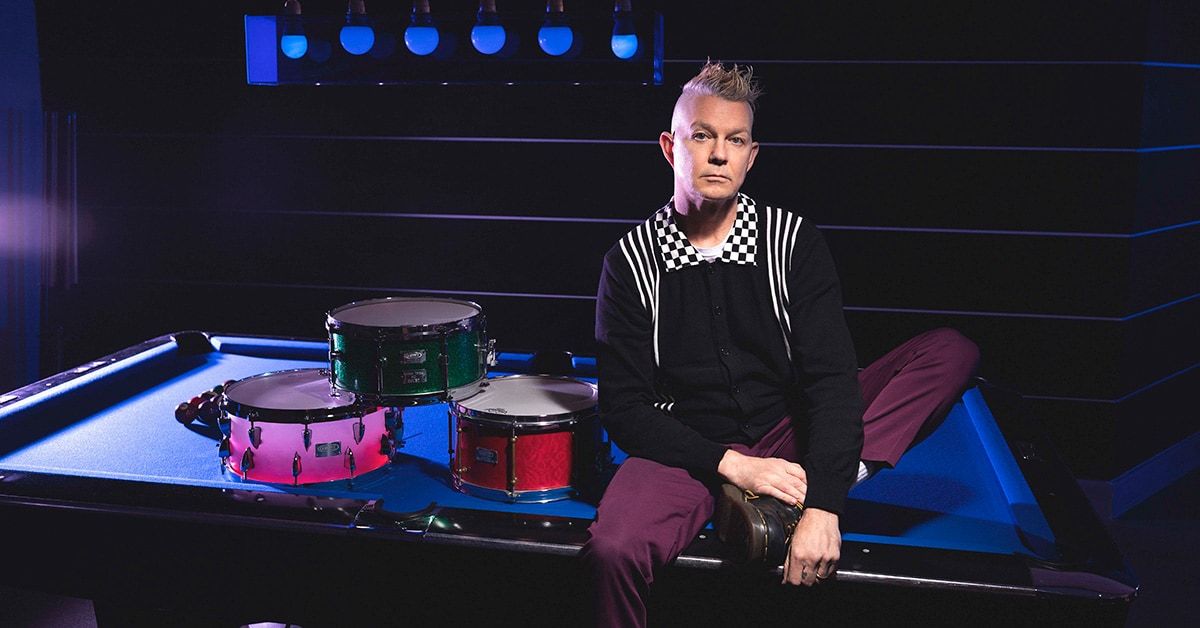
Pictured: Daniel Jensen (OCDP Co-founder) and Adrian Young (Drummer for No Doubt and OCDP Partner)
Other than founders Daniel Jensen and John Machado, everyone who joined OCDP started with zero drum-making—let alone woodworking—experience, learning on the job, finding and playing into their strengths along the way. The vast majority were drummers; all were musicians with palpable passion for the quality of instruments.
OCDP comprised a ragtag group of musicians who fully bought into the culture of hard work, attention to detail and, perhaps what set them apart the most, a fearlessness of breaking the mold.
Custom Drums, Loud Looks and the Pop-Punk Explosion
With Daniel Jensen serving an A&R role—along with wearing many other hats within the company—his ear for talent, gift of gab and willingness to accommodate artists’ needs won over OCDP some pivotal drummers to their fledgling roster. It wasn’t uncommon for him and a few other OCDP employees to offer their drum teching services—transporting, setting up, tuning and maintenance—in the studio and on tour to ensure their talent was well taken care of.
One of OCDP’s first major endorsements came from Chad Sexton of 311, who was outfitted with a custom kit that featured a 20-ply 12x6" vented snare that was used to record their self-titled “blue album.”
For those less familiar with OCDP drum specs, that’s not a typo. Aside from the nonstandard dimensions on that one, OCDP routinely used 20 to 40 plies for their snares. The higher ply count would lend that higher pitch “pop” you hear on albums like 311 and Transistor.
The other all-original component to many of their snares were the vents. Snares that were vented would have round holes anywhere from 2" to 4" in diameter—a notable “Swiss cheese” example having a whopping total of 42 vents. The vents imparted an exceptionally dry, exaggerated “snare” sound from ghost notes to 12 o’clock rimshots—cartoonishly loud projection that wasn’t for all genres, but worked wonders for loud music.
Another defining, early signing OCDP made was Adrian Young of No Doubt, just prior to the recording of 1995’s Tragic Kingdom, which would go on to reach RIAA Diamond certification.

Pictured: Orange County Drum & Percussion 4-piece Maple Shell Pack in Sharkbite Fade
Young reminisces on the appeal of OCDP drums: “The tradition of OCDP is there are no limitations. Some of the soundscape options are beyond what other manufacturers offer.”
And he was right. They went all in on a niche and carved out a name for themselves from the dark corners of the underground to the bright lights of the mainstream.
Orange County Drum & Percussion had arrived, and an unstoppable domino effect was pushed into motion.
One of the most archetypical examples of that unabashed vented snare sound was Abe Cunningham’s drumming on Deftones’ 1997 album Around the Fur, which opened the floodgates to up-and-coming nu metal drummers like John Otto of Limp Bizkit—first heard playing OCDP on Significant Other—and Joey Jordison’s drumming on Slipknot’s 1999 debut self-titled debut. Producer Terry Date, who’d worked on the first two examples, had mastered the art of dialing in that OCDP vented snare sound for heavier genres.
Around the same time, a relatively unknown drummer by the name of Travis Barker started playing OCDP kits with the Aquabats. Soon after, he was recruited by Blink-182 to record Enema of the State, which sparked a pop-punk cultural phenomenon. He took his multitude of custom-built OCDP kits with him to his side projects throughout the ’00s, including Transplants, Boxcar Racer and +44.
Arguably the biggest drum endorsement of the time, Barker’s influence led to an unforeseen demand for the small custom shop, but that didn’t stop them from continuing to expand their artist roster across pop-punk, nu metal, other heavier rock genres and anyone who wanted a fully customized, tricked-out kit they couldn’t find anywhere else.
Innovation and Signature OCDP Gear
Throughout the custom shop era, OCDP did everything from hand sanding and lacquering to assembling hardware in-house. And what they couldn’t do at the shop, they outsourced as much as they could locally.
Their now-iconic rectangular badges came from the trophy maker next door, an elderly man named Lou who would hand wrap them in stacks with toilet paper and tape. Their shark tooth lugs and bolts were the highest possible quality, and their expenses reflected that. No matter, they took no shortcuts when it came to quality control and fulfilling artist requests.
Daniel Jensen looks back on their unconventional kits: “We’d make things more elaborate and crazier looking to draw attention to their band and to them as a drummer. The drummer’s always in the back—the guitar player’s always getting the spotlight. This was something to get your drum set, your sound and your look to the forefront.
“We would have skinnier toms, longer bass drums, double-wide bass drum hoops. We’d do all the metals. We’d do hybrid kits—metal and wood, acrylic and wood—different variations of plies, different size vents. You name it, we did it. We weren’t afraid to give it a shot.”

Pictured: Adrian Young Holding OCDP 14x5.5 Acrylic Snare Drum in Nightglow Fade
A prime example of that ethos was when Kottonmouth King’s Lou Dog requested a drum kit on a three-wheel 1983 Mongoose Expert BMX bike. It was both a drum kit to be used on stage and a functioning bicycle—that just so happened to have a built-in hookah in the snare.
Another was John Otto’s kit, which appeared on the cover of the March 2004 issue of Modern Drummer. It was a sandblasted, frosted Candy Blue acrylic set that lit up from the inside to show Limp Bizkit’s logo in white. Once completed, Otto then requested an exact replica for his European tour, but with the inverse color scheme.
And these outlandish custom builds weren’t just reserved for the stars. With enough lead time and budget, anyone could get custom graphics—paint, print, wrap or textile—with whatever material, size and ply shells they wanted.
According to an episode of The Fully Vented Podcast, legend has it John Machado was approached by the Discovery Channel to do a reality show, depicting the day-to-day shenanigans, custom builds and celebrity appearances akin to how American Chopper documented the goings-on at Orange County Choppers, but he respectfully declined. In an alternate universe, the story of OCDP could have gone very differently had he accepted.
The Guitar Center Era and Broader Accessibility
By 2007, OCDP’s DIY business model and lack of a viable, long-term plan to scale up was starting to catch up to them. A combination of hardware sourcing issues, lack of price adjustment for several years, quoting orders before knowing what a custom paint job would cost, and asking for a 50% deposit upfront with the remainder to be paid upon fulfillment left incomplete drums on the shelves for weeks on end.
For years, Guitar Center had been wanting to be an OCDP dealer, but OCDP favored a model that would space out dealers at least 250 miles from one another. Eventually, OCDP agreed to a deal where Guitar Center supplied some much-needed hardware in return for a series of snares.

Pictured: Orange County Drum & Percussion 4-piece Maple Shell Pack Toms in Sharkbite Fade
The music industry as a whole was also changing. While the streaming era hadn’t quite made landfall yet, album sales dipped industrywide post-Napster. A new wave of electronic music was on the rise, and bands that played loud rock music weren’t getting the massive production and promotion budgets that used to be commonplace.
In 2011, OCDP looked to Guitar Center to keep the brand alive, but with a different approach. Guitar Center acquired OCDP, shifting to a lower-cost series of snares and drum kits to be produced in larger quantities.
It was the end of an era, but the beginning of a new chapter that allowed more OCDP drums than ever before to get into the hands of those who previously couldn’t afford the custom shop prices.
Orange County Drum & Percussion Today
After years of production hiatus, something was drumming up behind the scenes for OCDP. Daniel Jensen and Adrian Young teamed up with Guitar Center for a renewed vision of what the brand could be going forward.
In 2026, the reemergence of Orange County Drum & Percussion was official. Under the guidance of OCDP’s longtime president and artist duo, a new series of snares and kits were announced, bearing the classic rectangular badges, original shark tooth lugs, loud finishes and unorthodox extra-wide kick drum hoops that helped define their legendary custom shop era.
At No Doubt’s residency at Sphere in Las Vegas this summer, Adrian Young will be playing an all-new custom OCDP kit.
As Jensen puts it: “At the Sphere, you get to hear a whole brand-new custom OCDP kit right there—back to making it the cool boutique stuff that made it famous in the first place.”

Pictured: Orange County Drum & Percussion Snare Drums
The Legacy of Orange County Drum & Percussion
At long last, the story of Orange Country Drum & Percussion continues. The initial relaunch offerings harken back to some of the finishes, hardware appointments and form factors of the classic custom shop run, but are still wallet friendly as ever. Be sure to check out our guide to OCDP snares and shell packs available only at Guitar Center.
Stay tuned for more updates on all things OCDP—it’s an exciting time to be a fan of the brand.

Pictured: OCDP Rectangular Badges on 4-piece Acrylic Shell Pack in Blue/Purple Burst
People Also Ask …
Who founded Orange Country Drum & Percussion?
Daniel Jensen and John Machado, former coworkers at West Coast Drum Center in Santa Ana, California, founded Orange County Drum and Percussion.
It started as a retail drum shop, then grew into a custom drum brand that became closely associated with prominent ’90s/early 2000s drummers.
What does OCDP stand for?
OCDP stands for Orange County Drum & Percussion (often written as Orange County Drum and Percussion).
Why were OCDP drums so popular?
OCDP became known for bold visual finishes and “make it yours” builds. It was exactly the vibe many players of the time wanted as pop-punk, alt-rock, hard rock, nu metal and emo exploded.
What set OCDP apart from boutique competitors like Pork Pie was that they offered unlimited configurations and finish options.
They were decidedly not versatile—they were meant to be played loud.
What happened to OCDP?
Over time, OCDP shifted from a small-batch, custom-centric builder toward a more retail-scaled brand. Since 2011, OCDP has been owned by Guitar Center and sells production-line snare drums and drum sets, plus limited-edition and special-order USA Custom drums.
Written By: Drew Beaupré
Drew Beaupré is a multi-instrumentalist, audio engineer and writer. With a bachelor’s in psychology from Purdue and background as a gigging guitarist and drummer, he began his audio career at the world-famous Westlake Recording Studios, before venturing into live sound engineering for clients such as KCRW, Santa Monica College, CSULA and Nyjah Huston—eventually becoming studio manager at Guordan Banks’ Bank On It Studios in downtown L.A. He also has worked extensively with the industrial band Ministry, as an engineer at Al Jourgensen’s studio, as well as domestic and international touring stage tech for DJ Swamp and Joey Jordison. Prior to writing with Guitar Center, Drew has written for Fender and various music blogs.
Recently Added to Gear Tips
Be the first to know about exclusive offers, tips and more.

866-498-7882 English
877-687-5402 Español