.jpeg)

Pro Gear Advisers
•866-498-7882
The 1968 Fender Pink Paisley Telecaster Bass
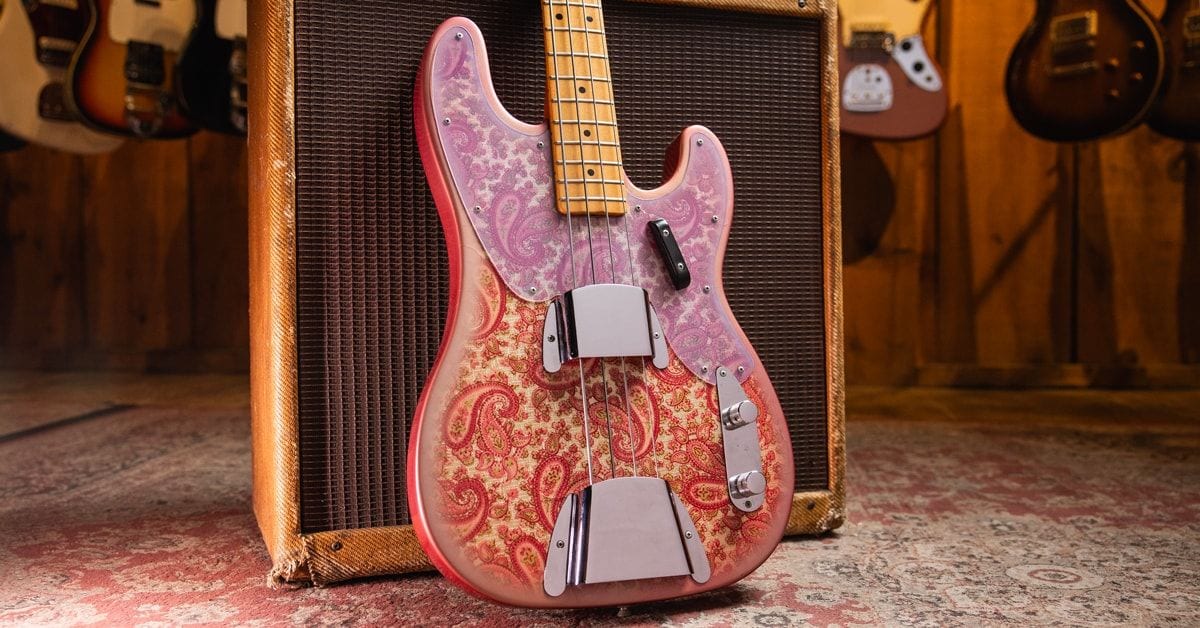
It’s 1968. The “Summer of Love” has come and gone, but corporate America is only just beginning to wake up to the youth revolution. Fender, now a subsidiary of CBS, is looking for a way to speak directly to a new generation of players. What better solution than covering an instrument in psychedelic-patterned wallpaper? Thus were born the Pink Paisley and Blue Flower Telecasters.
But what about bassists? Didn’t they deserve a matching, appropriately decorated instrument of their own?
That question led to the creation of the Paisley Telecaster Bass—a rare, short-lived experiment that remained in production for barely a year. Survivors from those halcyon days are scarce enough that many vintage collectors have never seen one in the flesh, much less had the chance to play one. Guitar Center’s flagship Hollywood Vintage Room is currently home to one of the cleanest, fully original examples in existence, and I was fortunate enough to spend a couple of hours examining and playing this extraordinary time capsule from the late 1960s.
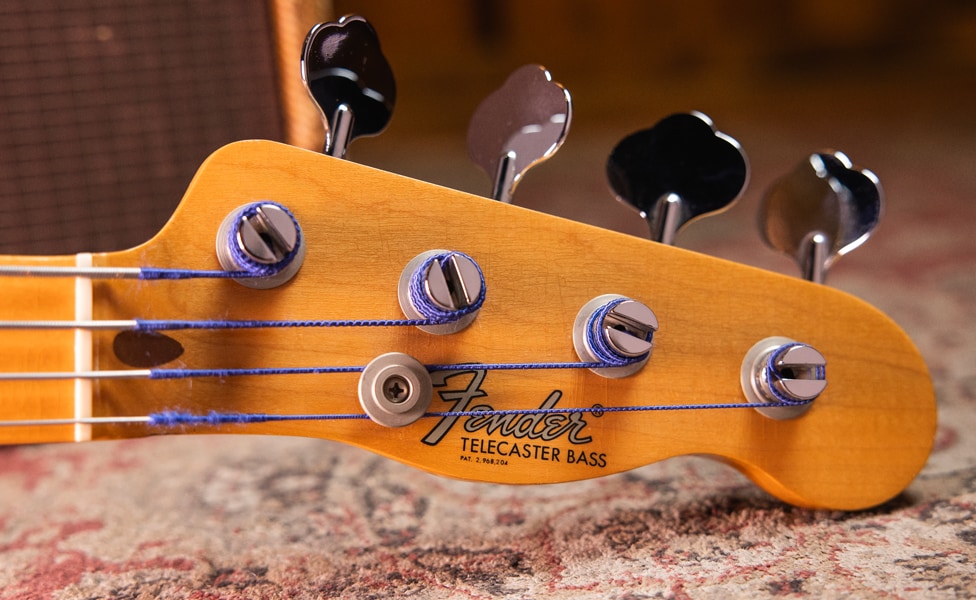
Pictured: 1968 Fender Pink Paisley Telecaster Bass Headstock
The History of the Psychedelic Paisley Telecaster Bass
Why a Telecaster Bass at all? Why not simply apply the psychedelic treatment to Fender’s existing bass models—the Precision or the Jazz—rather than introducing a new one? The answer is part manufacturing pragmatism and part historical sleight of hand, because the Telecaster Bass wasn’t really a new design at all. In retrospect, it may qualify as Fender’s first reissue, even though it was never marketed as such.
Since we’ve already set the DeLorean’s controls for 1968, let’s dial them back another 17 years to 1951 and the debut of the Fender Precision Bass. Leo Fender’s first bass was the logical follow-up to the success of the Broadcaster—later the “Nocaster,” then the Telecaster—and from 1951 until its sleeker, contoured redesign in 1957, the Precision Bass shared much of the Telecaster’s visual DNA. It featured a slab-style body with a flat top and flat back, along with a large, Tele-like single-coil pickup.
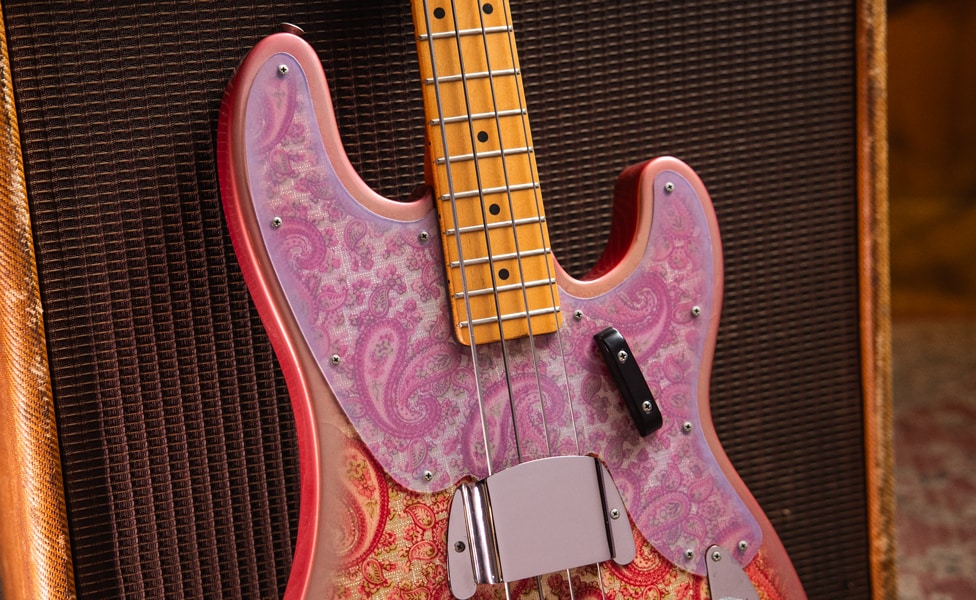
Pictured: 1968 Fender Pink Paisley Telecaster Bass
We can’t say for certain that Fender didn’t attempt to apply the colorful patterned Cling-Foil finish to the later, comfort-contoured Precision Bass—but they almost certainly tried. And in doing so, they would have discovered what anyone who has ever tried to wrap a flat pattern over a curved surface quickly learns: Getting a clean result without creases, gaps or unsightly wrinkles is far harder than it looks.
The solution was elegantly simple: Bring back the original Precision Bass body design, give it a new name and let geometry do the work. Those flat front and back surfaces made applying sheets of what was, essentially, decorative shelf liner or wallpaper fast, repeatable and relatively painless on a production line.
The experiment itself would be short-lived. “Flower Power” was already fading by the time Fender released the first Pink Paisley and Blue Flower instruments. The patterned Telecaster Basses were produced for barely a year, from mid-1968 through the summer of 1969, and only in very small numbers. Estimates typically range from 120 to 200 instruments, though no official Fender production records appear to exist for this variant.
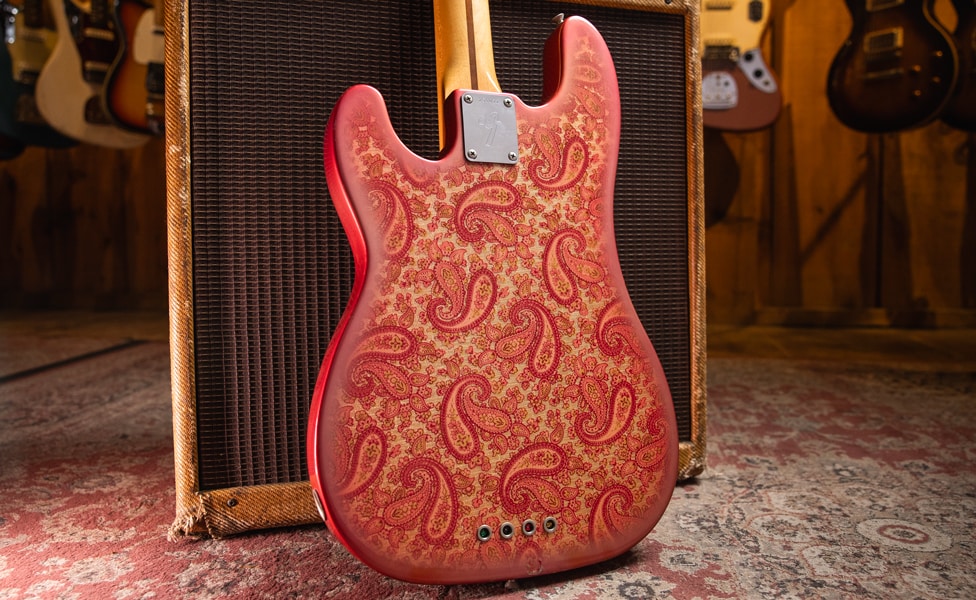
Pictured: 1968 Fender Pink Paisley Telecaster Bass Back
The Telecaster Bass in standard finishes would remain in Fender’s catalog until 1979, but a major redesign in 1971—replacing the original single-coil pickup with a humbucker and shifting from a four-bolt neck to a three-bolt Micro-Tilt design—meant that the slab-body, pseudo-reissue version had an especially brief run of its own.
Over the years, many original Cling-Foil instruments were refinished—either because psychedelic aesthetics fell out of favor or because the fragile finishes faded, peeled or deteriorated beyond practical repair. Current estimates suggest as few as 25 original examples may still exist today, possibly fewer. Which brings us back to the Vintage Room at Guitar Center and to one particularly stellar survivor—an authentic unicorn from one of Fender’s strangest and most fascinating chapters.
Hands On With a 1968 Pink Paisley Telecaster Bass
Spending time in Guitar Center Hollywood’s Vintage Room is always a slightly overwhelming experience, even if you’ve been immersed in the vintage instrument world for decades. After more than 18 years with Guitar Center—and earlier work with vintage specialists in both repair and sales—I still can’t walk into that room without a quiet sense of reverence and awe, tinged with barely contained enthusiasm. This time, that feeling was especially acute. I had seen photos of a handful of Pink Paisley Telecaster Basses over the years, but this would be my first direct encounter with one in the flesh. I was, needless to say, totally psyched.
This wasn’t one of those moments where mythology and anticipation outpace reality. Quite the opposite. Straight up, this bass is as close to museum quality as any vintage instrument I’ve ever had my hands on. While this was my first experience with a Cling-Foil-wrapped Telecaster Bass, I’ve examined a fair number of Pink Paisley and Blue Flower Telecaster guitars over the years, in every imaginable state of preservation. I’ve never seen Cling-Foil with less color fade or deterioration than what’s on this bass. The colors and pattern still pop, and the clear overcoat shows little to none of the yellowing that often accompanies age. Aside from very slight belt buckle wear on the back—more felt than visible—and a couple of tiny dings along the rear edge, this could easily pass for a case queen, deliberately stored away in a carefully climate-controlled closet.
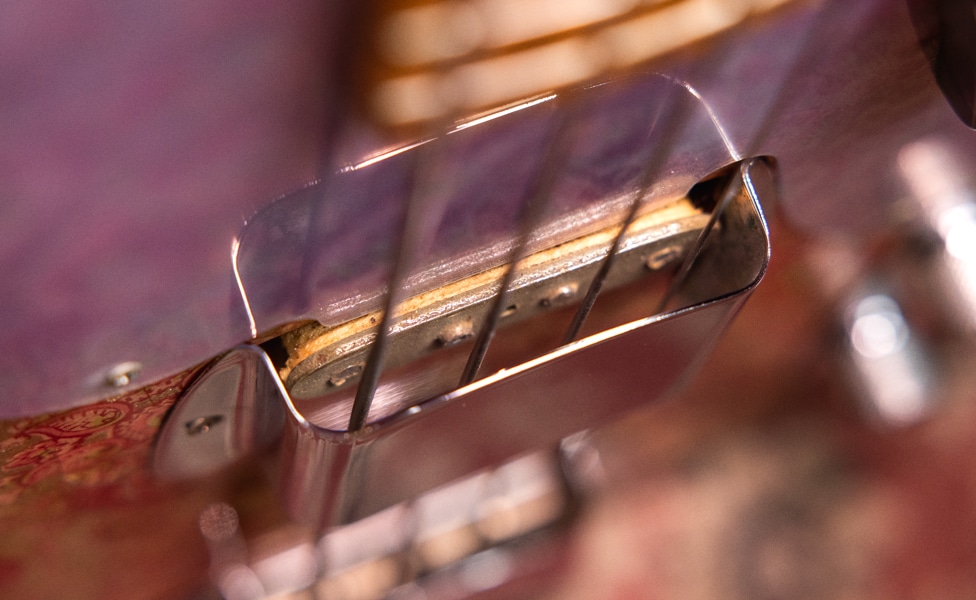
Pictured: 1968 Fender Pink Paisley Telecaster Bass Pickup
The neck finish was so clean and unworn for an almost 60-year-old instrument that I had to examine it closely to be certain it wasn’t refinished. Adding to the surprise, it still wears its original chromed bridge and pickup covers, along with the original thumb rest—typically the first parts players remove, misplace or discard altogether. The chrome itself is unpitted and pristine, suggesting that the covers were likely removed during whatever playing the original owner did, then carefully saved.
Strung with flatwound strings, as the bass would have been originally, it played beautifully. There were no dead spots anywhere on the neck, and it delivered that familiar blend of snap, low-end authority and midrange punch that has long made basses in the Precision lineage so enduringly popular.
One of the known weaknesses of the Cling-Foil process was that the foil could delaminate over time, causing bubbles that cracked the protective clear coat and accelerated oxidation and color fading. While there are a couple of very minor bubbles present on this instrument, they’re virtually invisible unless viewed at precisely the right angle, and the topcoat itself remains immaculate.
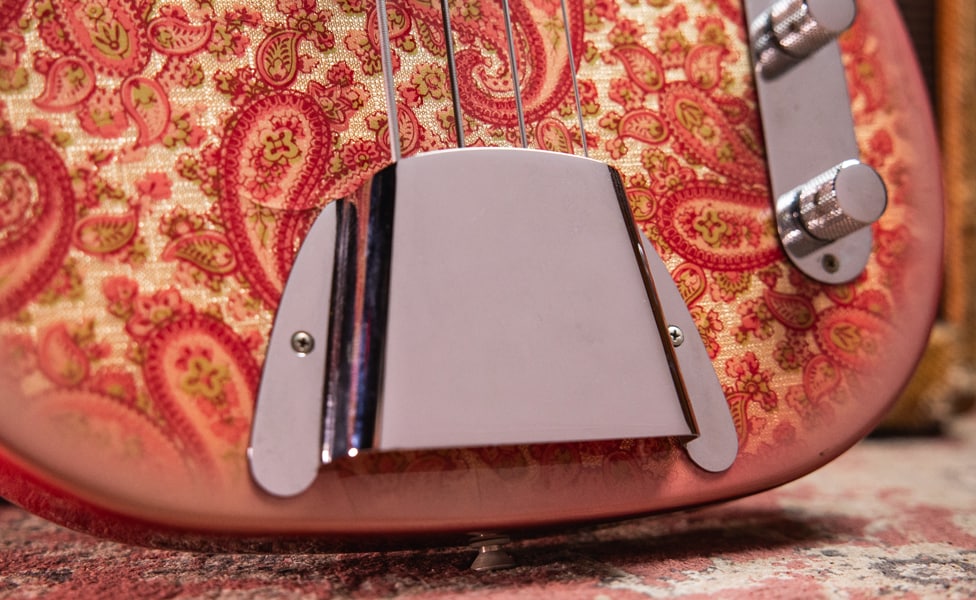
Pictured: 1968 Fender Pink Paisley Telecaster Bass Bridge Cover
Is it perfect? No—but what is? Given that there may be fewer than a couple dozen surviving Pink Paisley Telecaster Basses worldwide (and even fewer Blue Flower examples), this may well be one of the top two or three remaining specimens, and it stands as one of the rarest pieces in Guitar Center’s vintage collection.
Getting hands-on time with this bass was a genuinely exceptional experience—one I’ll file away among my once-in-a-lifetime memories, destined to be recalled in hushed, reverent tones. When an instrument manages to be a historical curiosity, a vivid symbol of cultural change and a genuinely great player all at once, it checks every box for me. I hope to make more pilgrimages to Hollywood’s Vintage Room to share stories of the remarkable instruments that pass through our doors. Until then, you can explore Guitar Center’s Vintage Collection online and dream a little dream of your own. Who knows? Maybe it’ll come true.
Written By: George Van Wagner
George Van Wagner is a writer and editor for Guitar Center, where he has worked since 2007. A multi-instrumentalist, freelance recording engineer, arranger, composer, writer and all-around tech geek, he has over 30 years of experience in the musical instrument industry at companies like Midiman/M-Audio and Line 6, doing everything from customer service and writing user manuals to working in product development. He is currently gigging around Los Angeles with Gruppo Subconscious and Bobby “Hurricane” Spencer.
Recently Added to Gear Tips
Be the first to know about exclusive offers, tips and more.

866-498-7882 English
877-687-5402 Español