.jpeg)

Pro Gear Advisers
•866-498-7882
BOSS PX-1 Plugout FX | Hands-on Review

I’ll never be honored with an award for controlling my obsession with stompboxes. I am, quite frankly, too far gone.
Even though it has been years since I was in the professional recording studio business, I still possess numerous Home Depot storage bins labeled “Fuzzes,” “Boosts,” “Modulation Pedals,” “Overdrives,” “Bizarreries” and so on.
I’ve also constructed five different pedalboards for specific gigs: Studio Sessions, Ambient Performances, The Trouble With Monkeys (rocked-out Monkees tribute), Cher Tribute and Solo Gigs. I know this is probably overkill, but I enjoy following the “right tool for the job at hand” philosophy.
You can certainly join my cadre of musician friends who never cease to tell me over and over, “Why don’t you just get a multi-effects board?”
Well, I’ve used them. I like them. But I don’t love them. Instead, I’d rather mix and match different pedals like multi-colored Legos and have the freedom to discover (and add) new boutique and big manufacturer pedals when they make the scene.
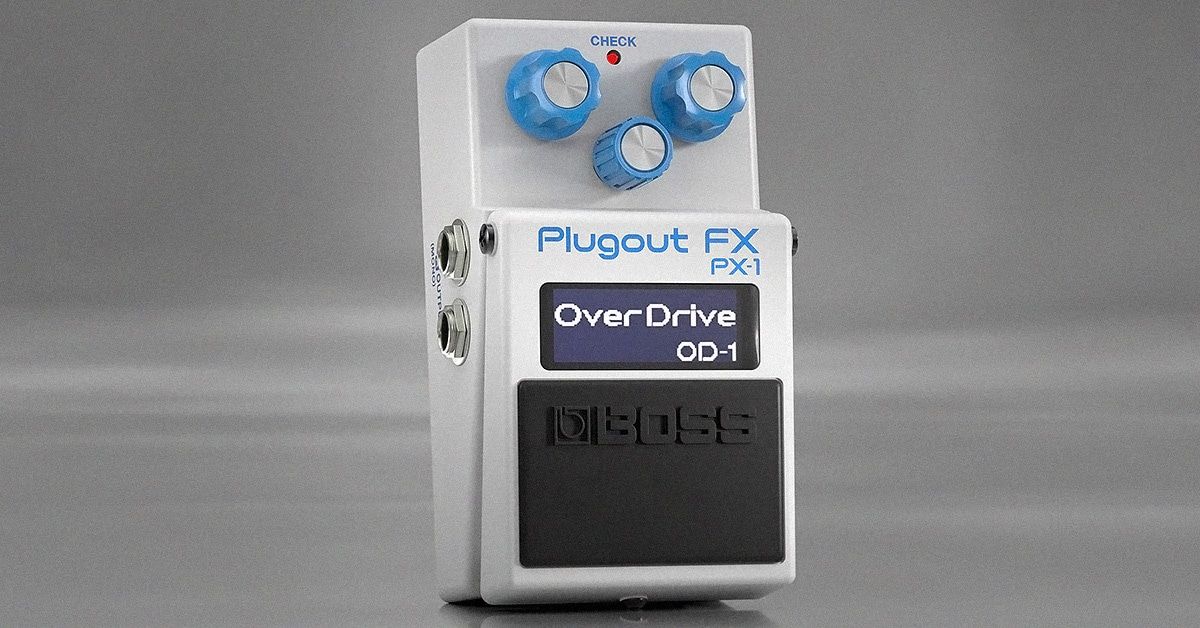
Given all the above, I was super thrilled over the concept of the BOSS PX-1 Plugout FX. As you’ll see, the PX-1 fits right into my single-pedal workflow, and it solves a personal effects dilemma that has bugged me for years.
What Is the BOSS PX-1?
The BOSS PX-1 Plugout FX is a single-effect-at-a-time multi-effects unit housed in BOSS’ original (1977), globally recognized, gig-tested and indestructible compact pedal chassis. The tech is enclosed in the old-school (but still relevant) casing, because the PX-1 is initially home for 16 digital models of classic BOSS pedals. Literally, every pedal I bought from Guitar Center San Francisco to use for my early bands is in this thing, including the OD-1 OverDrive, PH-1 Phaser, CS-1 Compression Sustainer, DS-1 Distortion, CE-2 Chorus, BF-2 Flanger, PN-2 Tremolo Pan, DD-2 Digital Delay and more.
Best for: Players desiring one classic BOSS effect at a time, and in the company’s pedalboard-friendly compact pedal format.
Not for: Players who like their stompboxes analog and need a slew of simultaneous effects on hand.
The catch: Keep in mind not all effects placements are created equally. Where you physically plop down the PX-1 in your signal chain may be great when you use the OD-1 OverDrive, but less optimum for the CE-2 Chorus or DD-2 Digital Delay. Here’s a refresher course on pedal order.
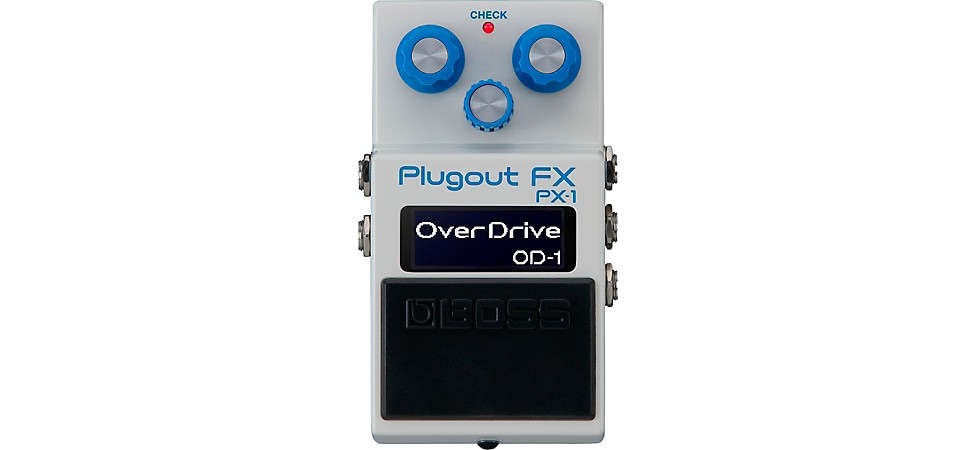
Shop Now: BOSS PX-1 Plugout FX Multi-Effects Pedal
Chart: Basic PX-1 Features
|
Bypass |
Display |
I/O |
Current Draw |
|
Buffered |
Graphic LCD 128 x 48 dots |
Mono/stereo input/output jacks (1/4"), CTL/EXP jack (1/4" TRS), MIDI IN, USB-C |
260 mA (AC adaptor) |
Is the BOSS PX-1 Easy to Use?
The BOSS PX-1 is a digital stompbox, so is it easier than powering up an analog pedal, plugging it into a couple of cables and finding a suitable spot on your pedalboard? No. It is not. Let’s run through what you can expect…
Setup: The PX-1 boasts 16 effects, but only half that number is preloaded into the pedal. To get the full complement of goodies, you must first download the BOSS Effect Loader app. You’ll also need to sign up for a free Roland Account, register your PX-1 and possibly update the firmware using a USB-C cable connected to a computer or smartphone. Note: Don’t forget to plug into the pedal’s included AC adapter during the update.
Loading effects: Once you complete the setup chores, you can use Bluetooth to add or swap effects via the BOSS Effect Loader app. Anyone with experience using touchscreens will be able to load models into the PX-1. That’s a good thing, because the PX-1 is limited to 16 storage slots. If you add effects, you’ll definitely find yourself reconfiguring the PX-1 to keep your fave pedals in the box and at the ready.
Negotiating parameters: Once you start using the PX-1 pedal, its controls are sensible and easily understandable. The physical knobs emulate the knobs on the original units with a couple of beneficial caveats. For example, if a parameter that wasn’t included on the original pedal is now deemed useful, it may be available on the PX-1 by simply pressing one of the three knobs to access a menu. In addition, if an original pedal had more than three knobs—such as the BF-2 Flanger—pressing one of the PX-1 knobs will reveal the “missing” control.
At the gig: The app pretty much explains everything in detail, but unless you want to trust Bluetooth at the venue, you’ll be using the PX-1’s onboard graphic LCD (128 x 48 dots) for critical ops. The size of the screen isn’t what you may be used to on some other multi-effect devices, but it’s big and bright enough to get the job done without squinting, missing parameters or having the text blown out by an errant spotlight shining on the pedal.
Other helpful features: The PX-1’s I/O includes 1/4" jacks for running mono or stereo rigs. An expression pedal (sold separately) input lets you do what many of the original pedals did not offer—real-time control of selected parameters. While the PX-1 is not a conventional multi-effects device—you already know that—it does allow you to switch between two different effects via its Swap function. A control input is provided so you can swap “pedals” using an optional (sold separately) footswitch. You can input tap tempo with a footswitch as well, or if you favor more automatic tempo coordination, a MIDI IN is onboard for MIDI clock sync.

Pictured: BOSS PX-1 and BOSS Effects Loader Application
What Eight BOSS Effects Does the PX-1 Give Me Immediately?
Well, you may or may not be overjoyed with the “automatic eight”—I wasn’t—but the first 16 are a pretty fabulous crew. Everything is subjective here and user dependent, so I can’t criticize BOSS for their initial eight choices. Selecting from a vast BOSS compact pedal inventory where every player has an opinion of which boxes are essential is the definition of a thankless task where no good deed (or choice) goes unpunished.
But given you can dive into the preloaded models without having to update firmware or deploy the app, those automatic eight offer the glorious advantage of instant gratification.
First Eight Pedals (Preloaded): OD-1 OverDrive, SP-1 Spectrum, PH-1 Phaser, CS-1 Compression Sustainer, TW-1 T Wah, DS-1 Distortion, SG-1 Slow Gear, SD-1 Super OverDrive.
Second Eight Pedals (User Loaded via App): CE-2 Chorus, BF-2 Flanger, VB-2 Vibrato, DD-2 Digital Delay, DF-2 Super Feedbacker & Distortion, OC-2 Octave, PS-2 Digital Pitch Shifter/Delay, PN-2 Tremolo/Pan.
My Essential Eight: I have an already configured pedalboard where the PX-1’s job one is to provide a one-stop modulation option. My individual use case didn’t align with BOSS’ very reasonable plan of offering sonic diversity with the PX-1’s initial eight, so I wouldn’t be able to gig out of the box. Unless, some obliging magic preloaded the PX-1 with my eight choices: PH-1 Phaser, CS-1 Compression Sustainer, CE-2 Chorus, BF-2 Flanger, VB-2 Vibrato, DD-2 Digital Delay, DF-2 Super Feedbacker & Distortion, PN-2 Tremolo/Pan.
Pedal Updates at Additional Cost
It’s no secret some musicians and influencers didn’t love BOSS’ decision to charge $9.99 for each extra pedal loaded into the PX-1. This is not a new idea, as other plug-in and processor companies across guitars, keyboards and recording offer expansion packs and premium access at additional cost, so users can continue to grow and diversify their creative options.
At press time, BOSS released a trio of additional classics for sale: the analog DM-2 Delay, OD-2 TURBO OverDrive and DC-2 Dimension C. All of these are drool-worthy effects.
The DM-2 was the first delay pedal on my board in the early ’80s, and it stayed there for years. Finding an original used model on the vintage market could cost around $300. I never used the DC-2, but I loved the Roland SDD-320 Dimension D rack processor that inspired the BOSS pedal. In fact, it’s embarrassing to listen to some of my old recordings and realize I used this chorus-like effect on almost every instrument. Used original DC-2 pedals go for $200 or more. The OD-2 TURBO OverDrive never found a spot on my pedalboard, but I had friends who were obsessed by its creamy high-gain tones. Used examples of the OG OD-2 are very reasonable, listing at under $100.
Obviously, the $9.99 charge for adding more BOSS classics to your PX-1 is a good deal compared to vintage hardware models. However, BOSS’ current price of $9.99 per added sound is higher than what many competitors charge.

Pictured: BOSS PX-1 Control/Expression and Input Jacks
Review Methodology for the BOSS PX-1
Yes, I have multiple pedalboards. But that doesn’t mean I’ve escaped the horror of managing pedalboard real estate. Keeping the various boards smartly pedal populated for their main gigs always requires a Tetris-style approach to space assignment, as well as a “you can’t have everything” mindset. What gets constant limits in my musical world are modulation pedals. I need them, but it’s often one effect for a specific song, so I can’t justify assigning tight quarters to chorus, flange and phase pedals I may use once each throughout a show.
I had thought using extremely inexpensive, mini multi-effects would be a wonderful way to experiment cheaply until I found a workable option for my pedalboard space and tonal needs. Unfortunately, those units would last a gig or three before they gave up the ghost. The BOSS PX-1 looked like the perfect solution for the way I play. It just had to work far more professionally, robustly and sonically than what I had been using.
Test Stage One. I visited my local Guitar Center, asked for a PX-1, grabbed an Epiphone Les Paul Custom Widow (I sometimes use the same model on stage), plugged into a VOX AC15 (my preferred amp) and started scrolling through the effects. It was noisy in the store, but it felt like being in a club, so I felt it was a fair test. After all, many sound checks are similarly intruded upon by jabbering bandmates and venue staff, clinking glasses at the bar and even house music playing softly but audibly in the background. I didn’t dare crank up to gig volumes, but I got a good home rehearsal level going, and I was able to hear the effects clearly. I didn’t download the app, so I just tested the initial eight models.
Test Stage Two. Good luck! A friend owned a fully configured PX-1, and he loaned it to me for a couple of days. Time to dig in. In my band’s rehearsal space, I brought my own VOX AC15 and an Orange Tiny Terror with custom MESA/Boogie 1x12 cabinet. The test guitars included my Reverend Reeves Gabrels Signature Dirtbike, Collings 290, Gibson Les Paul Standard, Hanson Chicagoan ST semi-hollowbody, California Guitars custom T-style and Gretsch Electromatic double-cut semi-hollow. I played the PX-1 solo through the guitars and amps, and also partnered it with some of the other effects on my Studio Sessions pedalboard, including the GAMMA Atlas Boosted Overdrive, Pro Tone Reeves Gabrels Distortion Engine and Dunlop Mick Ronson Cry Baby wah. Volume levels bounced between low and clean, rehearsal loud and full-on gig rage. I tested all 16 pedals in this session.

Pictured: BOSS PX-1 with BOSS Dual Expression Pedal
How Does the BOSS PX-1 Sound?
I had the opportunity to play or record with almost all of the original pedals modeled in the PX-1. All that means is I can witness the veracity of the BOSS models by comparing the PX-1 sounds to my own vintage pedals and even some of my old recordings where certain BOSS pedals were featured. I’m not sure how much that will mean to someone who has limited experience with the BOSS sound and simply wants a collection of awesome choruses, overdrives, delays and other effects. So, let me split my tone evaluation into two parts…
For BOSS aficionados: Because my mind was blown by Reggatta de Blanc by The Police, I drove straight to Guitar Center looking for “that sound.” In the days before Google and YouTube, I thought the effect was a chorus. It wasn’t. Andy Summers identified it as an Electro-Harmonix Electric Mistress flanger in a Guitar Player interview. But I fixated on the BOSS CE-2 Chorus, I bought it and I never turned it off. (At the time, my intimidatingly gruff Welsh road manager once threatened to reduce me to newsprint pulp if I didn’t give the chorus a rest.) When I play the PX-1 model of the CE-2, it is that sound. Even the musical joy hairs tingling on my arms are exactly the same. Not to ruin the suspense, but I had the same reaction with the PH-1 Phaser, BF-2 Flanger and DD-2 Digital Delay. It was like I was back on stage at San Francisco’s Mabuhay Gardens, plugged into my beloved Marshall half-stack and avoiding ashtrays being flung my way.
I have my original OD-1 OverDrive and SD-1 Super OverDrive, and compared to the PX-1 versions, the OGs are slightly rougher and grittier, and they are also a tad noisier. But I doubt a player would think these PX-1 models are anything but excellent drive pedals if heard on stage or in a recorded track. They’re really good.
For everyone else: Once uncoupled from BOSS devotee status, there are bazillions of outstanding effects available. In my roles as former editor of Guitar Player and current article content producer at Guitar Center—as well as a lifelong musician and pro recording studio owner—I’ve had the opportunity to test hundreds of pedals of all types and makes. Very few sucked. (Or if they did suck, they were brilliantly off-kilter.) So, while recognizing that specific pedals tend to ebb and flow in popularity, I can say that every sound in the PX-1 is of super high quality. The CE-2 Chorus is as animated and dreamy as you could ever want. The PH-1 Phaser, BF-2 Flanger and VB-2 Vibrato provide enough cinematic warbles to inspire guitar parts, riffs and perhaps even entire song arrangements. There’s that thrilling blend—in varying degrees—of luscious sustain and feral attack in the OD-1 OverDrive, DS-1 Distortion and SD-1 Super OverDrive, and the DF-2 Super Feedbacker & Distortion is magnificently unhinged. You may opt for a conventional multi-effects floorboard or the “influencer” pedal of the moment, but all of the sounds in the PX-1 will provide your playing with the sonic charisma it needs to stand out and be heard.

Pictured: BOSS PX-1 MIDI, 9V and USB-C Inputs
Why I Dig the PX-1
Listen. I love the PX-1. But I’m admittedly biased. I had a pedal problem and BOSS fixed it, so it’s almost like the designers came to my studio and crafted it just for me. Yeah. Didn’t happen. But for any other players looking for something as specific as a space-saving solution for adding one-by-one modulation effects to their rig, I’m calling this a slam dunk.
It could also be a song saver for guitarists who do a lot of studio work. Pro recording studios usually have a lot of gear on hand, but it isn’t like I’ve never had an engineer say something like, “Gads, if only we had a flange pedal available.” And then you pull out the PX-1. Hero.
Another PX-1 benefit—although I hate being so nostalgic—is that it’s a tiny museum of BOSS compact pedal history that you can actually play. I know I’m not alone in missing long gone (i.e.–lost, stolen, broken, etc.) pedals that informed my early playing years.
For example, I’ve used a ton of fabulous chorus pedals, but hearing the CE-2 Chorus in the PX-1 brought me right back to trying to get an Andy Summers sound at a college gig in Northern California around 1980. So many players have used BOSS pedals at some point in their careers that I’ll assume there’s a long list of faves out there currently stored in—or will soon be available for—the PX-1.
Admittedly, there are some aspects of the BOSS PX-1 that won’t appeal to everyone (see below for Kudos and Concerns). As a music professional, I acknowledge those criticisms, but—let’s put it this way. I know my Shiba Inu barks too much, never comes when called, is way too eccentric at all times and is fierce when bothered, but I love her to pieces, nonetheless. Therefore, the BOSS PX-1 is going to be on my pedalboard—well, one of them—for a very long time.
What I Loved
- Excellent sound
- Space-saving multi-effects solution (if using one effect at a time works for you)
- Virtually unbreakable
- Enhances some classic BOSS effects with MIDI and expression pedal control
Things to Consider
- Pedal only stores 16 effects, and only eight can be new (you can’t exchange the eight pedals that came with the PX-1)
- When new releases are available, you will have to pay for them
- BOSS Effect Loader app is super useful, but perhaps not at a gig
- Signal chain placement may be a problem for some users (such as when bouncing between the OD-1 OverDrive and DD-2 Digital Delay)
Written By: Michael Molenda
Michael Molenda is a content strategist, editor and writer for Guitar Center, where he has worked since 2022. He is the longest-serving Editor in Chief of Guitar Player (1997-2018), and former Editorial Director of Bass Player, EQ, Keyboard, Electronic Musician, Gig and Modern Drummer. A guitarist, drummer, bassist and producer, Mike co-owned three pro recording studios in San Francisco, and performs with Surf Monster and The Trouble With Monkeys.

Be the first to know about exclusive offers, tips and more.

866-498-7882 English
877-687-5402 Español