
.jpeg)

Pro Gear Advisers
•866-498-7882
5 Secret Weapon Guitar Pedals for Weird and Inspiring Tones
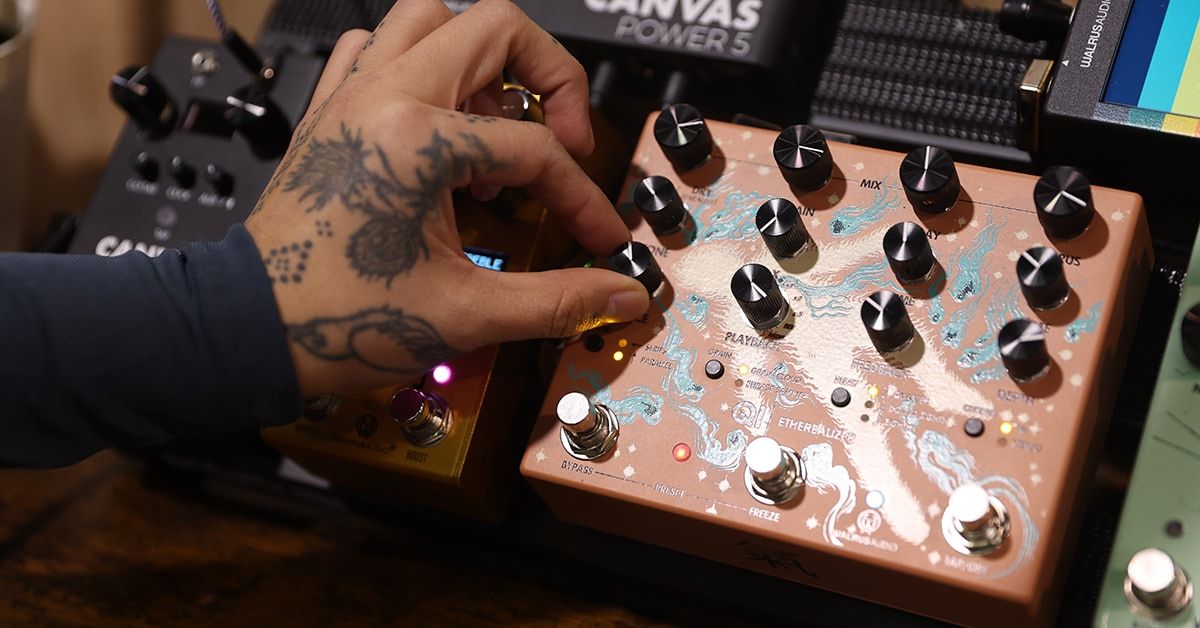

Why should a guitarist explore weird new sounds? You certainly don’t have to. But if you always reach for the “usual suspect” effects to produce the same-old, utterly predictable guitar tones, you may be draping yourself in dreary conformity, instead of wowing fans with strange and intriguing soundscapes.
Admittedly, embracing an eccentric guitar pedal is seldom comfortable, uncomplicated or a wise career move. After all, guitarists can fall easily into tedium traps, because the guitar sounds forged between the 1950s and 1990s have become the established language of popular music, and it’s no small challenge to defy tradition.
There’s also a significant chance exploring an arcane, completely unhinged stompbox may produce madcap and virtually unusable guitar sounds. But that weird pedal could also stimulate exciting new riffs, add heightened emotional substance to musical pads and crescendos, prevent your technique from relying on old habits, and elicit delight, shock and awe in listeners who have heard it all before.
If you’re still experiencing some trepidation, you can reduce weird effect anxiety by realizing you don’t need to forever replace the creamy, sustained and beautiful overdrive of a Gibson Les Paul plugged into a Marshall half-stack with a bizarre yet possibly more contemporary synth-guitar tone. But the million-dollar artistic question remains: Why must guitarists always bow to traditional tones for everything they do?
So, if you consider yourself a disruptive, curious and experimental creator, why not join the weird pedal crew and leap into the uncomfortably unknown? We have five secret weapons to start you off…
Quick Comparison Chart of Weird Guitar Pedals
|
Pedal |
What Does It Do? |
Switching |
Current Draw |
Price* |
|
Feedback looping of your pedals |
True bypass |
5 mA |
$250.00 |
|
|
Feedback generator |
True bypass |
235 mA |
$211.44 |
|
|
Polyphonic organ emulator |
True bypass |
81 mA |
$199.00 |
|
|
Produces synth atmospheres, lo-fi glitches, oscillations and prog-y sequences |
Buffered bypass |
100 mA |
$129.00 |
|
|
Multiprocessor with chorus, delay, reverb and granular effects |
Buffered bypass |
300 mA |
$449.99 |
Pricing as of September 2026*
Turn and Face the Strange
We know it may be somewhat unnerving to transition from your favorite overdrive, distortion, reverb and chorus pedals to audition the five wonderful wackos we’ve profiled here. As with many arcane pedals, randomness and vicious eccentricity are fundamental, so the tonally timid should probably seek joy elsewhere. Control freaks should also take heed, because it’s near impossible to regulate chaos.
For some players, plugging into an Electro-Harmonix Pico Atomic Cluster Spectral Decomposer will definitely require a tad more courage than stomping on an Ibanez Tube Screamer. But we’ve tried to provide enough real-world applications to make trying these weird pedals an exercise in discovery and fun. Let’s embrace the mysterious ...
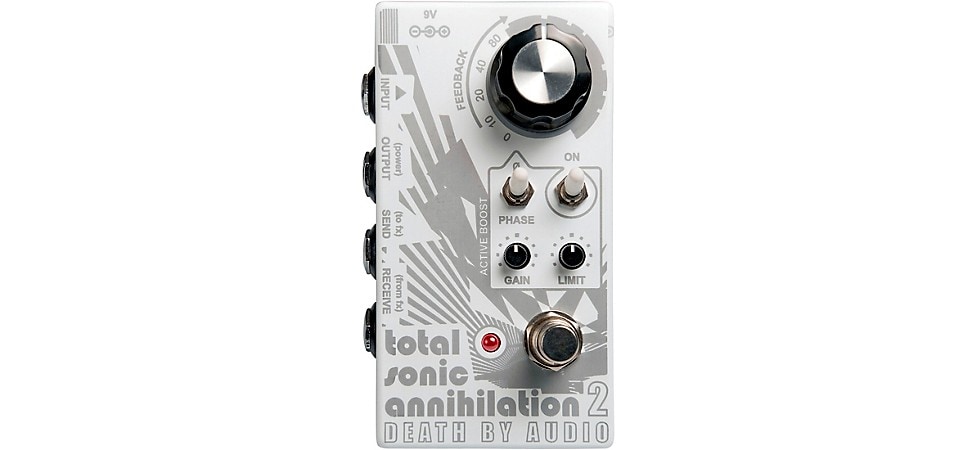
Death By Audio Total Sonic Annihilation 2
Why We Picked It: Feeding your pedals back into your pedals creates feedback loops and oscillations fearsome enough to panic alien invasion forces.
Key Features:
-
Feedback knob determines how much of the effects in the loop are slammed back in on themselves
-
Active Boost switches on the Phase, Gain and Limit features, and, with no pedals in the loop, can also produce oscillating fuzz and noise tones by itself
-
Built-in limiter can balance low- and high-volume sounds to avoid dropouts and uncomfortable level spikes
Shop Now: Death by Audio Total Sonic Annihilation 2 Forced Feedback Loop Noise Effects Pedal
I love the name of the Death By Audio Total Sonic Annihilation 2—and it’s not for the weak of heart—but I don’t see it as an “annihilator” as much as an audio pandemonium device. It transmutes the stompboxes already populating your pedalboard into boxes of mayhem.
For example, when fuzz, distortion and overdrive pedals are sent into the Total Sonic Annihilation 2, expect noise squalls, random grit and screeching, and “radio signal” splatter that evokes the dying transmissions of a damaged Voyager 1 probe. Delay pedals can get “modified” into evil cascades of near endless repeats, as well as the sound of ray guns blazing in ’50s sci-fi flicks. Even an effect as pleasingly ambient as reverb can be altered into more distressing noises, such as air raid sirens and the sounds of a wooden bunker tearing itself apart in an earthquake. You can dial in a ton of other glitchy, yowling and synth-like sounds to add climatic thrills to melodic lines, driving riffs and spacey textures.
Of course, the potential downside of any device that invites real-time knob twisting for sound creation is repeatability. The Total Sonic Annihilation 2 works great for home and studio recording—if you practice the AIR (Always In Record) method, that is—because whatever sounds you create on the fly will be documented. Replicating a favorite Total Sonic Annihilation 2 sound for a series of live shows, however, could be either an exercise in futility or exceptional good luck.
I look at audio production almost like painting, so flawlessly duplicating studio tones or parts onstage has never been a concern. A completed canvas exists as a singular work of art, and any potential rethinks of the original will stand alone, as well. I dig that specialness. You may have a different view, and that’s fabulous, but if you want to bring a specific Total Sonic Annihilation 2 sound to the stage, you may need to sample it and figure out how to trigger it live.
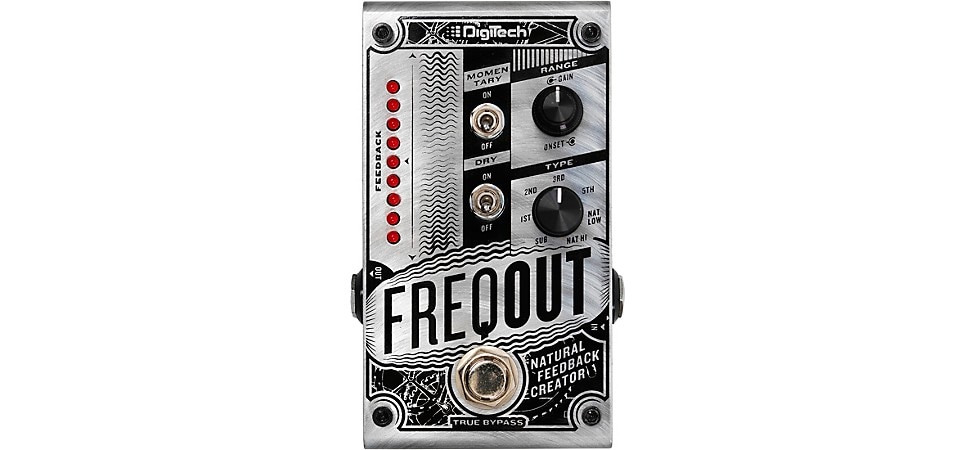
DigiTech FreqOut
Why We Picked It: Natural-sounding harmonic feedback that rages at any volume.
Key Features:
-
Choose from seven types of harmonic feedback (fundamental note to 2nd, 3rd, 5th, sub low and more)
-
You can delete the dry signal for liberated feedback frenzies or blend dry and effected signals
-
Option to dial in timing for the onset of feedback
Shop Now: DigiTech FreqOut Frequency Dynamic Feedback Generator Effects Pedal
The DigiTech FreqOut is a feedback generator and you may wonder, “What is so ‘weird about feedback?” I often ask myself the same question because feedback is massively cool. (C’mon, “Station to Station” by David Bowie?) But I could write an epic novel about all the recording sessions I’ve done where I’ve suggested feedback tempests and the artist looked at me as if I had said their taste in footwear was atrocious. Nonetheless, the FreqOut is always within reach when I’m producing a session or mixing tracks.
Unlike some of the other pedals on this list, the FreqOut is fairly easy to control. You can tailor the feedback voicing to a song’s mood with the Type knob, precisely manipulate the onset of feedback and how long it lasts, and kill the dry signal so all you hear is that gorgeous wailing. It sure beats the days when I had to wiggle my Les Paul in front of an oppressively loud Marshall half-stack and pray the feedback sounds I heard in my head would actually appear.
The FreqOut produces authentic amp-like feedback sounds that can elevate licks, riffs, solos and chords to something unexpected and grander. For example, if the entrance to or outro of a solo is lovely note- and tone-wise but simply lacks something magical to charm listeners, I’ll add the FreqOut to the signal chain and manipulate the effect myself while the guitarist records a take. If I’m brought on as a mixer and wasn’t present during the recording sessions, I can use one of the myriad reamping tools available to incorporate some FreqOut effects into already recorded guitar tracks.
There are other session-saving uses. For instance, let’s say the tag of a chord progression leading into a chorus, bridge, breakdown or instrumental segment is boring and doesn’t provide the energy or vibe to suitably “announce” the upcoming section. A spot of feedback can do wonders in these situations. I also like to add ghostly counterpoint lines to verses or choruses by using the FreqOut’s Dry switch to delete the guitar signal and only play with the feedback. It’s a way to get a sustaining EBow-like effect when you don’t have one, and the feedback adds some vibe-y spectral animation without calling too much attention to itself (unless you want it to). I’ve used this technique if a band kicks off a song with a cymbal crash, and the abrupt opening appears too stark and obvious. A few seconds of feedback creeping up before the cymbal crash often sets up the drama much more cinematically.
Oh, and there’s the “car horn dilemma” where a really good singer holds out a long note without any vibrato, and the vocal timbre is too pure, too perfect and too much like a hurricane warning. I’ll simply sneak in feedback swells under the vocal track to create a marvelous crescendo. For more even tips about what a FreqOut can do to invigorate your guitar tone, see "The Sound of the Smashing Pumpkins: Jeff Schroeder".
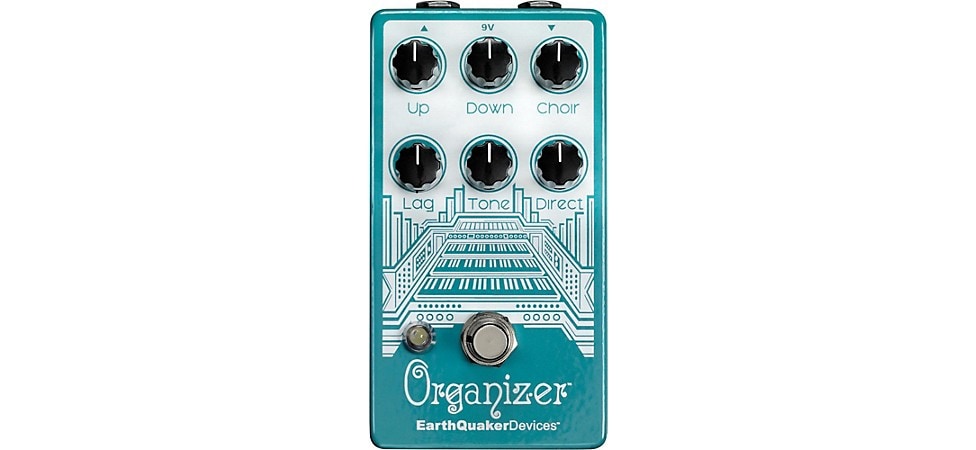
EarthQuaker Devices Organizer V2
Why We Picked It: Purports to be an organ emulator, but it’s much stranger and more wraithlike.
Key Features:
-
Up and Down controls offer precise blending of the octave up and octave down effects
-
Choir regenerates octave settings to produce an additional two octaves up and two octaves down, along with a slightly delayed direct signal
-
Lag knob sets delay time for the wet signal
Shop Now: EarthQuaker Devices Organizer V2 Effects Pedal
Although it’s starting to sound as if I’m channeling a 1960s carnival hawker, the EarthQuaker Devices Organizer V2 is another vibe-maker I can’t do without. In fact, it’s a constant resident of my own “Secret Weapons” storage bin where I keep my most bizarro pedals.
The Organizer was modeled after the MCI Guitorgan invented in the late 1960s by Bob Murrell, with some likely crossover from the VOX V251 Guitar Organ. However, I don’t deploy it as an organ emulator. (For those duties, I like the Electro-Harmonix B9 and C9 Organ Machine pedals.) The Organizer V2’s controls include octave up and octave down, a high-end roll-off, a delay for the wet signal and a level control for the direct (unaffected) signal. Those knobs alone offer many ways to disrupt conventional guitar sounds, but the Choir control—which regenerates, blends and slightly delays the octave for an additional two octaves up and down—is where truly bizarre sounds can be dialed in.
To be fair to the pedal’s designers, echoes of Baldwin, Hammond and church organs are always present no matter how you spin the knobs to obliterate any keyboard sounds. But those wisps of the familiar can easily be steered to otherworldly textures—especially as you experiment with adding overdrive, distortion, fuzz, chorus, flanging, phasing, EBow, different guitars and/or a volume pedal to the mix. Even with all manner of wildness afoot, the Organizer V2 manages to accurately track performance dynamics, bends, pull-offs, hammer-ons, trills, where you play on the neck and finger vibrato—although aggressive, Ramones-style bashing can smear things a bit and intensify the pedal’s always-active slight oscillation.
Like the DigiTech FreqOut, long-term recording clients of mine tend to fear the appearance of the Organizer V2 because they know it means I’m going to mess with their track’s time-space continuum. Well, it’s more of a shared joke between friends because they’re also aware the Organizer V2 is going to bring something marvelous.
I use the effect mostly for pads, both sitting in a mix on their own or blended with other instruments or sounds. The Organizer V2 is tailor-made for enriching musical breakdowns where a sonic shift can really power up a song. For example, dropping an arrangement down to just drums, percussion or a single guitar or bass riff is a proven technique for increasing dynamic interest, but adding an ethereal, sustaining pad from the Organizer V2 can elevate the impact even more. I may love a conventional breakdown, but I’ll still pull out the Organizer V2 to see if the vibe can be improved, and I’m always inspired by what it offers—even if the part ends up not making the cut for various reasons.
I also approach weird stompboxes as if I just discovered them for the first time, rather than thinking something like, “Oh, I’ve used this pedal a lot, and I know precisely how to set it for this specific situation.” I never embrace mental “presets,” where familiarity with an effect comes into play when I’m crafting sounds. In the case of the Organizer V2, I just spin the knobs until something catches my ear. There’s never a plan, and I respectfully recommend you adopt the same tactic. You’ll achieve more stunning results by letting the Organizer V2 drive the creative process.
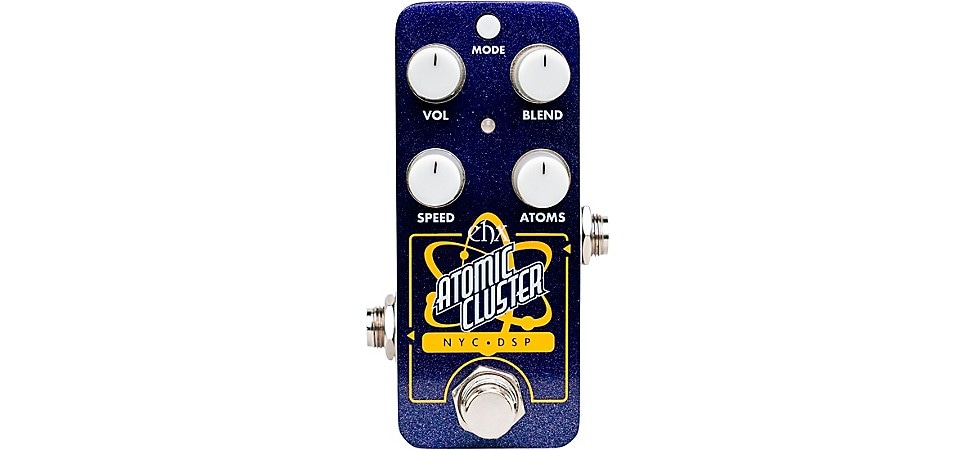
Electro-Harmonix Pico Atomic Cluster Spectral Decomposer
Why We Picked It: Deconstructs an instrument’s frequency resolution to summon ambient vistas (Smooth mode) or synth-like warbles (Sharp mode).
Key Features
-
Speed knob sets oscillator refresh rate for rhythmic filtering or unpredictable glitches
-
Tap tempo functionality
-
Compact Pico chassis saves room on your pedalboard
Shop Now: Electro-Harmonix Pico Atomic Cluster Spectral Decomposer Effects Pedal
Like the Death By Audio Total Sonic Annihilation 2, the Electro-Harmonix Pico Atomic Cluster Spectral Decomposer is the type of name that should fascinate experimental-leaning creators. It sounds like fun before you even plug it in, and it delivers. I don’t even need to know how it works, because I want to think it’s magic.
But for those who require context, the Atomic Cluster Spectral Decomposer employs an algorithm that breaks down the frequency content of an input signal to fewer parts—which Electro-Harmonix describes as “pixelating” a photograph or graphic image. Those smaller bits, or “atoms,” are then reconstructed as resonant oscillations, rhythmic glitches or synth-like tones. Most all of the Atomic Cluster Spectral Decomposer’s sonic results are fabulous for adding subtle interest or outright bedlam to parts—especially if you’re a player who likes exploring conjoined guitar/keyboard fusions (think The Fly, but more inspiring and less grotesque).
A small hurtle for using this pedal is imprinting into your brain that turning the Atoms and Speed knobs full up makes the sound more normal (like the input signal), rather than unleashing anarchy. It took me a while to grasp “turning down” meant “more effect.”
Sharp mode delivers the most synthy warbles and noises, and the effect can be disquieting if you let it fly unattended. However, the pedal’s tap-tempo functionality and Blend knob (balances wet/dry level) ensure the pulsing oscillations are locked into your groove and delicate enough to add some swagger without transforming your tone into a psychotic reaction.
I liked the sci-fi shimmers and gurgles Sharp mode affixed to chords, but I had more fun creating moody pads in Smooth mode. In yet another scenario where all bets are off regarding “appropriate” sounds, the Atomic Cluster Spectral Decomposer gives creators the tools to construct blizzards of the bizarre that would send most listeners running for the door. That is, except for the fact the Blend knob can position even the most outlandish sounds into the background of the direct signal, where a hint of the abnormal can offer attention-getting spectral benefits.
Walrus Audio Qi Etherealizer
Why We Picked It: Serves up a combo plate of chorus, delay, reverb and grain effects to create supernatural soundscapes.
Key Features:
-
Three modes: Pitch, Random and Swell
-
Freeze footswitch captures samples from your playing that can be looped as Grains (sampled content)
-
Onboard effects chain can be run in series or parallel configuration

Shop Now: Walrus Audio Qi Etherealizer Chorus, Delay and Granular Effects Pedal
I believe Yvette Young is one of today’s most original and inspiring guitarists. I’ll beam more respect her way, because she is not protective or possessive about her tonal inventions or techniques. She regularly shares knowledge with the guitar community and her fans—just check out her tone-crafting seminar and her pedal master class with Kiki Wong (Smashing Pumpkins). She is also unafraid of providing players with her sonic toolkit, and, as a result, the Walrus Audio Qi Etherealizer can be considered as more than a signature pedal—it’s an Yvette Young workstation that unlocks some specific keys to her cinematic soundscapes.
On the face of it, the Qi Etherealizer looks like a common multi-effects device with chorus, delay, reverb and something called “Grain.” But this is one of those situations where the angel is in the details. How you approach tone construction with the Qi Etherealizer is both familiar and delightfully surprising. Young herself has said she loves “surrendering control” and not knowing what to expect, and she and Walrus devised a pedal where losing yourself in the sounds is far more compelling than losing yourself in the controls. As with most of the other pedals in this article, I like to approach the Qi Etherealizer by turning knobs randomly until I start smiling, rather than devising a plan.
However, if you simply can’t help yourself from following a sonic strategy, the Grain feature will cure you of any notions of control. The Grain Cloud, for example, arbitrarily steals tiny samples from your playing and throws the bits back at you, while Phase Sample triggers Grains rhythmically as you play (identifying initial level peaks to start the samples) and, again, plays them back.
The result can be viewed as troubling, because you may never know what’s going to happen, or as an opportunity where you are reacting in real time to the effect to create improvised and uncommon musical parts. If you’re not frightened yet, the X knob adds some structure to the feeling of chance, setting the timing between the Grains (Grain Cloud) or the overall tempo (Phase Sample).
I feel one of the hippest ways to use this pedal is to just let go. As it’s mostly designed for ambient mood making, I ping-ponged back and forth between Grain Cloud and Phase Sample modes, allowing the machine to inform the fundamental sounds. Then, I’d turn knobs on the fly, adding chorus, delay, reverb and playback (normal, reverse, double speed, half speed, etc.) to craft atmospheres as everything happened around me. It’s an exciting way to create soundscapes. Free your mind.
Let’s Go Crazy
We’re well aware the five weird pedals we’ve profiled here can be two-edged swords. They might help energize a song to an ear-catching level of awe and audience engagement that wouldn’t have been possible if they didn’t make an appearance. On the other hand, they also can send some listeners cleansing their eardrums using an audio antidote of the soundtrack from the Peanuts television special Be My Valentine, Charlie Brown.
But it doesn’t have to be one or the other.
Throughout the history of recording, producers have sought performances, arrangements, songs and sounds that demand a listener’s attention. Whatever you might consider a “hit” these days, it doesn’t usually happen unless something captivating reaches out from a playback system and transforms a stranger into a fan.
One way to accomplish this goal is to present a track with a sound or two that astound. That sound doesn’t need to overtake the entire song, but a well-placed moment can charge up the excitement factor and perk up people’s ears. For the brave and adventurous, any one of these five weird pedals can do that job.
From the other side of the stompbox, so to speak, we’ve published several stories on more conventional options. Check out "5 Essential Guitar Pedals for Blues", "The Best Overdrive Pedals of 2026", "The Best Distortion Pedals of 2026", "The Best Reverb Pedals of 2026", "Top 10 Pedals for Psychedelic Rock", "The Best Chorus Pedals of 2026", "The Best Pedals for Shoegaze" and any of the other pedal content in our Riffs blog Buying Guides. Don’t forget our knowledgeable Gear Advisers and local Guitar Center associates can also provide you with some recommendations tailored to your needs, and our AI-driven Rig Advisor can offer sonic counsel, as well.
Written By: Michael Molenda
Michael Molenda is a content strategist, editor and writer for Guitar Center, where he has worked since 2022. He is the longest-serving Editor in Chief of Guitar Player (1997-2018), and former Editorial Director of Bass Player, EQ, Keyboard, Electronic Musician, Gig and Modern Drummer. A guitarist, drummer, bassist and producer, Mike co-owned three pro recording studios in San Francisco, and performs with Surf Monster and The Trouble With Monkeys.
Recently Added to Buying Guides
Be the first to know about exclusive offers, tips and more.

866-498-7882 English
877-687-5402 Español