.jpeg)

Pro Gear Advisers
•866-498-7882
Inside the Noise Season 2, Episode 4: Jeff “Skunk” Baxter


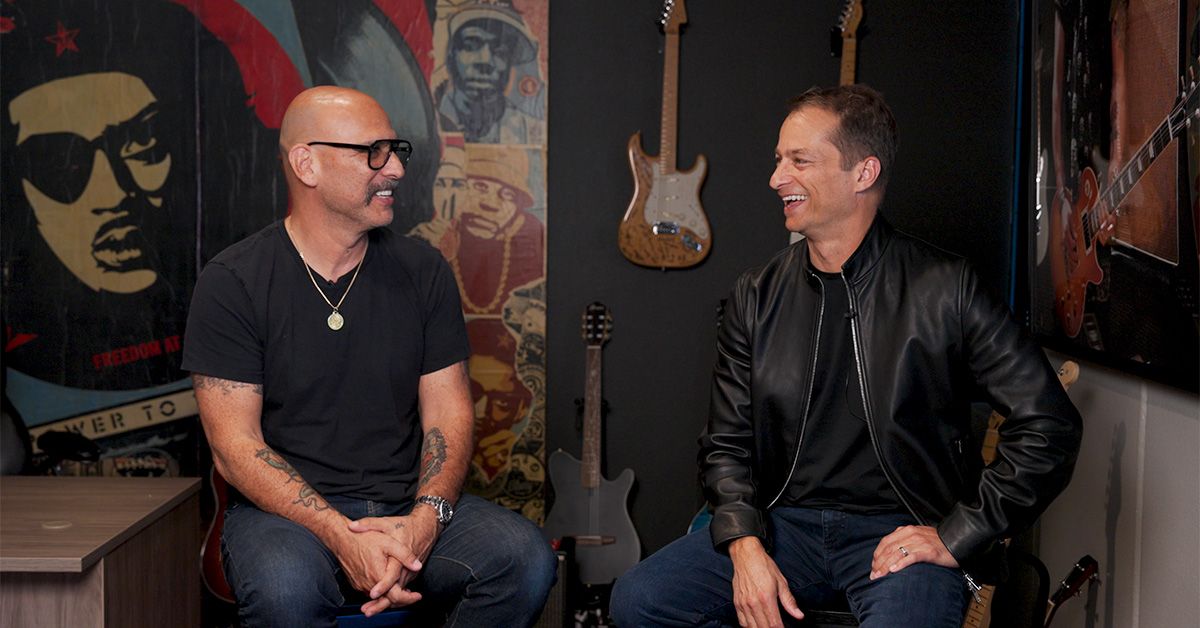
Jeff “Skunk” Baxter gained fame as a versatile and fearless session player, a member of Steely Dan and The Doobie Brothers, a soundtrack composer and a producer. But Baxter is just as keen to evolve music gear and consult on military missile systems as he is to create riffs, licks and solos. In a far-reaching discussion with an artist who seems to manage an encyclopedic variety of vocations, Guitar Center CEO Gabe Dalporto explores Baxter’s discipline, curiosity and creative drive.
One aspect of Baxter’s career that intrigues (and astonishes) many guitarists is how he negotiated the stratospherically high level of perfection “expected” during Steely Dan sessions.
“Well, being a studio musician, it felt really natural,” he says. “The discipline. The focus. I’m not sure if perfection is humanly possible, but at least striving for a level of performance and trying to be a cut above makes perfect sense to me. I never felt like, ‘I don’t want to do that.’ Why would I not want to do that?”
Another activity Baxter wants to do is collaborate and consult on music technology. From working at music shops as a teenager—first delivering amps and eventually becoming a guitar and amp tech—to a decades-long relationship with Roland where he helped pioneer guitar synthesis and modeling software, Baxter has gone deep on chasing tone.
“I'm a diode head,” he explains. “I'm going to take all the gozintas and the gozoutas I can, hook them all up and see what happens. I mean, everybody is a diode head—especially electric guitar players, because their whole survival and ability to create rests on the electron. Our very existence relies on our understanding, as best we can, of what our instrument does and how it works. And for me, having a deep understanding of the electronics of musical instruments allowed me to modify the instruments, amplifiers, pedals and things to expand the palette.”
But if you’re thinking, “Wow, that’s not for me—it would take a lot of higher education and real-world training to even conceive of developing and designing music tech,” you’d probably be right, of course. But Baxter believes musicians have an advantage in strategizing technological advancements
“The kind of thinking that goes into looking at a problem from a different perspective is one that musicians are extremely familiar with, which is nonlinear thinking. Musicians think in layers—not necessarily in a linear fashion from A to B. Instead, it's A, B, C, D, E, F and G moving together to H, I, J, K, L, M, N, O and P. In other words, instead of just moving from place to place, it's taking a number of different factors, considering them all at the same time and applying that to problem solving. It’s the ability to approach a problem from a multilevel, multilayered point of view with a lot of curiosity and very little fear. Basically, it’s the same kind of confidence you have as a studio musician going, ‘I don't care what this session is, I'm going to nail it.’”
With so much to talk about across so many aspects of music making, Dalporto keeps the discussion moving in this almost thrill-a-minute podcast. It’s an opportunity to learn so much about the guitar legend before Baxter releases his own, long-awaited autobiography.
Catch the full conversation and other episodes of Inside the Noise with Gabe Dalporto on YouTube, Apple Podcasts, Spotify or any of your favorite major platforms. When you subscribe, you’ll get new episodes every Tuesday at 3 p.m. PT.
Written By: Michael Molenda
Michael Molenda is a content strategist, editor and writer for Guitar Center, where he has worked since 2022. He is the longest-serving Editor in Chief of Guitar Player (1997-2018), and former Editorial Director of Bass Player, EQ, Keyboard, Electronic Musician, Gig and Modern Drummer. A guitarist, drummer, bassist and producer, Mike co-owned three pro recording studios in San Francisco, and performs with Surf Monster and The Trouble With Monkeys.

Be the first to know about exclusive offers, tips and more.

866-498-7882 English
877-687-5402 Español