.jpeg)

Pro Gear Advisers
•866-498-7882
5 Books to Make You a Better Guitarist

Sometimes, the most productive way to crank up your guitar chops is to abandon the screen—we’re talking to you, YouTube—and jump to the page.
Obviously, YouTube has massive value as a learning tool. I certainly wish I had YouTube available back when I was trying to learn riffs by slowing down albums from 33 1/3 rpm to 16 rpm on my grandmother’s Montgomery Ward record player. But you may be cheating yourself of musical growth, maturity and inspiration by relying solely on video tutorials and play-throughs.

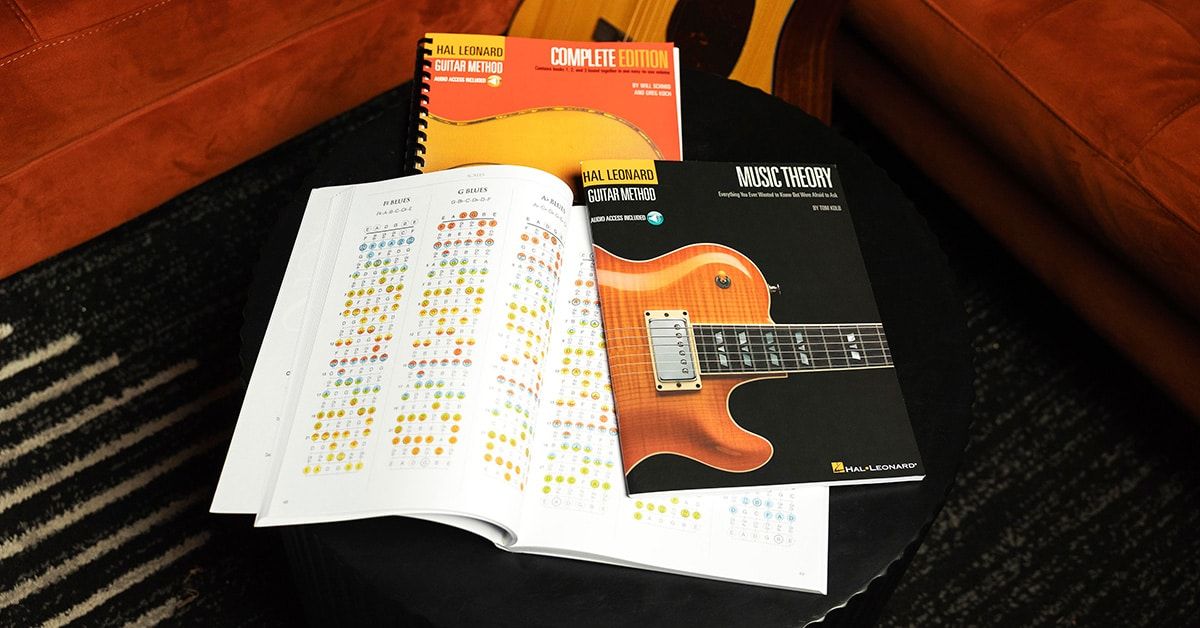
Left to Right: Hal Leonard Guitar Method Complete Edition, Guitar Fretboard Atlas, Music Theory for Guitarists
These Hal Leonard Books Can Boost Your Guitar Skills
Since 1947, Hal Leonard has been a trusted source for guitar method books as well as music education for just about every instrument—and voice—you can imagine. It is also the largest sheet music publisher on the planet.
When I was editor of Guitar Player, we had a wonderful relationship with Hal Leonard, and we relied on the company to augment and consult on the magazine’s guitar education articles and lessons. (A fun fact is my usual contact at Hal Leonard was Brad Smith, the brother of Red Hot Chili Peppers drummer Chad Smith.) As books are superheroes for teaching notation, music theory, chord construction, rhythm (i.e., counting) and sight reading, we’ve selected five books we feel will help transform you into the guitar player you want to be.
Music Theory for Guitarists
Hal Leonard’s Music Theory for Guitarists offers a real-world—and mercifully understandable—method for cracking the often enigmatic study of music theory. Written by guitarist and educator Tom Kolb—who played on an album with one of my favorite vocalists of all time, Mark Lindsay (Paul Revere & the Raiders)—Music Theory for Guitarists deploys straightforward terms and diagrams, as well as 94 tracks of online examples to enhance comprehension and test your knowledge.

Shop Now: Hal Leonard Music Theory for Guitarists
Guitar Method Complete Edition
In addition to music education ambassador Will Schmid, one of the funniest and most badass guitarists I’ve ever had the pleasure of getting my mind blown by, is co-author Greg Koch. I’d pick up Hal Leonard’s Guitar Method Complete Edition for that reason alone, but the book also covers everything from basics (playing position, strumming and picking), to intermediate skills (power chords, syncopation, improvising) and advanced exercises (bends, hammer-ons, pull-offs). The method is further enriched by 164 online tracks for demonstrating concepts and playing along yourself, as well as a PLAYBACK+ function that lets you slow down audio without changing pitch.

Shop Now: Hal Leonard Guitar Method Complete Edition
Guitar Fretboard Atlas
Les Paul almost made me cry. At an industry event, he told me if a guitarist can’t look at the fretboard and hear in their head—without actually playing—the notes each finger position makes, they’ll never be a great guitarist. I couldn’t do that then, and I suck at it now—which is why a book like Hal Leonard’s Guitar Fretboard Atlas is a career lifesaver. Author Joe Charupakorn serves up full-color diagrams that decode “maps” of scales and chord shapes in all 12 keys, giving you a fighting chance to memorize the fretboard. I may not be able to always “hear” the notes in my head, but at least the Guitar Fretboard Atlas clues me in to where I should be playing.

Shop Now: Hal Leonard Guitar Fretboard Atlas
Guitarist's Guide to Scales Over Chords
I wanted to be a soloist, so I learned a whole bunch of scales. But I soon got tired of playing the same old patterns over and over, and somehow missing out on the gorgeous melodies my favorite guitarists were creating. It took me a while to understand scales need to use chords as launching pads for melodic invention. Hal Leonard’s Guitarist’s Guide to Scales Over Chords would have saved me months of frustration and seven Home Depot buckets full of tears. Author Chad Johnson explains how scales and chords are intrinsically linked, and the 99 online audio tracks include 15 chord progressions for trying out tuneful lines yourself.

Shop Now: Hal Leonard Guitarist's Guide to Scales Over Chords
Rhythm Guitar 365
Steve Lukather will tell anyone who will listen to his sage counsel that his rhythm chops were what got him invited to play on so many famous sessions that yielded decades of smash hits and classic tracks. Hal Leonard’s Rhythm Guitar 365 may not transform you into a legendary guitarist, but it will prep your rhythmic sense to nail any groove or musical style. Author Troy Nelson throws 365 exercises at you as he challenges you to improve your strumming, fingerpicking, chord construction and more. Each of the 365 exercises is also demonstrated in the lesson’s online audio tracks.

Shop Now: Hal Leonard Rhythm Guitar 365
Why Do I Need Guitar Lesson Books?
Ultimately, only you can determine which educational approaches work for you. If that’s YouTube, then “carry on,” string bender. But how do you truly know which method enhances your brain and fingers if you don’t also explore other teaching options that could energize your playing? For example, here are some ways that lesson books really shine.
Books provide structured learning. Most lesson books revolve around an almost analytical progression from fundamentals to musical applications to proficiency. The best ones are designed to build your skill set from each page onward, and hopefully, you can feel your prowess grow with each page turn.
Books offer a “reference library.” As books are tangible materials, it’s easy for players to highlight desired passages and return to specific exercises, explanations and technique builders. Review and reinforcement objectives are much better when a book is part of your lesson routine.
Books can promise better retention. If you think back to your school days, studying books was critical to remembering concepts and passing often-intimidating tests. It’s no different with music education. If you trust ChatGPT, it counsels that book learners tend to have excellent conceptual retention, a strong ability transfer to skills and a high probability of finishing what they start. And here’s a shared—and paraphrased—guitar teacher remark you can argue over: “YouTube students play things, while book students understand music.”
Books complement teachers and videos. There’s no doubt that YouTube lessons are fun, inspirational and immediate. Because of the elevated motivation and targeted learning factors of YouTube lessons, you should certainly deploy them as part of your educational process. But YouTube is typically not a replacement for a comprehensive curriculum. On the other hand, books are awesome resources for structure, and they can be easily shared with teachers for advice and feedback. So, amplify your skill set with a trifecta of guitar education: YouTube, books and teachers.

Pictured: Hal Leonard Guitar Fretboard Atlas
Trust the Librarian
If you want to expand your studies or have interests and goals other than the subjects covered in these five Hal Leonard books, reach out to our knowledgeable “librarians”—aka Gear Advisers—to help you find the perfect lesson materials for your music education. You can also ask an associate at your local Guitar Center to recommend some books. Finally, if you’re at a point where guidance from an actual teacher would advance your technique enormously, consider signing up for a lesson plan at your nearby Guitar Center.
Written By: Michael Molenda
Michael Molenda is a content strategist, editor and writer for Guitar Center, where he has worked since 2022. He is the longest-serving Editor in Chief of Guitar Player (1997-2018), and former Editorial Director of Bass Player, EQ, Keyboard, Electronic Musician, Gig and Modern Drummer. A guitarist, drummer, bassist and producer, Mike co-owned three pro recording studios in San Francisco, and performs with Surf Monster and The Trouble With Monkeys.
Recently Added to Buying Guides

Be the first to know about exclusive offers, tips and more.

866-498-7882 English
877-687-5402 Español