Guitar Center logo
gear advisor icon
Pro Gear Advisers
866-498-7882
$699.00

GEARCARD
$30/mo.‡ with 24 months financing* + $34 back in Rewards** Limited time Learn More
Rebate

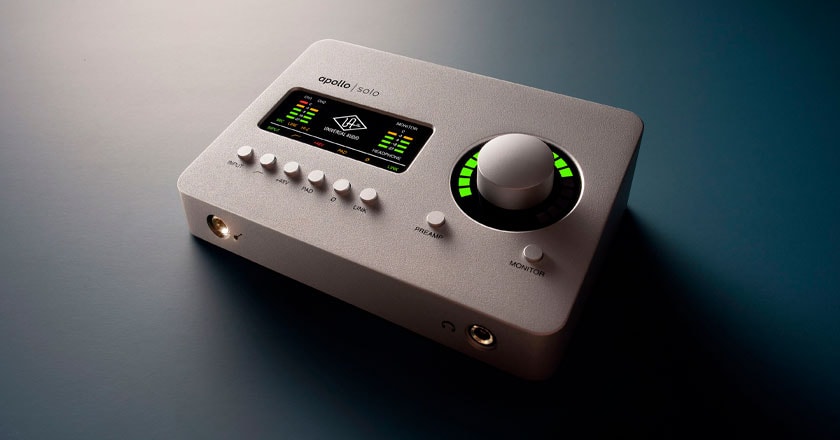
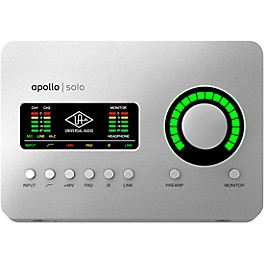
Universal Audio Apollo Solo Heritage Edition Thunderbolt 3 Audio Interface

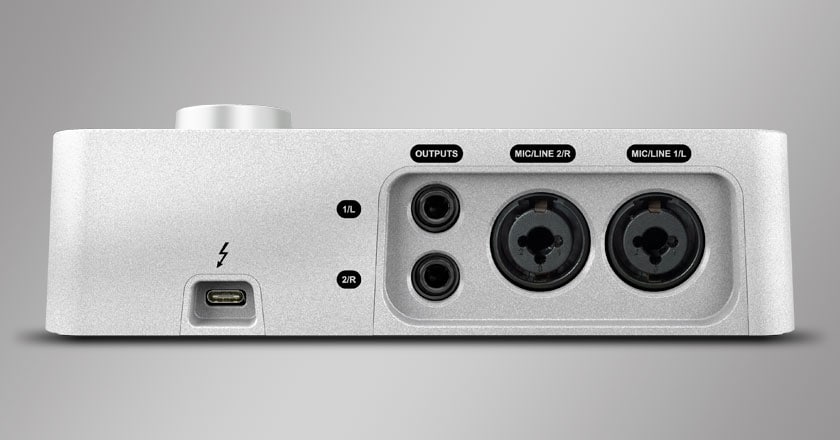
The Heritage Edition Apollo Solo Thunderbolt packs authoritative Universal Audio sonics in a compact, bus-powered 2x4 interface. Made for songwriters, electronic producers, engineers and audio creators of every sort, the Solo is the sleekest and most portable member of the Apollo family. The Solo sports a confident all-metal chassis, superior A/D and D/A conversion, a powerful headphone amplifier, a duo of premium Unison preamps and a SHARC DSP accelerator. Universal Audio hardware lends itself to iconic recording and monitoring fidelity, and included UAD software transforms the bus-powered Apollo Solo interface into an all-inclusive virtual “analog” studio. The Solo Thunderbolt is an ideal portal to the Universal Audio realm for newcomers, as well as a perfect secondary Apollo for users who require occasional portability and the uncompromising quality of larger UA interfaces.   

Universal Audio Apollo Solo Heritage Edition Desktop Interface

Special Heritage Edition Plug-in Bundle

The Apollo Solo Heritage Edition interface comes with a special collection of five Universal Audio plug-ins. These include full suites of Teletronix and 1176 compression, UA 610 Unison preamps, the Pultec Passive EQ Collection and Pure Plate Reverb. Together, these award-winning UAD plug-ins are valued at over $1,300. As with every Apollo, the Solo Thunderbolt 3 Heritage Edition also comes with the Realtime Analog Classics software package, so you can get familiar with the UAD ecosystem from the moment you plug it in. These inclusions are just a taste of the comprehensive UAD library consisting of plug-ins featured on hits by Billie Eilish, Kendrick Lamar, Foo Fighters and countless other chart-toppers.

Universal Audio Apollo Solo Heritage Edition Preamps

Two Preamps With Unison Technology

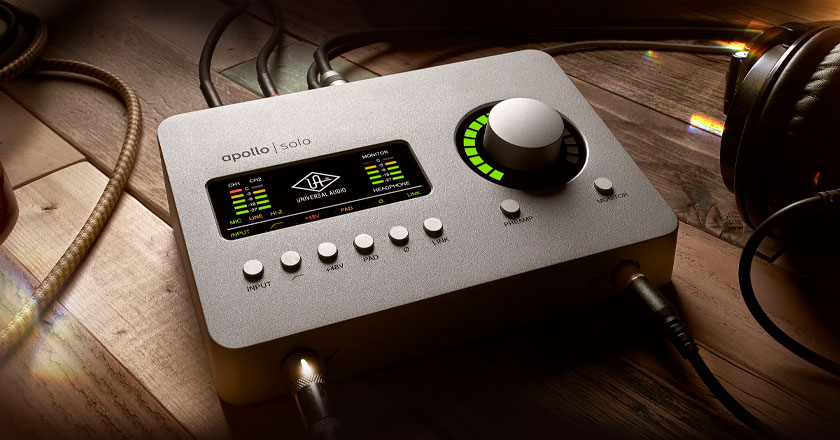
With the Apollo Solo, you can track through UAD plug-ins in real time using the Console application and up to two built-in, Unison-enabled preamps. Unison is a proprietary UA hardware/software technology that accurately replicates the sound and feel of iconic preamplifiers by Neve, SSL, API, Avalon and others, right down to component-level circuitry. The tech reconfigures Apollo microphone preamps’ input impedance and gain staging response to match that of the emulated device. As a result, you can harness the sound of legendary studio preamps in UAD format—the Solo gain knob controls the plug-in’s corresponding dial in real time. Additionally, each channel in Console has four virtual inserts, after your Unison mic pre, to load up more effects. They can then be placed in the record or monitor path, to print UAD plug-ins à la the analog days, or give your artist a fully decked-out headphone mix without committing to sounds on the way in.

Universal Audio Apollo Solo Heritage Edition Recording Guitars

SOLO Core Processing

Record, mix and master with UAD plug-ins, driven by SOLO Core DSP acceleration found in the Universal Audio Apollo Thunderbolt 3 desktop interface. The included Realtime Analog Classics and special Heritage Edition plug-in bundles contain digital emulations of famous gear, like the Pultec EQ, LA-2A compressor, a Marshall Plexi and an Ampeg SVT-VR bass amp, arming you with a studio’s worth of timeless equipment. SOLO Core processing also opens the interface up to the entire DSP-based UAD library, so you can track and mix with the best of the best in analog modeling while freeing up native CPU horsepower.

Universal Audio Apollo Solo Heritage Edition Recording Synths

Remarkably Detailed Recordings

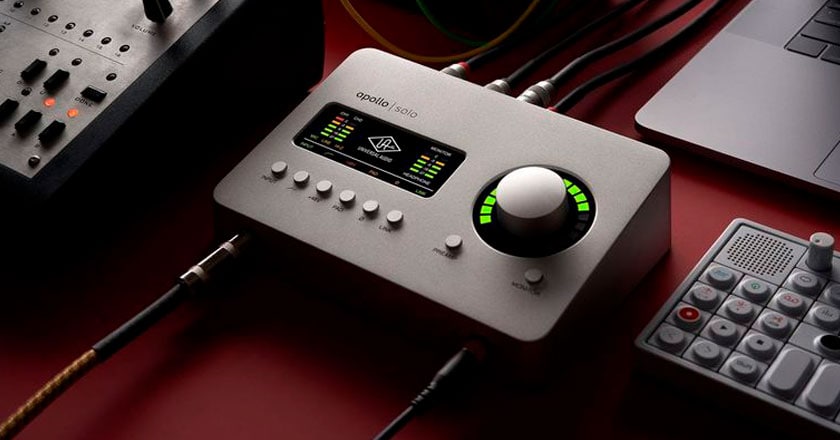
It’s never been easier to achieve professional-quality recordings anytime, anywhere than with the UA Apollo Solo interface—toss it in your backpack, and you’re a walking studio boasting crystal-clear 24-bit/192kHz conversion. Apollo converters and preamps are reputed for their stellar sound that’s been described as spacious, organic and ultrarealistic, as if the performer is in the room with you. These desirable sonic traits have been all over hit records since the Apollo series’ inception in 2012, and the Solo Thunderbolt Heritage Edition, with its current-day components, takes pristine audio fidelity to new heights.

The Universal Audio Apollo Solo Thunderbolt Heritage Edition is designed to mold your recordings into records. Track through Unison preamps for authentic analog tone on the way in, mix with the finest analog-emulated plug-ins available and take it all with you wherever the session goes. In the vast world of compact, bus-powered audio interfaces, the Universal Audio Apollo Solo remains a standout choice for discerning users seeking spectacular fidelity and unrelenting reliability that UA offers.      

 
More Details

Audio Interfaces

Unlock high-quality computer recording with an audio interface! This crucial piece of gear acts as the bridge between your microphones, instruments, and your computer, converting analog sound into digital data and back again. Essentially the heart of any modern home or project studio, a good audio interface ensures your recordings capture clear, detailed sound. Connected typically via USB or Thunderbolt, these devices range from simple two-channel boxes to complex multi-input units, providing the essential connections for musicians, podcasters, and creators.

1-24 out of 1719 products

Special Financing Available
Learn More
Special Financing Available
Learn More
Special Financing Available
Learn More
Special Financing Available
Learn More
Special Financing Available
Learn More
Special Financing Available
Learn More
Special Financing Available
Learn More
$30.00/mo.‡ with 24-month financing*
Learn More
Rebate
Price Drop
$42.00/mo.‡ with 24-month financing*
Learn More
Rebate
Special Financing Available
Learn More
Special Financing Available
Learn More
Price Drop
Special Financing Available
Learn More
Special Financing Available
Learn More
Special Financing Available
Learn More
Special Financing Available
Learn More
Special Financing Available
Learn More
Special Financing Available
Learn More
Special Financing Available
Learn More
Special Financing Available
Learn More
Special Financing Available
Learn More
Special Financing Available
Learn More
Special Financing Available
Learn More
$21.00/mo.‡ with 24-month financing*
Learn More

1-24 out of 1719 products

 
Blog Carousel 09 - Find the Right Recording Gear When you come right down to it, an audio interface is anything that lets you get audio signals in and out of your computer. The challenge in picking one is that there are so many ways of getting it done, and it will all depend on how you like to work and what you're trying to do. A very basic interface would be simply a box that converted analog audio to digital audio that the recording software in your computer can understand, and convert it back to analog audio when you want to hear it. Such converters are referred to as AD/DA (analog to digital/digital to analog) converters. Better quality converters have what's called "jitter correction" to compensate for small timing variations.

Most interfaces are far more than just converter boxes. They include mic preamps, multiple I/O (Input/Output) connections—balanced, unbalanced and digital—and even internal DSP (Digital Signal Processing) for effects, EQ and basic monitor or sub-mixing user. Some units can even act as a simple, stand-alone mixer without a computer attached for use as a basic live sound mixer.

One of the biggest determinants of overall audio quality in an audio interface is the quality of opamps (operational amplifiers) used in construction. Better systems will use lower-noise, lower-distortion components, or in some cases, discrete components rather than single-chip solutions. The number of I/O connections can be a deciding factor. The basic interfaces will be 2-in/2-out, able to handle a vocal and instrument together or a stereo pair of mics for capturing a live event. From there, you can expand as far as you need, depending on what you want to invest in your system. Interfaces with 18 inputs and 22 outputs are not uncommon and will handle most users needs, but you can go far larger with a full-blown Pro Tools HD rig, if that's what is required.

The final consideration is connectivity. There are multiple ways of connecting an audio interface to your computer—USB, FireWire, a PCI slot for desktop systems or Apple's Thunderbolt connection on newer Macintosh computers—all of which have different strengths and weaknesses. USB interfaces tend to be smaller, with most mobile interfaces using USB connections, but can be less robust when you need a lot of simultaneous ins and outs. FireWire, also called IEEE 1394, is fast and robust, but generally requires an external power supply. PCI cards are the fastest with the most bandwidth, but are tied to tower and desktop systems, so will be confined to a single studio location. Some of the more popular brands for interfaces are Akai, Apogee, Avid, Focusrite, M-Audio, MOTU, Presonus, Roland, Tascam and Yamaha, though there are many others. The best interface is the one you're going to use, so spend some time with the Pro Audio specialists at Guitar Center so they can help you find exactly the right one.

In addition to the mainstream audio interfaces described above, our GC Pro team of experts offers hands-on sales and support for professional solutions such as Avid HDX Systems and the Focusrite Rednet series. These solutions are typically used in recording studios, post facilities and other professional settings.