

Pro Gear Advisers
•866-498-7882
Gibson Les Paul vs. SG: What Are the Differences?
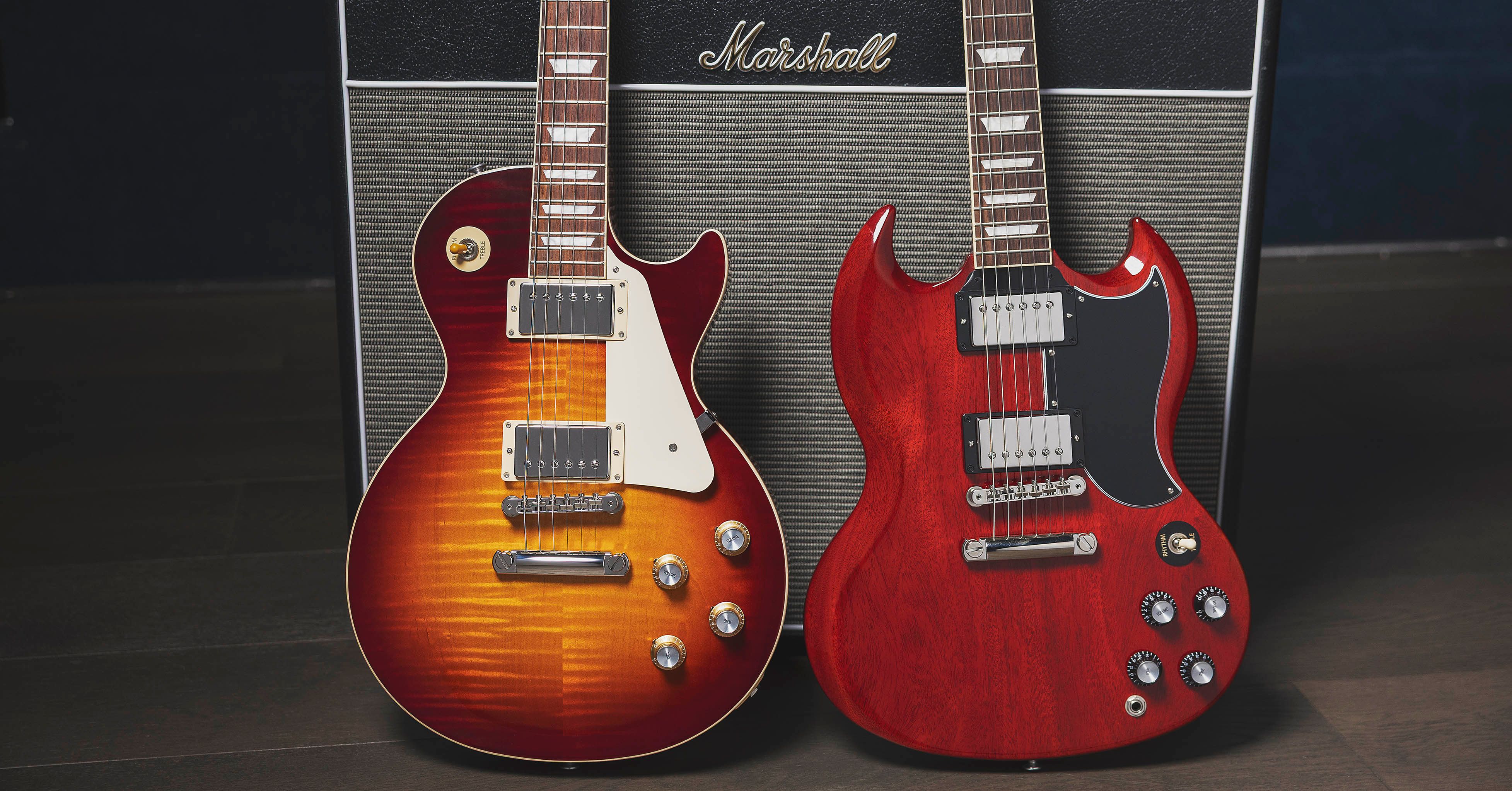

The Gibson Les Paul and SG are two of the most famous electric guitars in history. Wielded by some of the most influential guitarists of all time, they’ve helped shape the sound of blues, rock and beyond—and compelled aspiring players to set out on their own journey toward guitar heroism. In plainer words, the Les Paul and SG are ridiculously cool guitars.
In this article, we’ll investigate what separates these Gibson classics, take a moment to appreciate iconic Les Paul and SG players, and answer some of the most frequently asked questions about both models. The goal is for you to walk away with a better understanding of the differences (and similarities) between the Les Paul and SG, and ultimately help you decide which one is right for you.
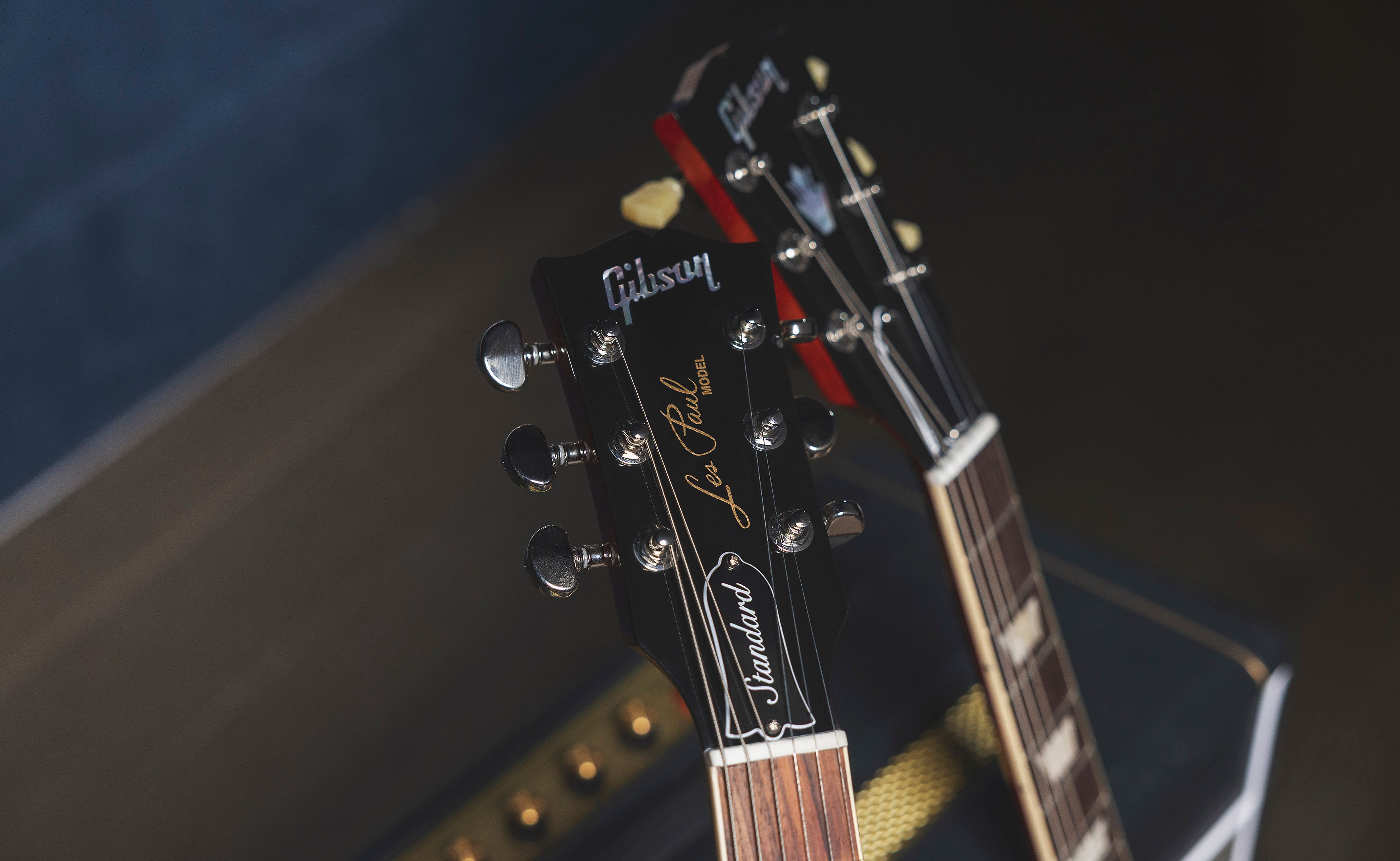
Pictured: Gibson SG Standard '61 and Gibson Les Paul Standard '60s Headstocks
Table of Contents
Comparing the Les Paul and SG
Key Differences Between the Les Paul and SG
Famous Les Paul Players
Famous SG Players
Choosing Between a Les Paul and SG
FAQs About Les Pauls and SGs
Comparing the Les Paul and SG
|
Feature |
Les Paul |
SG |
|
Year Introduced |
1952 |
1961 |
|
Body Shape |
Thick single cutaway, carved top; slab bodies on Junior and Special models |
Thin double cutaway, beveled edges |
|
Pickup Configuration |
2–3 humbuckers or 1–2 P-90s |
2–3 humbuckers or 1–2 P-90s |
|
Tonal Characteristics |
Rich and powerful; low-end depth, meaty mids, top-end sparkle and loads of sustain |
Snappy and raw; low-mid warmth, midrange punch and sharp high-end bite |
|
Popular Use Cases |
Jazz, blues, country, pop, rock, punk, metal |
Blues, indie, garage, punk, rock, metal |
Key Differences Between the Les Paul and SG
The SG was born as a radical redesign of 1950s Les Paul models, and for a couple years after launch, they were actually called Les Pauls. In the late ’50s, Gibson and Fender were solidbody electric guitar heavyweights duking it out for market share, and the SG’s designer, Larry Allers, delivered an uppercut with an instrument unlike anything else available. So, while the Les Paul and SG—based on the latter’s origins—do share some DNA, their distinctions are why both have endured.
For more on the detailed histories of these guitars, check out “The History and Evolution of the Gibson Les Paul” and “The History of the Gibson SG.”
Body Shape
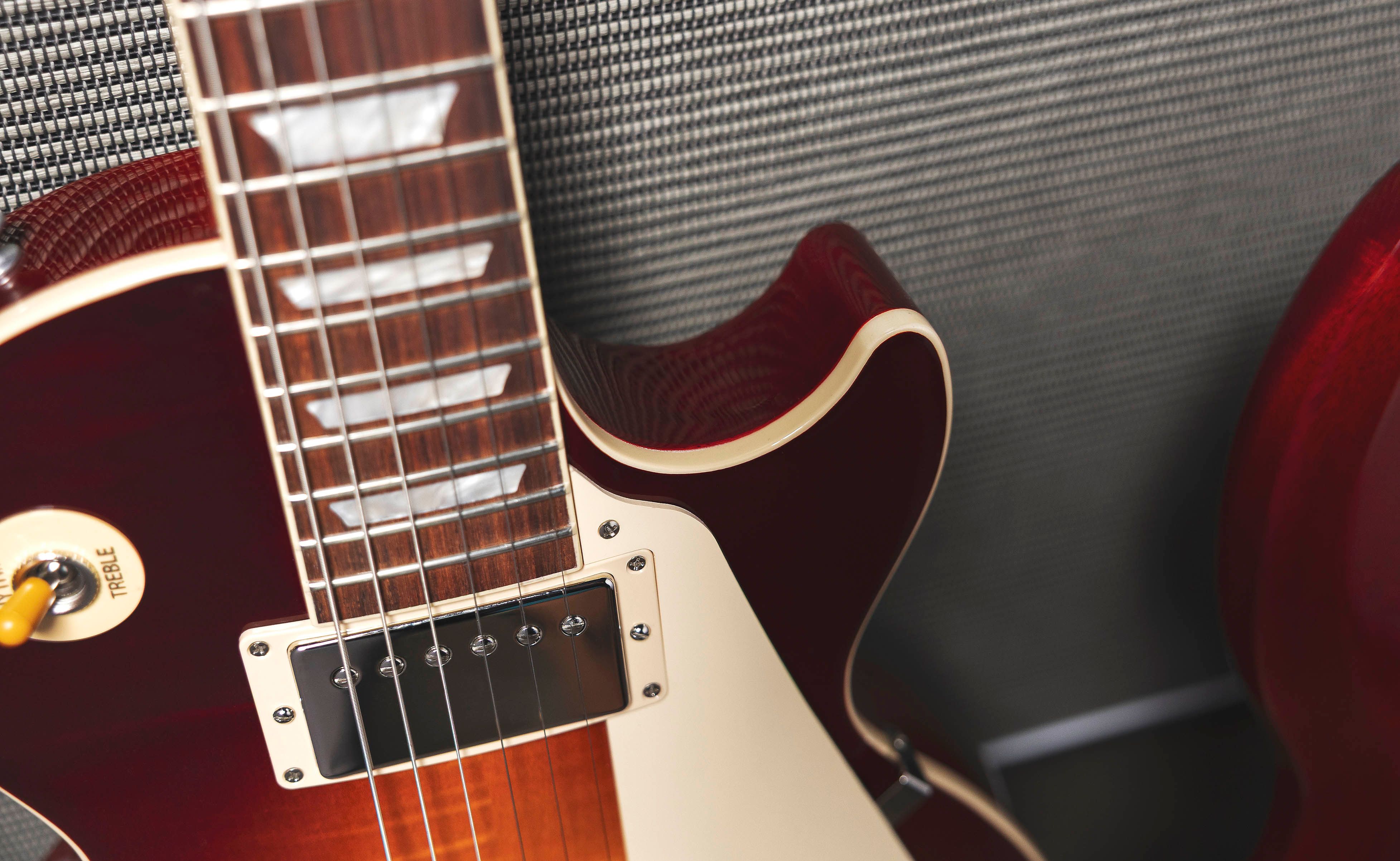
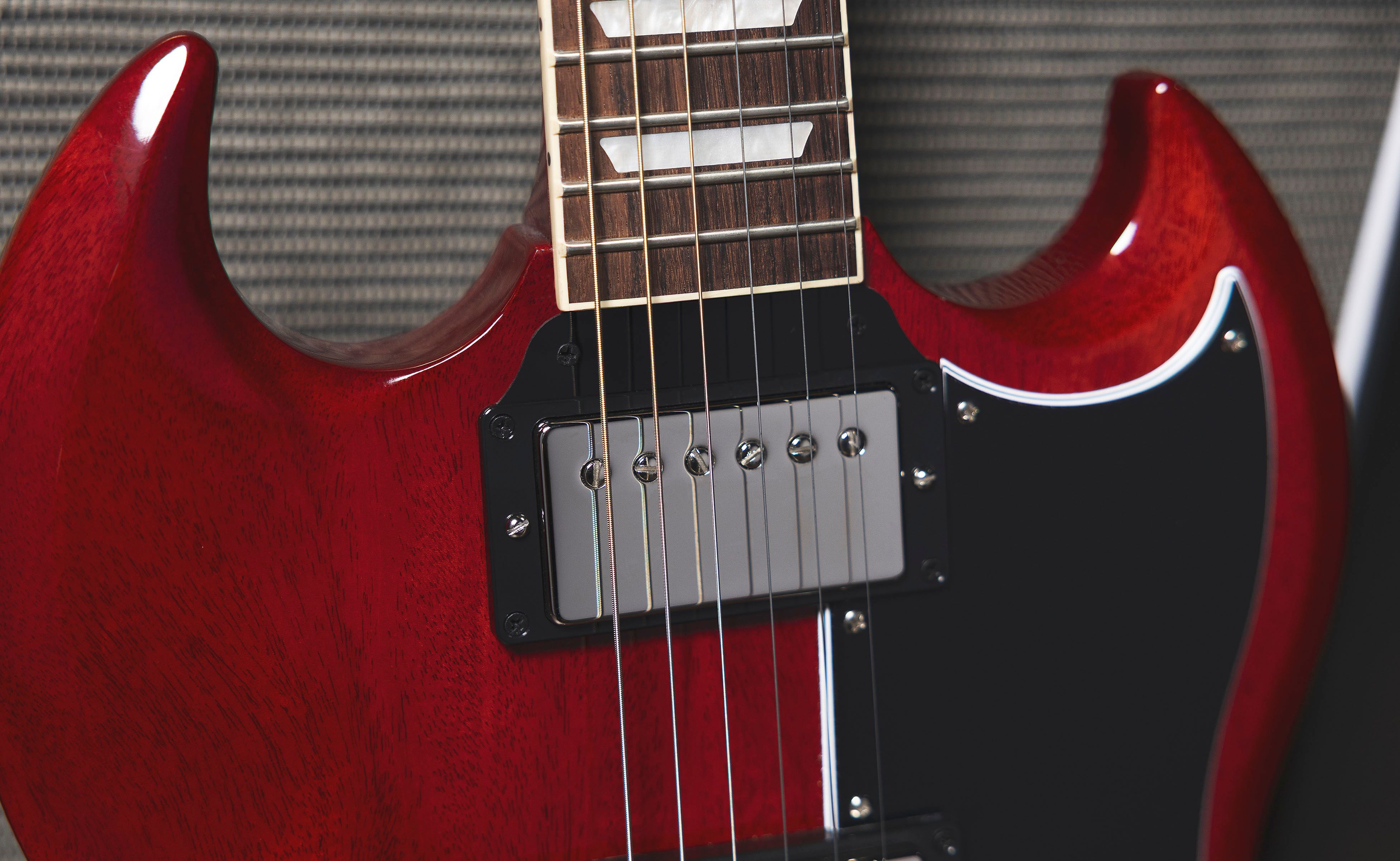
Body shape is the most obvious difference between the LP and SG. Both silhouettes are iconic: the Les Paul for its single-cutaway design and the Solid Guitar for its immediately recognizable double-cutaway “devil horns” with 22-degree beveled edges. The Les Paul body is approximately 2-3/8" thick, while the thinner SG shaves an entire inch of depth and measures 1-3/8".
Weight between the two instruments is also considerably different, where the average non-weight-relieved Les Paul tips the scale between 9–11 pounds and the SG clocks 6–7 pounds. More than just how they feel on your shoulder, weight differences alter their balance. The body-heavy Les Paul can have a slight upward tilt in playing position, while the neck- and headstock-heavy SG can have a downward one.
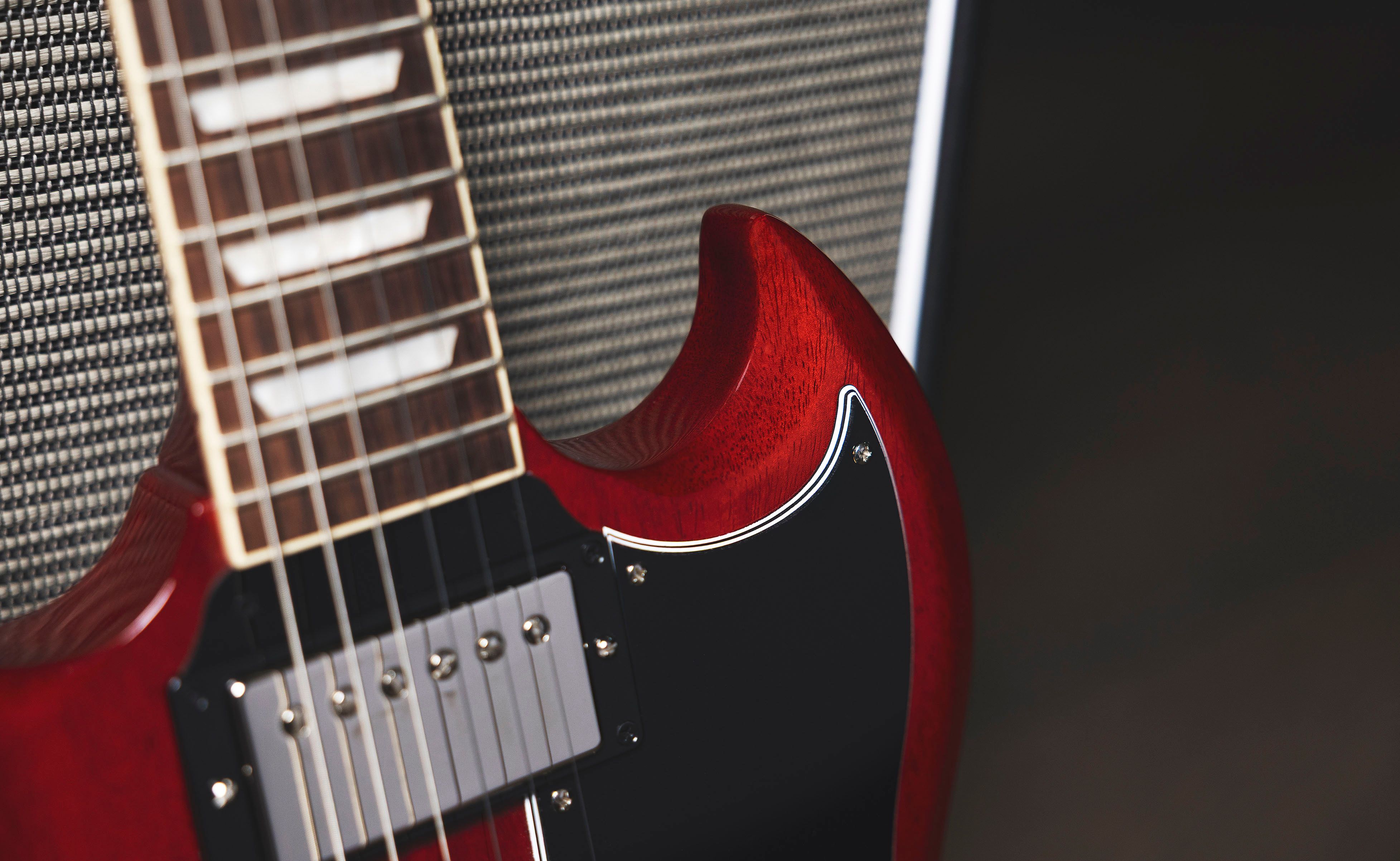
Pictured: Gibson SG Standard '61 Upper Bout Carve
Neck and Playability
Early Les Paul models were known for their “baseball bat” necks, and the SG debuted with a significantly slimmer profile for easier playability. When it launched, Gibson advertised the SG as having the “fastest neck in the world,” measuring around .78" deep at the first fret. Compare that to 1950s Les Pauls, which typically measured up to .90" in the same spot and over 1" at the 12th fret.
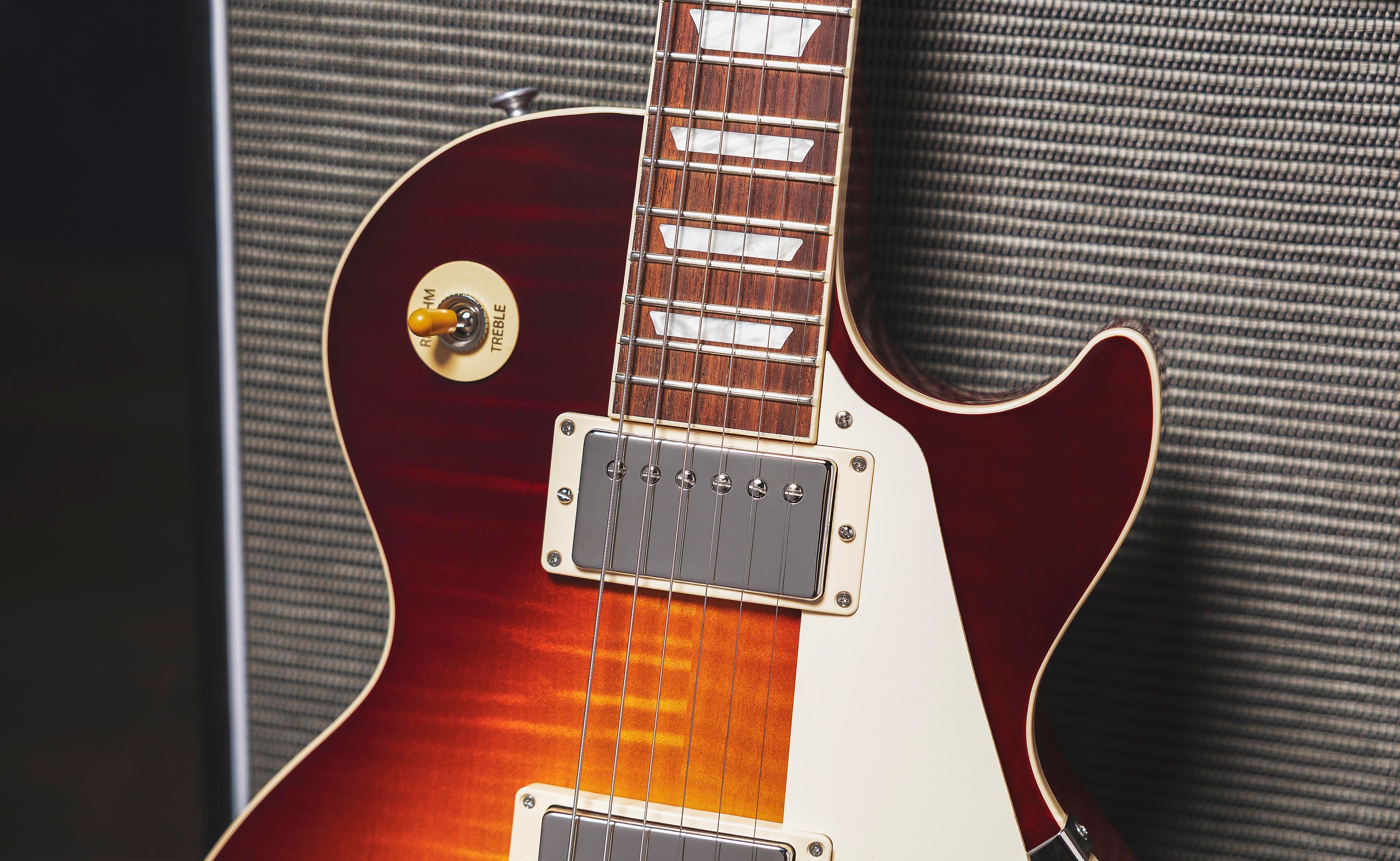
Today, you can find Les Paul and SG models in a variety of trims with differing neck profiles, so you’ll definitely find your comfort somewhere. Les Paul Modern and SG Modern guitars, for instance, feature unique asymmetrical SlimTaper neck profiles with compound radius fingerboards, allowing both to exceed their “traditional” playability.
In terms of construction, the Les Paul’s neck joins the body between the 16th and 17th frets, which limits upper-fret access to an extent. You can get up there, but it’s more of a stretch. On the other hand, the SG neck originally joined the body at the 22nd fret for unimpeded access to the highest register. That’s still true for 1961 models, whereas Standard SGs feature a 19th-fret neck joint. Either way, with an SG, it’s just you and the open fretboard.
Tone
We’ll compare tones based on the most popular pickup configuration for both guitars: a pair of PAF or PAF-style humbuckers. The Les Paul’s sound is warm and powerful, with a throaty roar when you lay into overdriven chords. But it also cleans up nicely, and you can play jazz using the neck pickup’s smooth, round sound. Les Pauls tend to have solid low end, giving them a somewhat dark tonality, though it isn’t muddy or woofy. And of course, there’s legendary Les Paul sustain, which can be attributed to its thick mahogany body and dense maple top.
The SG sound is brighter by comparison—a little rawer and more aggressive. Its attack is more immediate, too, lending itself to articulate lead lines and riffs. If you played a Les Paul and an SG with the exact same pickups, the SG will likely still sound brighter than the LP. Part of that comes from less wood mass, but most of it is due to the SG’s pickup placement—they’re closer to the bridge than a Les Paul’s. This was probably a purposeful design choice, since the SG was initially competing with the extremely popular (and very bright-sounding) Stratocaster.
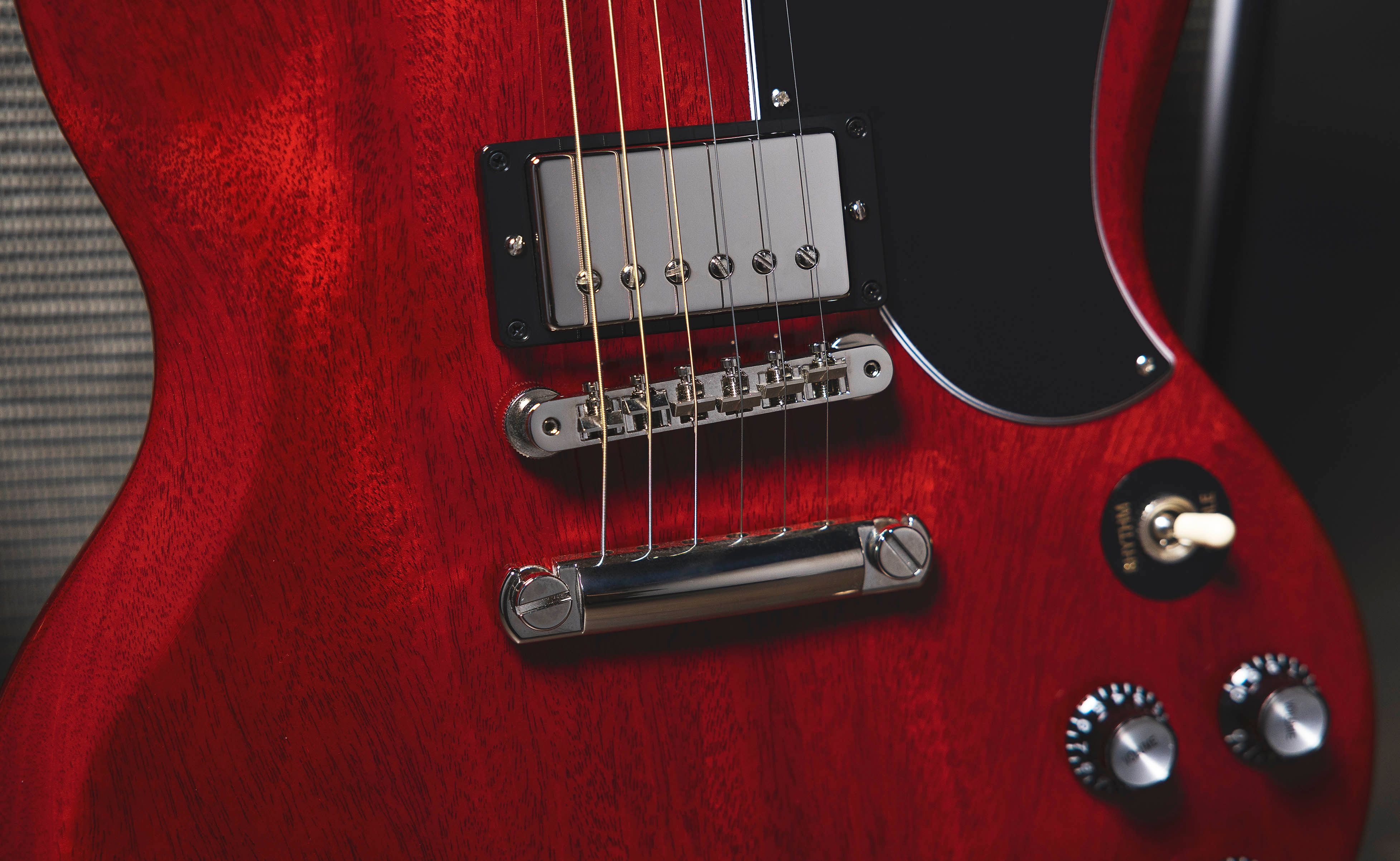
Hardware
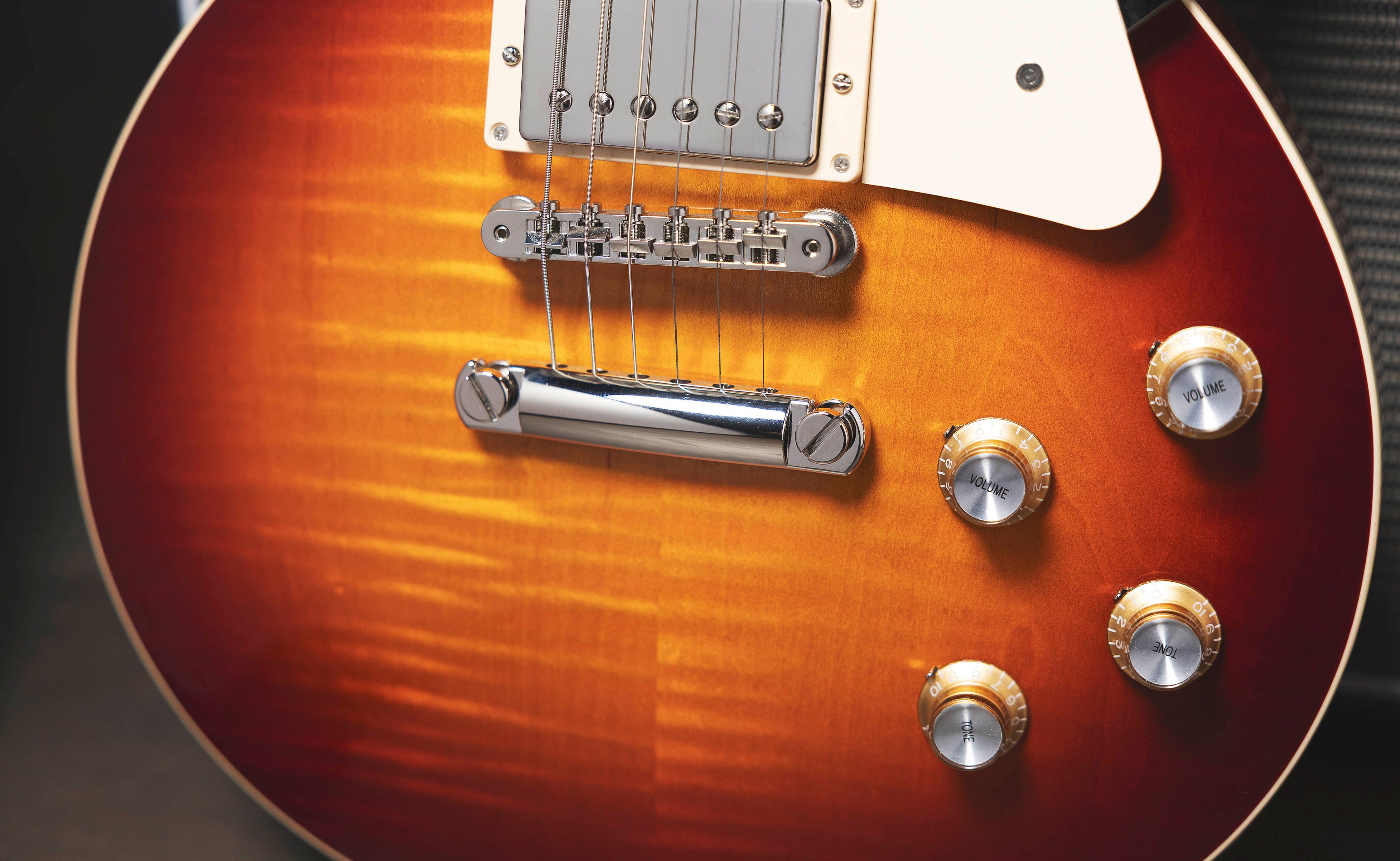
Current Les Paul Standard and SG Standard models have a lot of hardware in common, including Tune-O-Matic bridges, dual volume and tone controls with a 3-way pickup toggle, and Grover Rotomatic tuning machines. When you start to specialize or get into Gibson Custom territory, you can find spec deviations, such as an SG with a Maestro Vibrola bridge or a Les Paul with a Bigsby. Then you have Les Paul Supreme and SG Supreme models that introduce locking tuners for enhanced stability and quicker string swaps. As you explore different Les Paul and SG trims, you’ll certainly find some variety among their hardware, but the basic platform for both models is very similar.
Famous Les Paul Players
“Whole Lotta Love”—Led Zeppelin (1969)
Jimmy Page and his 1959 Les Paul Standard established one of rock’s most definitive guitar sounds on “Whole Lotta Love.” As the story goes, Page’s good friend Joe Walsh presented the instrument that would become “Number One” at a gig, urging him, “You’ve got to have this guitar.” Reluctant, Page thought his Les Paul Custom was enough at the time—he was primarily playing a Telecaster, anyway.
But after giving it a go, Page recalled, “I just really enjoyed playing Joe’s guitar, and so I agreed with him that maybe I should buy his Les Paul Standard after all.
“I played the Les Paul on ‘Whole Lotta Love’ and ‘What Is and What Should Never Be’ and that decided it for me: It was definitely going to be the Les Paul from then on. I always wanted to make a change for each album sonically, and that was my first decision for Led Zeppelin II,” Page said.
“Like I had built Led Zeppelin around the Fender Telecaster, I built the second album around the sonic texture of the Les Paul Standard. Neither Joe Walsh nor I realized at the time just what an important thing he had done by coming along with that Les Paul.”
And contrary to popular belief, Page played “Number One” through a VOX Super Beatle amp and Rickenbacker Transonic cabinet on “Whole Lotta Love”—not a screaming Marshall (yet).
In the mid-’90s, Gibson produced a Jimmy Page Signature Standard as their first collaboration with him. In 2004, Gibson Custom meticulously recreated “Number One,” and in 2008, they reproduced his 1960s, three-humbucker, Bigsby-equipped Les Paul Custom Black Beauty. All three are quite rare.
“All Right Now”—Free (1970)
Paul Kossoff and his love of late-’50s Les Paul Standards literally set the tone for the opening salvo on “All Right Now.” His stripped-down approach let the guitar do the talking, with little getting between his hands and the amp. It’s a textbook example of how assertive a Les Paul can sound without piling on the gain.
“In Memory of Elizabeth Reed”—The Allman Brothers Band (1970)
Duane Allman’s 1957 Les Paul Goldtop was his main guitar during the Allman Brothers Band’s early years, appearing on the band’s first two albums—including the studio version of “In Memory of Elizabeth Reed” from Idlewild South. Allman and Dickey Betts weave harmonized lines and fluid solos around the instrumental’s jazzy, Latin-tinged groove, showing a more nuanced side of the Les Paul than its reputation as a straight-ahead rock machine might suggest.
“Still in Love With You”—Thin Lizzy (1974)
Before Thin Lizzy became synonymous with twin-guitar harmonies, Gary Moore brought his own fiery blues vocabulary to “Still in Love With You.” Moore played the legendary 1959 Les Paul Standard (Greeny) previously owned by Peter Green—an instrument that became closely associated with both guitarists, and decades later, Kirk Hammett. Its distinctive out-of-phase pickup configuration contributes to Moore’s haunting sound throughout the song.
“November Rain”—Guns N’ Roses (1991)
If Slash helped put the Les Paul back in the spotlight for a new generation, “November Rain” might be the ultimate showcase. For the studio recording, Slash is widely reported to have used his main Kris Derrig-built 1959 Les Paul replica, pairing it with a Marshall for the leads throughout the song. It may not technically say Gibson on the headstock, but its ’59 Les Paul DNA—and Slash’s lifelong association with Gibson Les Pauls—make the track impossible to leave out of the conversation.
Shop our complete collection of Slash gear, including his signature Gibson Les Pauls, Magnatone amps and more.
“Threw Me to the Wolves”—Jared James Nichols (2020)
Jared James Nichols has an old-school philosophy, relying on dimed amps, minimal effects and the Les Paul’s ability to become a conduit for emotive lead playing. He doesn’t even use a pick, but you’d hardly know it by how pronounced the attack is from his fingers. 2020’s “Threw Me to the Wolves” features one of Nichols’ most beautifully expressive solos, capturing the raw, immediate sound of his fingerpicked blues rock style—as well as his Les Paul’s seemingly endless sustain.
Want to sound more like Jared James Nichols? Check out his signature guitars and amp.
Famous SG Players
“Love Me Two Times”—The Doors (1967)
Robby Krieger used an SG extensively throughout the Doors’ classic era, but his approach is a big departure from the heavy rock the model would later become known for. “Love Me Two Times” highlights Krieger’s distinctive fingerstyle technique, with bluesy riffs and slippery lead lines swirling around Ray Manzarek’s keyboards.
In 2011, Gibson released a signature Robby Krieger SG to celebrate the instrument’s 50th birthday. At the time of writing, Guitar Center has one available in our used inventory. It’s hard to say how long it’ll last, but if you check back on our Used Guitars selection from time to time, you never know what you’ll find.
“War Pigs”—Black Sabbath (1970)
Tony Iommi and the SG are heavy metal. After a pickup failure sidelined the Stratocaster he initially planned to use with Black Sabbath, Iommi turned to a Gibson SG and never looked back. (Thank the metal gods for their timely intervention there.) His heavily modified 1964 SG Special—better known as “Monkey”—became central to the crushing sound of the band’s early records. “War Pigs” is a prime example, moving from ominous chord work to snarling riffs and leads that wrote the lexicon for future generations of metal guitarists.
Tony Iommi has previously had a signature Gibson SG Special, in addition to various Epiphone models over the years. You can shop our Tony Iommi collection to see what’s both new and used.
“Cheepnis”—Frank Zappa and the Mothers (1974)
Leave it to Frank Zappa to take an SG and make it considerably weirder. His heavily modified “Roxy” SG featured additional switching and electronics that expanded an already versatile instrument, and it can be heard throughout the live material that became Roxy & Elsewhere. “Cheepnis” is a fitting snapshot of Zappa’s SG era—intricate, unpredictable and uninterested in following the stereotypical guitar hero playbook.
“Riff Raff”—AC/DC (1978)
Angus Young made the SG a symbol of rock ’n’ roll. “Riff Raff” is him at his most ferocious, kicking off with a tense, climbing intro before exploding into one of AC/DC’s most relentless riffs. His SG helps keep every chord and rapid-fire lead articulate, demonstrating how much aggression you can get from a guitar tone that still leaves a little room to breathe.
They’re hard to come by, but every once in a while, we get a limited-edition Gibson Angus Young Signature Thunderstruck SG. This one won’t last, so keep your eyes on our complete Used Guitars inventory for updates on must-have models.
“Midnight in Harlem”—Tedeschi Trucks Band (2011)
Derek Trucks relies on the SG to bring one of contemporary blues rock’s most recognizable guitar voices to life. On “Midnight in Harlem,” his gorgeous slide playing and warm clean sound again shows there is a lot more to the SG than high-octane riffs—as much as we love those, too.
Guitar Center sometimes finds Derek Trucks signature SGs, produced from 2012–2015, and adds them to our Used selection.
“Nterini”—Fatoumata Diawara (2018)
Malian singer-songwriter and guitarist Fatoumata Diawara offers a completely different take on what an SG can do. Diawara gravitated toward the model partly because its lightweight body made it comfortable to play without sacrificing the powerful sound she wanted. Her guitar work on songs like “Nterini” blends traditional Wassoulou influences with blues, rock and contemporary African sounds, and her affinity for the SG recently led to her own signature Epiphone model.
Choosing Between a Les Paul and SG
The best thing about choosing between a Les Paul or SG is there’s no wrong answer. You’re getting time-honored style and sound—and a workhorse for any collection—no matter which way you go.
With a Les Paul, you’ll get somewhat smoother, creamier tones compared to an SG’s mid-forward bark and responsive, biting attack, but both can cover a tremendous amount of sonic ground if you’re not shy about fiddling with volume and tone controls. For example, you can experiment with custom blends of the bridge and neck pickups using the middle position on the 3-way toggle and see where that takes you.
The SG offers easier upper-fret access and a lighter, slimmer profile, while the Les Paul’s beefiness contributes to its full, commanding voice and singing sustain. It’s almost unfair to pit these two against each other, as they’re equally outstanding guitars with well-established legacies—just slightly different personalities.
My unhelpful advice? Get both. You can never have too many guitars. For “real” assistance, though, we have dedicated buying guides for both models, crafted to help you make those tough decisions:
Interested in a guitar with heritage? Check this out:
Naturally, you’re encouraged to visit your local Guitar Center store and test drive as many LPs and SGs as you can handle until you find the “one.” There’s really no substitute for hands-on experience, especially when seemingly identical models might feel totally different when you try them. You can also reach out to a Gear Adviser for personalized advice on which Les Paul or SG is right for you.
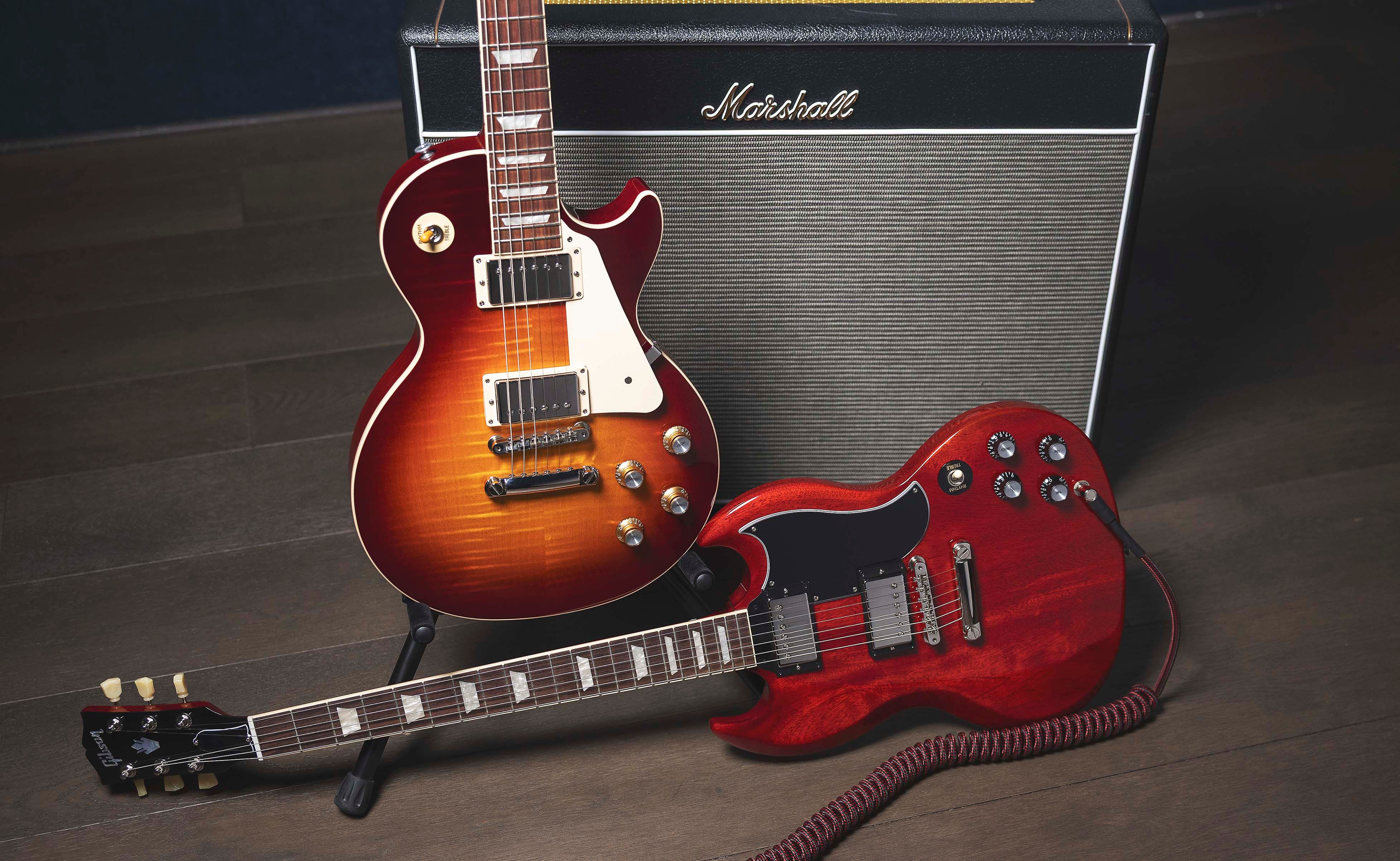
Pictured: Gibson Les Paul Standard '60s in Bourbon Burst and Gibson SG Standard '61 in Vintage Cherry
FAQs About Les Pauls and SGs
How much does a Gibson Les Paul weigh?
Les Paul models have a reputation for being heavy, although weight varies from guitar to guitar. Traditionally, a non-weight-relieved Les Paul Standard sits at around nine pounds—but it’s not uncommon for them to exceed 10 pounds (I can attest, as both my 1986 and 1991 Les Paul Customs are about 10.5 pounds apiece). The guitar’s thick mahogany body and carved maple top are a big part of the Les Paul’s famously solid feel, sustaining sound and, ultimately, its heft.
What is the difference between a Gibson Les Paul Standard and Les Paul Studio?
Both deliver the fundamental Les Paul recipe, but they take different approaches to features and appointments. The Les Paul Standard emphasizes traditional styling and vintage-inspired specs, including details such as body and neck binding and figured maple tops on many versions. The Les Paul Studio strips back some of those cosmetic appointments while retaining the core mahogany/maple construction, making it a more streamlined take on the Les Paul formula.
What kind of music is a Gibson Les Paul good for?
The Les Paul has roots in rock and blues, but its tones have found a home in everything from jazz and country to punk and metal. The interaction between volume and tone knobs on many Les Pauls lets you roll off for warmer, cleaner sounds, or dial up for roaring riffs and searing leads.
Here are some suggested models for each of the genres mentioned:
-
Rock/blues: Gibson Les Paul Standard ’60s
-
Jazz/country: Gibson Les Paul Standard ’50s P-90
-
Punk: Gibson Les Paul Junior or Gibson Les Paul Junior Double Cut
-
Metal: Gibson Les Paul Modern, Gibson Les Paul Modern Studio or Gibson Custom Les Paul Axcess Standard
What does SG stand for on a Gibson guitar?
SG stands for “Solid Guitar.” The design debuted in 1961 as a dramatically redesigned Les Paul, featuring a thinner, lighter body and sharp twin cutaways. Les Paul’s name was eventually removed from the model, and Gibson stuck with the SG moniker players know today.
Is a Gibson SG good for metal?
It sure is. The SG’s humbuckers, focused tone and aggressive bite have made it a longtime favorite for hard rock and metal, with Black Sabbath’s Tony Iommi providing perhaps the most famous example of how savage a Solid Guitar can be. Of course, the SG’s birthday predates heavier rock and metal as we know it, so the model has excelled at blues, slide and plenty of other “old-school” styles before becoming a hard hitter. Consider players like Angus Young, Derek Trucks and Sister Rosetta Tharpe as an indication of how versatile the SG can be.
If you’re looking for a shred-ready SG, check out the Gibson SG Modern. With high-output Burstbucker Pro pickups and a sleek, fast-playing neck, it’s the ideal instrument for someone who loves the traditional SG profile but needs the extra performance.
Do all Gibson SG guitars have neck dive?
Not at all. “Neck dive” describes the tendency of a guitar’s headstock to droop toward the floor while in playing position, caused by an imbalance between a lightweight body and heavy, tuner-laden headstock. Some players notice it with their individual SG, but every model is different. If you’re having trouble with yours, something as simple as a wide, grippy strap can help keep the guitar comfortably in place.
Written By: Max McAllister
Max McAllister is an audio engineer, guitarist and writer. At the Brewery Recording Studio, he earned engineering credits on Kid Cudi’s Man on the Moon III, Duckwrth’s SuperGood and the LeBron James Space Jam compilation, among others. Max previously wrote for Produce Like A Pro, where he authored over 600 articles, and has also contributed to Adorama’s 42West. He’s proudly served Guitar Center as a senior writer since 2023.
Be the first to know about exclusive offers, tips and more.

866-498-7882 English
877-687-5402 Español