

Pro Gear Advisers
•866-498-7882
Vintage Spotlight: 1966 Fender Electric XII 12-String Electric Guitars
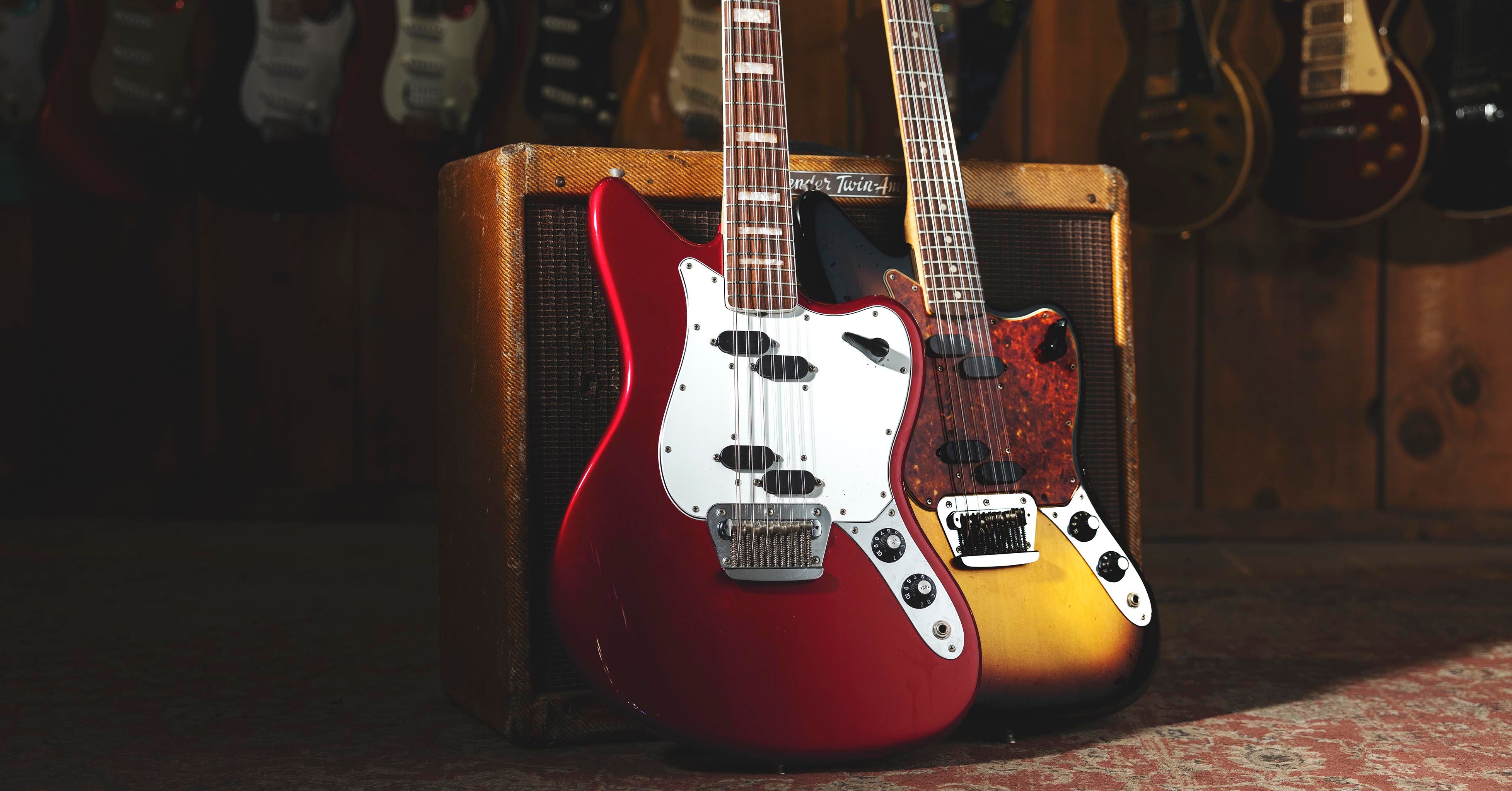

In some ways, it’s the guitar that almost wasn’t. Its innovative bridge was among the last things Leo Fender designed for the company that bore his name before its sale to CBS in late 1964. The Fender Electric XII 12-string electric guitar arrived at that turning point in the company’s history, and its original production run lasted only a few years.
In this piece, we’re going to take a look at a pair of 1966 Fender Electric XIIs from the Guitar Center Vintage Collection at the flagship Guitar Center in Hollywood, California. One wears the familiar sunburst finish and unbound, dot-inlay rosewood fingerboard; the other steps out in Candy Apple Red, with a matching headstock, bound neck and rare block inlays. As is always the case with these vintage spotlight articles, there's no guarantee that a particular guitar is still going to be available.
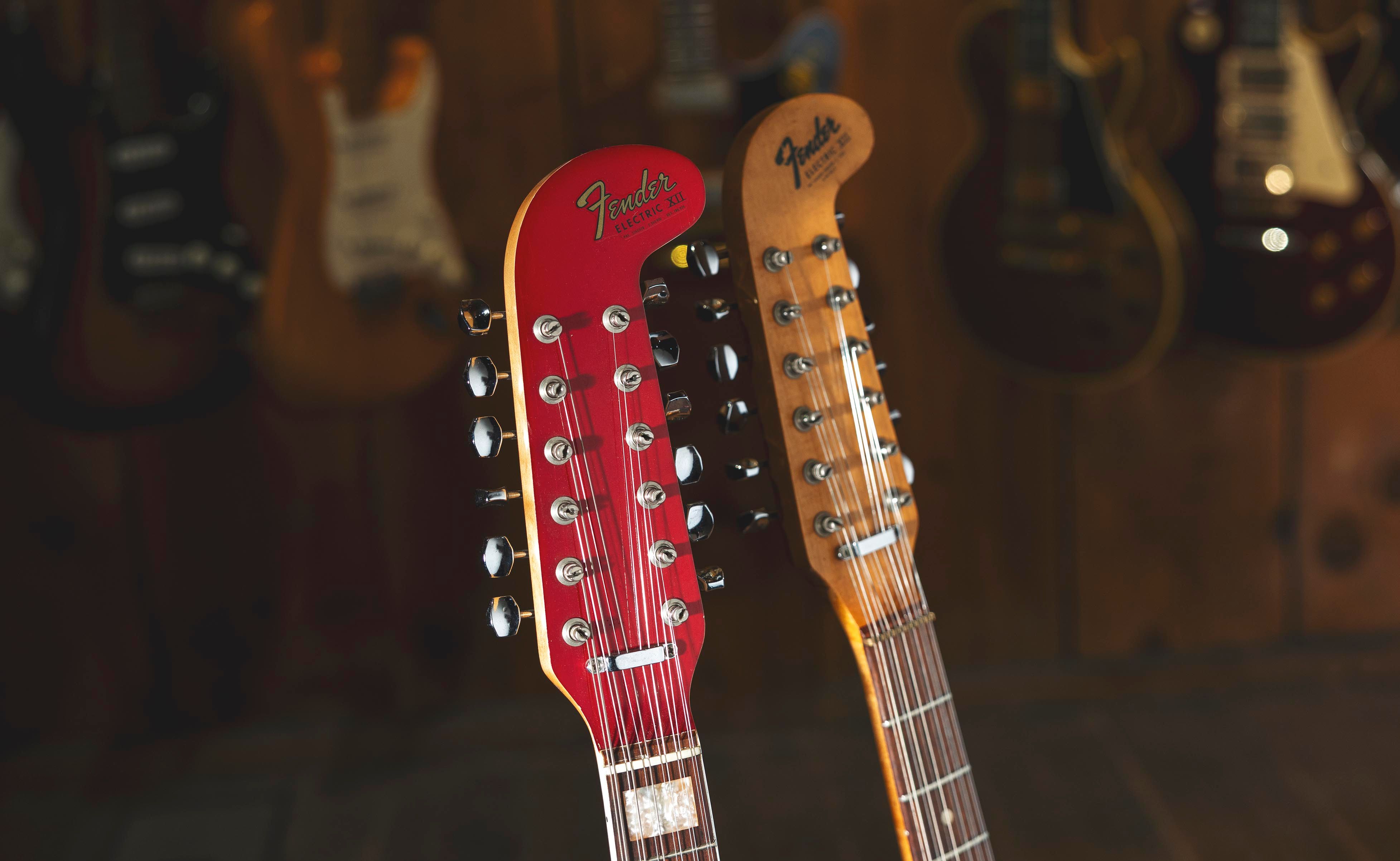
Pictured: 1966 Fender Electric XII Headstocks
A Brief History of the Fender Electric XII
Quick Highlights of Fender Electric XII History
Introduced: 1965/1966 Fender Catalog
Discontinued: Removed from catalog in 1968, with sales into 1969
Innovations: 12-saddle bridge, "baseball bat" pickup switch, split-coil pickups
Leo Fender's last design for the company he founded
Artists who played them (partial list): Jimmy Page (on the intro for the studio recording of "Stairway to Heaven" no less), Johnny Winter, Pete Townshend, Bob Dylan, Carl Wilson, Tim Buckley, Lou Reed, Sterling Morrison
We’ve already written quite a bit about Fender’s history in other articles, so we won’t rehash all of that here. You’ll find links to those articles at the bottom of the page, just in case your curiosity gets the best of you.
Here, we’ll focus on the Electric XII—how and why it came to be at a particularly interesting moment in the company’s history.
It was 1964, and Rickenbacker had scored a major hit by getting an electric 12-string into the hands of the Beatles’ George Harrison. Meanwhile, the folk music boom had helped popularize 12-string acoustics. Jangle was in, and it didn’t take long for other guitar companies to double down on doubling the number of strings. Fender was no exception.
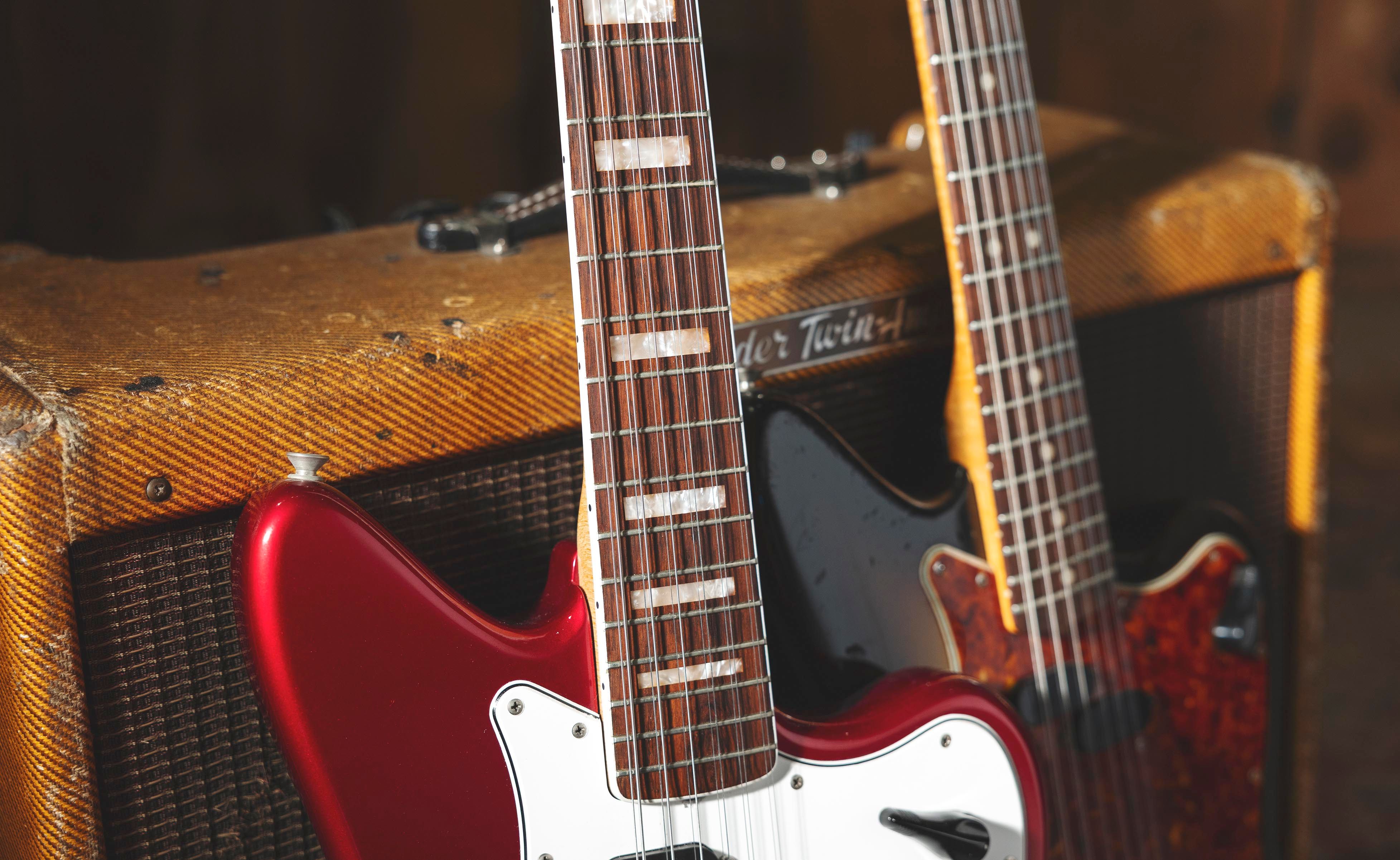
Pictured: 1966 Fender Electric XII Fingerboards with Block and Dot Inlays
There’s not a lot of information about the development of the Electric XII, which took place during a chaotic time at Fender. The company was very successful, but Leo Fender had been having health issues (which is a whole other story) that had led him to look for a buyer for the company. Despite these issues, he was still very much involved in the design of the Electric XII, especially the bridge design.
Previous electric 12-string guitars had used a single bridge saddle for each pair—or course, if you want to use traditional luthiers’ terminology—of strings. While efficient for manufacturing, that meant intonation would be a compromise, especially in the octave courses, where a wound string and its thinner octave partner need different amounts of compensation. Put both on the same saddle, and getting one accurately intonated can leave the other slightly out.
Fender's solution was brilliant and, in retrospect, obvious (ain't that always the way?). Design a bridge with an individual saddle for each string—12 strings, 12 saddles. This enables the intonation of each string to be set independently. This simple concept, although it took some mechanical engineering to make it work, gave the Electric XII a significant intonation advantage over most competitors with shared saddles when it debuted in June of 1965, just four months after CBS took over.
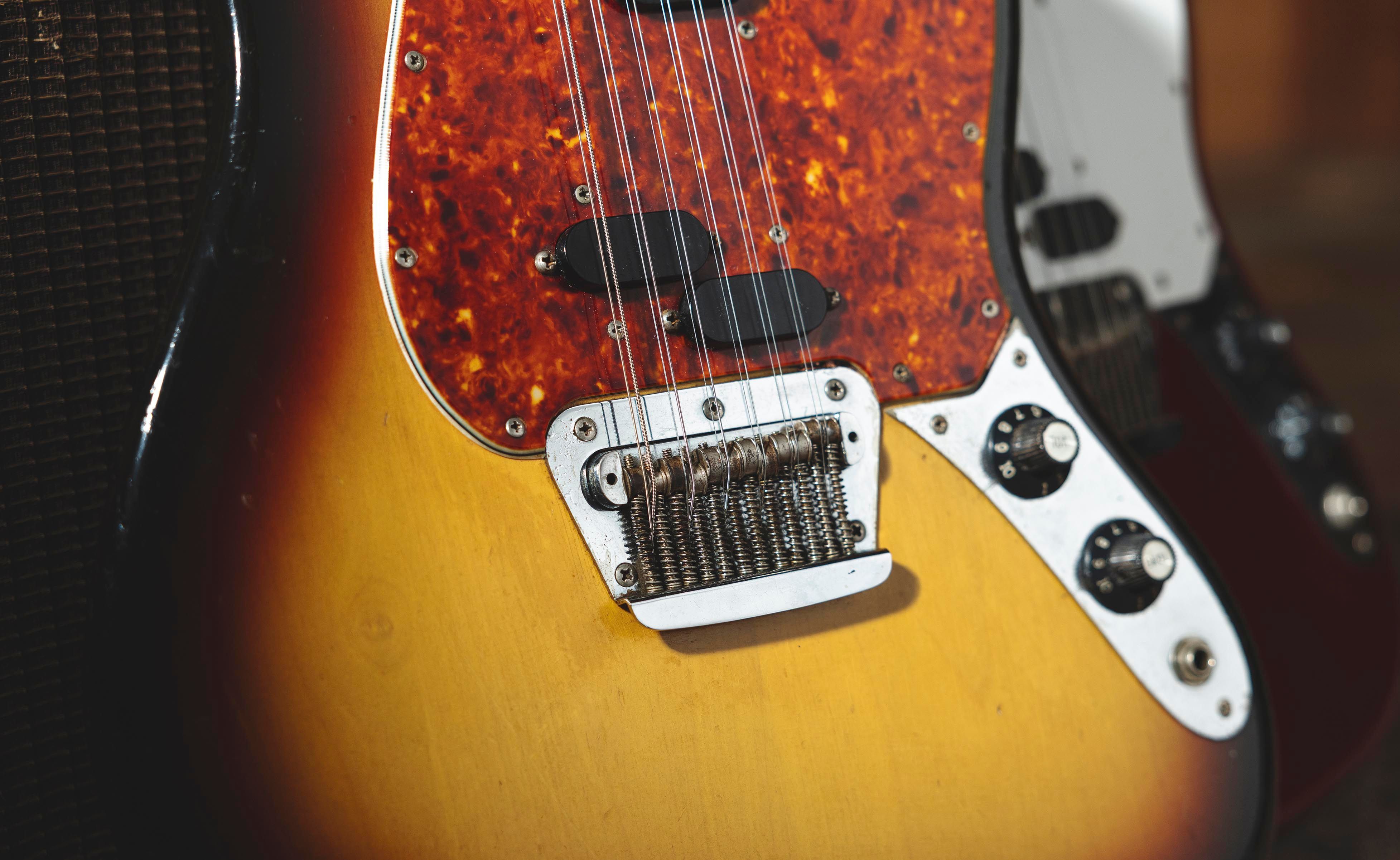
Pictured: 1966 Fender Electric XII Bridge and Saddles
Another interesting aspect of the Electric XII is the pickup arrangement. The Electric XII’s split-coil pickups were wired to a 4-position rotary switch that gave the player a choice of neck, both pickups in phase, bridge and a fourth position that combined the neck and bridge pickups out of phase. Fender marketing referred to the last one as the “deep-tone” position in its 1965–66 catalog. That’s a bit of a misnomer, since the out-of-phase setting thins out the lows and low mids, leaving a nasal, quacking upper-mid tone. It could be said to emphasize the 12-string jangle, but deep it emphatically is not. Marketers, though, are going to market.
The Electric XII pickups, unlike those of the Precision Bass and Leo Fender's later G&L Z-Coil pickups, were not wired for noise canceling. Why not? There has been supposition in the internet guitar community that Leo Fender had intended to use RWRP (reverse wound/reverse polarity) for noise cancelation on one coil of each pickup, but that detail had possibly gotten lost between development and production, due to the sale to CBS. I wanted to see if I could dig up evidence one way or the other. In pursuit of this, I had a brief conversation with boutique pickup maker Curtis Novak, who was the first to develop replacement pickups for the Electric XII and was tapped by the Fender Custom Shop to design the pickups for its Electric XII reissues.
Novak, who has possibly been inside more Electric XIIs than anyone else on the planet, told me that in his research—which included multiple conversations with legendary Fender pickup winder Abigail Ybarra—he found no indication that the Electric XII's pickups had ever been intended to be noise canceling. He also pointed to the Mustang Bass, which has an almost identical pickup design and was in development at the same time as the Electric XII.
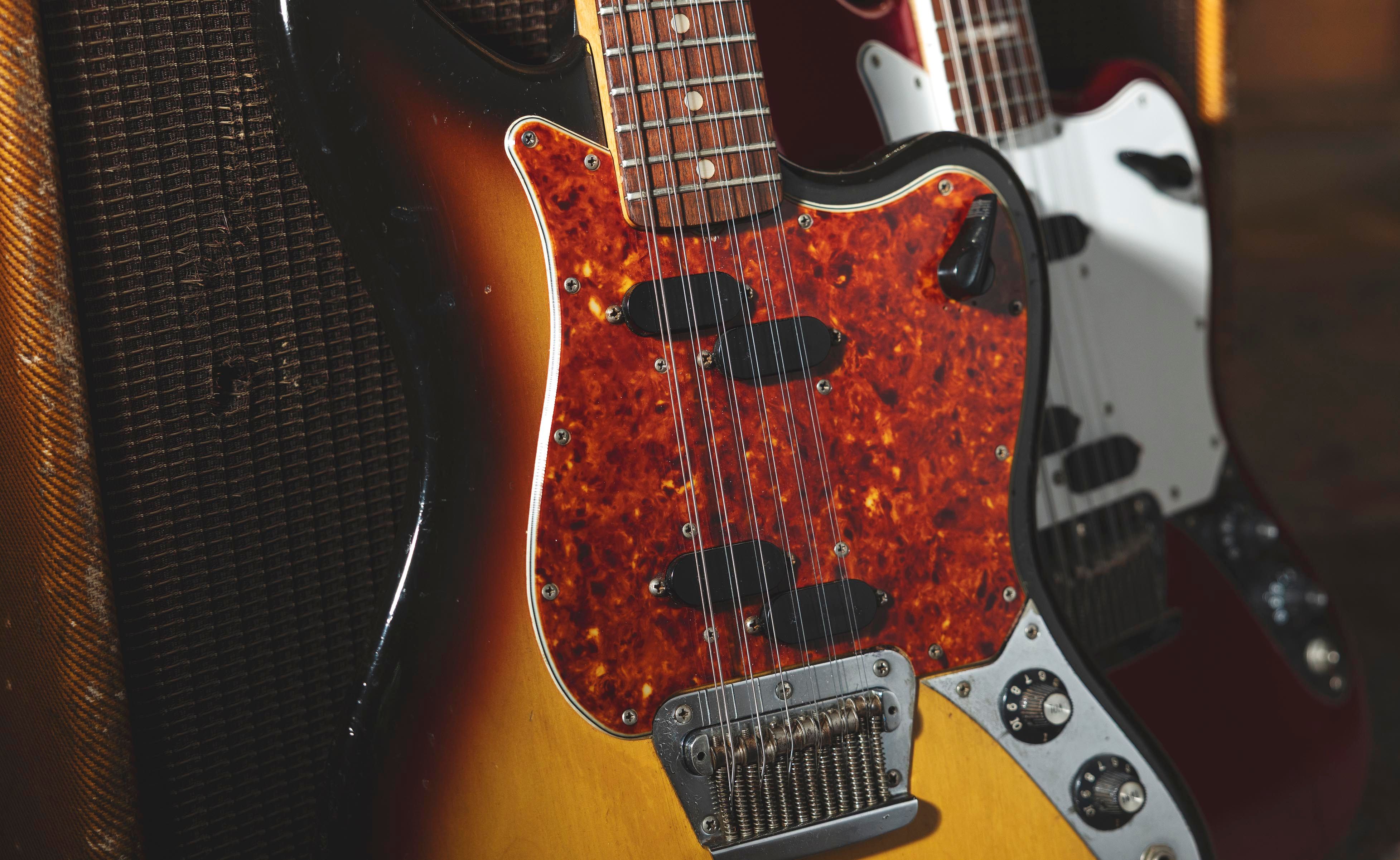
Pictured: 1966 Fender Electric XII Pickups
Referring to himself as "more an archeologist than a historian," Novak also said that he had no solid idea as to why Fender designed the pickups the way they did and would love to know for sure. He did offer up the idea that perhaps Leo Fender was looking for a design that would provide more clarity and articulation across the string courses than other 12-string electric guitar designs of the time. Barring any new information coming to light, this may just be one of those mysteries that will continue to provide fodder for internet speculation.
Finally, the Electric XII's headstock, often referred to as the "hockey stick" headstock, deserves mention. It was an inelegant but efficient design that placed 12 tuners in a relatively small space, while retaining easy access to the tuning keys. It is, visually, one of the more striking features of the Electric XII. This design was echoed in Fender's acoustic 12-strings and later Coronado 12-string. It was also used in the short-lived Fender Custom/Maverick, which Fender cites as having been a way for them to use up leftover 12-string bodies and necks after the Electric XII was removed from the catalog in 1968.
Having pieced together these facts and educated guesses, it was time to head to Hollywood and get hands-on.
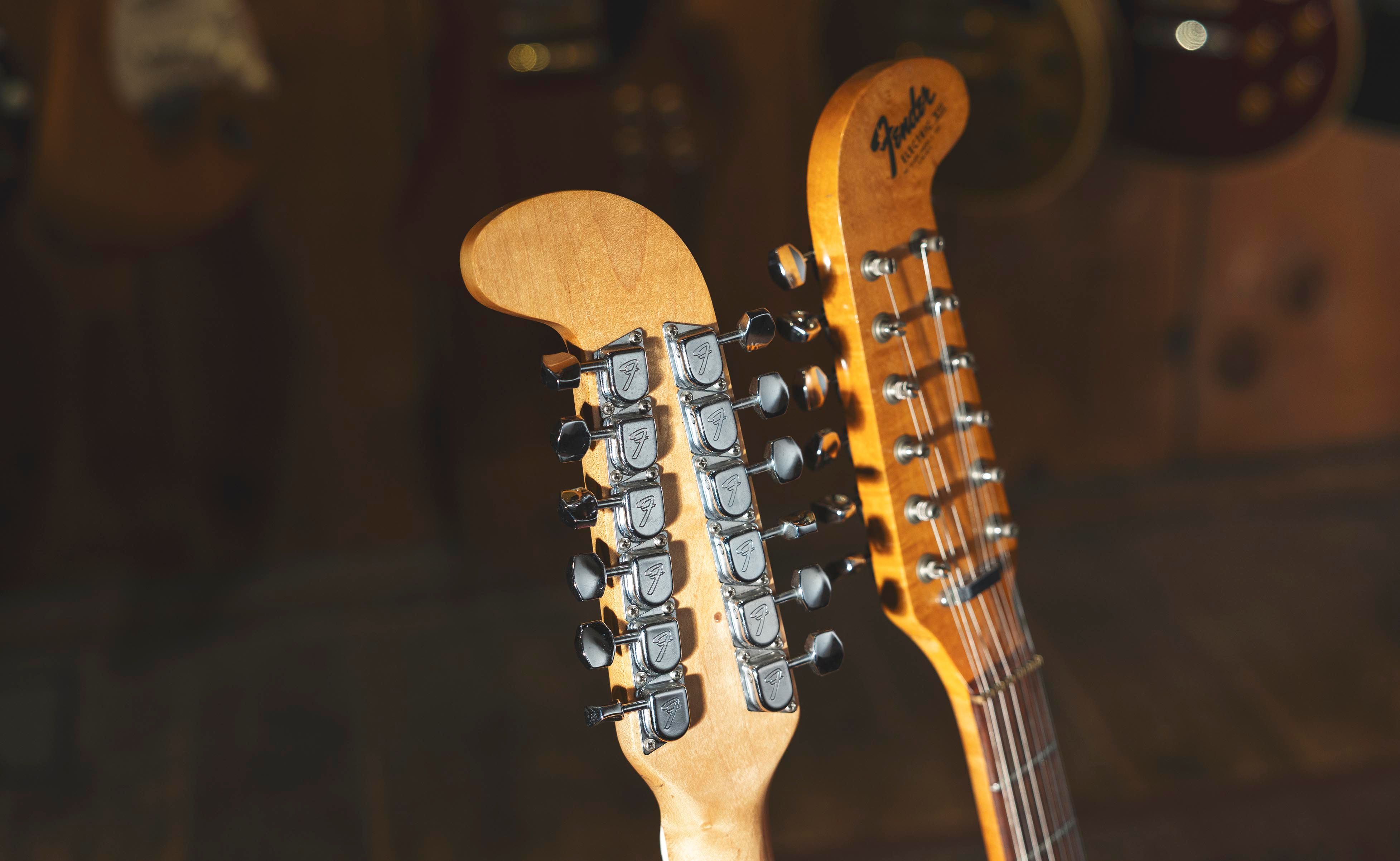
Pictured: 1966 Fender Electric XII Tuning Machines
Hands-on With the Fender Electric XII
It's not often that you get a chance to directly compare two vintage guitars of the same model and year side by side. So, walking into the Vintage/Platinum room at Guitar Center Hollywood had me feeling completely stoked to check out this pair of 1966 Fender Electric XII 12-string electric guitars.
A confession up front: I'm completely a sucker for Fender's Candy Apple Red finish, whether it's the earlier version with the silver metallic undercoat or the later version with the gold metallic undercoat (Fender switched in 1965/66 to get a deeper red). So, obviously that was the first one I picked up.
I don't know that I've ever seen a guitar of this vintage that had obviously been played but was still in close to pristine condition. The finish is extraordinarily clean, and the color-matched headstock makes the custom color even more striking. The neck feels great, and the frets are in excellent shape. It was even in tune (kudos to the Vintage Room team for that, especially considering that 12-strings are notoriously difficult to get, much less keep, in tune). This is also one of the rare examples with a bound fingerboard and block—rather than dot—inlays, making it especially interesting.
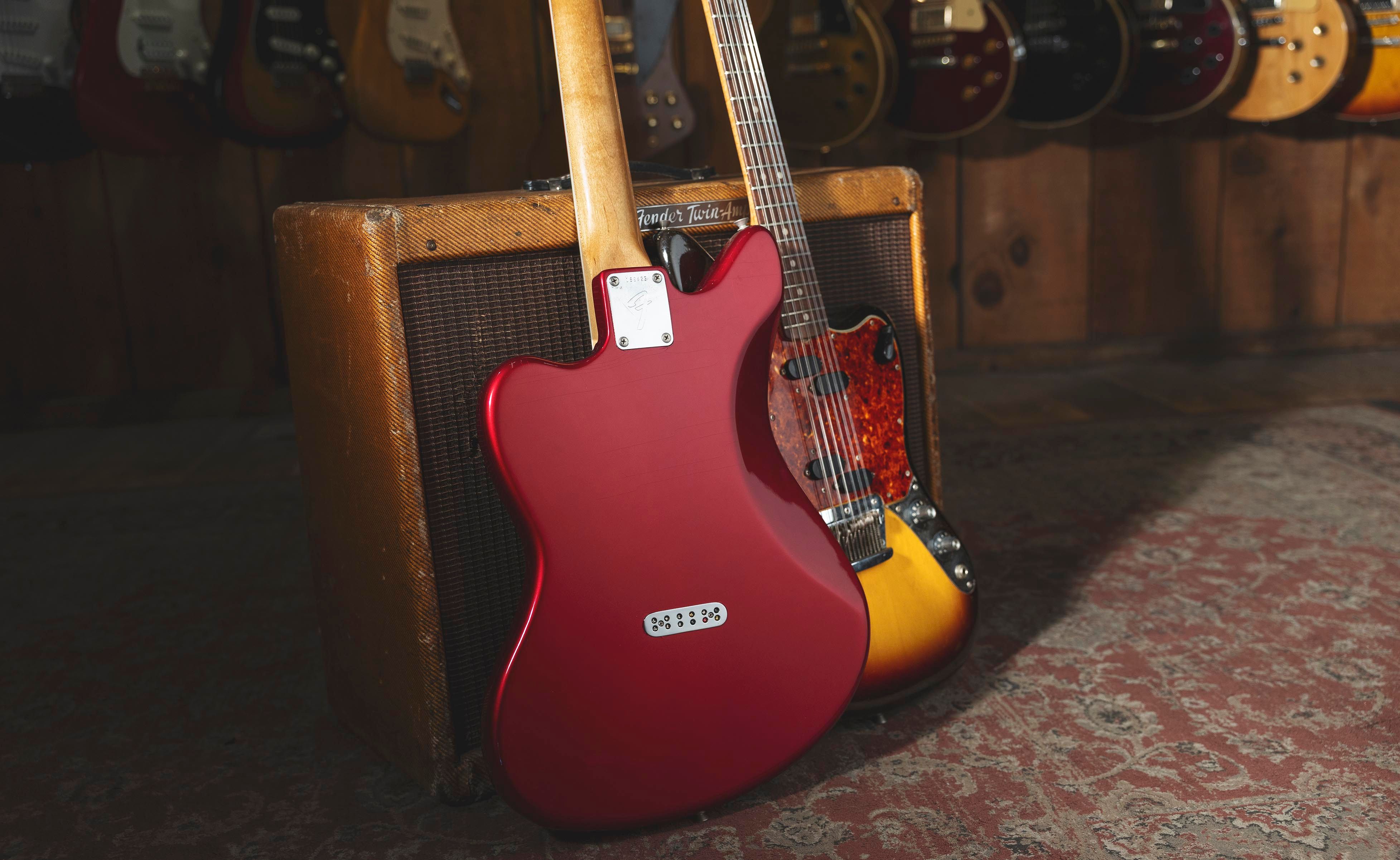
Pictured: 1966 Fender Electric XII String Through Body
Playing unplugged, the guitar was comfortable, though I would have liked just a hair more relief in the neck, but that's just me having a minor quibble. I played it for a few minutes, just to get a feel for it, since it's been a while since I've played a 12-string.
Once I'd gotten a feel for the guitar, I plugged it into a nearby Fender Vibrolux and started going through the pickup and control combinations. Positions 1, 2 and 3 on the "baseball bat" pickup selector switch provide the normal configurations you'd expect—neck pickup only, both pickups in parallel and bridge pickup only. Position 4—the "deep-tone" position, with both pickups out of phase—is the interesting one. The partial cancelation of low and low-mid frequencies from the phase cancelation does certainly increase the "jangle factor" of the guitar, at the expense of a fuller-bodied tone. It seems to me as if it would be a great choice for texture as a backing guitar, providing 12-string shimmer without muddying the rest of the mix. It was fun to play, which is the best thing you can say for a guitar, in my opinion.
Turning to the second guitar, which has a stock sunburst finish with unbound fingerboard, dot inlays and a plain headstock, I went through the same process. This one has a few more artifacts of being played but is still in great shape for a 60-year-old instrument. It has a very similar neck—minus the bling—to the Candy Apple Red guitar, with the same great feel. This one is definitely more of a player's guitar than the first, mostly because the custom color guitar is in such great shape that I would be a little hesitant to take it out to my usual club gigs.
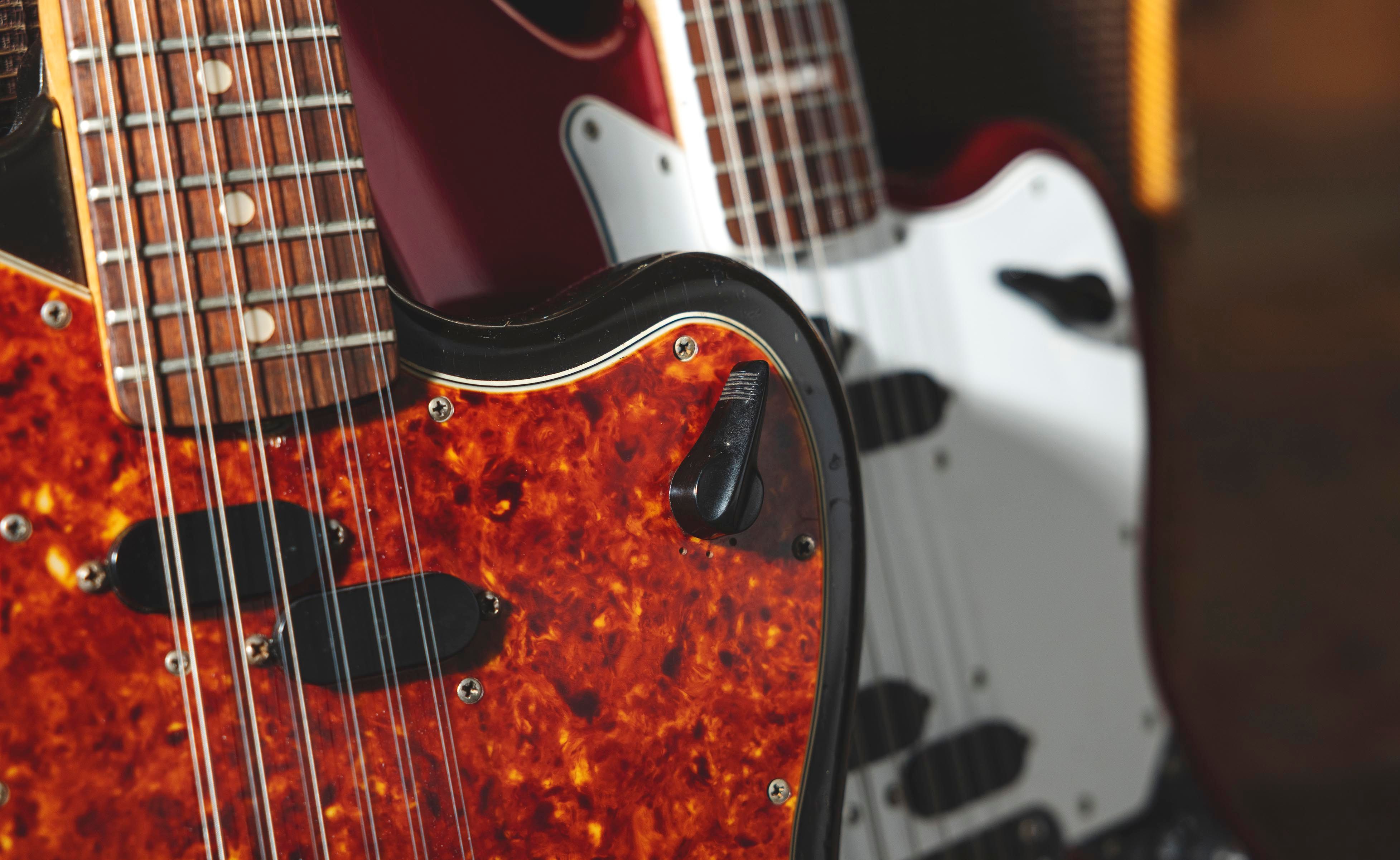
Pictured: 1966 Fender Electric XII 4-Position Rotary Switch
Plugging into the same amp, I went through my limited repertoire of 12-string licks and found myself wishing I had brought a slide with me, though I would have hesitated to retune the guitar to my usual open G tuning. I know that the Electric XII is a great guitar for slide, and if you've seen the 1969 Woodstock footage of Johnny Winter's performance, you'll see and hear that, too (though Winter played his Electric XII as a six-string). But I didn't want to go try and dig one up, so I just made a mental note to make sure I had one with me on future trips.
There was only the very slightest tonal difference between the two guitars, and they behaved very similarly. I don't know that I could pick them out in a blind listening test, but both were satisfying and fun to play.
Which one would I take home, if I could? As much as I love Candy Apple Red, I think I'd go with the sunburst guitar, if only because I'd be likely to play it more, since I'd be less worried about gigging it, and one of my criteria for my personal guitars is that they get played regularly. But I wouldn't turn down the other one, either. I think that anybody who's looking for a vintage Fender Electric XII would be very happy with either of these instruments.
Conclusion
The electric 12-string guitar has always been a bit of a niche instrument, which is a bit of a shame, I think. It's a unique and distinctive sound that can add a lot of texture and depth to a performance or recording. It's also a way to find new approaches to your playing because of how the extra strings, especially the octave courses, interact in chord voicings and melodies.
The Electric XII is an interesting chapter in Fender's history, partly because it points out how much continuity there was in the company's transition to CBS ownership as well as how the eventual differences would begin to emerge (the eventual use of "leftover" bodies and necks to the Custom/Maverick guitars after the Electric XII was discontinued in 1968 is a good example of this).
If this article has piqued your interest in Fender history, I'd recommend checking out our articles on "The History of the Fender Stratocaster," "The History of the Fender Telecaster," " A Guide to the Fender Jazzmaster" and others. Because the more you know, the easier it is to find the right guitar for you.
Written By: George Van Wagner
George Van Wagner is a writer and editor for Guitar Center, where he has worked since 2007. A multi-instrumentalist, freelance recording engineer, arranger, composer, writer and all-around tech geek, he has over 30 years of experience in the musical instrument industry at companies like Midiman/M-Audio and Line 6, doing everything from customer service and writing user manuals to working in product development. He is currently gigging around Los Angeles with Gruppo Subconscious and Bobby “Hurricane” Spencer.
Recently Added to Gear Tips

Be the first to know about exclusive offers, tips and more.

866-498-7882 English
877-687-5402 Español