

Pro Gear Advisers
•866-498-7882
How to Choose the Perfect Guitar Pick: Thickness, Materials, Shapes and Tone
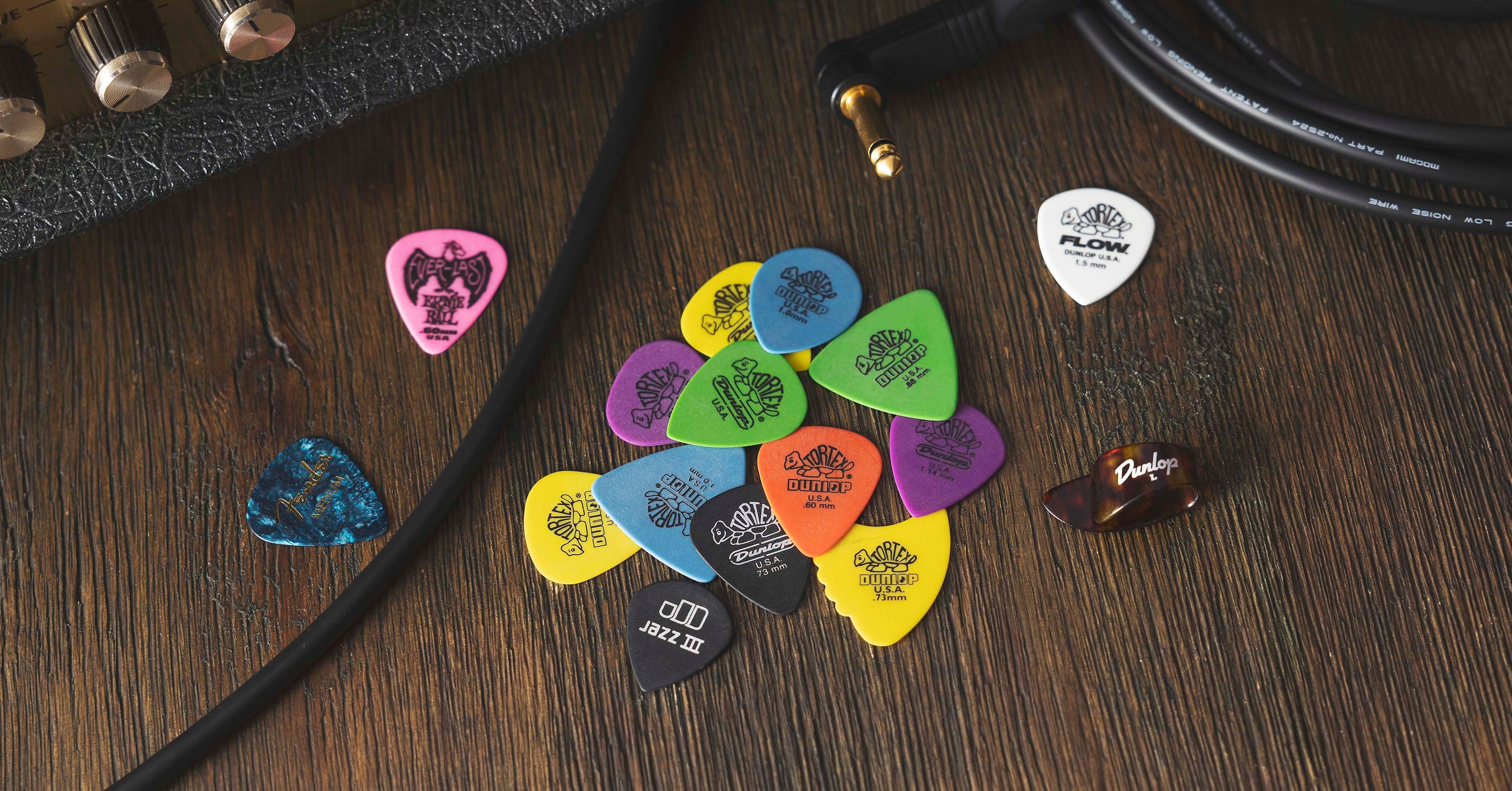

Guitar picks are like weeds. If you spend any time hanging out with a guitarist or bassist, you will find picks clacking in the dryer or swimming in the washer. Picks will hide under tables and chairs and inhabit garages, automobiles, rehearsal spaces, recording studios, workplaces and virtually anywhere they might fall out of a pocket. (I once found an abandoned Everly Star Pick on the entry ramp to Disneyland’s Space Mountain.)
But while picks are everywhere, their critical influence on tone, attack, technique, speed and comfort is sometimes taken for granted. So, let’s dig into why you should give these tiny titans their due, as well as celebrate the pick’s impact on how you play and how you sound.
Why Guitar Pick Material Matters
Years ago, when I interviewed Devo for Guitar Player at San Francisco’s Warfield Theater, Mark Mothersbaugh suddenly appeared beside me and pressed something plastic into my hand.
“That’s my guitar pick,” he smiled. “I always cut up my hotel keycards. I like how they feel, and I don’t have to go out and buy picks when we’re on the road.”
This was before guitar pick punches were readily available, and Mothersbaugh’s handmade, scissors-cut pick from a Hotel Nikko keycard was oddly shaped like the state of California. I still have it somewhere.
The PVC material of the keycard pick was rigid, and it sounded far snappier and articulate than the Dunlop Tortex 1.14 mm and Fender 351 Extra Heavy I was using at the time.
Therefore, in addition to discovering that Mothersbaugh’s creativity extended to DIY guitar accessories, I also learned that pick materials do matter in a very big way.
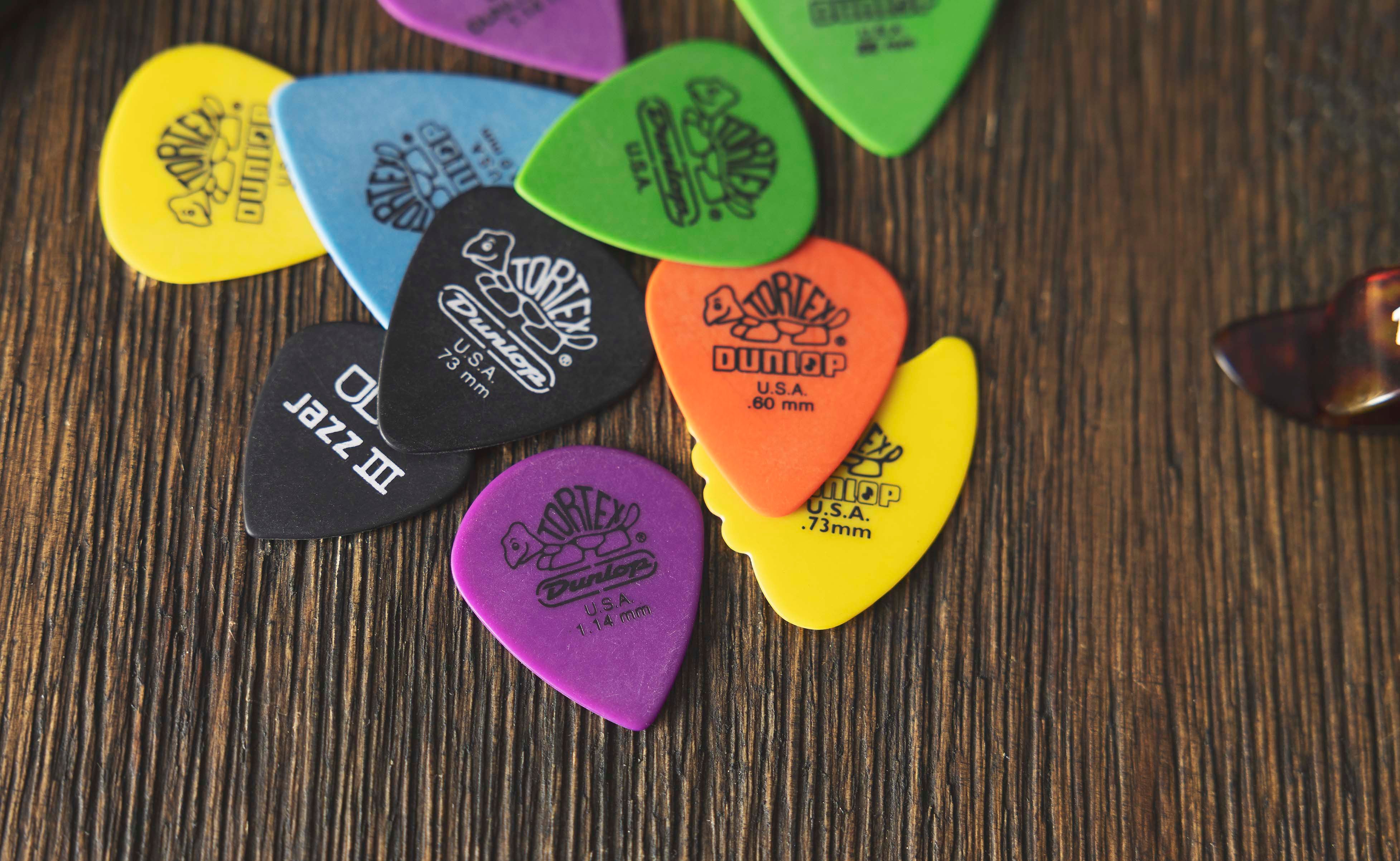
Pictured: Dunlop PVP110 Tortex Pick Variety Pack
Common Pick Materials
Here are some basic parameters to consider when evaluating which pick materials might be good fits for your music, your technique and your grip. Please note the chart provides a general peek. For example, while wood picks share similar characteristics, a harder species such as ebony will usually sound a bit brighter than softer varieties like rosewood (depending on thickness and tip shape). As you can see, Guitar Center offers a varied selection of pick materials from different manufacturers, so “try ‘em all” and find out what you like.
Material | Flexibility | Response | Typical Tonal Character | Start Exploring |
Acrylic | Rigid | Fast attack, articulate | Crisp | |
Bone | Rigid | Instant, scratchy | Bright | |
Celluloid | Springy | Round, warm, organic | Chirp | |
Delrin/Acetal Resin | Solid | Defined, articulate | Click | |
Felt | Spongy | Soft, warm, vintage-like | Muted | |
Metal | Rigid | Aggressive attack, bright | Glassy | |
Nylon | Springy | Warm, mellow | Silky | |
Ultem/Ultex | Rigid | Defined attack, sharp | Cutting | |
Wood | Rigid | Warm, organic | Earthy |
In the Thick of It
Pick material isn’t the only factor that informs sound production. Thickness also needs to be considered. Slim, flexible picks bend as they pass over guitar strings, producing a bright, percussive shimmer. Chunkier and more solid picks punch right in and deliver an immediate and articulate attack. It will be up to you to decide which gauge works best for whatever you are trying to achieve. Keep in mind you don’t have to look for one pick that does everything.
For example, I go for light gauges for strumming acoustic guitars—especially when recording parts in the studio. I like the airy sparkle a light pick delivers, as well as the jangling transients created as the pick bends and flexes over the strings. I tend to stack lots of strummed acoustics because I’ve always loved the rhythm bed of George Harrison’s “My Sweet Lord,” and using a thin pick for each overdub nails that epic vibe for me.
However, a light gauge is so not what the guitar doctor ordered when I’m playing an electric onstage. Then, I use heavy or extra heavy gauges to get the snap and articulation I like for solos, riffs and chord work.
You can also “fake” thickness if you’re in a spot. Occasionally, when I go see a friend’s band, I might get spontaneously invited onstage to make some noise. Inevitably, the guitarist will hand me a spare guitar and—for me—a less-than-ideal light pick. Happily, if you choke up on the pick, moving your fingers as close as comfortable toward the tip, you can get the feel of a thicker pick.
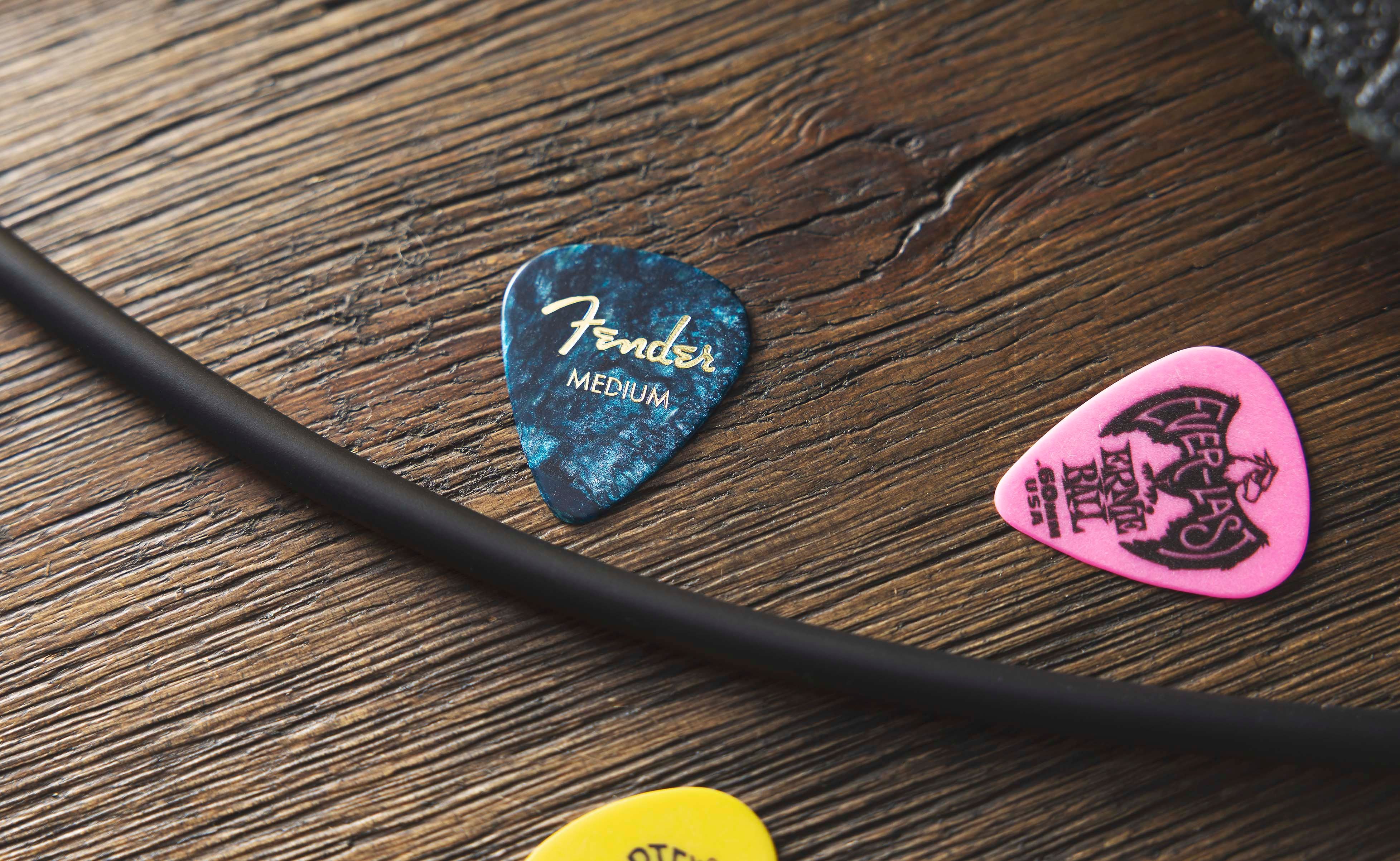
Pictured: Fender 351 Medium and Ernie Ball Everlast .60mm Guitar Picks
Pick Gauges and General Applications
Thickness | Feel | Applications to Try |
Extra Light (under .45 mm) | Super flexible | Strumming an acoustic guitar |
Light (.45–.60 mm) | Flexible and forgiving | Acoustic rhythm, folk, pop |
Medium (.60–.88 mm) | Controlled flex | General purpose |
Heavy (.88-1.50 mm) | Firm attack | Lead guitar, rock |
Extra Heavy (above 1.50 mm) | Extremely rigid | Extreme playing, jazz, fast solos |
The Shapes of Things
Picks come in various shapes, sizes and tips, and they’ve come a long way from the 351 shape developed by the D’Andrea brothers for guitarist Nick Lucas in the 1920s. When the D’Andrea company partnered with Fender in 1955 to provide Fender-branded celluloid picks, the 351 became the de facto standard for rock and country guitarists across the globe. I still remember my very first guitar teacher handing me a couple of Nick Lucas Medium picks when I started taking lessons from him. At the time, I thought “Nick Lucas” was a brand, like Ford or Disney. (I was a youngster, okay?)
The evolution of pick shapes tends to keep pace with the progression of guitar techniques and musical styles. That said, frequent group giggles amongst the Guitar Player staff occurred when the magazine would receive a new pick molded to enhance speed and articulation. “Oh, this one is shaped like an angry tiki god,” or “Look, it’s a Viking’s battle axe,” or “Wow, this pick looks like the beast with three heads.” Sometimes, a strange shape did turbocharge pick technique, and we’d all have to shut up. It didn’t happen very often, though.
To keep things simple, there are popular shapes used as foundational designs by numerous pick manufacturers. So, battle axes and Mothersbaugh’s DIY pattern aside, the chart below provides rudimentary intel on pick and tip shapes and their benefits.
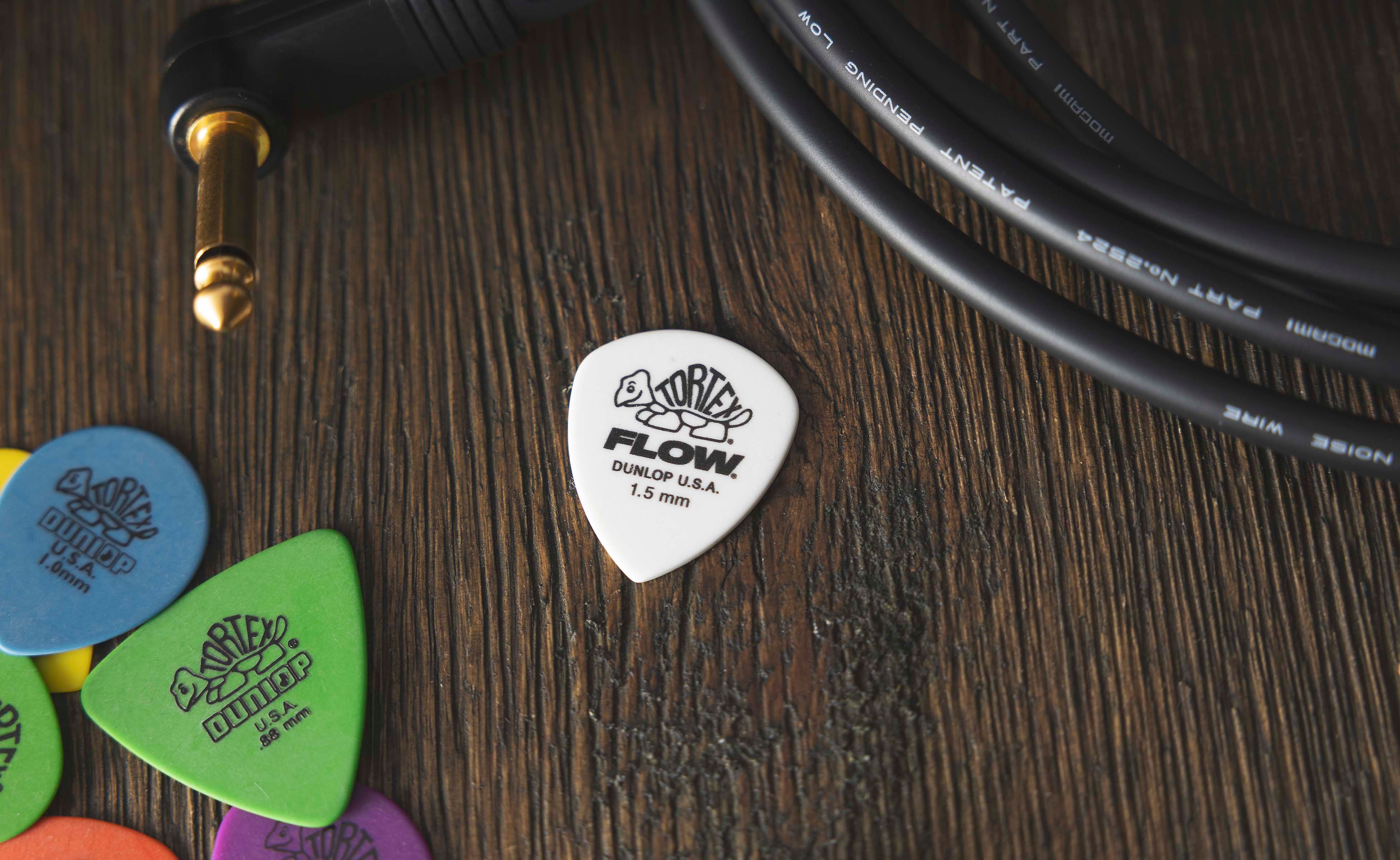
Pictured: Dunlop Tortex Flow 1.5mm Guitar Pick
Basic Pick Shapes and Tips
Shape/Tip | Utility | Grip/Feel | Sound |
Standard 351 | All purpose | Familiar, comfortable | Depends on gauge and material |
Jazz | Speed, precision | Compact, controlled | Focused attack |
Triangle | Versatile | Substantial | Depends on tip |
Rounded Tip | Smooth release | Forgiving | Smooth attack |
Sharp Tip | Precise single-notes | Direct | Defined |
Beveled Tip | Smooth picking | Glides atop strings | Varies with bevel |
Grip It Good
It’s baffling. I’ve never had much of a problem holding onto guitar picks, but a drumstick without a textured grip will end up zooming dangerously into the audience multiple times when I play drums.
It just goes to show that, whatever you are holding, grip is a critical consideration. As a musician, you want to focus on what you’re playing, rather than worry about an inopportune case of the dropsies. Also, if you’re into using the different edges of a pick to produce varied tones, you don’t want any slippage every time you change your finger position.
Pick manufacturers know all about grip dynamics, of course, and many of them have produced solutions. Some of my favorites—in alphabetical order—include the following:
D’Addario Satch Grip. Thanks to my former job at Guitar Player, I’ve had multiple opportunities to interview Joe Satriani. He is not only a stratospherically talented guitar player, but he’s also incredibly savvy about gear and developing products. In other words, I trust the guy. These extra-heavy gauge celluloid picks feature DuraGrip technology to ensure the Satch Grip don’t slip. If you’d prefer to have DuraGrip picks in other gauges and without an artist’s name attached, you can choose DuraGrip Light/Medium, DuraGrip Medium or DuraGrip Extra Heavy.

Dunlop Primetone Grip. I switch out pick types a lot—simply to explore new vistas of sound—and I was obsessed with Primetones for a while. The dimpled grip feels natural, and the Ultex material and sculpted edges really deliver playability and tone. If you sweat a bunch while playing and would appreciate a bit more security, Dunlop Max Grip picks use a textured design—kind of like a high-end tire tread—cut into the pick material to battle slippage.

Shop Now: Dunlop Primetone Grip 1.3mm Guitar Pick
Everly Star Picks. Created by Phil Everly of the Everly Brothers, Star Picks use an ingenious star cutout that lets the tips of your thumb and finger “meet in the middle” to keep the pick secure. Star picks were quite the “stars” when they first showed up at the Guitar Player offices in the ’90s. They looked totally cool, and they worked brilliantly. I even dug the feel of the cutout on my thumb and fingertips, as it was a gentle yet reassuring reminder that the pick wasn’t going anywhere. For added stage sizzle, Everly offers glow-in-the-dark Star Picks.

Shop Now: Everly Star Classic .96mm Guitar Pick
Fender Mojo Grip. I’m not a huge fan of pick add-ons, but the removeable rubber grip on these classic Fender 351s is kind of ingenious. Yes, it took me a little while to get used to having a thick padded top and a slimmer celluloid bottom, but I soon locked in and forgot about the two different surfaces. A benefit is the removable grip can be transferred to other 351-shaped picks, so if you want to rock additional Fender colors or gauges—or even try other brands entirely—the Mojo Grip can always be at your fingertips. If you’d prefer a more integrated non-slip pick, the Fender F Grip carves the iconic Fender “F” logo into the top of the celluloid material, providing a recessed groove your fingers can grab.

Shop Now: Fender Mojo Grip 351 Medium Guitar Pick
Pick Boy Pos-a-Grip. Japan’s Pick Boy has been making picks since 1967, and the Pos-a-Grip series kicked off in the 1980s. For some reason, the company reached out to me while I was editor of Electronic Musician—not exactly a guitar magazine—and quite shrewdly sent me a package of colorful and striking Rainbow Pos-a-Grips. Looking like a crop circle of polka dots, the cutouts keep the pick secure.

Where to Start Your Guitar Pick Search
We’ve (hopefully) provided you with a bunch of pick pointers in this article, but if you’d like even more suggestions, peruse the chart below to begin matching pick materials and gauges to your musical style and technique.
However, the chart recommendations are merely starting points for reference. You might find one of the suggestions to be perfect for you, but even if you do, have some fun trying other picks to see how they might expand your options.
After all, guitarists often invest hundreds or even thousands of dollars on guitars, amps, pedals and other tone-chasing gear, when one of the simplest and least expensive ways to change their sound is to switch guitar picks.
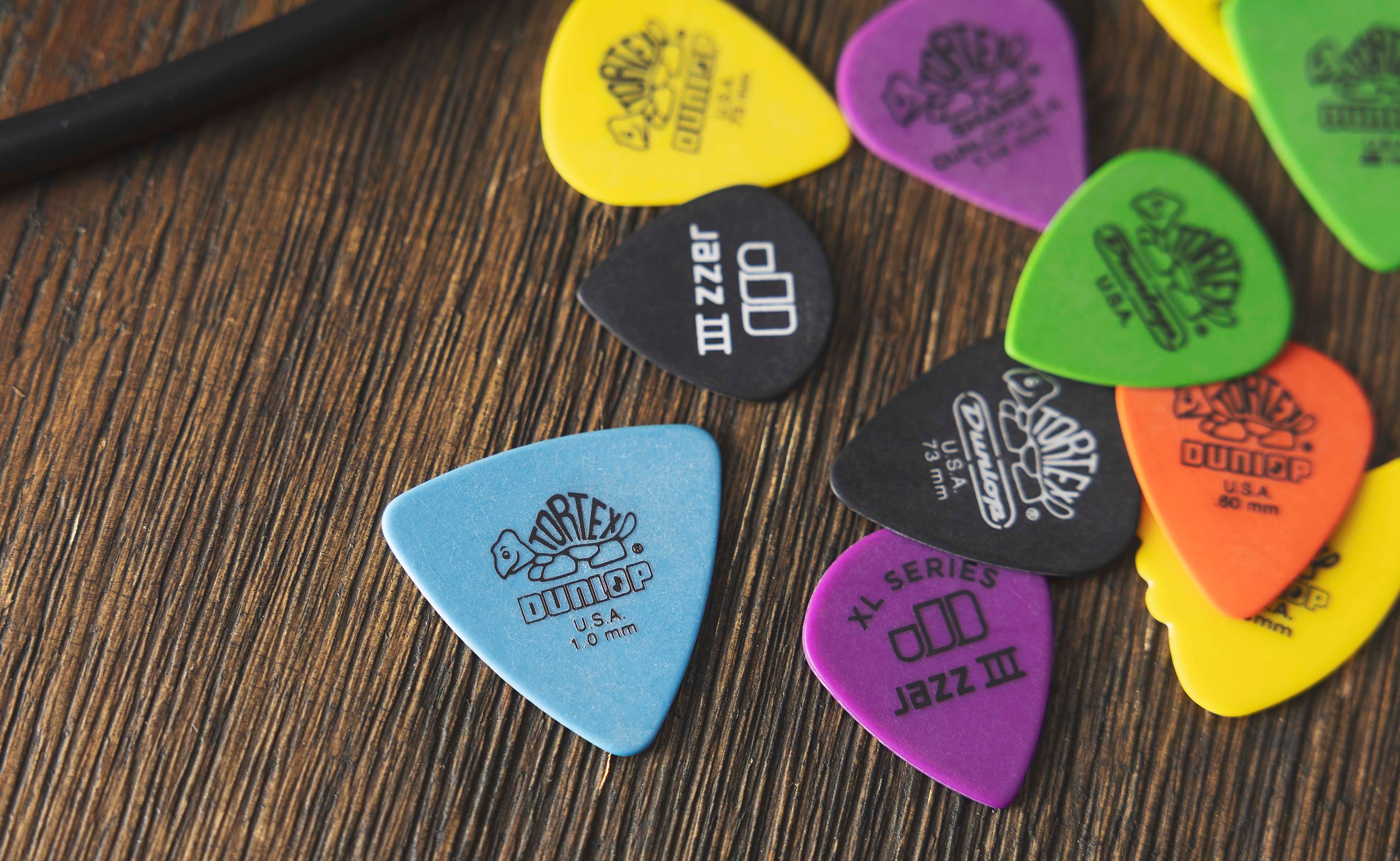
Pictured: Dunlop PVP110 Tortex Pick Variety Pack
So, consider spending the “little bucks” to acquire every type of pick mentioned in the charts throughout this article, and don’t forget to experiment with different shapes and tips, various gauges and so on.
Be bold and play Metalcore with a felt pick, or solos with a very light celluloid pick, or jazz with a bone pick. Starting conventionally and ending like a revolutionary is a surefire way to discover unique sounds.
Style | Suggested Pick Material | Suggested Pick Thickness | Why Give It a Try? |
Strumming (acoustic) | Celluloid | .46–.73 mm | Supple across multiple strings |
Electric blues, rock | Celluloid | .73–1.14 mm | Balanced chord and single-note articulation |
Hard rock, metal | Delrin | 1.0–1.5 mm | Precise attack for fast picking and tight rhythm accents |
Jazz, fusion | Nylon | 1.0–2.0 mm | Single-note definition |
Bluegrass flatpicking | Acrylic | 1.0–2.0 mm | Good projection and control |
Country hybrid picking | Delrin | .73–1.5 mm | Good control when using pick and fingers (Don’t forget thumbpicks) |
Bass | Felt | .88–2.0 mm | Muted, vintage-style articulation |
Who Are You?
Thanks to my music journalism gigs over the years, I’ve probably interviewed thousands of guitar and bass players, and just for my own amusement, I like to put players into four pick categories.
Borrowers. They never have picks on them. Ever. They will scan the floor and tops of amps for random castoffs or gratefully use whatever picks they can bum from bystanders.
Naysayers. They don’t consider picks as significant tone influencers. More than a few times, for example, I’d interview someone to meticulously detail their guitar rig for Guitar Player readers, and they wouldn’t know what to say when I asked about their picks. Even more embarrassing, a fair amount of these guitar stars probably thought I was mad or a wretched little geek for even posing the question.
Loyalists. They swear by a particular pick and won’t even go near a guitar unless that very special pick is securely in their grasp. I’ve witnessed recording sessions stop dead until a guitarist rummaged through pockets, road cases and gig bags to find an MIA pick.
Magicians. These players not only know the value of a pick for producing certain tones, but they also follow the “right tool for every job” principle. They carry several quart-sized sandwich bags filled with lots of different picks, tote the collection everywhere and judiciously select the exact pick for the sound they are trying to create at a particular moment.
But whether you find yourself in one of my whimsical categories or have developed your very own pick profile, picks deserve to be far more than an “indispensable afterthought” of guitar tone generation.
Written By: Michael Molenda
Michael Molenda is a content strategist, editor and writer for Guitar Center, where he has worked since 2022. He is the longest-serving Editor in Chief of Guitar Player (1997-2018), and former Editorial Director of Bass Player, EQ, Keyboard, Electronic Musician, Gig and Modern Drummer. A guitarist, drummer, bassist and producer, Mike co-owned three pro recording studios in San Francisco, and performs with Surf Monster and The Trouble With Monkeys.
Recently Added to Gear Tips
Be the first to know about exclusive offers, tips and more.

866-498-7882 English
877-687-5402 Español