.jpeg)

Pro Gear Advisers
•866-498-7882
How to Choose the Best Guitar Pedal Tuner for Your Rig

We’ve all experienced it—go to a show and someone is out of tune. Or, go to a rehearsal and someone can’t quite play in tune with everybody else, and what was going to be creative fun becomes kind of a slog with lots of wincing going on. The solution may be simple and obvious to most of us—a reliable guitar pedal tuner for your pedalboard. But, when you go online or get to the store, the selection of available tuners can be a little overwhelming.
Ultimately, the best guitar pedal tuner for you depends on use case and other factors: live performance, pedalboard size, display visibility, tuning accuracy, bypass preference and whether you’ll want chromatic, polyphonic or strobe tuning.
In this article, we’ll look at several tuners you can slap on your pedalboard to help you find the most harmonious solution for your needs.
Table of Contents
- Why a Guitar Pedal Tuner Belongs in Your Rig
- What Is a Guitar Pedal Tuner?
- How to Choose a Guitar Pedal Tuner
- Pedal Tuners vs. Clip-On, Rackmount and Microphone Tuners
- Comparing Types of Tuners
- Which Type of Tuner is Best for Me?
- Quick Picks
- Chromatic vs. Polyphonic vs. Strobe Tuners
- Tuning Style Comparison
- True Bypass vs. Buffered Bypass in Tuner Pedals
- Where to Put a Tuner Pedal in Your Signal Chain
- Guitar Pedal Tuner Buying Guide: What to Look For
- BOSS TU-3 Chromatic Pedal Tuner
- D'Addario CT-20 Chromatic Pedal Tuner
- KORG Pitchblack X Pedal Tuner
- Peterson StroboStomp HD Pedal Tuner
- Pigtronix 2NR Chromatic Pedal Tuner
- Walrus Audio Canvas Pedal Tuner
- TC Electronic PolyTune 3 Pedal Tuner
- Getting It All in Tune
- People Also Ask ...
Why a Guitar Pedal Tuner Belongs in Your Rig
Naturally, the primary reason to have a tuner in your rig is to make it easier to play, and stay, in tune. Not that every musician shouldn't work at training their ear to be able to tune their instrument to a simple reference tone—a skill that's an important part of mastering your instrument—but having a tuner certainly makes it quick and easy when you're in the studio or on stage and need to do a quick touchup with maximum accuracy. But there are other reasons why it's a good idea.
Many modern tuners have preset modes for what are called "sweetened" tunings, frequently available as alternate tuning modes. These are slight tweaks to the tuning frequencies for individual strings that step away from what's called "equal temperament" tuning and can make an instrument play more in tune with itself, or to create a specific effect.
Another reason to have a tuner is the ability of pretty much all modern tuners to change the basic reference frequency (generally A=440Hz) or tuning standard. Let's say that you're playing somewhere where there's an acoustic piano that, for some unknown reason, is tuned to A=436Hz. The ability to quickly change the tuning on your tuner means that you will be able to play in tune with the piano all night—much easier than asking the audience if anybody there is a piano tuner.
So, quick touchups, adjusting to the more fixed tuning of other instruments, and not driving your audience out into the freezing night because that's preferable to sour harmonies—all reasons why you need a tuner in your rig.
What Is a Guitar Pedal Tuner?
The pedal-style tuner, whether mounted on a pedalboard or free-floating on the stage, makes for one of the most common and most versatile tuner setups. In the same form factor as standard or mini-size effects pedals, they are always available without having to take your hands off the guitar, and usually self-muting for silent tuning.
They are the simplest, easiest way to make sure you’re always in tune. Whichever size you choose, they’re easy to use, easy to power from battery or power supply (for which, see our article on choosing a power supply) and super easy to read. Many are switchable between true- and buffered-bypass modes, about which more in a bit. With one of these in your rig, there’s never a reason to not be in tune.
Keep in mind: Pedal tuners need an instrument signal. They work with electric guitars, basses and acoustic-electric guitars, but not purely acoustic instruments—unless you use a pickup or external mic.
How to Choose a Guitar Pedal Tuner
-
Choose chromatic for straightforward, general-purpose tuning.
-
Choose polyphonic if you want fast tuning checks across all strings.
-
Choose strobe if you need high-precision tuning (great for intonation work).
-
Choose a bright, large display for stage use.
-
Choose a mini pedal if board real estate is tight.
-
Consider true bypass vs. buffered bypass based on your pedalboard and cable run.
Pedal Tuners vs. Clip-On, Rackmount and Microphone Tuners
As you're probably aware, there are a number of types of electronic tuners available today. Of course, if you're seriously old school, you'll make do with a tuning fork or one of those little round pitch pipes that grade school music teachers used to whip out when it was time for chorus practice, but this isn't that kind of party.
Currently available tuners can be broken down into five basic types:
-
Pedal tuners
-
Clip-on headstock tuners
-
Rackmount tuners
-
Microphone-based tuners
-
Mobile app tuners (which are mostly a subset of the microphone-based tuners, with some exceptions)
Two of these, pedal and rackmount tuners, are specifically designed for pitch detection from instruments with some sort of pickup. The clip-on headstock tuner is designed to detect pitch directly from the physical vibration of the neck of your instrument. Microphone tuners and mobile app tuners rely on a microphone built into the device (as you might guess from the name). Some mobile apps can also use the input from an external audio interface, so are in a kind of in-between world.
So why are we focusing on pedal tuners here? Well, unless you only ever play purely acoustically, we think the pedal tuner is the most versatile and universally usable for most players. They just work, regardless of background noise or placement. We've tried using microphone-based tuners in a noisy room, and that can be an exercise in frustration. We've used clip-on tuners that don't grip the headstock well enough for the vibrations of the neck to be cleanly transmitted to the internal sensors of the tuner, or where the body/neck combination has resonant points that emphasize one of the natural harmonic series, usually the second harmonic (the fifth) strongly enough that it overpowers the fundamental note. And a rackmount tuner, although great for guitar techs who work on a lot of guitars, requires that you lug around a rack. For simplicity's sake, here's a quick chart of the strong and weak points of the various tuner types.
Comparing Types of Tuners
|
Tuner Type |
Applications |
Pros |
Cons |
|
Pedal Tuner |
Live performance, studio sessions, making intonation adjustments |
Difficult to misplace, always powered if it's on your pedalboard, clean look, easy to read, silent tuning |
Won't tune purely acoustic instruments without a separate microphone |
|
Clip-on Tuner |
Live performance, studio sessions |
Small, easily portable, silent tuning, can leave it on while playing for quick checks, affordable |
Batteries go dead at inconvenient times, can be confused by overtones, clunky look, easy to misplace, can be slightly less accurate |
|
Rackmount Tuner |
Live performance, studio sessions, instrument repair, making intonation adjustments |
Accurate, can be left on while playing |
More expensive, not as portable |
|
Microphone Tuner |
Studio sessions, practice sessions, acoustic instruments |
Affordable, compact, longer battery life |
Very susceptible to background noise, not sufficiently accurate for more technical use |
|
Mobile App Tuner |
Practice sessions, studio sessions, acoustic instruments |
Affordable, always with you |
Very susceptible to background noise, varying accuracy from app to app |
Which Type of Tuner is Best for Me?
So, taking all of this under consideration, which tuner is the right one for you? First consider where and how you're most likely to be using a tuner. Then, use the table above as a guide to your needs. If, for instance, your primary usage is likely to be in live performance or rehearsal situations where there's a lot of background noise, the microphone-based and mobile app-based tuners are probably not your best bet. If you're in the studio or live, and want to do quick, silent touchups to your tuning, that would point toward either a pedal or a clip-on headstock tuner. The pedal tuner tends to be a little more accurate, and, since they generally mute the instrument when you step on the button, it's one less thing you have to remember to go silent. If you're a tech, or bring a lot of instruments to a gig, either the pedal or rackmount tuners would be the right way to go. But, it's all down to you and what your priorities are. In this article, we're focusing on pedal tuners because we've found them to be the most versatile solution for most players.
Quick Picks
|
Pedal Tuner |
Tuning Mode |
Bypass Type |
Size |
Display Style |
Good Fit If |
|
Chromatic |
Buffered |
Full-size |
21-segment LED meter with brightness options |
You want an excellent all-around, tough-as-nails tuner |
|
|
Chromatic |
True |
Mini |
Full-color vertical display |
You want speed, aren’t a fan of the strobe tuner-type display and you’re running out of pedalboard space |
|
|
Chromatic |
True, Ultra Buffer |
Full-size |
Meter LEDs with brightness setting and four display modes (Regular, Strobe, Half Strobe, Mirror) |
You appreciate the stealthy look, display versatility and bypass choices |
|
|
Strobe |
True, buffered, monitor (tuning always visible) |
Full-size |
LCD with a variable-color LED backlight |
You’re a gear geek who loves to tweak, and if you do home setups and intonation |
|
|
Chromatic |
True |
Full-size |
Large, high-contrast LED screen |
Your style is simple—short, sweet and in tune |
|
|
Chromatic |
True, buffered |
Full-size |
2.8" LCD with adjustable orientation and customizable themes/photos |
You need the flexibility of the rotatable display (and the side benefit of uploading any photo you wish) |
|
|
Polyphonic |
True, buffered |
Compact |
100+ LEDs with an auto-dimming feature on dark stages |
You find yourself always needing (or wanting) to do quick, mid-song touchups to your tuning |
Chromatic vs. Polyphonic vs. Strobe Tuners
Generally, pedal tuners can be divided into three basic types: chromatic, polyphonic and strobe. So, what do these terms really mean, when it comes to tuners?
A chromatic tuner can tune any note, so if you like to tune the entire guitar down a half-step (or more), or use a lot of open tunings, like DADGAD, as long as you know the pitch names you want, it's a piece of cake to get tuned up (or down, as the case may be).
Polyphonic tuners, as you might guess from the name, have pitch detection algorithms that can display the tuning of all six strings at the same time (sorry, 7- and 8-string players). This is great, especially for tremolo-equipped guitars, since it makes it really easy to see how the tension changes involved in tuning one string can affect all the others. These tuners will also have a single-string mode and often a sort of faux strobe display mode. This leads us to the last category of tuner.
Strobe tuners are the oldest electronic (actually electro-mechanical at first) tuners, first developed in 1936, by the C.G. Conn company. The original versions used spinning disks, a variable speed motor and one (or more) strobing lights to compare the input to a set reference frequency. While this may seem like a rather complex scheme, it offers incredible accuracy (on the order of .01 cents, or 1/1000 of a semi-tone) and extremely fast response. Conn's tuner division was sold to Peterson in 1985. Peterson had developed the first solid-state version of a stroboscopic tuner in the mid-1970s, so they were an appropriate steward of the tradition. The use of a reference frequency rather than computed pitch-detection keeps strobe tuners at the top in speed and accuracy.
Tuning Style Comparison
|
Tuning Type |
Applications |
Pros |
Cons |
|
Chromatic |
General-purpose tuning |
Great for non-standard tunings, works with any instrument with pickups or electronic output |
Less likely to have sweetened tunings |
|
Polyphonic |
General-purpose tuning |
Excellent for quick tuning touchups as you can easily see the relationship between strings |
Guitar-centric, so if you need to tune other instruments, you may need a workaround |
|
Strobe |
Any tuning task that requires extreme accuracy |
Absolutely the most accurate tuning standard, great for setting intonation and other precision tasks |
Can take a little extra time to tune |
True Bypass vs. Buffered Bypass in Tuner Pedals
A number of these pedal tuners can switch between buffered and true-bypass modes. While this has been discussed extensively (and exhaustively) elsewhere, with some rather strong opinions being expressed on occasion about the advantages and disadvantages of each mode, we're going to just touch on it here.
Buffered bypass means that whether a pedal is on or off, the instrument signal is still passing through the circuitry of the pedal, and is running through whatever chips (analog op-amps, digital converters, etc.) are in the pedal's circuitry, with the effect simply turned off.
True bypass means that there is an alternate circuit path, generally switched to by an internal relay, that is a "straight-wire" connection for the pedal input to the pedal output, so the pedal circuit board is taken entirely out of the signal path when the pedal is bypassed.
The basic argument for a true-bypass system is that your guitar's tone can be affected by passing through a pedal's circuitry in a buffered situation, changing the overall impedance that the amp sees if a guitar were plugged directly into it. A true-bypass pedal is closer to having a direct guitar>cable>amp signal path, and your amp sees the actual output impedance of your pickups. The downside is that, unless every one of your pedals is true bypass, any potential upside goes away.
The essential argument in favor of a buffered pedal is that it compensates for the normal signal, frequency losses and noise that can come from running an unbalanced audio signal. This generally means that no pedal is going to cause a big gain or loss in volume from its internal circuitry when it's switching on or off (unless, of course, you've set it to do that). The downside is that you might lose a little touch sensitivity at the amp and, if you do have a pedal (like some vintage fuzz pedals) that is very responsive to the changes in the guitar's output impedance, you'll lose that if there's a buffered pedal between your guitar and that pedal.
We're not making a call either way here, as the choice of buffered or true bypass is completely in your hands and ears. You do you, and we'll help however we can.
Where to Put a Tuner Pedal in Your Signal Chain
Since you want a tuner to see the purest signal it can from your guitar or bass—without any other pedals adding noise or affecting the pitch—the tuner should always be the very first pedal in your signal chain. The only possible exception might be if you're running the tuner as a buffer and using a wah pedal, since a buffer in front of a wah will affect how the wah pedal behaves.
Basically, we want to do everything we can to help the tuner track our instrument’s pitch, and going straight from our output jack to the pedal ensures that. We’re not muddying things up with drive, modulation or time-based effects before our signal ever reaches the tuner. Even if you’re using a volume pedal, the tuner should typically still be first in the chain.
Guitar Pedal Tuner Buying Guide: What to Look For
Now that we’ve laid the groundwork and defined some terms, let’s get down to seven pedal tuner options worth considering, each with different strengths depending on your rig, tuning needs and pedalboard setup.
BOSS TU-3 Chromatic Pedal Tuner
What to Know:
-
Chromatic tuning mode gives players a straightforward way to tune guitar, bass and other instruments onstage or in the studio.
-
Rugged BOSS construction makes it a dependable option for pedalboards that see regular rehearsal, gigging or touring use.
-
A strong fit for players who want a highly visible, easy-to-use tuner pedal with familiar operation.
Shop Now: BOSS TU-3 Chromatic Pedal Tuner
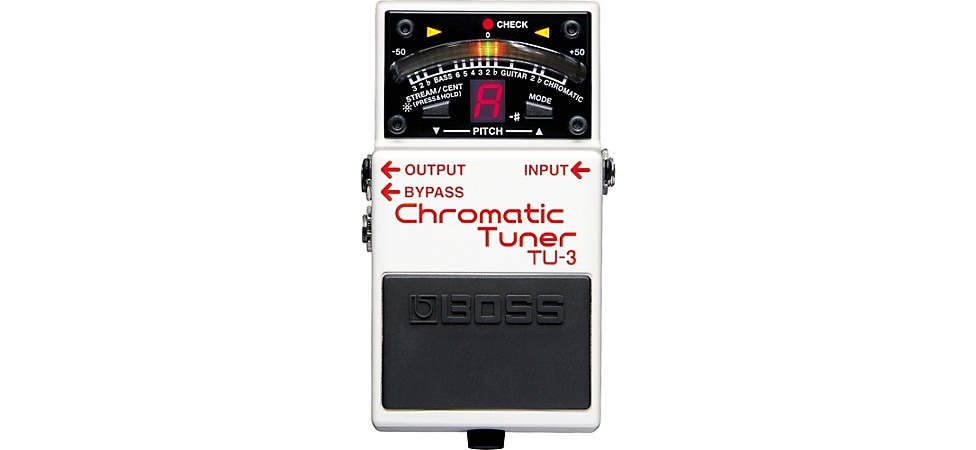
The BOSS TU-3 chromatic pedal tuner is one of the most popular tuners on the market today. A standard-size pedal with switchable chromatic and guitar/bass modes (Bonus: It supports 7-string guitars and 6-string basses in that mode, and has a drop pitch mode), it's easy to set up for your exact use case. A bright 21-segment LED display with note name and Accu-Pitch indicator give you positive feedback when you're in tune. As an added bonus, the TU-3 can act as power distribution for up to seven other BOSS pedals with the optional PCS-20A accessory cable (sold separately). With 86 reviews, at an average rating of 4.66, the BOSS TU-3 is the top reviewed tuner on this list.
D'Addario CT-20 Chromatic Pedal Tuner
What to Know:
-
32-bit processor provides fast pitch detection, while the full-color vertical display makes tuning information easy to read at a glance.
-
True-bypass wiring, a rugged aluminum enclosure and a wide A415–A475 calibration range support stage, studio and alternate-reference-pitch applications.
-
Useful for players who want responsive chromatic tuning in a streamlined footprint that fits comfortably on a crowded pedalboard.
Shop Now: D'Addario CT-20 Chromatic Pedal Tuner
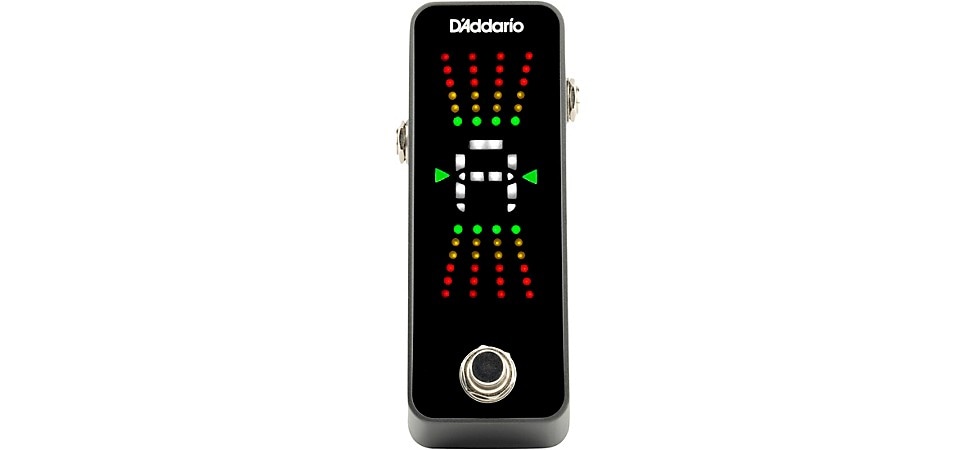
The true-bypass D'Addario CT-20 chromatic tuner pedal is a great choice for crowded pedalboards. The bright, colorful LED display is easy to read with a quick glance, and the powerful 32-bit processor makes for lightning-fast pitch detection. The mini-pedal size makes it easy to fit almost anywhere. A side button enables you to scroll through and select a wide range of tuning standards, from A415 to A475.
KORG Pitchblack X Pedal Tuner
What to Know:
-
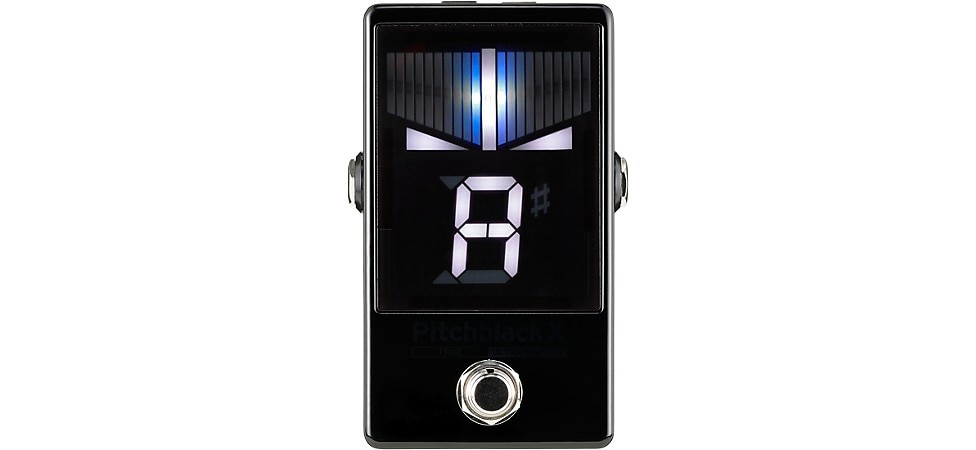
Four display modes—including a strobe mode with accuracy down to ±0.1 cent—let players choose between “normal” tuning feedback and more detailed pitch adjustment.
-
Switchable true-bypass and Ultra Buffer modes make it adaptable to both simple signal chains and larger pedalboards with long cable runs.
-
Designed for rigs that need a sturdy, legible tuner with flexible display and signal-routing options for performing or recording.
Shop Now: KORG Pitchblack X Pedal Tuner
The KORG Pitchblack X offers strobe tuner accuracy in a standard-sized pedal. With the ability to switch between KORG's Ultra Buffer technology or true bypass, it's an excellent choice for either school of signal chain devotee. Its multiple display modes (regular, strobe, half strobe and mirror) make it suitable for multiple applications and, like many of the tuners we discuss here, it has a power out jack that can distribute power to another pedal, when the Pitchblack X is running off an AC power supply, rather than its internal 9V battery.
Peterson StroboStomp HD Pedal Tuner
What to Know:
-
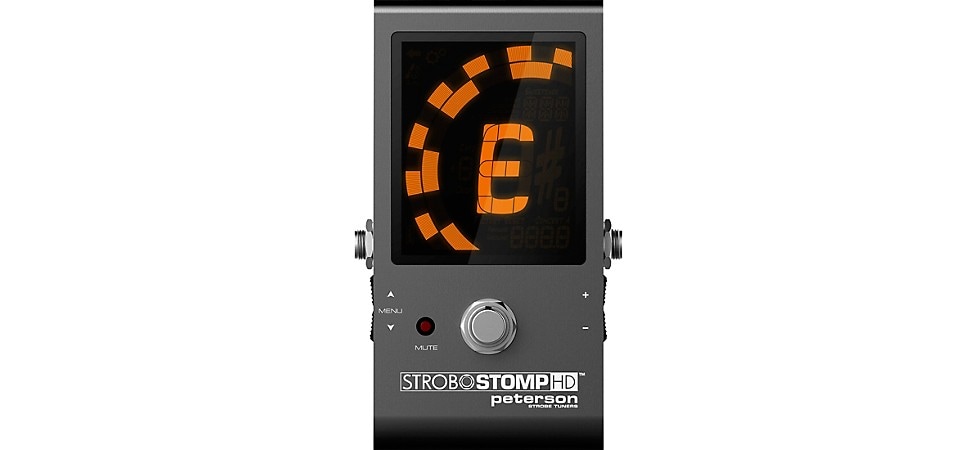
Virtual strobe technology delivers ±0.1-cent accuracy, with more than 100 Sweetened and Guided Tuning presets for a wide variety of instruments and alternate tunings.
-
A large high-definition display with adjustable backlight colors remains easy to follow under changing stage, studio and outdoor lighting conditions.
-
Worth considering for players and technicians who require precise intonation work, customizable tunings or selectable true-bypass, buffered and monitor (pitch always visible) modes.
Shop Now: Peterson StroboStomp HD Pedal Tuner
The Peterson StroboStomp HD tuner is a great plug 'n' play strobe tuner. There are a ton of hidden features in it, as well, which makes it one of the most versatile tuners here. The extensive manual is a must-read to access them, but it's definitely time well spent. With over 130 different tuning presets built in, some of which Peterson calls "Guided Tuning" for specific instruments and some "sweetened" tunings, as we discussed earlier, you can dial in extraordinary precision. It's even possible to create your own customized tunings with the free Peterson Connect app and the pedal's micro-USB port. The StroboStomp HD is switchable between true bypass, buffered bypass and a buffered bypass/monitor mode, which keeps the tuner display active while you're playing for those quick touchups. It does have a power passthrough when connected to an external power supply. There's also the StroboStomp Mini, for crowded pedalboards, which gives up that power passthrough, but retains almost the entire feature set of the HD version.
Bottom Line: If you're a gear geek who loves to tweak, this tuner will have you in tech heaven. Also if you do home setups and intonation, Peterson has been the guitar tech's standard on the road for decades.
Pigtronix 2NR Chromatic Pedal Tuner
What to Know:
-
Ultrafast pitch detection and an oversized, high-contrast LED display provide straightforward chromatic tuning for guitar and bass at concert A440 pitch.
-
Activating the tuner mutes the output, while relay-based true bypass keeps the pedal out of the signal path when tuning is disengaged.
-
A solid fit for players who prefer a single-purpose tuner without alternate modes, menus or additional setup steps.

Shop Now: Pigtronix 2NR Chromatic Pedal Tuner
If you're looking for a tuner that is just a tuner, the Pigtronix 2NR Chromatic tuner is quick, accurate and provides a larger, clean, colorful display that makes for a fast tuning experience. This pedal is true-bypass only, mutes while tuning, and is locked to the A440 tuning standard. With a minimum of bells and whistles, this just works, without distractions and hassle.
Walrus Audio Canvas Pedal Tuner
What to Know:
-
±0.1-cent accuracy and six selectable tuning modes support everything from quick stage checks to more detailed tuning adjustments.
-
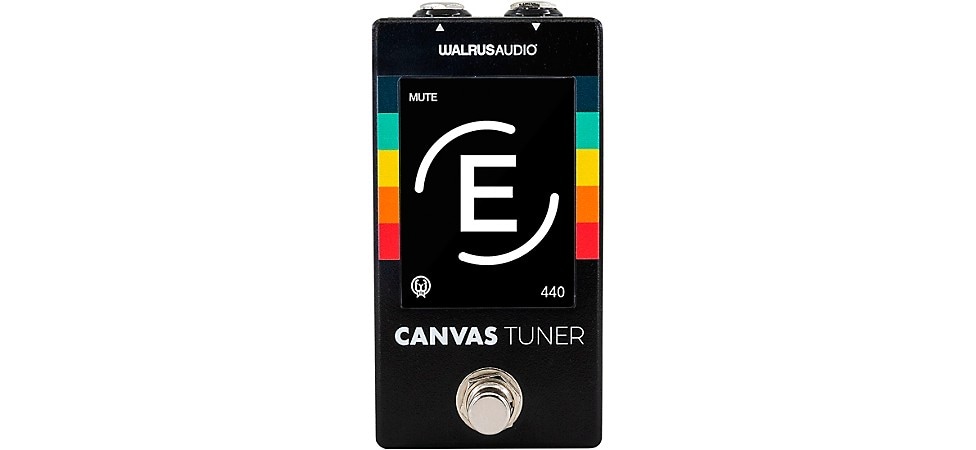
Bright 2.8" TFT LCD offers multiple screen orientations, allowing the pedal to sit vertically or horizontally according to available pedalboard space.
-
Useful for modern guitar and bass rigs that benefit from a wide tuning range, customizable displays and a choice of true-bypass or buffered operation.
Shop Now: Walrus Audio Canvas Pedal Tuner
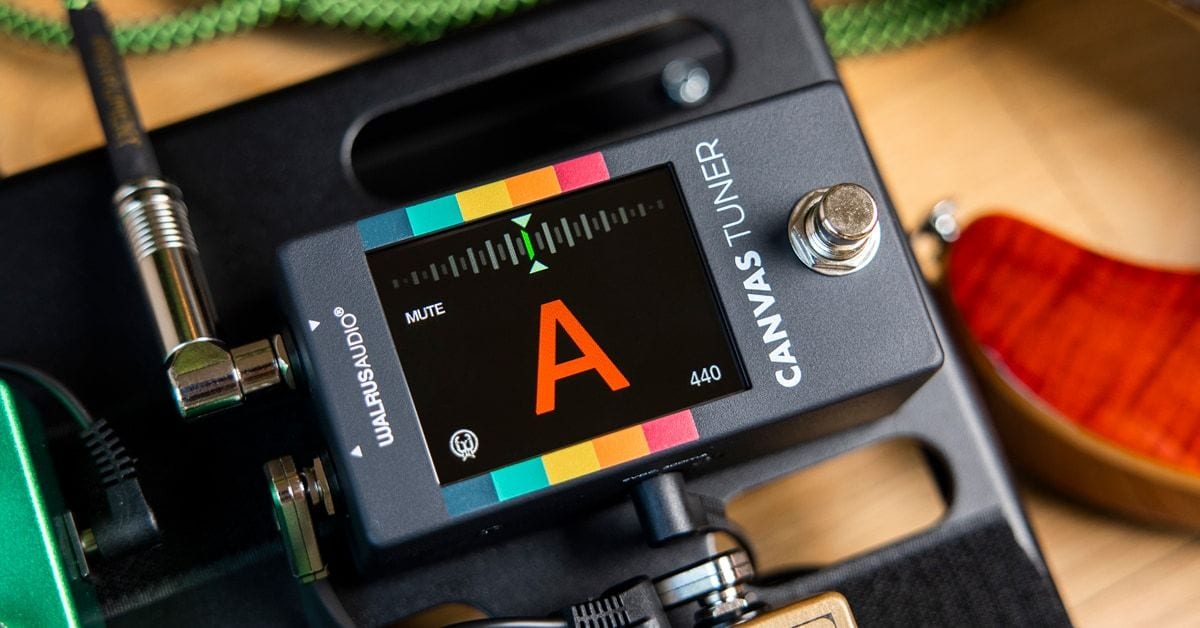
Walrus Audio spent a fair amount of time listening to their users when designing the Walrus Audio Canvas tuner pedal. This one has some unique features from the fun, but relatively trivial, ability to upload a personalized photo to your standby screen, to the ability to rotate the display, enabling the pedal to be used in vertical or horizontal orientation on your pedalboard. Switchable from "needle" mode to strobe mode, with tuning customizability, and with an exceptionally wide range of available tuning standards (from A390 to A490), Walrus really hit it out of the park with their very first tuner pedal. A quick caveat is that all the computing power for this needs a higher current draw than most tuners, so you will want to run this on a high current (300mA or greater) power supply.
TC Electronic PolyTune 3 Pedal Tuner
What to Know:
-
Polyphonic mode displays the tuning status of every string from a single strum, while chromatic and strobe modes provide focused, single-string adjustment.
-
Onboard Bonafide Buffer helps maintain signal clarity through long cables and larger pedalboards, with true-bypass operation also available.
-
A great fit for guitarists who want fast tuning checks between songs in a compact, pedalboard-friendly format.

Shop Now: TC Electronic PolyTune 3 Pedal Tuner
When TC Electronic debuted the PolyTune 3 tuner pedal it was a true breakthrough. The ability to just strum your open strings and instantly see how the guitar was in tune with itself made quick, mid-song tuning touchups incredibly quick and easy. The latest generation of the Polytune pedal features TC's Bonafide Buffer technology for a clean, clear signal, no matter how long your signal path, but retains the ability to switch to a true-bypass mode. The polyphonic mode is easily switched to a needle or strobe mode for when you need to concentrate on getting that one troublesome string locked in or touch up your intonation. The compact size is a plus for easy pedalboard placement.
Getting It All in Tune
Now you should be armed with the info you need to choose the best tuner for your needs. Before we go, though, we'd like to reiterate something we touched on earlier. A tuner is a tool, but it shouldn't be your only tool. Learning how to tune your guitar or bass by ear to an external reference tone (or to a tone in your head) is an important part of mastering your instrument. It feeds into refining your ear so you can recognize intervals more readily, which is an excellent musical skill to have, especially when, like many of us, you need to figure out chords and melodies on the fly. Tuners are seriously convenient, but they should supplement your ability to hear and listen, not replace it.
As always, if you have any questions about the pedals we've talked about here, drop into your local Guitar Center store, or dial up our call center and talk to one of our knowledgeable Gear Advisers to get even more of the info you need to make your final decision. And keep playing—the world always needs all the music it can get.
People Also Ask ...
Do Pedal Tuners Affect Tone?
As with so many things in life, the real answer is, "It depends." If you're running a lot of pedals and they're all true bypass, you'll add a little extra capacitance to the signal chain at the cost of a little high-frequency content. If you're running buffered, no, it shouldn't change your tone at all.
Are Strobe Tuners More Accurate?
Yes, strobe tuners are more accurate, though not to the extent that they used to be when tuners were strictly analog and used mechanical deflection meters (i.e. needles that physically moved). These digital days, it's more about the accuracy and scaling of the display than about the tolerances of analog components. That being said, strobe tuners are still the number one choice for guitar techs who are obsessive about accurate intonation.
Can I Tune a Bass With a Guitar Pedal Tuner?
Yup, sure can. Although you may have to use the 12th-fret harmonic (which assumes that your bass is properly intonated) to get a stable readout.
Can Polyphonic Tuners Work for 7- and 8-string Guitars?
Not when the tuner is in polyphonic mode. But in the single note tuning mode that this type of tuner always has, yes.
Can a Pedal Tuner Work With an Acoustic Guitar?
If it's a purely acoustic guitar, no. If it's an acoustic-electric, yes. Or, you can add a small mic to carry around in your case that will plug into the pedal tuner, but that seems a bit over-complicated, doesn't it?
Can I Change Tuning Standard on a Guitar Pedal Tuner?
Pretty much every contemporary guitar tuner pedal has the ability to change to tuning standards other than A=440Hz. How you do that will vary from tuner to tuner, but it tends to be either a single button to scroll through options or a pair of up and down arrow buttons.
Written By: George Van Wagner
George Van Wagner is a writer and editor for Guitar Center, where he has worked since 2007. A multi-instrumentalist, freelance recording engineer, arranger, composer, writer and all-around tech geek, he has over 30 years of experience in the musical instrument industry at companies like Midiman/M-Audio and Line 6, doing everything from customer service and writing user manuals to working in product development. He is currently gigging around Los Angeles with Gruppo Subconscious and Bobby “Hurricane” Spencer.
Recently Added to Buying Guides
Be the first to know about exclusive offers, tips and more.

866-498-7882 English
877-687-5402 Español