.jpeg)

Pro Gear Advisers
•866-498-7882
How to Decode Fender Serial Numbers

Every Fender guitar has a story to tell. The secret to unlocking that story lies in the serial numbers and date codes carefully stamped, written or etched into its form. Whether you’re a curious guitarist or a seasoned collector, decoding these markers can help you learn about when and where your guitar was made.
In this article, we’ll help you navigate the maze of Fender’s serialization practices, equipping you with the knowledge to understand how to date your Fender guitar or bass, so you can trace your instrument’s history with confidence and accuracy.

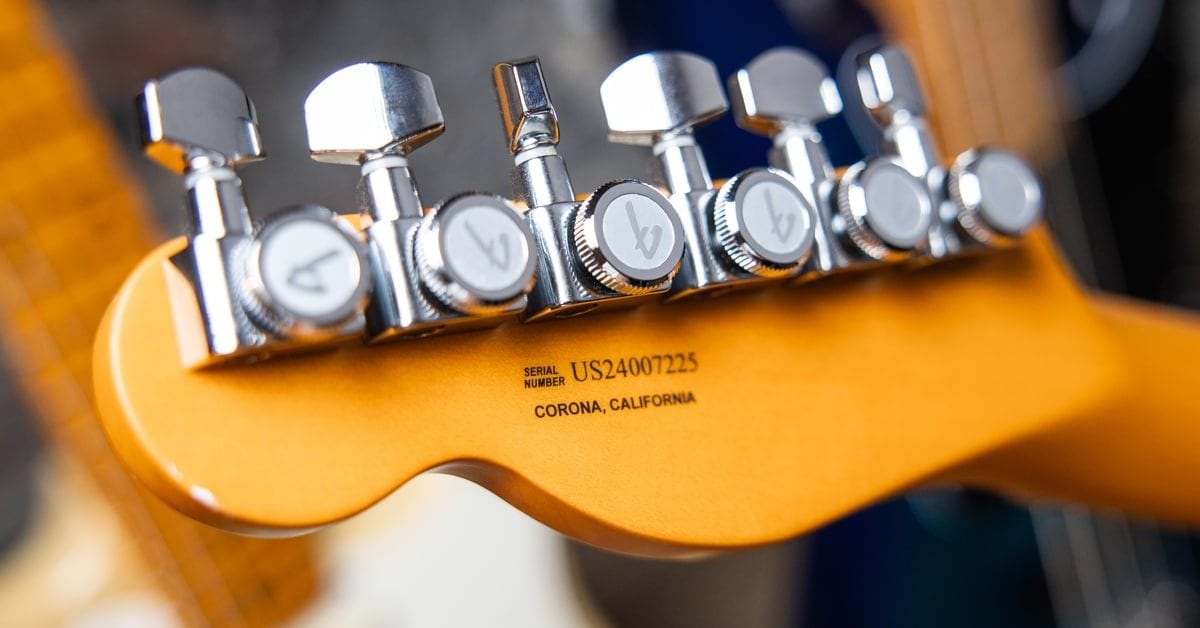
Pictured: Fender American Ultra II Telecaster Headstock
How to Decode a Fender Serial Number
We’ll delve into the specifics for these in the following sections, but first, we’ll go over the step-by-step basics. To estimate the age and origin of a Fender guitar or bass, here’s what you’ll want to do:
-
Find the serial number. Depending on the instrument and production era, it may appear on the bridge plate, neck plate, headstock or back of the neck near the body joint.
-
Identify the prefix or format. Look for letters such as L, S, E, N, Z, US, MX or a country-specific format.
-
Compare it with Fender’s general dating ranges. The prefix and following digits can often narrow the instrument to a production era.
-
Check Fender’s official serial number lookup. A match can provide useful model and production information, but the database may not contain every instrument.
-
Cross-check the result. Neck dates, body stamps, potentiometer codes, pickup markings, logos, hardware and construction details can help confirm—or challenge—the estimated date.
-
Treat the result as an estimate. This is especially important with vintage, CBS-era, modified, replacement-part and Japanese-made instruments.
Table of Contents
- How to Find Fender Serial Numbers and Date Codes
- Where Is the Serial Number on a Fender Guitar or Bass?
- Beyond the Serial: The World of Date Codes
- Putting the Puzzle Together
- How to Decode Fender Serial Numbers by Decade
- Serial Numbers by Letter Prefix
- Fender Serial Number Prefixes At-a-Glance Chart
- Fender Serial Numbers by Country of Manufacture
- U.S.-Made Fender Serial Numbers
- Mexican Fender Serial Numbers
- Japanese Fender Serial Numbers
- Other Fender and Squier Serial Numbers
- Filling the Gap: Early CBS Era Serial Numbers (1965–1976)
- Challenges Dating Fender Guitars Produced During the CBS Era
- Fender Serial Number Date Ranges
- Why It Matters
- Need Help Dating a Fender Guitar?
- Fender Serial Number FAQs
How to Find Fender Serial Numbers and Date Codes
The hunt for a Fender guitar’s origin starts with its serial number, but it doesn’t end there. Serial numbers provide a broad manufacturing window, while date codes narrow it down to specific weeks or months, offering a more precise timeline. Together, they paint a fuller picture of your instrument’s journey. We will add the caveat that, especially with the modular nature of Fender’s building process and the ease of players making their own modifications, dating a Fender guitar or bass leans more toward art than science. So, it’s important to gather all the other physical clues—date codes, feature specs for particular models and years, signs of previous mods, etc.—to get closer to a truly definitive answer for any individual guitar.
Where Is the Serial Number on a Fender Guitar or Bass?
Fender’s serial number placement evolved over the years, reflecting changes in production and design:
-
1950s–Early 1960s: Early Telecasters, Esquires and Precision Basses had serial numbers stamped on their bridge plates, a hallmark of Fender’s earliest years.
-
1960s–1970s: As Fender streamlined production, serial numbers moved to the neckplate, a transition that marked the rise of Fender’s golden era.
-
Post-1976: Fender shifted serial numbers to the headstock—typically on the front or back—a practice that continues today.
Beyond the Serial: The World of Date Codes
Serial numbers are just the beginning. Fender’s modular design often means necks and bodies were manufactured separately, making date codes an invaluable secondary clue:
-
Neck Pocket: Found on the heel of the neck, stamped or handwritten dates reveal when the neck was made. Accessing these requires removing the neck, a practice familiar to vintage enthusiasts.
-
Body Cavities: Hidden inside the pickup or control cavities, date codes here can help corroborate the timeline suggested by the neck.
-
Potentiometer Codes: Look to the volume and tone pots for codes like “137YYWW” (“YY” = year, “WW” = week). These dates don’t mark assembly but confirm when components were manufactured.

Pictured: Fender American Ultra II Telecaster Potentiometer Code
Putting the Puzzle Together
Fender’s modular construction philosophy often results in date mismatches between parts. Here’s how to make sense of it:
-
Match serial numbers with date codes for consistency.
-
Verify potentiometer codes to ensure the electronics fit the expected era.
-
Be mindful of replacement parts, especially those from the Fender Custom Shop, as they might replicate vintage serialization formats.
By examining serial numbers and date codes together, you can uncover not only your guitar’s manufacture date but also its unique place in Fender’s storied timeline.
How to Decode Fender Serial Numbers by Decade
Fender’s serial numbers offer a fascinating glimpse into the company’s history, but decoding them can be a challenge. Fender didn’t always follow a strict serialization system, and the modular nature of their designs adds to the complexity. Still, with the right guidance, you can decode your guitar’s serial number and narrow down its era of production.
Serial Numbers by Letter Prefix
In the mid-20th century, Fender introduced letter prefixes to help organize their serial numbers. Here’s a quick breakdown by era:
-
1950s: Early guitars and basses had no letter prefix, with serial numbers starting at #0001.
-
1960s: Fender began using the prefix “L” in the early 1960s, marking instruments from approximately 1963–1965.
-
1970s: The “S” prefix appeared, standing for the 1970s. “S6xxxxx” or similar codes often indicate late ’70s production.
-
1980s: The “E” prefix (“E” for ‘80s) became standard, starting around 1983. Our used and vintage maven, Jack Hetherington, points out this start date means that there are some early ’80s Fender instruments that still have the “S” prefix, so it’s necessary to look for other physical clues to positively date the instrument.
-
1990s: Fender adopted the “N” prefix, signifying the ‘90s, beginning in 1990.
Fender Serial Number Prefixes At-a-Glance Chart
|
Format |
General Era |
What to Know |
|
No prefix |
1950s–mid-1970s |
Found on many early bridge plates and neck plates |
|
L + digits |
Early–mid-1960s |
Commonly associated with instruments made around the transition from the pre-CBS to early CBS era |
|
S + digits |
1970s–early 1980s |
Often points to the 1970s, but some S-prefix instruments were completed in the early 1980s |
|
E + digits |
1980s |
Linked to 1980s instruments, although the prefix alone may not identify the exact year |
|
N + digits |
1990s |
Marked on U.S.-made Fender instruments from the 1990s |
|
Z + digits |
2000s |
Frequently found on U.S.-made Fender instruments from the 2000s |
|
US + digits |
Modern U.S. production |
Used on many later U.S.-made Fender instruments |
|
MX + digits |
Modern Mexican production |
Made in the Ensenada, Mexico factory |
|
Other letter formats |
Japanese production |
Multiple systems have been used, and letter ranges may overlap—“Made in Japan” and “Crafted in Japan” markings may be the cues |
Important: Prefixes provide a general production window, not a guaranteed assembly date. Always check the entire serial format and compare it with other physical evidence.

Pictured: Fender American Vintage II 1957 Stratocaster Neck Plate
Fender Serial Numbers by Country of Manufacture
Prefixes and formats vary by country, factory and production period. While the various formats don’t always make serial number decoding a cut-and-dry process, here are some pieces to the puzzle that may help contextualize your guitar’s manufacture.
U.S.-Made Fender Serial Numbers
Early U.S.-made Fender guitars and basses often used sequential numbers without a letter prefix. These numbers may appear on bridge plates or neck plates and should be cross referenced with neck dates, body details and period-correct hardware.
Letter prefixes became more common in later decades. L-, S-, E-, N- and Z-prefix formats are generally associated with broad production eras, while many newer U.S.-made instruments use serial numbers beginning with US.
Mexican Fender Serial Numbers
Many Fender instruments made in Mexico use serial numbers with prefixes that identify Mexican production, including formats beginning with M or MX.
Mexican Fender serial formats have changed across different periods, so you can’t run with the assumption that every digit works as a simple year code. Compare the complete serial number with Fender’s applicable dating information and verify that the model, logo, hardware and other specifications match the estimated period.
Japanese Fender Serial Numbers
Japanese-made Fender instruments require particular care because several serial systems have been used and some letter ranges overlap.
Look for the complete serial number as well as markings such as Made in Japan or Crafted in Japan. These markings, the serial-number location, the model designation and instrument specifications can help narrow the production period.
Other Fender and Squier Serial Numbers
Fender and Squier instruments have been produced in several countries, including Korea, China, Indonesia and India. Their serial formats may identify a factory, country, production year or production sequence, but there is no single decoding rule that covers every instrument.
Simply applying U.S.-made Fender prefix conventions to a Squier serial number won’t give you an accurate read. Start with the country-of-origin marking and complete serial format, then consult the relevant manufacturer resource. Model specifications, headstock logos, neck construction and hardware can provide additional confirmation.
Filling the Gap: Early CBS Era Serial Numbers (1965–1976)
When CBS purchased Fender in 1965, they inherited the “L-series” numbering system but quickly transitioned to a new sequential system without letter prefixes:
-
1965–1970: Serial numbers ranged approximately from 100,000 to 300,000. These were stamped on the neckplate and did not include letter prefixes.
-
1970–1976: Serial numbers progressed further, reaching into the 500,000 range by the mid-1970s. Still located on the neckplate, these numbers followed a sequential progression but lacked clear indicators of specific years.
Challenges Dating Fender Guitars Produced During the CBS Era
This period can be tricky for collectors because:
-
Serial Number Overlaps: There are overlaps between years, so pinpointing an exact year requires additional corroboration from date codes on the neck heel, potentiometers or body stamps.
-
Less Attention to Detail: CBS’s increased production volume led to less meticulous record keeping compared to Fender’s early days.
-
Neckplate Swaps: Modular production and the availability of replacement parts mean that neckplates alone aren’t always a reliable indicator.
Fender Serial Number Date Ranges
Fender’s serialization methods varied slightly depending on the production era and facility. Here’s a breakdown by specific date ranges:
-
1950–1954: Early serial numbers (up to #10,000) were stamped on the bridge plates.
-
1955–1965: Neckplate serial numbers began, progressing sequentially from #10,000 to over #100,000 by 1965.
-
1965–1970: Early CBS-era neckplate serial numbers ranged from approximately #100,000 to #300,000.
-
1970–1976: Serial numbers continued sequentially on neckplates, eventually reaching the #500,000 range.
-
1976–1983: Fender introduced headstock serial numbers, with a notable “76” prefix for some bicentennial models.
-
1984–present: Modern serial numbers follow more systematic patterns, often including year-specific prefixes.
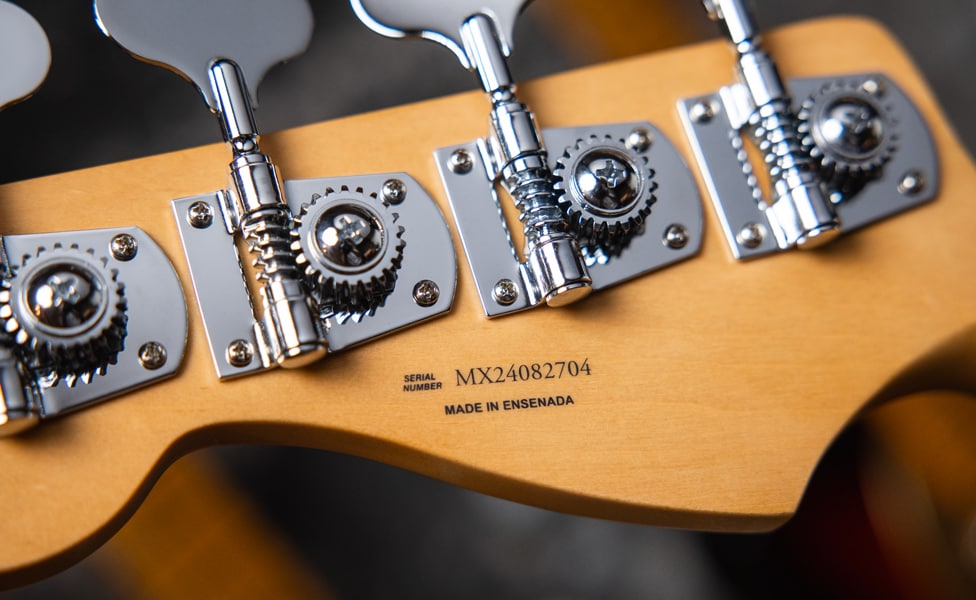
Pictured: Fender Player II Jazz Bass Headstock Serial Number
Why It Matters
Understanding serial number patterns helps validate your guitar’s authenticity and era. Keep in mind that Fender’s production in different locations (Fullerton, Corona, Ensenada, etc.) can also affect serial number conventions, so always cross-check with a trusted database.
Need Help Dating a Fender Guitar?
You should now have a pretty good basic understanding of how and where to find the serial number and date codes on your Fender guitar. But we understand if you're a little bit leery of starting to disassemble your favorite axe, especially if you've never done that before.
You should have no worries on that front. If it's something you're uncomfortable with, you can always rely on the skilled techs at Guitar Center Repairs to lend a hand in helping you ID your axe.
We'll add that if this article has piqued your interest, and you want to delve a little deeper into the arcane art of vintage guitar collecting, our Riffs articles on How to Buy a Vintage Fender Telecaster and How to Buy a Vintage Fender Stratocaster are well worth diving into.

Pictured: Fender American Vintage II 1957 Stratocaster Headstock
Fender Serial Number FAQs
If you need a little more detail, here are some of the most commonly asked questions about Fender serial numbers with quick answers to get you oriented in a snap.
Can I date a Fender by serial number only?
A serial number can usually provide a general production range, but it should not be treated as the only evidence of an exact date. Fender instruments use modular construction, and parts may have been made at different times or replaced later. Neck dates, body stamps, potentiometer codes, pickups, hardware and model features can provide additional confirmation.
Are Fender and Squier serial numbers formatted the same?
No. Fender and Squier instruments may use different serial systems depending on the factory, country and production period. A prefix used on a U.S.-made Fender should not interpreted the same way on a Squier, as Squier models have been produced in different—and more—countries than Fender instruments. For Squiers, begin with the country-of-origin marking
How can I find out when my American-made Fender instrument was manufactured?
To determine the production date of your American-made Fender, locate the serial number, which is typically found on the neck plate, headstock or bridge. You can use Fender’s Serial Number Lookup tool to get an approximate date. For a more precise date, consider checking the neck heel for a stamped or written date, though this may require professional assistance.
Where is the serial number located on Fender guitars?
The location of the serial number on Fender guitars has changed over the years. Depending on the model and production year, you might find it on the bridge plate (early 1950s), neck plate (mid-1950s to 1970s) or headstock (post-1976). Consulting Fender’s official resources can provide model-specific guidance.
How do I read a date code in the neck pocket of my Fender guitar?
The neck pocket, or heel, often contains a date stamp indicating when the neck was manufactured. This date can be written in various formats, such as “5 NOV 65” for November 5, 1965. Keep in mind that due to Fender’s production processes, the neck date may precede the final assembly date of the guitar.
Can potentiometer date codes help me date my Fender guitar?
Yes, potentiometer (pot) date codes can provide clues about your guitar’s age. These codes are usually stamped on the side of the pots and can indicate the week and year of manufacture. However, since pots could have been stored before use, their dates should be considered alongside other indicators like serial numbers and neck dates.
How do I find out when my Japanese-made Fender instrument was manufactured?
Japanese-made Fender instruments have serial numbers that can be decoded to determine their production period. These serial numbers are typically found on the back of the neck near the neck joint. Fender provides guidelines to help interpret these serial numbers.
For more detailed information, Fender’s Product Dating page offers comprehensive guides on dating instruments from various production regions.
Where can I get help dating a Fender guitar?
Removing a neck or accessing internal electronics can damage an instrument when done incorrectly. Sometimes it’s best to play it safe with a qualified technician who can help inspect serial numbers, neck dates, potentiometer codes and other identifying details. In addition to maintenance, modding and repairs, Guitar Center Repairs can assist with manufacture forensics.
Written By: George Van Wagner
George Van Wagner is a writer and editor for Guitar Center, where he has worked since 2007. A multi-instrumentalist, freelance recording engineer, arranger, composer, writer and all-around tech geek, he has over 30 years of experience in the musical instrument industry at companies like Midiman/M-Audio and Line 6, doing everything from customer service and writing user manuals to working in product development. He is currently gigging around Los Angeles with Gruppo Subconscious and Bobby “Hurricane” Spencer.
Be the first to know about exclusive offers, tips and more.

866-498-7882 English
877-687-5402 Español