

Pro Gear Advisers
•866-498-7882
Spotlight on the Guild Starfire Series
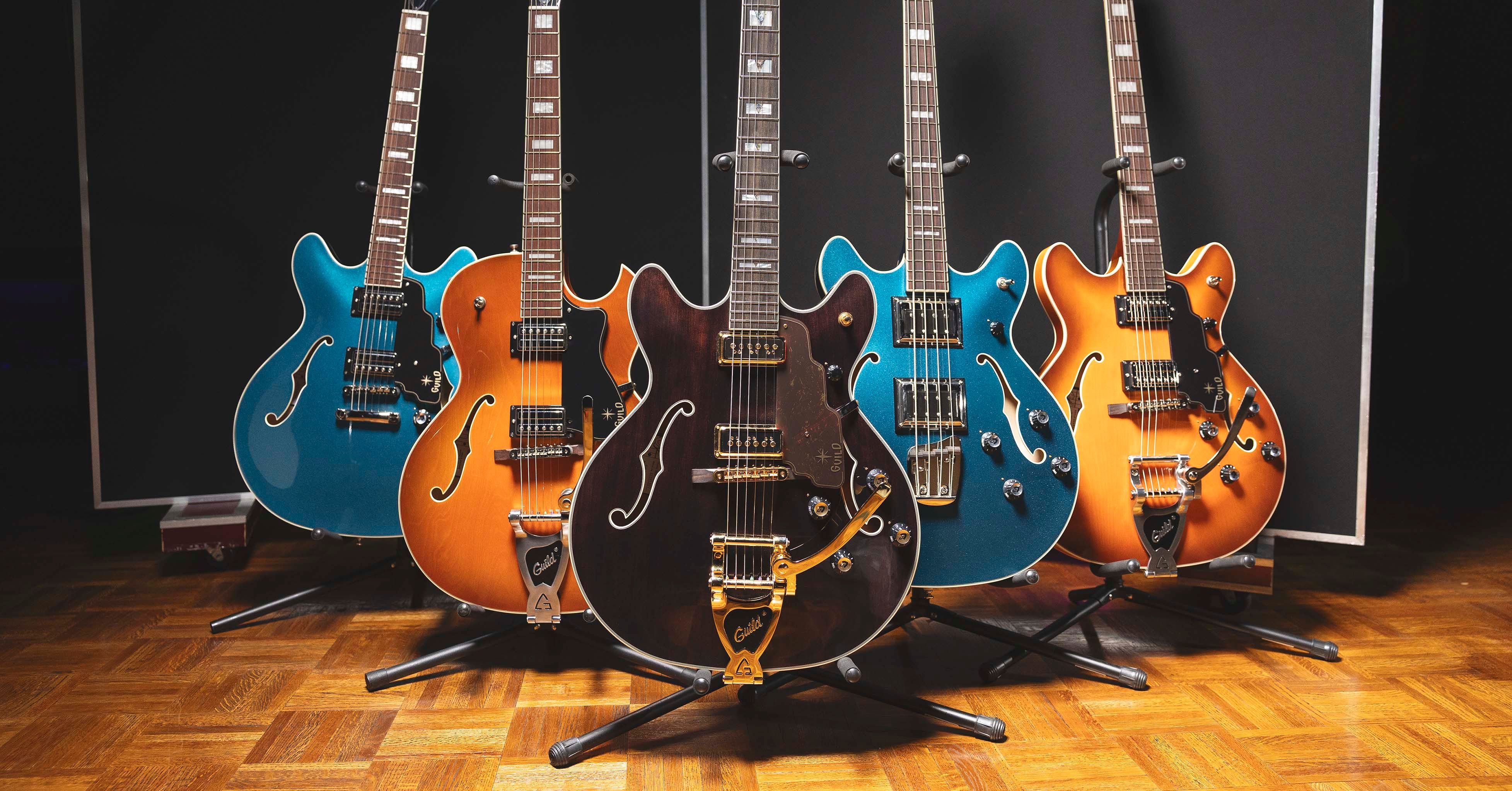

Though sometimes it may seem like Guild electric guitars can get lost in the shuffle, they've been some of the most interesting electric and acoustic guitars out there since their founding in 1952. The Guild Starfire Series is a prime example of where Guild has quietly been doing some of their best work.
Stalwarts during the 1960s, the Starfire Series has recently been revamped and, in this article, we'd like to give you a little historical background on Guild in general and the Starfire in particular, as well as look at what's with the new guitars and basses in the series.
Table of Contents
The History of the Guild Starfire Series
Guild Starfire Models
FAQs About the Guild Starfire Series
Conclusion
The History of Guild and the Starfire Series
The history of Guild Guitars starts with Epiphone's decision to move its production from New York City to Philadelphia. As there were a fair number of Epiphone's luthiers and builders who wanted to stay in the familiarity of their New York City neighborhood, former Epiphone Vice President George Mann decided to try and do something about that.
Mann approached Alfred “Al” Dronge, a guitarist, banjo player and former music store owner in New York, about the possibility of them starting a new guitar company, using the expertise of those now-unemployed but highly skilled Epiphone builders. Dronge agreed, and in 1952, they were joined by Gene Detgen, a sales manager at Pacific Music Supply and an old friend of Dronge's, and Guild Guitars was founded. The name, based on the old European guild system of craftsmen, was contributed by Detgen, who had rights to the name from a previous company.
For the first few years, Guild was best known for its full-depth hollowbody archtop guitars, with many well-known jazz guitarists of the time playing them, including guitar legends George Barnes, Barry Galbraith and Johnny Smith (who had his own Guild signature model). They had introduced a thinline, fully hollow guitar in 1954—the unique M-75 Aristocrat, built with no f-holes in its carved spruce top—but it wasn't until 1958 that they introduced more traditional thinline hollowbody archtops, first with the T-100 single-pickup and T-100D double-pickup models, and then with the entry-level Freshman M-65.
In 1960, Guild introduced the Starfire Series, with the Starfire I, a single-cutaway, single-pickup hollowbody; the Starfire II, a double-pickup version and the Starfire III, which added a Bigsby tailpiece. These instruments were, at first, T-100 and T-100D bodies with a new finish called Starfire Red, using the same laminated maple body as the T-100 models, but switching to a laminated mahogany (often in the wood known today as "sapele") body. The guitar was also available in green and black finishes, but as the Emerald Star and the Blackfire, rather than under the Starfire name.
It was in 1963 that the Starfire Series added a new double-cutaway semi-hollowbody model, the Starfire IV, which, like the Gibson ES-335 that may have inspired it, had a solid center block to reduce feedback and improve sustain. Guild historians have credited this and many of the other newer models that were aimed at the "youth" pop and rock market to Al Dronge's son, Mark Dronge, who had joined the company on graduating college in 1960.
There were also more deluxe versions, the Starfire V and Starfire VI, introduced that year and the next. These deluxe models added features like a master volume knob, higher-end Kolb tuners and a Guild-branded Bigsby vibrato tailpiece. A related guitar, a signature model for British guitarist Bert Weedon, was a fully hollow version of the Starfire V and is sometimes confused with being an official Starfire model. No matter how much we love Bert Weedon, it's not a Starfire, and that's perfectly normal.
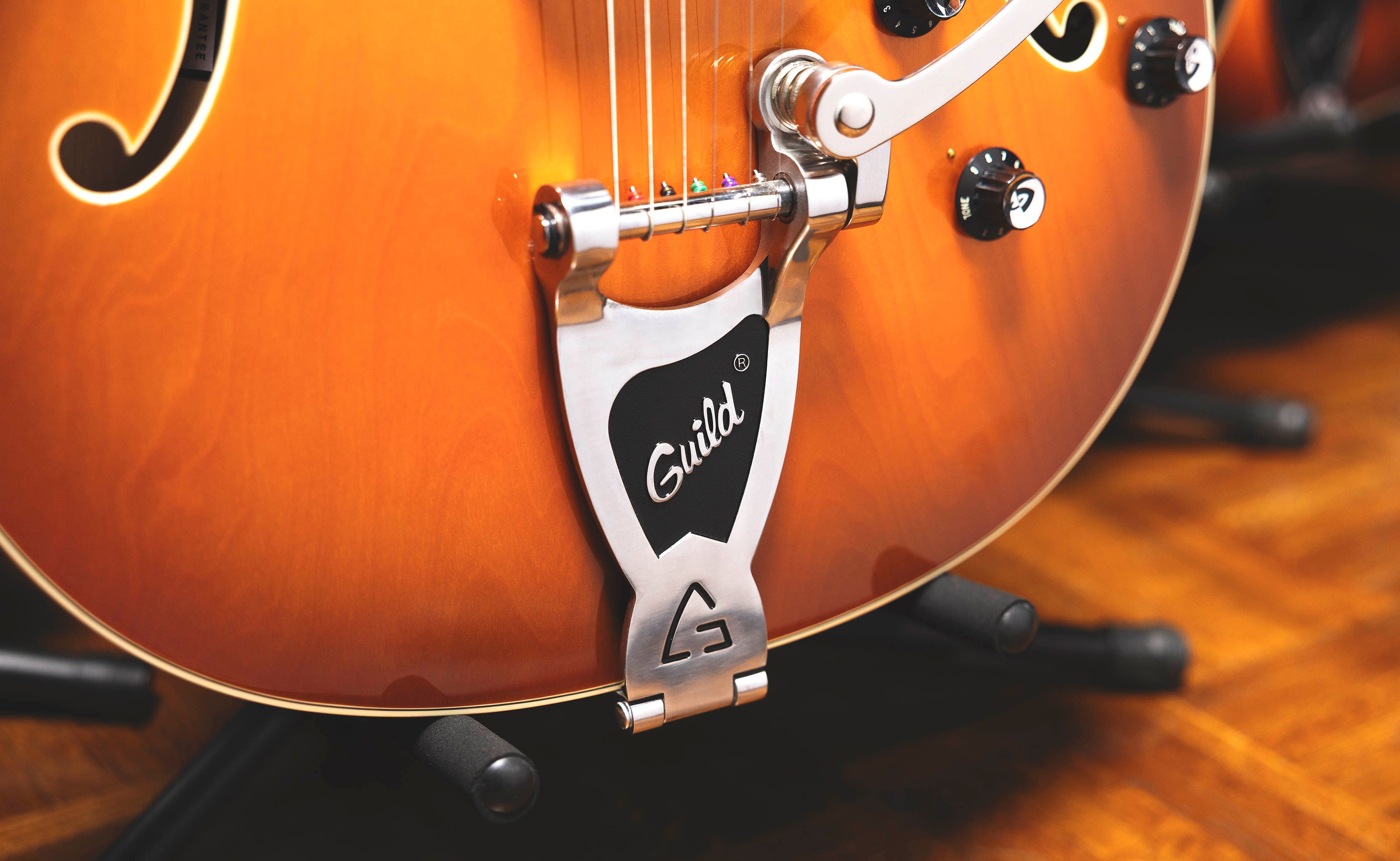
During this time period, Guild was also switching from the earlier DeArmond single-coil pickups (essentially the same as the Gretsch Dynasonic pickups, but with a white plastic bobbin instead of Gretsch's black one) to the new Guild mini "anti-hum" pickups and later full-size HB-1 humbucking pickups. As a side note, the HB-1s are often underrated these days, but I had a pair of them installed in an early 1970s custom build and would put them up against any of Gibson's T-Tops of the same period.
The original Starfire Series survived through Guild's purchase by Avnet and factory moves from Hoboken, New Jersey to Westerly, Rhode Island, staying in Guild's lineup until to the late 1970s. There was also a short-lived Starfire XII, a 12-string version, which is probably best known for being the guitar of choice for blues performer Robert Jr. Lockwood, Robert Johnson's stepson, on his Trix Records album Robert Jr. Lockwood Does 12.
Guild Starfire Models
Now that you know where we came from, let's take a look at where we are with Guild's new lineup of Starfire Series models.
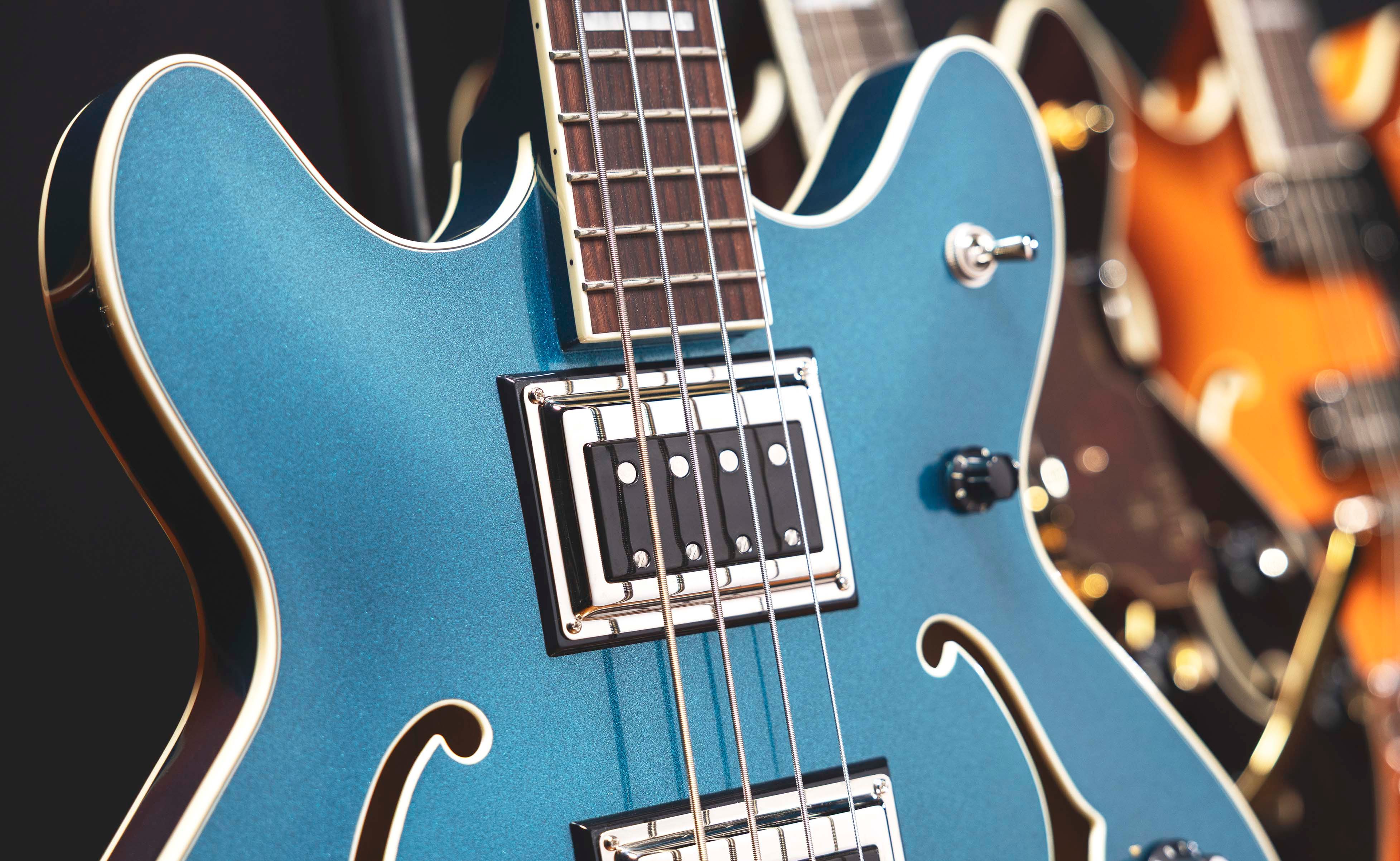
Guild’s refreshed Starfire lineup shares a basic idea: arched semi-hollow bodies with poplar center blocks. The block helps rein in feedback as stage volume rises while enhancing sustain and retaining some of the response that draws players to a hollowbody. From there, the instruments take different paths with pickup choices: DeArmond Dynasonics in the Custom, HB-2+ humbuckers in the Deluxe guitars and BS-1 BiSonics in the bass.
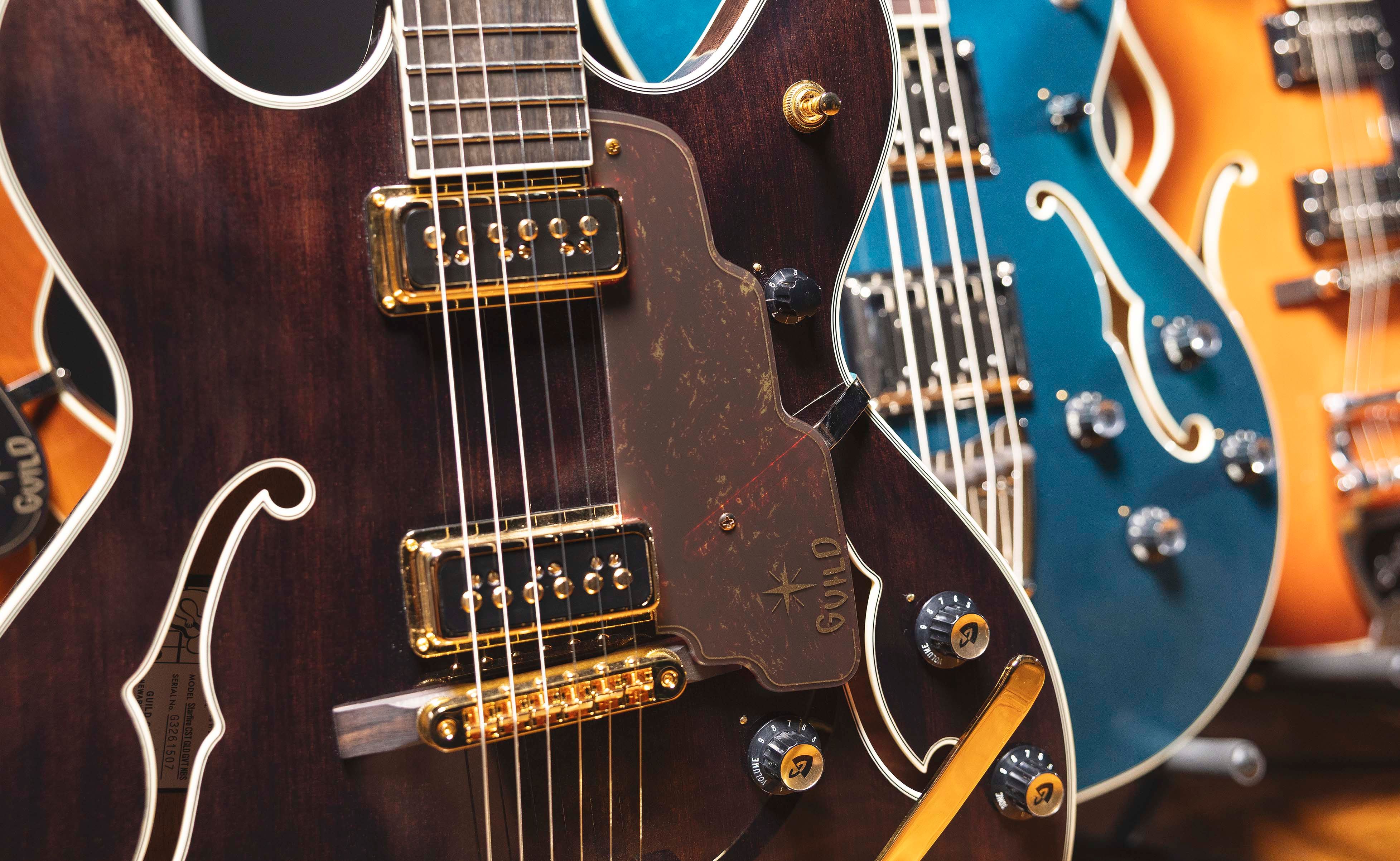
Guild Starfire Custom DC GVT Electric Guitar
What to Know:
-
The maple-bodied Custom DC GVT comes in Sweet Tea and Vintage White with nickel hardware. Gold-hardware GH versions come in maple-bodied Black Metallic and Teal the Deal, plus mahogany-bodied Nobel Stain.
-
Two DeArmond Dynasonics have individual volume and tone controls, a three-way selector and a master volume.
-
The 24-3/4"-scale, 22-fret ebony fingerboard has V-block inlays; the maple-bodied versions have a Guild Vibrato.

The Custom DC GVT is for the player who wants a Starfire with single-coil bite. Dynasonics put a crisp edge on the start of a note and keep busy chords distinct when the amp begins to grit up. Once you’ve found a balance between the pickups, the master volume lets you move the whole guitar forward or back without losing that mix. The GH models keep the same pickup arrangement while changing the hardware look; Nobel Stain also changes the body wood.
Guild Starfire Deluxe DC GVT
What to Know:
-
The Guild Vibrato-equipped GVT comes in maple-bodied Emerald Green, Honey Burst and Vintage Sterling, or mahogany-bodied Cherry.
-
The stop tailpiece Deluxe DC comes in maple-bodied Sweet Tea and Teal the Deal, or mahogany-bodied Nobel Stain.
-
Both versions have two Alnico II HB-2+ humbuckers, individual pickup volume and tone controls, a master volume and a 22-fret rosewood fingerboard.

The Starfire Deluxe DC GVT has a rounder, fuller attack than the Dynasonic-equipped Custom. Its useful choice is between tailpieces: The GVT puts small pitch inflections under your picking hand, while the Deluxe DC gives players who never reach for a vibrato arm a fixed tailpiece option. You get the same pickup and control arrangement either way, so that decision can come down to how you actually play.
Guild Starfire Deluxe SC GVT
What to Know:
-
Honey Burst and Vintage White have maple bodies; Cherry has a mahogany body. All three have a Guild Vibrato.
-
Two HB-2+ humbuckers with Alnico V magnets are selected by a three-way switch.
-
The 24-3/4"-scale rosewood fingerboard has 20 frets, and the neck meets the body at the 14th fret.

The single-cutaway Deluxe SC GVT recalls the outline of the earliest Starfires, but it also changes how this guitar asks to be played. Compared with the Deluxe DC, there’s a little less room to work high up the neck. For a player whose solos and fills tend to live in the middle register, that may be an easy trade for the single-cut shape. Its Alnico V pickups are another reason to approach it as its own guitar, rather than a Deluxe DC with one cutaway removed.
Guild Starfire Deluxe Bass
What to Know:
-
Sweet Tea and Teal the Deal are finish choices for the same maple-bodied bass.
-
The 30-3/4" scale and 22-fret rosewood fingerboard sit between familiar short-scale and 34" bass territory.
-
Two Guild BS-1 BiSonic single-coils have individual volume and tone controls, a three-way selector and a master volume.

The medium scale is part of Starfire Deluxe Bass’s appeal: The reach is shorter than on a 34" instrument, and the strings should feel a little more yielding at the same tuning and gauge. That can make moving lines and quick fills inviting without limiting the bass to those jobs. The BiSonics bring the fullness expected of a Starfire bass while keeping the front of the note clear enough for those parts to register.
FAQs About the Guild Starfire Series
When did Guild introduce the Starfire?
Guild introduced the first Starfires in 1960. The original single-cutaway guitars were hollow; the double-cutaway, center-block Starfire IV followed in 1963.
Are Guild Starfires hollow or semi-hollow?
It depends on the model and era. The early single-cutaway Starfires were fully hollow, while later double-cutaway models used center blocks. All four models in this refreshed lineup are semi-hollow with poplar center blocks.
What does GVT mean on a Starfire?
GVT stands for Guild Vibrato Tailpiece. It distinguishes the vibrato-equipped Deluxe DC GVT from the stop-tailpiece Deluxe DC.
Did Guild make a 12-string Starfire?
Yes. The Starfire XII was an electric 12-string, though it isn’t part of this refresh.
Is the Starfire Deluxe Bass short-scale?
Guild specifies a 30-3/4" scale. That’s shorter than a standard 34" bass, but a little longer than the 30" scale commonly meant by “short scale.”
What well-known players have used a Starfire?
Dave Davies, Tom Fogerty of Creedence Clearwater Revival, Buddy Guy and Jerry Garcia are among the guitarists associated with Starfires. John Lennon and Robert Jr. Lockwood used Starfire XIIs, while Jack Casady and Phil Lesh helped put Starfire basses on the map.
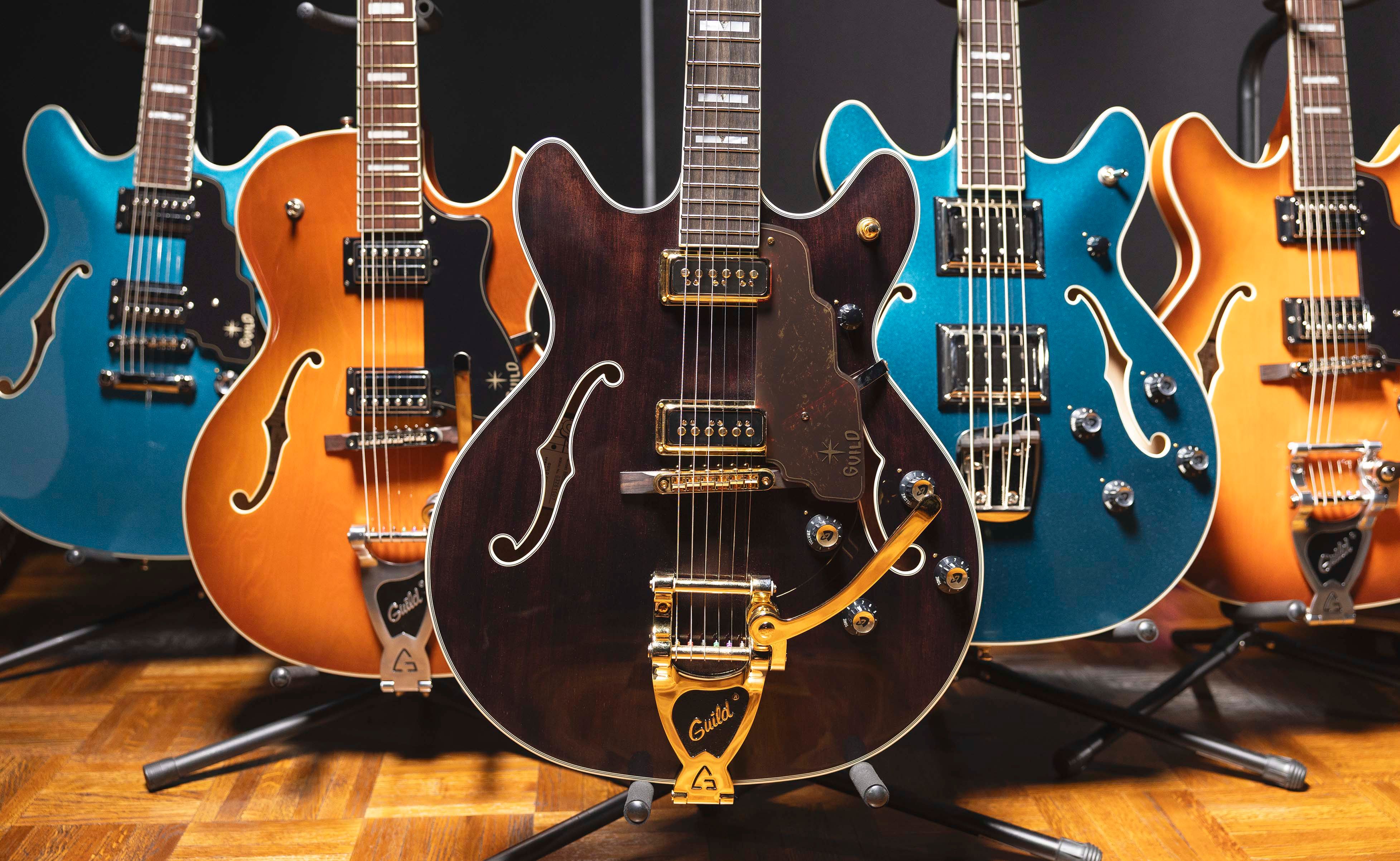
Pictured: Guild Starfire Guitars and Bass
Conclusion
We hope you've enjoyed this look at a little bit of Guild's history and the Guild Starfire Series. If you've been looking for a semi-hollow electric guitar or bass that gives you the versatility and tone this style of instrument is known for, the Guild Starfire is a great choice—especially if you're one of those players who doesn't always follow the crowd.
With the ability to cover almost any genre of music where an electric guitar or bass is the required tool, you'll definitely want to get to your local Guitar Center and check these out. If you're having trouble making up your mind about which model is right for you, it's certainly worth a chat with your personal Gear Adviser to get some perspective about the choice that will best fit your needs.
Written By: George Van Wagner
George Van Wagner is a writer and editor for Guitar Center, where he has worked since 2007. A multi-instrumentalist, freelance recording engineer, arranger, composer, writer and all-around tech geek, he has over 30 years of experience in the musical instrument industry at companies like Midiman/M-Audio and Line 6, doing everything from customer service and writing user manuals to working in product development. He is currently gigging around Los Angeles with Gruppo Subconscious and Bobby “Hurricane” Spencer.
Recently Added to Buying Guides
Be the first to know about exclusive offers, tips and more.

866-498-7882 English
877-687-5402 Español