


StudioMonitorsMixing
.jpeg)

Pro Gear Advisers
•866-498-7882
Guitars
Guitars
Amps & Effects
Amps & Effects
Used & Vintage
Keyboards & MIDI
Keyboards & MIDI
Drums
Drums
DJ Equipment
DJ Equipment
Basses
Basses
Recording
Recording
Live Sound
Live Sound
Accessories
Accessories
Mics & Wireless
Mics & Wireless
Music Software
Music Software
Lighting
Lighting
- Popular Brands
Band & Orchestra
Band & Orchestra
Platinum Gear
Deals
Deals
New Arrivals
Rupert Neve Designs INDUCTOR EQ 500 SERIES
$999.00
6-month special financing^ + $49 back in Rewards** Limited time Learn More
Lease-To-Own Purchase OptionsLearn more

Protect your gearLearn more
Cover drops, spills or cracks with Pro Coverage

Need Help?
Description
The world’s most natural feedback reduction.
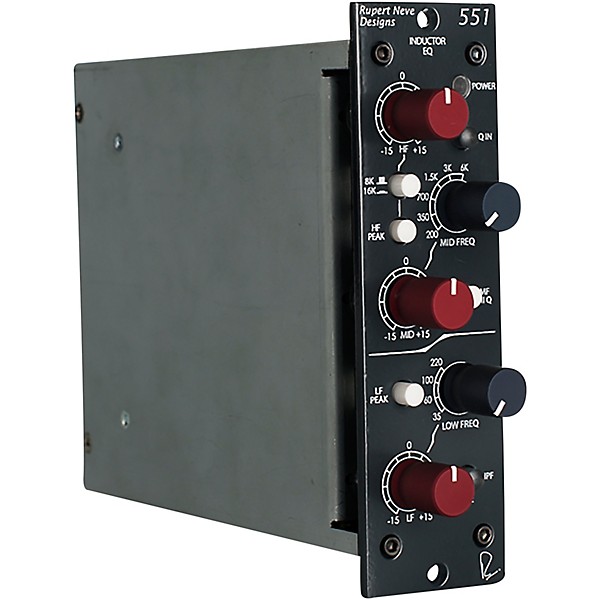
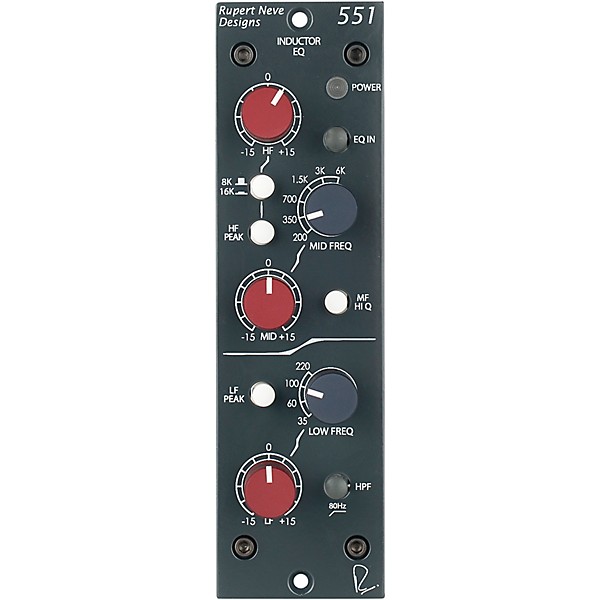
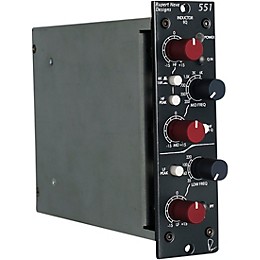
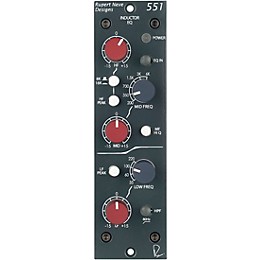
The 551 is the only equalizer for the 500 Series actually designed by Rupert Neve. Featuring 3 bands of EQ inspired by Mr. Neve’s most prized vintage designs, along with custom-wound inductors, transformers and class-A gain blocks, the 551 brings the thick, powerful lows and sweet highs of Rupert’s classics to the 500-Series format.
The 551’s 3-band, custom-tapped inductor EQ was inspired by elements of Rupert’s vintage EQ designs. The low frequency band is designed to produce a creamy, resonant bass response similar to a vintage 1064 – but unlike the vintage modules, the LF band on the 551 can be used as either a shelf or a peak filter, adding punch, dimension, and control to your low end.
The midrange band is based on that of the 1073, ideal for sweetening vocals and instruments while bringing them forward in a mix, and its proportional “Q” response makes it well-suited for minimizing problematic frequencies. The high frequency band is a hybrid vintage / modern design, blending inductor circuitry with capacitor-based topologies to achieve vintage tones with enhanced control. The High Pass filter is a 12dB/octave design with a fixed 80Hz frequency, and can be used in tandem with the low frequency EQ to add low-end presence without clouding the source material.
As with Rupert’s most prized classic designs, each EQ section uses low-feedback, class-A discrete electronics to prevent low-level artifacts and harshness from detracting from the tonal shaping. However, this new circuit is a decidedly modern design with updated techniques and components that were simply not available 50 years ago, and is definitely not a “clone”.
What Are Inductors?
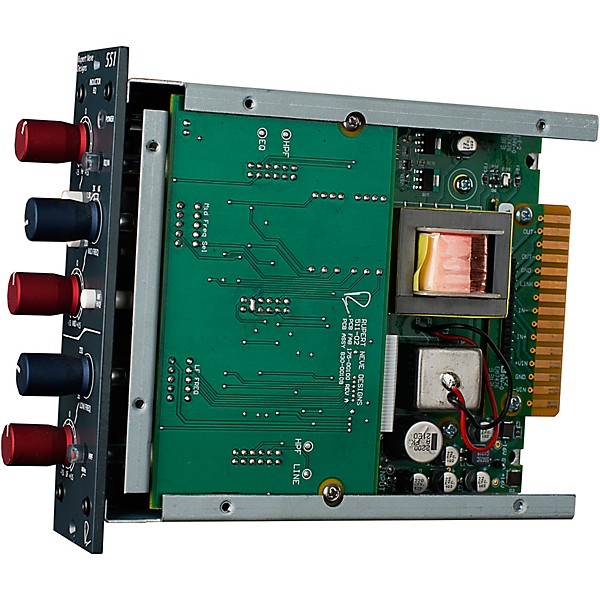
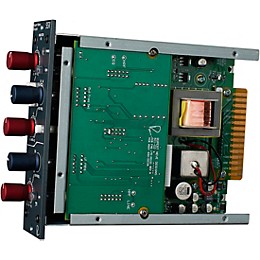
Inductors are wires wound around a coil that provide a form of frequency-dependant resistance. When they saturate, they bring out beautifully musical harmonics that give your tracks the smooth, polished sound that has made Rupert’s consoles and equipment so desirable for over fifty years. This is what makes them different from capacitor-based EQ designs, which do a great job at surgical equalization. But inductors provide the tone.
While it is certainly possible to create a functioning EQ using off-the-shelf inductors, we choose to use our own custom inductors for the 551. This attention to detail in controlling variables such as the winding and core materials in relation to the surrounding circuitry allows the 551 to capture the vitality and personality of Rupert’s classic designs.
The 551 is the only equalizer for the 500 Series actually designed by Rupert Neve. Featuring 3 bands of EQ inspired by Mr. Neve’s most prized vintage designs, along with custom-wound inductors, transformers and class-A gain blocks, the 551 brings the thick, powerful lows and sweet highs of Rupert’s classics to the 500-Series format.
The 551’s 3-band, custom-tapped inductor EQ was inspired by elements of Rupert’s vintage EQ designs. The low frequency band is designed to produce a creamy, resonant bass response similar to a vintage 1064 – but unlike the vintage modules, the LF band on the 551 can be used as either a shelf or a peak filter, adding punch, dimension, and control to your low end.
The midrange band is based on that of the 1073, ideal for sweetening vocals and instruments while bringing them forward in a mix, and its proportional “Q” response makes it well-suited for minimizing problematic frequencies. The high frequency band is a hybrid vintage / modern design, blending inductor circuitry with capacitor-based topologies to achieve vintage tones with enhanced control. The High Pass filter is a 12dB/octave design with a fixed 80Hz frequency, and can be used in tandem with the low frequency EQ to add low-end presence without clouding the source material.
As with Rupert’s most prized classic designs, each EQ section uses low-feedback, class-A discrete electronics to prevent low-level artifacts and harshness from detracting from the tonal shaping. However, this new circuit is a decidedly modern design with updated techniques and components that were simply not available 50 years ago, and is definitely not a “clone”.
What Are Inductors?
Inductors are wires wound around a coil that provide a form of frequency-dependant resistance. When they saturate, they bring out beautifully musical harmonics that give your tracks the smooth, polished sound that has made Rupert’s consoles and equipment so desirable for over fifty years. This is what makes them different from capacitor-based EQ designs, which do a great job at surgical equalization. But inductors provide the tone.
While it is certainly possible to create a functioning EQ using off-the-shelf inductors, we choose to use our own custom inductors for the 551. This attention to detail in controlling variables such as the winding and core materials in relation to the surrounding circuitry allows the 551 to capture the vitality and personality of Rupert’s classic designs.
Features
Included
- User manual
- Recall sheet
- 'Quick Start' video
- Equalizer bypassed
Specs
Equalizer bypassed
Power requirements
Measured at Main Output, un-weighted, 22Hz-22kHz, source impedance 40 Ohm balanced.- Better than -102 dBV
Main output, no load: +/- 0.1 dBu from 20 Hz to 31.5 kHz, -1 dB @ 120 kHz
23.25 dBu
@ 1 kHz, +20 dBu output level, no load: Better than 0.0025%- @ 20 Hz, +20 dBu output level, no load: 0.13% Typical (2nd and 3rd harmonic)
-2.7 dB @ 80 Hz- Slope: 12 dB/Octave
Measured at Main Output, un-weighted, 22 Hz - 22 kHz, source impedance 40 Ohm balanced.- Better than -94 dBV
Main output, no load: +/- 0.25 dBu from 20 Hz to 45 kHz, -2 dB @ 120 kHz
23 dBu
@ 1 kHz, +20 dBu output level, no load: Better than 0.009%- @ 20 Hz, +20 dBu output level, no load: 0.13% Typical (2nd and 3rd harmonic)
Power requirements
120mA on +16VDC- 110ma on -16VDC
Featured Articles
Reviews
Be the first to review the Product
Q&A
Have a question about this product? Our expert Gear Advisers have the answers.
No results but…
You can be the first to ask a new question.
It may be Answered within 48 hours.
Be the first to know about exclusive offers, tips and more.

866-498-7882 English
877-687-5402 Español