

Pro Gear Advisers
•866-498-7882
Meet Guitar Center’s Drum-Off 2026 Finalists

America’s ultimate “get your groove on” competition, the Guitar Center Drum-Off, returns August 20, at the Fonda Theater in Los Angeles. Launched in 1988, the national contest celebrated drums and drummers for 28 consecutive years before its temporary retirement after the 2016 event.
But now it’s back, and back with a thunderous drum roll.
Six talented drummers—who played their hearts out to triumph over more than 2,600 total submissions—reached the finals to compete in front of a judging panel filled with legendary players to vie for the Drum-Off 2026 title.
The six finalists are Michael-Andrew Cornish (Stockton, California), Christopher “CJ” Darden (Lillington, North Carolina), Jonathan Fortson (Hamilton, Alabama), Mitch Gorman (Antioch, Illinois), Caleb Robinson (Lansing, Michigan) and Jake Ward (Provo, Utah).
Cornish, Darden, Fortson, Gorman, Robinson and Ward will be judged for their technique, groove, creativity and stage presence. The top prize for the winner includes $25,000 in cash, a brand endorsement deal, a complete drum and cymbal rig, a Roland electronic drum kit and a content creation gig at Drumeo headquarters in British Columbia, Canada.
But first, they’ll have to impress formidable drum icons, such as Josh Freese, Tré Cool, Pocket Queen, Adrian Young, Alex González, Brad Wilk and a bevy of other judges.
Interviews With the Drum-Off 2026 Finalists
Before they grab their sticks and hit the skins (and cymbals) on August 20, we’d like you to get to know each of the finalists a bit. We compiled a list of questions so they can share their thoughts about drummers, drumming, techniques, approaching the big moment onstage and more.
When and how did you learn Guitar Center’s Drum-Off was back, and what prompted you to enter the competition?
Michael-Andrew Cornish: I was just scrolling through Instagram and I saw it was announced. Initially, I wasn't even going to sign up. But my mom also noticed it, and she sent it to me. She was like, “Hey, did you check this out?” I told her I wasn’t going to do it, and she said, “Why not?” So, if it wasn't for my mom, I would not be in this contest. So, shout out to Dorcas Jean Crear.
Christopher “CJ” Darden: I got a call from a friend of mine, so shout out to Dean, because without him, this wouldn't even be a thing right now. He told me Drum-Off was back, and I didn't believe him. I thought he was joking, because who would have thought Drum-Off was coming back? Even then, I wasn't too interested in doing the competition. But for some reason, something kept pressing me to submit a video. I even waited until the very last day—around 9 p.m. or 10 p.m.—to send it. And here we are today.
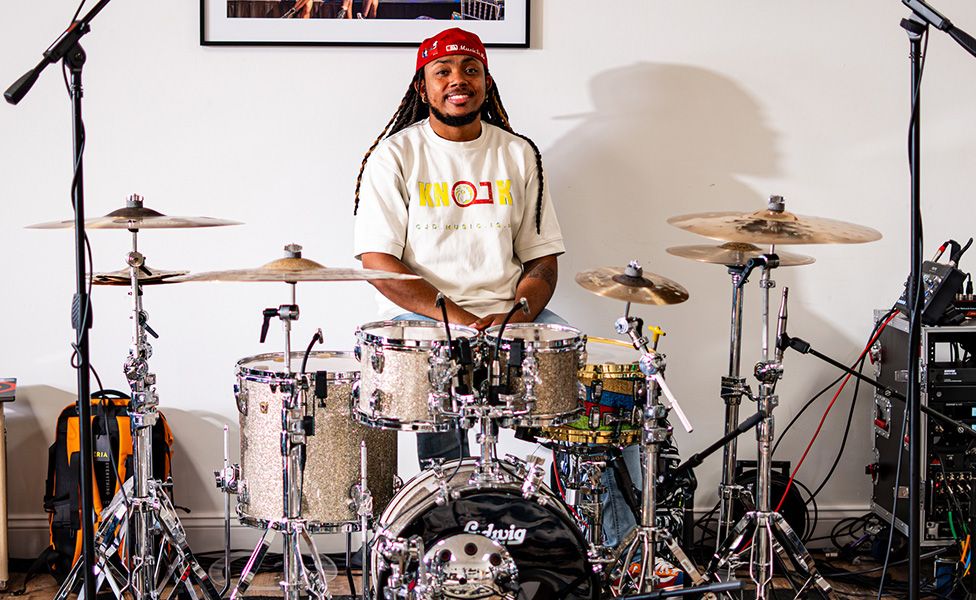
Pictured: Christopher "CJ" Darden
Jonathan Fortson: A couple of my friends on Instagram tagged me in the videos Guitar Center posted on social media. But I was like, “Man, I don't know if I'm going to do this. There are so many great drummers now.” But something told me to just go ahead and do it. I thought about it, and then I was like, “Well, what do you have to lose?” I submitted a video, and now I’m here, so I must be doing something right.
Mitch Gorman: A friend of mine sent me a DM about Drum-Off, saying “Hey, dude, you should enter this.” My first thought was it was a spam post, because it has been so long since Drum-Off was a thing. I wondered if I’d see something on Guitar Center's official page saying, “This is not real. Don’t listen to this guy.” Well, it ended up being real and here I am. There’s obviously a high-stakes feel to Drum-Off, but it’s also so fun to meet new drummers and see what they bring to the table. The fact I'm in the top six is actually blowing my mind right now.
Caleb Robinson: I always knew about the Guitar Center Drum-Off. I watched videos featuring the 2003 Drum-Off champion Eric Moore II a lot, and I knew one of my favorite drummers, Thomas Pridgen, had won it in 1992, when he was just nine years old. But what really piqued my interest of getting into the competition was that Eugene McBride and Anthony Burns made the Drum-Off finals in the 2000s. I'm from Flint, Michigan, and so is Eugene, and my guy Anthony is from Saginaw, Michigan. So, being able to actually be close to them and what they did really inspired me to go into the Drum-Off this year.
Jake Ward: I first learned about Drum-Off coming back when I walked into a Guitar Center one day to find a few pairs of sticks. I didn't give much thought to it at the time, because I didn’t feel I’d get the votes to make it to the next round. But my dear sweet wife is the one who prompted me to enter the competition. She heard it was a great opportunity, and she really pushed me to do it. If it had not been for her, I would not be where I am now in the competition.
What has been your strategy to get the judges to notice your performance over those of the other competitors?
Darden: My strategy, honestly, has been taking God with me in every aspect of the competition. Even outside of Drum-Off, when I play, I always make sure God is in the forefront of what I'm doing, because without him, there's no me. Without him, there's no gift. I'm very aware of that. I do practice and I take my craft seriously. But there's nothing like having the man upstairs with me while I’m playing, because the ability, capability and thought process that occurs in real time and in the heat of the moment sometimes can’t be duplicated nor explained without him.
Gorman: My strategy for all of my drum solo arrangements is simply to keep people engaged. Whether they are drummers, guitarists or non-players—no matter who is in the audience, I want to do anything and everything I can to keep them engaged in any way possible. I like to offer lots of dynamics, crazy showmanship and really engaging transitions that keep people guessing.
Robinson: It’s making sure I have stage presence, because it's really easy for musicians to close our eyes, zone out and get into another realm. But, in the gig scene, I think people want to be included, so even just looking at the audience, smiling at them and doing things that are unique to me are important. I also want to make sure I tell a good story with peaks and valleys, so the solo isn't just straight bang-bang-bang-bang-bang. It should be like a movie or a book. It might start off hot, but then it slows, you get into the backstory and everything starts making sense. I want to keep the judges and audience involved by having different types of stories and lanes they can flow through.
Ward: Something I've done to try to grab a judge's attention is to think melodically behind the drum set. I think a lot of drummers have an enormous amount of chops and the ability to fly around the drums quickly and cleverly. That is very important. But I think what can create a moment for both the judges and the audience to remember is to latch on to thinking melodically—whether it’s playing a repeating phrase or a familiar rhythm. I think that helps the audience join with you.
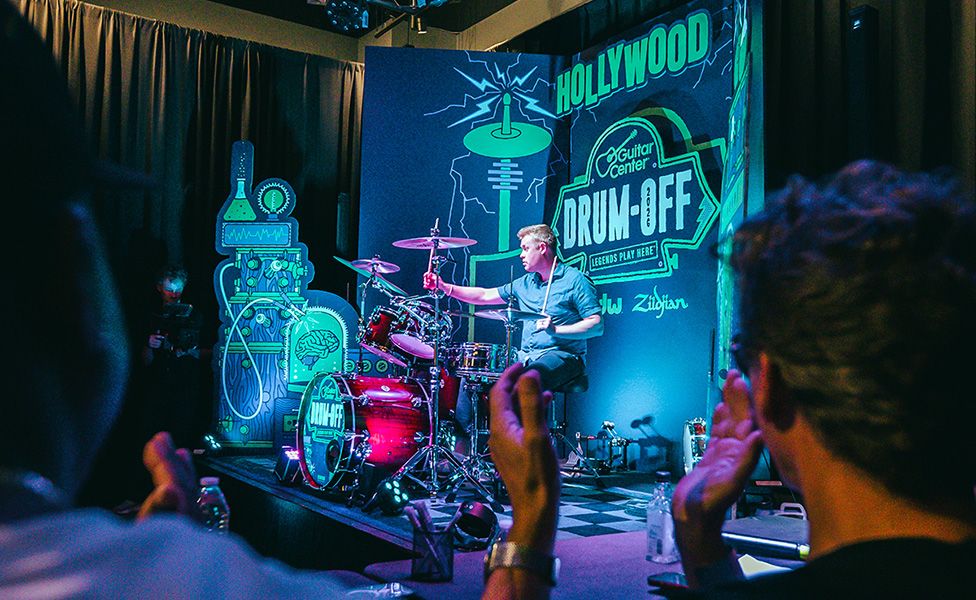
Pictured: Jake Ward at the 2026 Drum-Off Regionals in Hollywood
Describe your practice regiment to prep for Guitar Center’s Drum-Off.
Darden: Practice regimens. I didn't really have any starting out, because, again, this was really an act of faith—talking to God and asking him to guide me in what I should do. But as time started going on, I tried to think like a chameleon to show how versatile I can be and not appear like a one-dimensional drummer to the judges. Through praying, talking and studying, I've been watching other genres to incorporate a variety—or a pot of gumbo, if you will—into my performances. That has been my strategy throughout the previous rounds of the competition.
Fortson: Of course, I practice and try to build into all of that stuff. But mainly, my [practice] strategy is telling my story the best way I can and playing from my heart.
Gorman: My goal anytime I'm in the practice room is two very simple things. Number one is fundamentals—such as, “Am I still holding the sticks right and still playing the drums in the most ergonomic way possible?” I want to avoid injury in the short term and not ingrain any bad habits in the long term. Number two—which I think is the most important thing—is to always challenge yourself. Never get complacent. Never think to yourself, “I feel like I've learned everything. Now I'm bored.” The moment you think like that is the moment you are letting yourself down. That’s the moment you are going to settle for less and worse.
Robinson: All musicians are athletes, but especially drummers. Drummers use all of their limbs, finger and core muscles, forearms, quads, calves and so on. To prepare for Drum-Off, I've been hitting the gym a little bit more, because I have some crazy parts in my solo. I know I can pull it off, but it's one thing just pulling something off versus being able to do it in my sleep. So, I’ve been really focusing on strengthening specific muscles. When I play that solo, I want it to be easy.
Ward: In preparation for the Drum-Off, I've been practicing a lot of certain patterns and licks that may not be the most clean. I’m trying to make those things part of my vocabulary and then practicing shutting off my brain and just flowing. I don’t want to force certain licks to come out, because if you try and force them, they end up sounding bad. I'm also practicing them in every style I could possibly go to during my solo. Finally, I’m practicing how to form a theme and make the drum solo melodic.
Who is your favorite drummer of all time and why?
Cornish: Thomas Lang was pretty much like a drummer idol when I was younger, but my favorite drummer right now is Xavier Ware. The guy is absolutely crazy. I’ve never heard someone not only play chops but also groove right on the money. He's on it. That dude can play.
Darden: That is a tough one, because I studied a lot of drummers growing up. But if I had to pick one right this second, it would have to be CJ Thompson. Huge shout out to him. He's literally a producer's drummer. He's able to take off when needed, but he's also able to stay in his lane and play the parts that are asked of him.
Fortson: My favorite drummer of all time, hands down, is Dennis Chambers. I love the way he approaches the drums, and how he executes everything he does. His drumming has been inspirational to me ever since I saw the Coming Ground: Inspiration instructional video on VHS tape. That tape changed my life. I mean, come on, for a lot of drummers, he's the blueprint for why we sound the way we sound.
Gorman: One of the biggest influences who inspired me to pick up drum sticks for the first time was Michael Shrieve, who was drumming for Santana at Woodstock. He did the most mind-blowing drum solo during “Soul Sacrifice.” I mean, he made a three-piece kit sound like it was a 100-piece kit. That was the moment I said to myself, “I don't know when, but I am going to pick up this instrument, because this is too dang cool.” From there, John Bonham, Buddy Rich, Tony Royster Jr., Eric Moore, Chris Coleman, Aaron Spears, Marvin McQuitty, Teddy Campbell, Ray Luzier, Thomas Lang, Matt Halpern and Matt Garstka.
Robinson: The guy I will mention for today is Thomas Pridgen, because when I was in middle school and high school, he was playing with the Mars Volta and The Memorials. I was like, “Oh, he plays with one shoe off—bet, I'm going play with one shoe off. He plays with his shirt off. Let me go to church and try to play with my shirt off—which didn't work. All right, he has dreads, let me get dreads, too.” I wasn't really listening to rock music at all—especially coming from church. Also, being from Flint, Michigan, we like jazz, R&B and pop. But when I heard some of the stuff Thomas was doing with the Mars Volta, I was like, “I got to get into this. I want to be just like him.” Omar Hakim is golden, too.
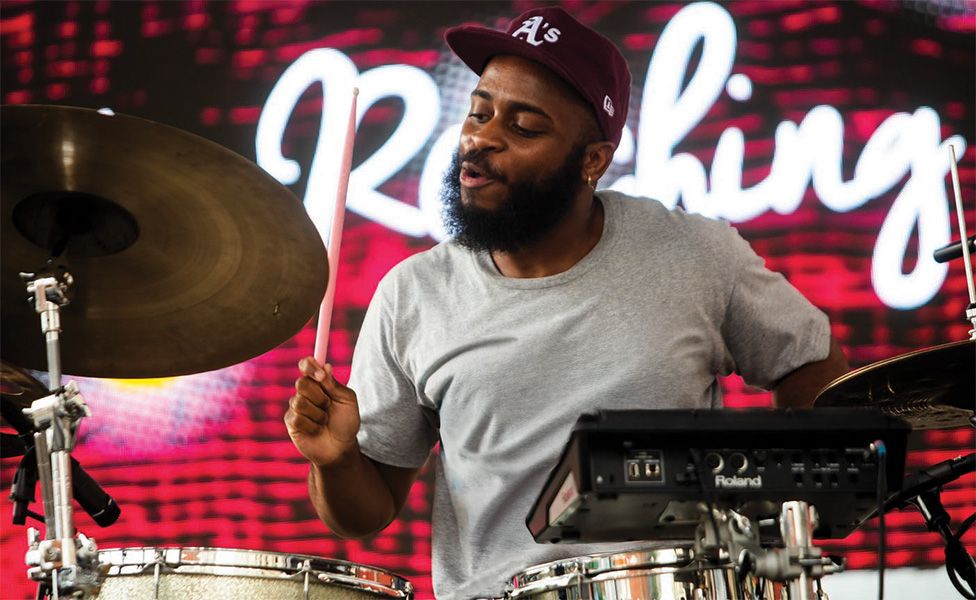
Pictured: Caleb Robinson Drumming
Ward: If I had to pick one, it would probably be Tony Williams. His work with Miles Davis, his Lifetime group and his quintet all had a serious impact on me. Drummers that were inspired by Tony are also some of my favorite drummers, like Vinnie Colaiuta, Gary Novak, Dave Weckl, Dennis Chambers and Billy Cobham. Then, there are some more modern cats, such as Jeff “Tain” Watts, Bill Stewart, Brian Blade, Lewis Nash and Gregory Hutchinson—and that's just in the jazz and fusion side of things. I love Omar Hakim—he's great—and some even more modern guys, such as Cory Fonville, Ofri Nehemya, Anthony Fung, Larnell Lewis, Robert "Sput" Searight and Jonathan Barber. The list could be endless. These drummers are just super incredible and so impactful on the way that I play. But all of them, in some way, lead back to Tony Williams.
How did you come up with the drum arrangement for your performance?
Darden: My arrangement thought process was more of an act of faith again, but also including emotion. I want people to not just hear what I'm playing, but also to feel it. At the end of the day, I'm really big on having someone be moved or touched by something I play—not necessarily for the sake of my name, but because I'm a real big advocate of music and how it can change people. Somebody could be having a terrible day, and they can come to a concert, hear you play and, just like that, their day is better. Music has helped me in rough times, and I want to make sure I'm the same extension to other people. So, all in all, my performances are between trying to be as versatile as possible and connecting with my audience.
Fortson: Drummers obviously need chops to advance through the Drum-Off. What I mainly came up with for this is telling a story in my own way—placing fills, crescendos, tempos, accent spots, tom and cymbal licks and so on. I don’t want to sound like anybody else or duplicate what they do. Also, using dynamics within my solo and throwing in a couple of tricks here and there. Other than that, it’s organizing it all and playing from my heart.
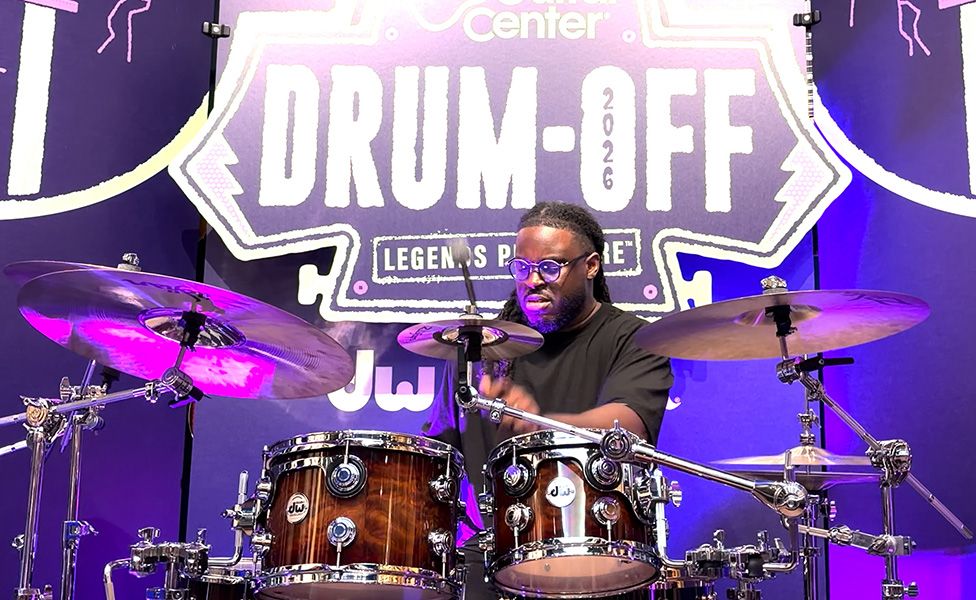
Pictured: Jonathan Fortson at the 2026 Drum-Off Regionals in New York
Gorman: My strategy is, “Don't do the same thing for too long.” I try to do everything I can to keep people guessing, but also keep the solo concise. I think that helped me separate myself from so many other people in this competition, because it is so easy for a drummer to get so locked into a groove. You're dancing and doing your thing, and all of a sudden you're like, “Oh, I've been doing the same groove for three minutes.” I want to show I know more than just one genre. I want to take everything from my metal, rock, jazz, gospel and marching band backgrounds—as well as every style in between—and showcase what I can truly do.
Robinson: I know the judges probably want some heavy grooves and to be able to tap their feet, but you also can’t just let go of your chops. You can't get away from your chop suey stuff. I have to make sure my solo sounds musical and makes sense in a certain way, or I'm finished.
Do you have a signature technique or trick that always wows audiences?
Cornish: Yes. It's a little crisscross thing I like to do across the floor tom and the hi-hats. I will be doing it for the finals, so make sure you watch out for it.
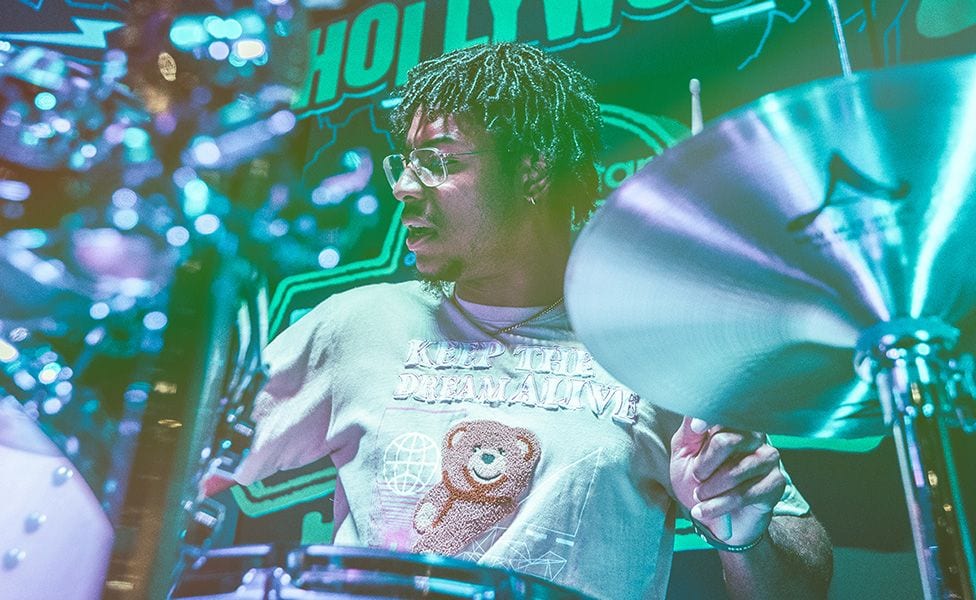
Pictured: Michael-Andrew Cornish at the 2026 Drum-Off Regionals in Hollywood
Gorman: I think my go-to thing to genuinely put a wow factor into my performances is to do stick tricks in seemingly difficult circumstances. I was inspired by Eric Moore, because he does some crazy stick tricks. I try to get the stick to rotate as smoothly as possible, and I figure out sticking that allows me to do stuff very quickly and with both hands. I can actually implement this while doing, say, double-kick patterns. It looks like my hands are on a teeter-totter or something and if I do it quick enough, it looks insane.
Robinson: I don't necessarily have a trick. I would say it’s more my personality and quirkiness that makes a solo open up to the crowd. I try to make things more fun versus giving a drum clinic where it’s like, “I’m going to show you my muscles.” Well, I am going to show you my muscles, but the performance is still supposed to be a joyous occasion.
Drummers obviously need chops to advance through the Drum-Off, but how important is putting on a show, as well?
Cornish: Most definitely, it's important. Of course, having chops is great, but putting on a show is everything. As a musician, you want people to relate to you, so when you're putting on a show, it's like you're presenting yourself as more welcoming, instead of just playing straight chops and leaving the stage. You don’t want to seem like a robot. Putting on a show definitely puts icing on the cake.
Fortson: If you want your solo to be remembered, there has to be some kind of showmanship. To me, putting on a show is not hugely important, but it is important to having an impact and being an inspiration to someone.
Gorman: In my opinion, putting on a show is everything. I don't want to be up there doing math. If you're up there looking like you're not having a good time, people see that. I’m going to be honest—if you’re not putting on a show, what are you doing? We’re in this to have fun, and we want people to have fun with us. Chops are important and showmanship is important. That’s my whole thing.
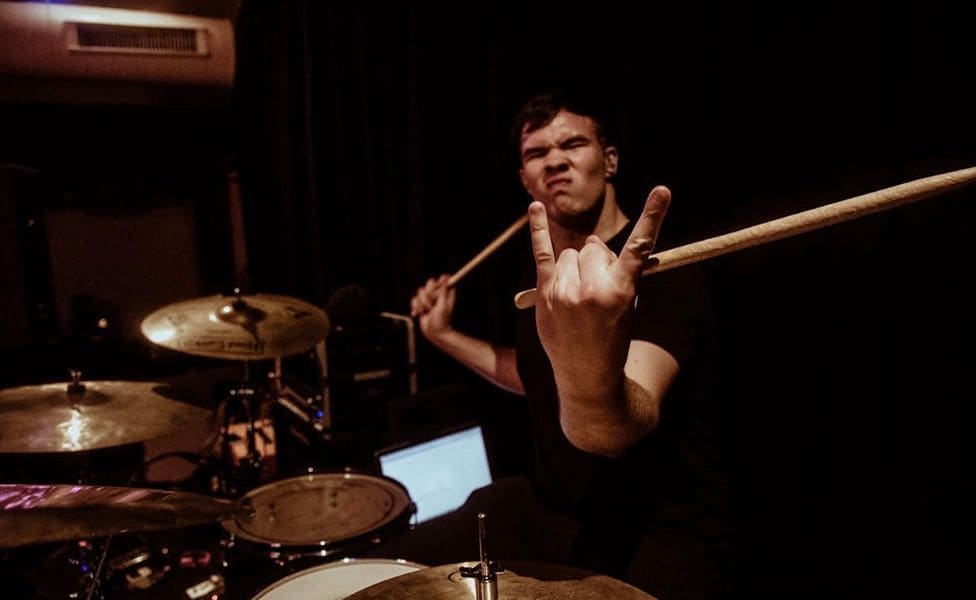
Pictured: Mitch Gorman
Robinson: It's the number one thing. My dad is a drummer, and when I was a teenager, he’d have me listen to drummers—such as Virgil Donati and Horacio "El Negro" Hernández—that were doing some weird, crazy stuff. So, I had like the technical stuff in my bag. But the show wasn't all the way there. I wasn't showing my personality enough. It had a lot of things missing, and it’s easy when you’re in competitions like this to make drum solos sound like a drum clinic. There are drummers judging you, of course, but the audience is there as well, and most of them could be beginning drummers, guitar players or even people who don't play at all. They just want to hear some music. They don’t know how hard it is to play a left-foot clave or cleanly perform doubles on a double bass drum. So, you could be the best drummer in the world, but if your solo doesn’t captivate anyone, then you can lose a competition to someone else. I do love being chop suey, but I know I also have to bring the audience in.
Ward: Obviously, in a competition such as the Guitar Center Drum-Off, you need to have chops and the ability to flow behind the drum kit. That’s super important. But you also need to put on a show. This is a drum solo, but if you just go up there and blow chops for five minutes, it's going to get lost on some people. But if you engage the audience and make moments with people, they will help you succeed in the Drum-Off further than just displaying chops alone. Put chops and a show together, and that is a drummer who will win.
Drum-Off 2026 FAQs
Hosts: Bill Burr, Stephen Perkins
Special Performances: Robert Trujillo and the Kate Mess Project (also featuring Tosh Peterson, Jordi Radnoti, Tim Stewart and Tiara Stewart) and Kenny Aronoff and Friends (including Michael Anthony and Phil X)
Show Times: Doors open at 6 p.m. Competition downbeat at 7 p.m. VIP ticket holders invited to exclusive rooftop after-party.
Ticket Info: Click to AXS.com. Note: 15% of each ticket price benefits the Guitar Center Music Foundation.
Written By: Michael Molenda
Michael Molenda is a content strategist, editor and writer for Guitar Center, where he has worked since 2022. He is the longest-serving Editor in Chief of Guitar Player (1997-2018), and former Editorial Director of Bass Player, EQ, Keyboard, Electronic Musician, Gig and Modern Drummer. A guitarist, drummer, bassist and producer, Mike co-owned three pro recording studios in San Francisco, and performs with Surf Monster and The Trouble With Monkeys.

Be the first to know about exclusive offers, tips and more.

866-498-7882 English
877-687-5402 Español