

Pro Gear Advisers
•866-498-7882
Joe Satriani and Steve Vai on The Sea of Emotion: Friendship, Collaboration and Raising the Bar
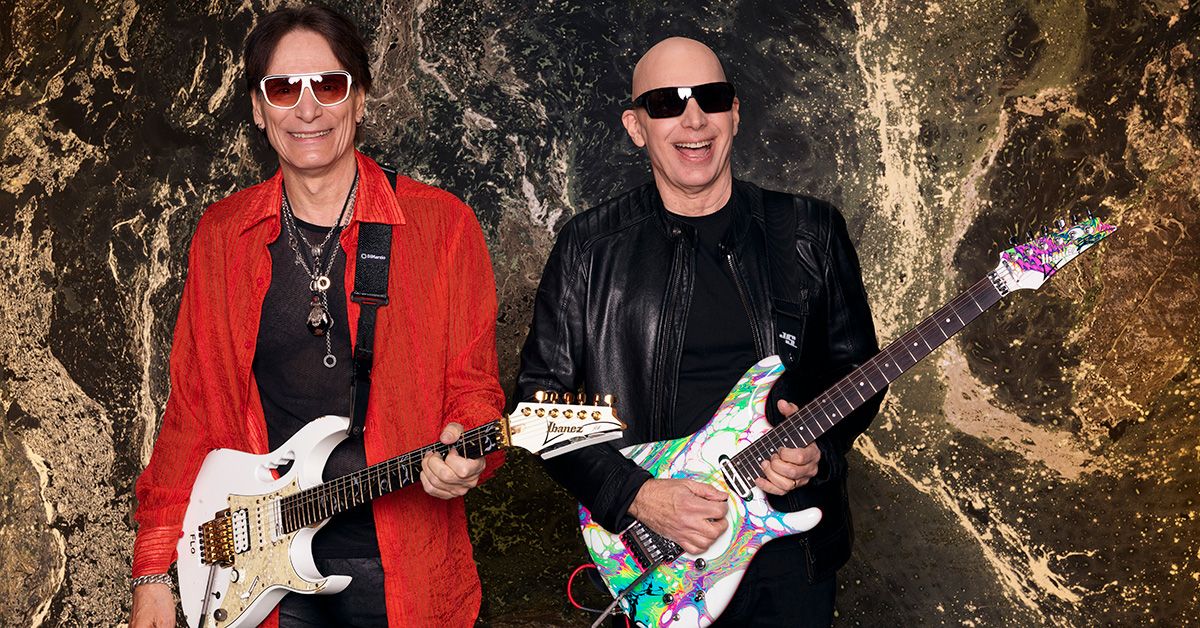
Credit: Larry DiMarzio
Unless you’re in a classical handbell choir that abolishes all knowledge of the electric guitar, you know guitarists Joe Satriani and Steve Vai are otherworldly virtuosos. Friends since 1973, when a 13-year-old Vai started taking lessons from 17-year-old Satriani, the duo’s shared talent, creative verve and evangelism for the instrument catapulted both into global guitar superstardom. (Proof that lightning can strike twice.)
While the guitar heroes often appear together in Satriani’s G3 tours—an international concert juggernaut and celebration of guitar since 1996—they have never collaborated on a studio album. Given their musical relationship, years upon years of an MIA joint project seemed like a momentously unfulfilled opportunity for fans of guitar craft. But neither artist wanted to force an album until the time was right.
The right time took more than five decades after their first meeting. Released November 2026 under SatchVai, The Sea of Emotion [earMUSIC] fuses the inventive imaginations and technical sorcery of the two creators throughout 10 astounding tracks.
It’s kind of a miracle the record happened at all.
Individual touring schedules and other commitments ensured the two guitarists weren’t in the same studio at the same time except for two sessions. One was tracking Glenn Hughes’ vocals on “I Wanna Play My Guitar.” The other occurred 53 years ago. (More on that later …)
Parts written and recorded in Satriani and Vai’s home studios were emailed back and forth until it was clear a song had evolved to where it needed to be. Then, producer Eric Caudieux was challenged with enhancing and finalizing the arrangements, as well as marshalling players to replace the programmed drums and “placeholder” bass lines used during the writing process.
As a result, the story of SatchVai and The Sea of Emotion is like a thrilling miniseries, where our heroes craft most of the album virtually, deal with each other’s singular approaches to composition, level up their ideas and performances, graciously accept favorite parts being tossed out (whether by each other or Caudieux) and restrain any attachment they may have had to being in total control of their own solo projects.
The story also offers a lot of knowledge for guitarists, home recording musicians and creators of all types to absorb as Satriani and Vai share some of their approaches for manifesting their art. Spoiler alert: Creating music isn’t always about technique, tone or initial inspiration.
After you read this interview with these two virtuosos, you'll likely be inspired to level up your technique and tone. Did you know you can do that with signature gear? Check out the Satriani Collection and the Vai Collection.
Joe, as you like to create albums that have strong themes, what was the inspiration for The Sea Of Emotion?
Satriani: I hate to use that phrase, “What's my motivation?” but I have to know what I'm writing about. That's how everything starts. I just kept thinking further back into the long history Steve and I have together, growing up as teenagers in Westbury, New York. I thought, “There must be someplace, something or some event that is going to be my foundation for writing something,” and I came up with “Sea of Emotion”—which is this place my friends and I christened that was part of the school grounds. We used to hang out there at 2:30 or 3:30 in the morning after partying and just hang out, recover and talk about our innermost feelings. It was unusual for teenage guys to find a place where they could open up, and it became a really cool place for us. At some point, I introduced Steve to it, saying, “You can come here when you've got things to sort out. Bring your friends, hang out, whatever.” That was where I went back to when I started to write this music.
How did you two seek to characterize this magical place in song?
Satriani: I wrote two pieces, “The Sea of Emotion Pt. 1” and “The Sea of Emotion Pt. 2,” and sent them to Steve. To my surprise, he came up with “The Sea of Emotion Pt. 3,” and not only that—he dug out a tape recording I had made on a Sony 2-track of the two of us playing during a lesson in 1973. So, “Pt. 3” starts off with that recording. To this day, we don't know who is playing what. But it was obvious we had started to mind-meld at that stage. The song was a beautiful way to realize we had a really great foundation for this album, as well as how we were going to proceed.
Vai: I had been taking lessons and playing the guitar for about a year and a half at that time, which is why the complete title of the song is “The Sea of Emotion Pt. 3, Reflections on a Year and a Half.” Back then, I asked Joe about this reel-to-reel tape recorder he had, and he said, “Oh, yeah. Let’s record.” We started playing and recording for about eight minutes. I didn’t think about it much after that, but 15 years later, Joe sent me the tape reel and I transferred it to digital. When I got “The Sea of Emotion Pt. 1 and Pt. 2” from Joe, the idea came to take a little snippet from that jam and put it in front of “The Sea of Emotion Pt. 3, Reflections on a Year and a Half” to kick off the song.
It seems like it was easier for both of you to hang out at the actual “Sea of Emotion” school yard than it was to finally start the process for making The Sea of Emotion album.
Vai: Well, it was a little unorthodox. Joe and I were juggling a lot of different things. He had The Best of All Worlds tour with Sammy Hagar and his solo career, and I had my solo career and the BEAT tour. Then, we did the G3 reunion tour, and right from there, Joe and I went out together as the SatchVai Band. During the process of doing that, we thought, “It would be nice to have a couple of new songs from us.” We had never done that. And once we got a couple of songs, we thought, “Game on. Let's make an entire record.”
Satriani: It all fell together by accident, but in a very conversational and organic manner. Steve and I were on tour for the G3 reunion with Eric Johnson, and my son ZZ was along with his crew to film the whole thing for what was going to be a G3 documentary. Things were going so well that we said, “Hey, why don't we keep the tour going?” But Eric was like, “I've already booked the next 18 months.” Steve and I decided to keep going, and we needed to make a distinction between the G3 reunion being finished and that we were moving on. My manager said to us, “How about you guys record a track as a way of introducing the fact you are going to tour together?” I wound up in this little room [his home studio] thinking about writing a song for Steve and myself—which brought me to the “Sea of Emotion” concept.
Steve, once it was “game on,” how did the writing process unfold for you?
Vai: When it came to constructing these songs, it was so much fun, because it was a different engagement of my creativity than if I was making a solo album. I had songs coming in from Joe that had a different inspiration than my own. Take a song like “I Wanna Play My Guitar.” When I got it from Joe, it was basically his rhythm part and a rough layout of the track. I just love the opportunity to listen to an idea and hear how I would add something—especially as I'm applying my ideas to a composition I wouldn't have written or I didn't write.
And then there were situations such as “The Feeling I Know,” where I had a simple, eight-bar chord riff on my iPhone. I sent it to Joe to see if he liked it, and he sent back this track where he comes in right after the riff I sent him with this wonderful samba thing. I thought, “Oh, cool.” I started chopping up the track and adding parts, and after I sent it back to Joe, he started adding more parts. It was really great, because I would get things from Joe I wasn't expecting, and that would cause me to do things I wasn't expecting from myself.
Those are examples of how the creative convergence of the two of us came together. Whatever kinds of pasts we've experienced, we were in a comfortable state of mind to do this project, and we came in with similar intentions. We never perceived there would be any drama between us—not even for a moment—so it was a good environment to make music in.
I know this will sound idealistic and odd, but your most powerful tool in co-creating powerful music is to be friendly.
As the songs were traded back and forth, were there any surprises that either of you didn’t expect from the other?
Satriani: Every time Steve would send me an idea for a song, I wasn't surprised, but, at the same time, it would confirm that he's completely nuts. When he sent me the video for the song “Dancing” by Paolo Conte, for example, I said, “You're absolutely crazy if you think we can pull off a version of this song, but I'll try my best to be part of it.” “Bronco Freight Train” was initially two little bits, and Steve prefaced it by saying, “I don't really want to do this, but I'll just send you this riff.” I remember messaging him back with, “This is monumental Steve Vai stuff. I can already see you onstage playing this, so I'm going to finish it, it's going on the album, and I don't want to hear an argument.”
There was a lot of that kind of back and forth, and some of the pieces had to be written over a period of months, because we were working so much with our other gigs. But we benefited from the delays, because they gave us time to think, reflect and understand how each of us were reacting to the music we had sent each other—rather than having a knee-jerk reaction. For example, in a recording studio, there's a clock on the wall, and you often feel like, “I've got to come up with something now.” For these tracks, we could get used to what we had in front of us. We had the time to go, “Okay, I finally see where he's going with this. Let me see if I can add to it or help it happen.”
Vai: Joe and I know a lot of things without talking. It's almost like a weird ESP. If I would go to do something, I instinctually knew if it was going to be in Joe's ballpark. I mean, how stupid would it be for me to go “Vai squared” and not consider who I was playing with? That would just be too weird.
Did you ever get too close to the “Vai Squared” zone?
Vai: Maybe a few times, I would send Joe a part, and he’d say something like, “Well, it sounds a little busy with all the other stuff.” Very rarely was it suggested I change things, but if so, I was eager to do it, because if it came from Joe, how could I question it? He is inspired and his ears are brilliant.
Satriani: You find yourself thinking, “I don't know if this is what I would do." But I think we were allowed to freely express our feelings about where things were going.
On your solo projects, you both obviously have extremely strong and individual voices. How did those different styles play out during the collaboration?
Satriani: Steve and I are so different. In a way, it's comical how we can get along onstage as if we’ve never stopped rehearsing together. I noticed he was different from me even when he was a young kid. The first time I played him Hot Rats by Frank Zappa, I saw the twinkle in his eye, and I thought, “Oh, there's a crazy person in there.”
Who knew, you know? I was hoping he would have a different reaction—that he would love Jimi Hendrix and the other things I was playing for him. But no, when he heard Zappa that very first time, I could tell this was the beginning of a very different way of hearing and conceptualizing music than myself. And even though we were just a couple of years apart in age, I was clearly an earlier generation, and Steve was the new generation. It’s kind of weird when you're only a teenager and you go, "Wow, I'm old." But I think that was a great lesson to get early in life, rather than waiting until you’re much older. It set me right to accept the fact these young students I was teaching were the new generation, so to speak, and I had to acknowledge that as a teacher, player and composer.
Vai: I wouldn't say the style of our writing is very different, but what we write is very different. Maybe not even very different—they're in the same playground, but on different sides of the sandbox.
Getting back to your different approaches, could you detail what those are, and provide a specific example on The Sea of Emotion?
Satriani: It's pretty simple. I try to simplify everything to its lowest common denominator, and Steve loves embellishment and arrangement on the highest musical level. A good example is “Old Sins Have Long Shadows.” If I had to compare that song with something I've done before, I'd say it’s kind of like “Ice 9.” The rhythm guitars are pretty tight and dry, and they're doing a simple riff. The melody comes in, and I'm playing Phrygian blues with a wah pedal. Then, it goes to a kind of classical Baroque modulation and a weird breakdown with something creepy going on.
I sent it to Steve, thinking, “Maybe he’ll like it and maybe he won’t.” Well, he sent “Old Sins Have Long Shadows” back and, of course, he figured out a way to add so much harmony to the piece. Not only does he come up with this weird guitar counter rhythm against my totally dry guitars in the beginning, but when the song starts, the first thing Steve does is this bizarre arpeggiated chord that completely sets the tone for the weirdness of it. He took this slightly creepy, groovy thing I had going, and he harmonically turned it into really long shadows, so to speak.
He told me, “Is this okay? If you don't like it, you can turn it off.” But I thought, “No, this is great. This is exactly what I would expect if I was listening to a Steve Vai album. I want to hear the weird Steve Vai stuff come in.”
Vai: A big conundrum for people trying to write songs or potential hits is thinking, "Well, this is what people want." I've done that and I've made abysmal mistakes. The thing that people want is your authenticity.
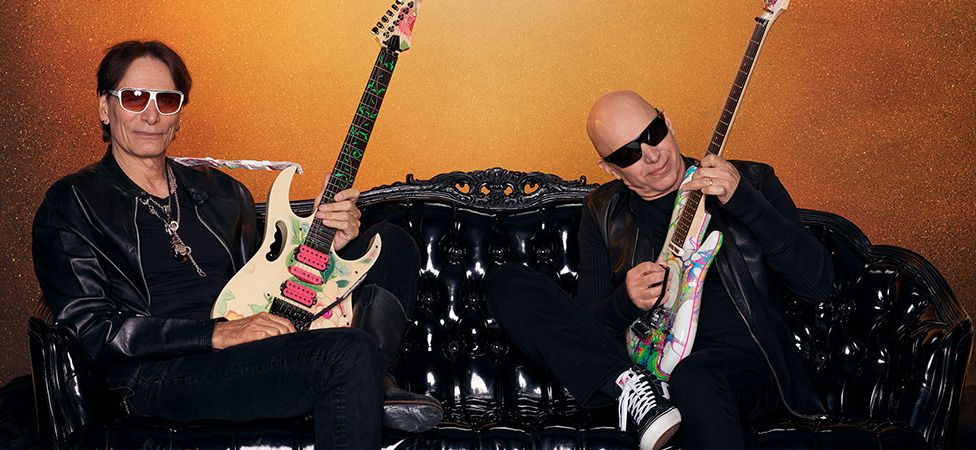
Credit: Larry DiMarzio
What was producer Eric Caudieux’s key contribution to The Sea of Emotion?
Satriani: There was certainly work to be done in sorting all the audio files out, and Eric really helped us. We needed a central producer to receive all the ideas we had, sort them out and then give us versions of these ideas we put together until we went, “That's a good idea,” “That's not a good idea,” or “These ideas can go together better.”
Eric would also come back with marching orders, such as, “Joe, now that Steve has added his part, maybe you could do this.” That's the kind of thing you need when you're allowed to be very artistic. It's great to have someone looking over your shoulder, and saying, “Hey, do that one more time.”
Vai: Eric became the washing machine for everything we did—the overseer of all the tracks. He was as important in constructing this record as we were.
Satriani: There also were issues where Steve and I had been working with drum machines or old drum performances that needed to be redone. Most of the songs had Steve or I playing bass, and we knew we had to replace those tracks a real bass player, but we couldn't do that because we were both on tour. So, Eric took care of building the rhythm sections, as he was able to do live recording studio sessions with all the extra players. Then, he’d send rough mixes to us wherever we were in the world, and ask, “Is this right? Do you want this performance or that performance?” It was great, because otherwise the album never would have gotten done because we were always working.
Another example of how The Sea of Emotion was virtually a virtual project. You’d get, let’s say, progress updates from Eric and then evaluate the tracks from the road.
Satriani: Yes. Eric would put together these really great Pro Tools sessions for us. For example, Steve might send something to Eric I hadn't heard yet, and Eric would clean it up and create stems so I could easily track my new stuff to it. Sometimes, there were even markers in the session file where Steve would write something like, “Joe, can you come up with a melody for this part and maybe do a little noise over there?”
Vai: There were a couple of these “virtual” decisions that initially disappointed me, but I realized later they were the right thing to do. In “Dancing,” for example, I had done this crazy guitar orchestra of diversified harmonies and punches, and I doubled it with sampled horns. The samples really popped, and I thought they were great, but they were more a product of my desire to overproduce, because that's what I do. But Eric said to me, “We've got to take those horns out. It has got to be just guitars, because we want to hear you.”
Now, you have to consider I’m 40 years into being the master and commander of every single note on my records—never really receiving or taking suggestions and never compromising. It was always like, “Here it is. It's done. I hope you like it, but if not—sorry, it’s the best I can do.” So, when Eric wanted to take the horns out, I thought, “Oh, really? No. Those have to stay. I want my horns.” I asked Joe, “What do you think?” And he goes, “Hate it.” They were completely right, because when I listen to “Dancing” now, I realize I almost covered up all of those guitars.
I’ve been working in studios long enough to know that, many times, decisions to keep or delete often fall to the whim of the artist who created the part—even if the rest of the band and/or the producer are uncomfortable with doing their bidding. It’s instructive and so nice to hear that collaborative assent was respected for this project.
Vai: Well, we didn't treat anything as being precious personally, because the thing that would really be precious was when we both raised our hands and said, “Yes, that's it.” For example, I sent “Zoot Suit Riot” to Joe, and he sent back a melody, saying, “I'm thinking of something in this direction. What do you think?” And I'm like, “You don't have to think anymore—there it is.” Things like that happened, but there were also times where I’d send Joe something that was heavily chopped up and edited, and he might say, “It still feels kind of weird.” Just the fact he disagreed was enough to tell me we weren’t there yet.
Satriani: Like any album, some songs seemed to struggle to reach their highest potential, and other songs just seemed to sit up straight right from the beginning.
Vai: We were still the commanders of our own ships, but with the added benefit of valuable cargo being presented. The underlining protocol was not the “best idea wins” from an individual sense. It was, “The best idea is the one we both like.” That means you come up with more of a mastermind product than a single-mind product. It doesn't work if it doesn't work for us as a team.
What was it like involving bassist/vocalist Glenn Hughes on the album’s only vocal track, “I Wanna Play My Guitar?”
Satriani: That session was the only time we were all together in the studio. It was just a freak situation where Steve, Glenn, Eric and I were not working. Watching Glenn do his magic for five or six hours was amazing, because we had to figure out what the final lyrics would be for that song. We had my lyrics, and we had Steve's lyrics and Glenn was like, “Okay, you guys obviously are not singers.” It reminded me when I started with Chickenfoot, and I brought Sammy Hagar pages of lyrics, and he’d just laugh and say much the same thing: “You’re not a singer, Joe.” But Sammy would somehow reduce the lyric content by 75% and yet communicate the idea of the song 100% better. In this instance, Glenn was able to bring together the two different lyrics from Steve and me, as well as add his own ideas about the words and how to sing them.
So, everyone was writing lyrics?
Satriani: Let me explain. First, I had lyrics, and I sent them to Steve. His idea was to change the perspective of the singer to where he was telling the audience, “It's time to play the guitar.” I kept saying, “No, Steve, it should be that he's expressing himself and everybody in the audience is joining in because they feel like he does.” Then, we looked at each other and said, “We need Glenn to sort this out.”
Glenn showed up at the studio and said, “I've decided which parts of Steve's and Joe's lyrics I'm going to sing, but I still need to go in there and snip a couple of words out and make it more like a singer's art form.” He went through the lyrics so fast, crossing out words and asking things like, “Can I use this version of that word instead of what it is now?” It was effortless for him. Steve and I were grinning ear to ear, because we realized, “No wonder he's Glenn Hughes.” We also knew we could never have done that he did. We would have ruined the song with too many words.
Was Glenn provided with a melodic guide or scratch vocal?
Satriani: Yes, and I pray it never gets on the internet. I had a demo of the basic tracks for “I Wanna Play My Guitar,” but I didn't have any microphones around at the time to record a vocal. I played the song on my laptop as I held up my phone to sing the melody along with the rhythm track. I sent that demo to Steve, saying, “Please keep this to yourself.” Then, I had to send it to Glenn. I said, “Many apologies …”
Steve, as this was somewhat new ground for you both, what was your experience working so closely with Joe on a collaborative recording project?
Vai: I've watched Joe his whole career, and for every record he releases, he's raising his bar. Frankly, when we got to this record, I felt the same way about myself, and I knew we would raise each other’s bar. I mean, if you're not raising your bar, what are you doing?
This isn't specifically about what the other person is playing. For example, if I heard one of Joe’s solos, I wouldn’t go, “What am I going to do to play a better solo than him?” That would be an insane perspective. It’s more productive to be able to resonate with what I'm receiving—to raise my bar by doing something that's musical, accessible, inspiring, unthinkable and sometimes impossible.
What about Joe?
Vai: One of the ways Joe raises his bar is not only how he continues to develop the way he touches a note with subtle technique—because when he does that, the tone that comes out is to die for—but with his absurd quirkiness of approaching guitar acrobatics or sounds. I think for any performer, the big question is, “Are you allowing your uniqueness to come out, or are you trying to pantomime the brilliance of somebody else?
On that note, I’ve watched Joe in his home studio spend a half hour or so going over and over what I thought was a very short and simple melody—record, rewind, record, rewind, etc. But it schooled me that for people with big ears, the articulation of a part isn’t done until it’s exactly right—whatever that means to the player. Joe’s brain was hearing the music of the stratosphere or something. I couldn’t comprehend it. In my less-than-evolved brain, I was thinking, “Why is he spending a half hour on this?”
Vai: Well, that’s something very important that hopefully guitar players who are reading this interview will absorb. What you witnessed was Joe hearing something superior to what he was playing, but he knew he could get there. Most people don't think that way. They just practice to improve facility. But to really finesse a note, to cradle a note, to find the soul of a note, melody or a phrase requires certain components that need to come together. Is every note perfectly in tune? Is the intonation beautiful? Is there a life in it? Is it speaking like a piece of music and not just notes and fingering? Phrasing is so important, as well.
You have to know how to listen for all of that. I say this, and it sounds kind of peculiar, but those who understand it, get it: You become the note. What that means is your attention is surrendered to the note, the sound, the feel and the emotional content.
How can all instrumentalists strive to get there?
Vai: Inspired notes are a consequence of not thinking. Thinking is a deterrent. It throws you off every time. Even thinking, "Is this good enough?" drops you out of the zone. You've lost it. The state you want to be in is hearing and responding. Of course, you have to work to get to that, because you need to have enough technique to respond to what your inspiration is telling you. There's no way out of that.
Listen to The Sea of Emotion
Written By: Michael Molenda
Michael Molenda is a content strategist, editor and writer for Guitar Center, where he has worked since 2022. He is the longest-serving Editor in Chief of Guitar Player (1997-2018), and former Editorial Director of Bass Player, EQ, Keyboard, Electronic Musician, Gig and Modern Drummer. A guitarist, drummer, bassist and producer, Mike co-owned three pro recording studios in San Francisco, and performs with Surf Monster and The Trouble With Monkeys.
Recently Added to Interviews
Be the first to know about exclusive offers, tips and more.

866-498-7882 English
877-687-5402 Español